


Alberta Cannabis License Cost 2026: The Complete Budgeting Guide
- jzanglaw
- 3 days ago
- 12 min read
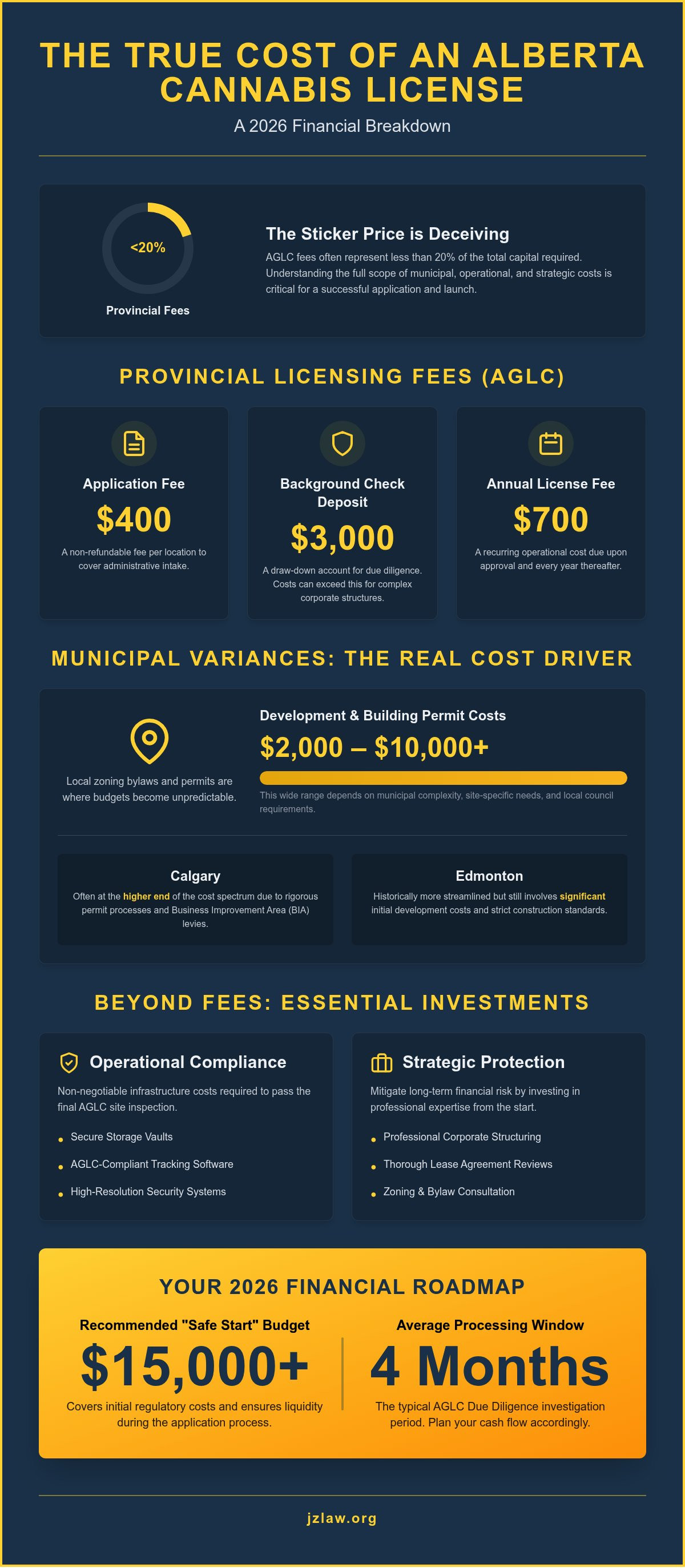
Most prospective retailers mistakenly believe that the AGLC sticker price defines the finish line, yet the reality is that provincial fees often represent less than 20% of the total capital necessary to secure a legal retail presence. While the $400 application fee and $1,200 annual license fee are clearly defined, the true alberta cannabis license cost in 2026 is driven by municipal zoning complexities and the rigorous $3,000 background check deposit. It's understandable if you feel a sense of apprehension regarding these opaque municipal requirements or the financial risk of an application rejection due to minor structural errors.
This comprehensive guide provides the clarity you need by offering a line-item breakdown of every fee, deposit, and hidden regulatory cost required to maintain compliance. You'll gain a precise understanding of the fiscal divergence between Calgary and Edmonton requirements, alongside a strategic roadmap designed to eliminate fee-wasting delays. We've structured this analysis to transform a high-stakes regulatory hurdle into a predictable, manageable business expense, allowing you to focus on the long-term growth of your enterprise with absolute confidence. By identifying these costs early, you can protect your investment and ensure your corporate structure meets the highest standards of regulatory scrutiny.
Table of Contents
The AGLC Sticker Price: Fixed Provincial Licensing Fees
The initial financial commitment to the Alberta Gaming, Liquor and Cannabis Commission (AGLC) is often perceived as a simple entry fee. In reality, it's a multi-layered fiscal screening process. The base alberta cannabis license cost begins with a $400 non-refundable application fee per location. This fee covers the administrative intake but doesn't guarantee approval. Since the legalization of Cannabis in Alberta, the regulatory framework has matured. While 2026 updates have streamlined some producer-level SKU listing fees, they've simultaneously sharpened the focus on the financial suitability of retail applicants.
The Background Check: A Deep Financial Dive
Beyond the application fee, the AGLC requires a $3,000 background check deposit. This isn't a flat fee; it's a draw-down account used by the Due Diligence Unit to cover the actual costs of their investigation. If your corporate structure is straightforward, you'll likely see a partial refund of the unused portion. However, if your board includes international directors or complex holding companies, the investigative hours will quickly exceed this initial amount. The AGLC will invoice you for any deficit before the license is granted.
In 2026, expect the Due Diligence Unit to take two to four months to finalize these investigations. They now scrutinize the source of funds with greater precision to ensure every dollar entering the industry is transparently sourced. This applies to directors, shareholders with more than a 10% stake, and key employees. If your ownership model involves multiple layers of parent companies, the cost of these checks can escalate rapidly. Precision in your initial disclosure is the only way to prevent the AGLC from requesting additional deposits.
Annual Renewal and Maintenance Costs
Once you secure approval, the $700 annual license fee becomes a recurring line item in your operational budget. It's due immediately upon approval and every year thereafter. Missing the renewal deadline doesn't just result in late fees. It can trigger a suspension of your ability to order inventory from the AGLC, which effectively halts your revenue.
Administrative costs also arise from mandatory reporting requirements. Any change in your corporate directors or significant shareholders requires a formal disclosure. These updates often trigger new background check requirements for the incoming parties. While the AGLC has worked to reduce red tape in other areas, the scrutiny on retail ownership remains a high-stakes priority. Meticulous record-keeping is essential to avoid administrative penalties that can arise from even minor reporting delays.
Municipal Variances: The Real Cost of Location
While the AGLC licensing fees provide a standardized baseline for provincial entry, the municipal layer of the alberta cannabis license cost is where budget predictability often evaporates. Each municipality holds independent authority over land use. This means your location strategy must account for local bylaws that can quintuple your initial regulatory spend. Zoning and Development Permit (DP) costs typically fluctuate between $2,000 and $10,000, depending on the complexity of the site and the specific requirements of the local council.
Calgary vs. Edmonton: A Comparative Budget
Calgary and Edmonton present two distinct financial landscapes for retailers. In Calgary, applicants must navigate Business Improvement Area (BIA) levies and a rigorous development permit process that often sits at the higher end of the $10,000 spectrum. Edmonton has historically offered a more streamlined licensing path, yet initial development costs remain significant due to strict construction standards. If you're looking at small-town Alberta, you might find lower permit fees, but you face a higher risk of sudden zoning moratoriums as smaller councils react to local market saturation.
Zoning and Land-Use Restrictions
The most expensive errors in a cannabis budget involve "buffer zones." Provincial regulations mandate a 100-metre separation from schools, provincial health care facilities, and school reserves. However, many municipalities extend these distances or add additional buffers for parks and existing cannabis retailers. If your chosen site violates these invisible boundaries, your permit will be rejected, and your initial application fees will be lost. Building permit fees for cannabis-specific security renovations also add several thousand dollars to the tally, as vaults and reinforced entry points require specialized structural inspections.
The Municipal Planning Commission acts as the primary discretionary body responsible for reviewing development permit applications and ensuring proposed cannabis retail sites align with local land-use bylaws and community standards.
Hidden costs often emerge during the community engagement phase. Most cities require public notification, which involves the applicant paying for physical signage and mailers to residents within a specific radius. If a community group opposes your site, you may find yourself in a Subdivision and Development Appeal Board (SDAB) hearing. These appeals can delay your opening by months and cost thousands in legal representation and continued rent. Securing a professional legal review of your municipal application can prevent these costly re-submissions and protect your capital from being drained by avoidable administrative errors.
Operational Compliance: Infrastructure and Security Costs
The physical environment of a cannabis retail location is subject to a level of scrutiny that far exceeds standard commercial requirements. While administrative filings comprise the first phase of your budget, the capital required for operational compliance represents the most significant upfront investment. Every square inch of the facility must align with the AGLC security handbook before an inspector will authorize the commencement of sales. This necessitates a strategic approach to infrastructure that prioritizes regulatory durability. You should consult the latest AGLC Retail Cannabis Licence Fees and guidelines to ensure your site plan accounts for these mandatory physical safeguards.
Security System Standards and Installation
It's a common oversight to underestimate the precision required for the surveillance suite. The AGLC mandates high-definition coverage of all point-of-sale areas, shipping entrances, and secure storage zones. These systems must maintain data storage for a minimum period and remain accessible for remote audit. Standard "off-the-shelf" residential hardware doesn't offer the redundancy or the forensic quality required to pass the final pre-licensing inspection. Beyond cameras, you'll need a commercial-grade intrusion detection system and a reinforced storage vault. The cost of these physical barriers depends on your building's existing perimeter strength, as reinforced doors and barred windows are often non-negotiable for approval.
Inventory Management and Reporting Software
Operational alberta cannabis license cost also includes specialized Point of Sale (POS) and inventory tracking software. These systems aren't just for processing payments; they must integrate directly with AGLC reporting portals to track every gram of product from receipt to sale. Compliance software subscriptions often involve significant monthly fees and initial integration costs. The financial risk of reporting errors is high, as the AGLC can issue administrative sanctions for inventory discrepancies. You should also budget for hardware capable of age verification and RFID tracking to minimize the risk of human error during the high-volume retail hours.
Staffing adds another layer to your regulatory budget. Every employee must complete the SellSafe Cannabis Staff Training program and pass a background check to become a qualified cannabis worker. While these individual fees are modest, the cumulative cost of certifying a full retail team is substantial. Finally, you must account for insurance premiums in 2026. As the industry matures, insurers have refined their risk models for cannabis retail, often requiring specialized policies that cover theft, product liability, and regulatory business interruption. These premiums are typically higher than those for traditional retail due to the perceived risk of the inventory.
Legal and Strategic Investment: Protecting Your License
The visible components of the alberta cannabis license cost, such as application fees and security hardware, are often overshadowed by the "soft costs" of legal and strategic planning. These investments act as the primary safeguard for your capital. Meticulous corporate structuring isn't just a formality; it's a prerequisite for AGLC approval. If your ownership model is opaque or your corporate records are disorganized, the Due Diligence Unit will likely pause your application, leading to month-long delays that drain your operating reserves. Cleaning up messy records after a rejection is significantly more expensive than building a compliant foundation from the outset.
Lease agreements represent another significant financial risk. Many commercial landlords include "claws-back" clauses that require full rent payments even if your licensing is delayed or denied. A professional review of your lease ensures you have the necessary contingencies to pause or terminate the agreement if the AGLC identifies a site-specific issue. Additionally, you must navigate Section 280E-style tax hurdles. While Canadian tax law differs from the United States, the interaction between provincial markups and federal excise taxes requires a sophisticated corporate structure to maintain profitability. Identifying "criminal interest" triggers before the AGLC does is also vital, as any association with individuals who fail the background check can result in an immediate and permanent application dismissal.
Strategic Corporate Transactions
If your long-term vision includes scaling or taking companies public, your initial licensing strategy must reflect that ambition. Shareholder agreements must be drafted with strict disclosure rules in mind to ensure every future investor meets AGLC standards. A proactive approach to corporate transactions prevents the need for costly restructuring when you're ready to expand. By aligning your governance model with regulatory expectations today, you simplify the path for future capital raises and public listings.
Regulatory Compliance Audits
Pre-inspection audits are an essential tool for identifying floor plan flaws before the official AGLC visit. These internal reviews catch minor errors in camera placement or vault reinforcement that would otherwise trigger a failed inspection. For those managing cannabis licensing across multiple provinces, these audits ensure consistency and prevent regional administrative errors from affecting your broader brand reputation. The return on investment for rigorous legal due diligence is realized by eliminating the month-long delays and forfeited application fees that inevitably follow a failed AGLC financial review.
Securing a professional corporate consultation early in the process ensures your regulatory foundation is as resilient as your business plan, protecting your investment from avoidable administrative setbacks.
The 2026 Financial Roadmap: Total Capital Requirements
Synthesizing the various regulatory layers reveals that a "Safe Start" budget for licensing alone should exceed $15,000. This figure represents the realistic alberta cannabis license cost for a single retail location before a single gram of inventory is purchased or a hammer touches the floor. It accounts for the $400 application fee, the $1,200 annual license fee, the $3,000 background check deposit, and the necessary municipal development permits. One of the most significant financial drains is the burn rate during the "Application Pending" phase. You must prepare to carry at least four months of rent while the AGLC and municipal authorities finalize their reviews. John Zang Services focuses on streamlining this process by ensuring your initial submission is error-free, effectively reducing the total time-to-market and protecting your operating reserves from being consumed by avoidable delays.
Timeline vs. Budget: The Cost of Delay
The AGLC typically estimates a two to four month processing window, but this timeline is contingent on the clarity of your corporate disclosures. Common bottlenecks often arise during the financial due diligence phase. If your background check triggers additional billings due to complex international holdings or disorganized shareholder records, your initial $3,000 deposit will deplete quickly, necessitating further payments to the Due Diligence Unit. Strategic timing is essential for lease commencement and staff hiring. Commencing a lease too early wastes capital on an empty storefront, yet waiting until the final license is issued might lead to losing a prime location to a competitor. We recommend securing a lease with a licensing contingency clause to mitigate this risk.
Conclusion: Securing Your Investment
Successfully launching a cannabis retail store in Alberta requires a blend of conservative fiscal planning and aggressive regulatory precision. While the fixed provincial fees are predictable, the variable costs of municipal zoning and professional due diligence determine your ultimate success. Every minor error in your application or site plan doesn't just result in a rejection; it results in forfeited fees and extended rent payments without revenue. High-stakes industry challenges demand a boutique approach that prioritizes the long-term security of your license. By identifying these costs early and investing in professional oversight, you transform a complex regulatory hurdle into a structured business roadmap.
If you're ready to navigate these requirements with the support of a strategic partner, we invite you to Contact JZ Law for a Cannabis Licensing Consultation to ensure your venture is built on a foundation of absolute compliance and fiscal efficiency.
Strategic Planning for Your 2026 Retail Launch
Navigating the complex regulatory landscape of 2026 requires more than just capital; it demands a meticulous approach to compliance and corporate transparency. While the fixed AGLC fees are straightforward, the actual alberta cannabis license cost is determined by the precision of your municipal applications and the robustness of your operational infrastructure. Success hinges on your ability to anticipate these expenses before they drain your operating reserves. By identifying potential bottlenecks in zoning or background checks early, you protect your investment from the high cost of administrative delays.
Our Calgary-based firm offers boutique expertise in cannabis regulation combined with a global perspective to help you avoid the pitfalls of application rejection. We focus on strategic corporate structuring for high-growth firms, ensuring your organization is ready for future scalability and market expansion. We invite you to Consult with JZ Law on Your Alberta Cannabis Licensing Strategy to ensure your venture is positioned for long-term profitability. With the right professional oversight, the complexity of the licensing process becomes a manageable strategic advantage. Your path to a successful retail opening starts with a foundation of absolute regulatory clarity.
Frequently Asked Questions
How much is the total cost to open a cannabis store in Alberta in 2026?
Opening a retail location typically requires a "Safe Start" regulatory budget of at least $15,000 to cover provincial and municipal filings. This figure excludes the significant capital required for physical security, lease deposits, and initial inventory. When accounting for all operational compliance factors, your total alberta cannabis license cost and startup capital will likely exceed $100,000. Meticulous planning is essential to ensure you have sufficient liquidity to survive the four month application pending phase.
Is the $3,000 background check deposit refundable?
The $3,000 background check deposit is partially refundable. The AGLC uses this amount as a draw down account to cover the actual investigative hours spent by the Due Diligence Unit. If your corporate structure is straightforward and requires minimal investigation, the AGLC will refund the remaining balance upon completion. However, complex international ownership models often exhaust this deposit. This might lead to additional invoices that must be paid before the license is granted.
Can I get a cannabis license if I have a criminal record?
Possession of a criminal record does not automatically disqualify an applicant, but it triggers intense scrutiny during the due diligence phase. The AGLC evaluates the nature of the offense and its relevance to the lawful conduct of a cannabis business. Any perceived "criminal interest" or associations with organized crime will result in an immediate rejection. It's vital to disclose all past history transparently. Failing to do so is considered a character flaw that justifies application dismissal.
How long does the AGLC background check process take?
The AGLC background check process typically takes between two and four months to complete. This window depends heavily on the responsiveness of your directors and the complexity of your financial history. Delays often occur when the Due Diligence Unit requires additional documentation regarding the source of funds or international corporate records. Maintaining organized corporate minutes and transparent financial statements is the most effective way to ensure your application moves through the queue without unnecessary administrative pauses.
Do I need to pay municipal fees before the AGLC approves my license?
Possession of a criminal record does not automatically disqualify an applicant, but it triggers intense scrutiny during the due diligence phase. The AGLC evaluates the nature of the offense and its relevance to the lawful conduct of a cannabis business. In these high-stakes situations, specialized defense and litigation services from firms like Mandisa Gumede and Partners can provide the necessary framework for addressing past legal history. Any perceived "criminal interest" or associations with organized crime will result in an immediate rejection. It's vital to disclose all past history transparently. Failing to do so is considered a character flaw that justifies application dismissal.
If your application is rejected, the initial $400 provincial application fee is non-refundable. You'll also lose any capital spent on municipal public notifications and development permit filings. Beyond the financial loss, a rejection based on character or financial integrity can create a permanent barrier to future licensing. It's often more cost-effective to withdraw a flawed application and re-submit with professional guidance than to risk a formal rejection that stays on your regulatory record.
Are there annual fees for cannabis retailers in Alberta?
Retailers must pay a $700 annual license fee to maintain their standing with the AGLC. This payment is due upon the initial approval of your license and on every subsequent anniversary of that date. Failing to pay this fee on time can lead to the immediate suspension of your ability to order inventory. You should also budget for recurring municipal business license renewals. These vary by city but generally add several hundred dollars to your yearly compliance costs.
How much should I budget for legal fees when applying for a license?
While legal fees vary based on the complexity of your corporate structure, you should view them as a strategic investment in risk mitigation. Professional oversight for lease reviews and AGLC disclosures typically prevents the forfeiture of much larger sums, such as the $3,000 background deposit. Investing in a alberta cannabis license cost analysis with a qualified partner ensures your corporate foundation is resilient enough to withstand the highest levels of regulatory scrutiny during the investigation.


Comments