


Alberta Cannabis Lounge Regulations 2026: A Legal Roadmap for Hospitality Founders
- jzanglaw
- May 3
- 12 min read
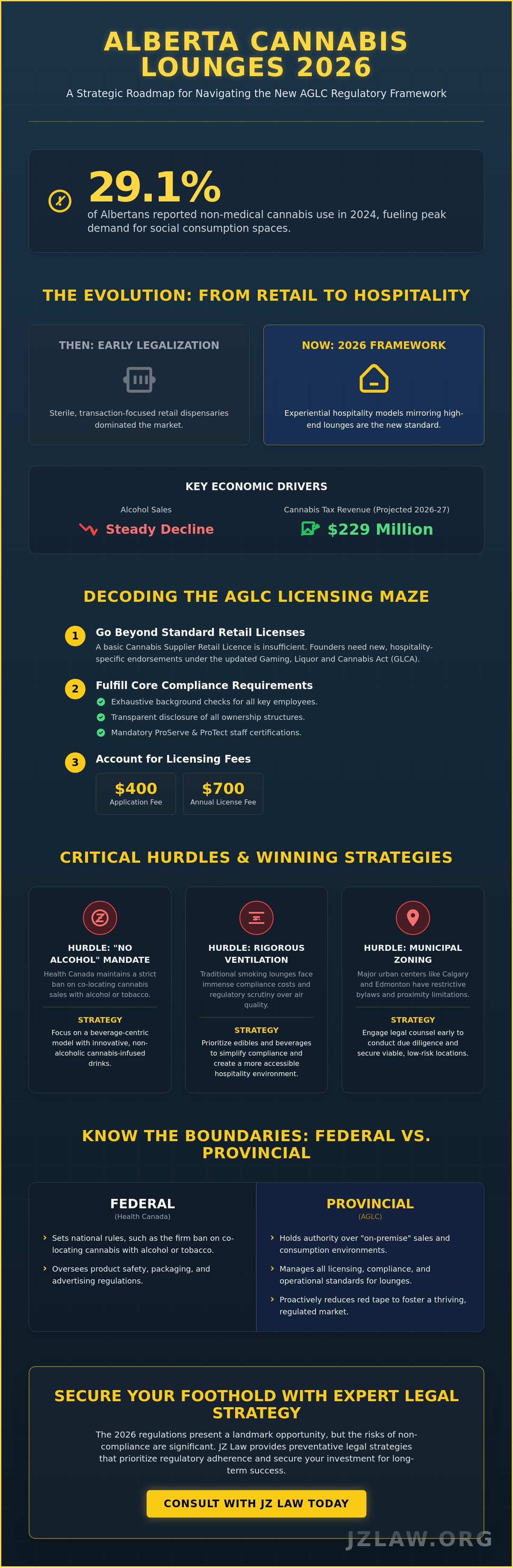
With 29.1% of Alberta residents reporting non-medical cannabis use in 2024, the demand for social consumption spaces has reached a peak, yet the legal path to opening one remains deceptively complex. You've likely noticed that despite the 752 licensed retail stores operating as of July 2025, a specific license for "cannabis lounges" still doesn't exist within the current AGLC framework. Successfully entering this market requires a sophisticated understanding of the alberta cannabis lounge regulations 2026, where the focus shifts from traditional smoking to a compliance-first hospitality model centered on innovative beverages and rigorous ventilation standards.
We understand that interpreting opaque application processes and restrictive municipal zoning can feel like a high-risk gamble with your capital. This guide provides a clear roadmap through the evolving provincial bulletins and municipal bylaws to ensure your venture remains compliant and secure. You'll learn the legal strategies to mitigate risk; this includes how to leverage the federal "research lounge" model and navigate the mandatory separation of cannabis and alcohol to successfully launch your consumption space in Alberta's unique regulatory environment.
Key Takeaways
Understand the fundamental shift from traditional retail models to the experiential hospitality concepts currently emerging in Calgary and Edmonton.
Navigate the complexities of the alberta cannabis lounge regulations 2026 by distinguishing between standard retail licenses and new hospitality-specific endorsements.
Identify the critical regulatory hurdles regarding the "No Alcohol" mandate and the strategic advantages of beverage-focused lounge models for large-scale venues.
Master municipal zoning requirements and proximity restrictions to secure viable, low-risk locations in major urban centers.
Implement a preventative legal strategy that prioritizes long-term compliance and risk mitigation through expert regulatory and corporate counsel.
Table of Contents The Evolution of Cannabis Consumption Spaces in Alberta for 2026 Navigating the AGLC Framework: Licensing Requirements for Lounges Cannabis Beverages vs. Traditional Consumption: Regulatory Hurdles Strategic Planning for Your Calgary or Edmonton Cannabis Lounge How JZ Law Secures Your Foothold in Alberta’s Cannabis Sector
The Evolution of Cannabis Consumption Spaces in Alberta for 2026
The concept of a cannabis lounge in 2026 has transitioned from a fringe proposal to a cornerstone of Alberta’s hospitality strategy. These spaces are defined as commercial environments where the sale and immediate consumption of cannabis products occur under unified regulatory oversight. In cities like Calgary and Edmonton, we're witnessing a decisive shift from the sterile, retail-only dispensaries of the early legalization era toward experiential hospitality models. This evolution is driven by a sophisticated understanding of the alberta cannabis lounge regulations 2026, which now prioritize consumer experience and public safety over mere transaction. The Gaming, Liquor and Cannabis Act (GLCA) continues to serve as the legislative backbone; however, the provincial sentiment has matured. Alberta has moved beyond the restrictive "private club" mentality, embracing a public hospitality framework that mirrors the dignity of high-end wine bars or traditional lounges.
Historical Context: From Retail Stores to Consumption Sites
The path to the current 2026 landscape was paved by the 2024-2025 pilot programs. These initiatives provided the data necessary to convince regulators that social consumption could be managed without compromising public order. A significant driver for this change is economic. As alcohol sales figures showed a steady decline in 2025, provincial authorities looked toward the robust cannabis sector to fill the fiscal gap. With cannabis tax revenue projected to reach $229 million in the 2026-27 fiscal year, the incentive for the AGLC to modernize its approach is clear. The 2026 Cannabis Representative Handbook Review served as the final catalyst. It streamlined the operational requirements for business owners and signaled a new era of cooperation between the province and hospitality founders.
Federal vs. Provincial Jurisdictional Boundaries
Success in this sector requires a precise understanding of where federal oversight ends and provincial authority begins. Health Canada maintains a firm stance against the co-location of cannabis with alcohol or tobacco, a rule that remains a primary hurdle for founders. However, the AGLC holds significant power over "on-premise" sales and consumption environments. This dual-layered governance is part of the broader history of Cannabis in Alberta, a province that has consistently led the national conversation on retail innovation. While other provinces remain hesitant, Alberta’s proactive reduction of red tape, such as the April 1, 2026, removal of early payment fees for producers, demonstrates a commitment to a thriving, regulated market. Founders must respect these jurisdictional boundaries to ensure their business models remain legally resilient. It's a complex landscape, but the rewards for compliant operators are substantial.
Navigating the AGLC Framework: Licensing Requirements for Lounges
Securing a commercial foothold in Alberta’s social consumption market requires more than a standard business permit; it demands a precise alignment with the multi-tiered AGLC licensing structure. The March 2025 AGLC Bulletin introduced significant updates to the representative handbooks, emphasizing that hospitality founders must look beyond the basic Cannabis Supplier Retail Licence. These updates are rooted in the Gaming, Liquor and Cannabis Act, which remains the definitive source of authority for all on-premise activities. To succeed under the alberta cannabis lounge regulations 2026, you must treat the license not as a static document, but as an ongoing commitment to provincial standards. This involves rigorous due diligence, including exhaustive background checks for all key employees and a transparent disclosure of ownership structures to ensure the integrity of the market.
Operational readiness also involves integrating mandatory training programs that go beyond basic retail knowledge. Staff must be certified in ProServe and ProTect to manage the specific risks associated with on-site consumption environments. Founders must also account for specific costs, such as the $400 application fee and the $700 annual license fee. Additionally, the policy change effective April 1, 2026, which eliminated the 2% early payment fee for producers, reflects a broader provincial effort to reduce red tape for compliant operators. For those seeking to master these requirements, obtaining strategic regulatory advice is a vital step in securing long-term viability.
The Application Process: Step-by-Step
The initial application package for the AGLC Board must be comprehensive, detailing everything from security protocols to specific ventilation plans. Once submitted, founders must navigate a public objection period. This phase is critical for community buy-in, as local opposition can stall a project indefinitely. In the 2026 calendar year, applicants should anticipate a timeline of six to nine months for full approval, provided all provincial and municipal criteria are met without significant revision. Precision in the initial filing is the most effective way to prevent administrative delays.
Regulatory Handbooks and Compliance Audits
The Retail Cannabis Store Handbook (RCSH) contains critical clauses that now apply to lounge environments. Maintaining meticulous inventory records and reporting real-time sales data to the AGLC are daily requirements that leave no room for error. Common pitfalls during AGLC site inspections often include inadequate signage or minor lapses in record-keeping. To avoid these, implement a preventative audit schedule that mirrors the AGLC’s own criteria. This proactive approach ensures that your lounge remains operational and avoids the high risk of non-compliance that leads to license revocation.
Cannabis Beverages vs. Traditional Consumption: Regulatory Hurdles
The prohibition of co-locating alcohol and cannabis remains the most significant legal barrier for hospitality founders in 2026. Under the current AGLC framework, establishments cannot hold both a liquor license and a cannabis retail license for the same physical space. This strict "No Alcohol" rule is rooted in federal safety concerns regarding the unpredictable physiological effects of cross-consumption. While this may seem restrictive, it has catalyzed the "Bud Bar" trend, where founders pivot toward high-end, beverage-focused environments. Within the scope of the alberta cannabis lounge regulations 2026, these venues are becoming viable alternatives at stadiums and festivals, where a dedicated cannabis-only zone provides a controlled environment for consumption. This model allows operators to capture the market segment of consumers who are increasingly moving away from traditional alcohol consumption.
Serving food alongside cannabis beverages adds another layer of regulatory complexity. While you can serve a meal in a lounge, the preparation and sale of that food must strictly comply with Alberta Health Services (AHS) standards while remaining physically separate from the cannabis storage area. A 5mg THC beverage served with a meal is legally permissible within a licensed space, provided the server ensures the patron doesn't exceed personal possession limits of 30 grams of dried equivalent. This requires a sophisticated point-of-sale system that tracks individual consumption to prevent over-service and maintain provincial compliance.
The Legal Nuance of Infused Beverages
On-site beverage service requires meticulous attention to packaging and labeling. Even if a drink is served in a glass, the original packaging must be available for inspection to verify its THC content and source. Server liability is paramount; the ProServe training mentioned in previous sections now includes specific modules on dose control for liquid edibles. Because beverages are absorbed differently than flower, staff must be trained to recognize the delayed onset of effects. Storage is equally critical; cannabis beverages must be kept in temperature-controlled, secure areas that are separate from any traditional flower products to prevent cross-contamination and ensure product integrity.
Ventilation and Indoor Air Quality Standards
Choosing between a smoking-permitted lounge and a beverage-only model is a strategic financial decision. Municipalities like Edmonton and Calgary enforce rigorous Public Places Bylaws, which often require smoking lounges to install high-grade HVAC systems capable of multiple air exchanges per hour. These systems represent a significant capital expenditure. Conversely, an edible-only or beverage-focused lounge avoids these specific alberta cannabis lounge regulations 2026 regarding air quality, significantly lowering the barrier to entry. Strategic site selection also plays a role; placing a smoking lounge near residential zones increases the risk of nuisance complaints, which can jeopardize your license during the annual AGLC review process.
Strategic Planning for Your Calgary or Edmonton Cannabis Lounge
Launching a consumption space in Alberta requires a dual-track strategy that satisfies both provincial mandates and municipal zoning bylaws. While the AGLC provides the license to operate, the City of Calgary and the City of Edmonton determine where you can actually open your doors. Calgary’s Land Use Bylaw and Edmonton’s Public Places Bylaw create distinct operational boundaries that founders must respect. For instance, Edmonton enforces a $250 fine for smoking or vaping in non-designated areas, which underscores the importance of securing a location with the correct municipal designation. Under the alberta cannabis lounge regulations 2026, your site must also adhere to strict proximity restrictions. These rules generally prohibit lounges within 100 meters of schools, parks, and other sensitive locations, though specific municipal overlays can extend these buffers significantly.
Security protocols represent another pillar of your strategic plan. The 2026 AGLC bulletins mandate 24/7 high-definition video surveillance that covers all entry points and consumption areas. Your facility must include a commercial-grade alarm system and secure, limited-access storage for inventory. Public signage and advertising are equally regulated; you cannot use imagery that appeals to minors or depicts consumption in a way that is visible from the street. Compliance isn't just about avoiding fines; it's about building a brand that the community and regulators trust.
Site Selection and Lease Negotiations
Securing a property is often the most difficult hurdle for hospitality founders. You must ensure your commercial lease explicitly allows for cannabis-related activities to prevent future legal disputes. Landlords often harbor concerns regarding odor control and increased security risks. To address these, your proposal should include detailed HVAC specifications and a robust security plan. When you're negotiating a commercial lease in Alberta, it's vital to include "subject to licensing" clauses. These protect your capital if the AGLC or the city denies your application for reasons beyond your control.
Community Relations and Public Image
A successful lounge doesn't exist in a vacuum. Engaging with local Business Improvement Areas (BIAs) early in the process helps mitigate potential opposition during the public objection period. We recommend developing a "Good Neighbor" policy that outlines how your business will manage litter, noise, and patron behavior outside the premises. This proactive stance is often the deciding factor when municipal boards review your application. Legal counsel plays a decisive role here, representing your interests at city council hearings and ensuring that your business model is presented with the professional dignity it deserves. If you're ready to secure your location, contact our regulatory team for a comprehensive site-risk assessment.
How JZ Law Secures Your Foothold in Alberta’s Cannabis Sector
JZ Law positions itself as a strategic partner for hospitality founders entering the high-stakes Alberta market. We provide more than just administrative assistance; we offer a preventative legal framework that identifies potential AGLC violations before they manifest into license revocations or fines. This proactive approach is essential when interpreting the alberta cannabis lounge regulations 2026, where the margin for error remains razor-thin. John Zang brings specialized expertise in complex corporate transactions and securities, ensuring that your hospitality venture is built on a legally sound foundation from the first day of operation. For a deeper look at the broader landscape, our Comprehensive Cannabis Licensing Guide 2026 offers an exhaustive overview of the regulatory hurdles facing global business hubs.
Our firm treats legal compliance as a competitive advantage rather than a mere hurdle. By aligning your operational protocols with the latest AGLC bulletins, we help you build a brand that commands respect from both regulators and the community. We don't believe in a one-size-fits-all approach. Instead, we tailor our strategy to the specific needs of your Calgary or Edmonton location, accounting for the unique municipal nuances that often surprise unprepared founders. This level of precision is what distinguishes a successful lounge from a failed experiment in Alberta's evolving 2026 cannabis sector.
Corporate Structuring and Tax Planning
Establishing a robust legal entity is the first step in mitigating personal liability and optimizing your fiscal position. The cannabis industry faces unique tax challenges, particularly regarding the deductibility of business expenses and the management of provincial tax levies projected to reach $229 million in the 2026-27 fiscal year. We guide founders through the nuances of Strategic Corporate Transactions for Cannabis Founders, ensuring that your corporate structure is both tax-efficient and fully compliant with the GLCA. This level of logical precision is necessary to protect your investment and facilitate future capital raises in a volatile market.
Taking Your Cannabis Business Public
Long-term success often involves a transition from a private hospitality brand to a public entity or an attractive acquisition target. Preparing for this shift begins at the inception of your lounge project, not years down the line. We assist in auditing your compliance history and corporate governance to ensure you meet the rigorous standards required for a successful listing. Understanding The IPO Process for Cannabis Companies allows you to build a brand with a clear exit strategy in mind. Contact JZ Law today to schedule a strategic consultation and ensure your 2026 lounge project is positioned for both immediate compliance and sustainable long-term growth.
Securing Your Future in Alberta’s Hospitality Evolution
The 2026 landscape for Alberta's cannabis hospitality sector offers a significant opportunity for founders who prioritize regulatory precision over rapid expansion. Success depends on your ability to navigate the alberta cannabis lounge regulations 2026, which demand a clear separation between cannabis and alcohol while maintaining rigorous municipal zoning standards. By focusing on innovative beverage concepts and high-level ventilation protocols, you can establish a brand that meets both consumer demand and the provincial safety mandates that govern this $229 million market.
Establishing a lounge isn't merely a retail venture; it's a complex corporate undertaking that requires a preventative legal mindset. JZ Law provides the strategic counsel necessary to manage these intricacies, from initial AGLC applications to sophisticated corporate structuring and securities advice. We help you identify risks before they escalate into non-compliance issues, ensuring your foothold in the market is secure and scalable. If you're ready to transform your hospitality vision into a compliant reality, Consult JZ Law for Expert Cannabis Licensing Strategy. With our expertise in AGLC regulatory compliance and strategic counsel for complex corporate transactions, we ensure your business is positioned for long-term success. The future of social consumption in Alberta is yours to shape.
Frequently Asked Questions
Can I sell alcohol and cannabis in the same lounge in Alberta in 2026?
No establishment can legally hold both a liquor license and a cannabis retail license for the same physical space. Federal and provincial laws mandate a strict separation to prevent the health risks associated with cross-consumption. This remains a primary hurdle for founders who must choose one revenue stream or create completely separate physical entities with independent entrances and separate staff.
What are the ventilation requirements for a cannabis smoking lounge in Calgary?
Calgary's Public Places Bylaw requires smoking lounges to install commercial-grade HVAC systems capable of multiple air exchanges per hour. These units must maintain indoor air quality and prevent odor migration to neighboring businesses. Because of the high capital costs associated with these systems, many founders opt for edible-only models that bypass these complex alberta cannabis lounge regulations 2026.
Do I need a separate license for cannabis beverages and flower products?
You don't need separate licenses for different product formats; a single retail license covers flower, oils, and beverages. However, your operational handbook must detail specific storage and server protocols for beverages. Staff must manage these products differently than traditional flower to ensure dose control and product integrity, especially when serving liquid edibles with varying onset times.
How does the AGLC handle cannabis sales at festivals or public events in 2026?
Sales at festivals require a temporary extension of an existing retail license or a specific event endorsement from the AGLC. All transactions and consumption must happen within a secured, age-restricted perimeter that is not visible to the general public. Operators must also coordinate with municipal authorities to ensure the event layout complies with local bylaws regarding public place restrictions.
Is there a limit on the number of cannabis lounges allowed in Edmonton?
Edmonton doesn't impose a hard numerical cap on lounges, but zoning restrictions create a functional ceiling for the market. Establishments must maintain a 100-meter buffer from schools, parks, and libraries. In high-density urban areas, these proximity rules often limit the number of viable storefronts, making early site selection and municipal due diligence a critical part of your business strategy.
What is the cost of an AGLC cannabis lounge license application?
The AGLC charges a $400 non-refundable application fee to initiate the licensing process. If your application is approved, you'll pay an annual license fee of $700 to maintain your standing. These costs are fixed as of May 2026 and don't include municipal permit fees, background check costs, or the security audits required for final operational approval.
Can I serve food in my Alberta cannabis lounge?
Yes, you can serve food, provided the kitchen is Alberta Health Services (AHS) certified and operates under a valid food handling permit. The preparation area must remain physically separate from the cannabis storage zone. Under the alberta cannabis lounge regulations 2026, servers must ensure that food service doesn't lead to over-consumption or compromise the security of the cannabis products on site.
What happens if a cannabis lounge violates AGLC signage regulations?
Violating signage rules results in administrative sanctions or fines, which typically start at $500 for first-time offenses. Repeated non-compliance or signage that directly targets minors can lead to license suspension or permanent revocation. The AGLC requires all promotional materials to be discreet, professional, and never visible from public sidewalks or roads to maintain community standards.


Comments