


Alberta Cannabis Processing License Application: A Calgary Legal Guide (2026)
- jzanglaw
- Apr 6
- 13 min read
Updated: Apr 17
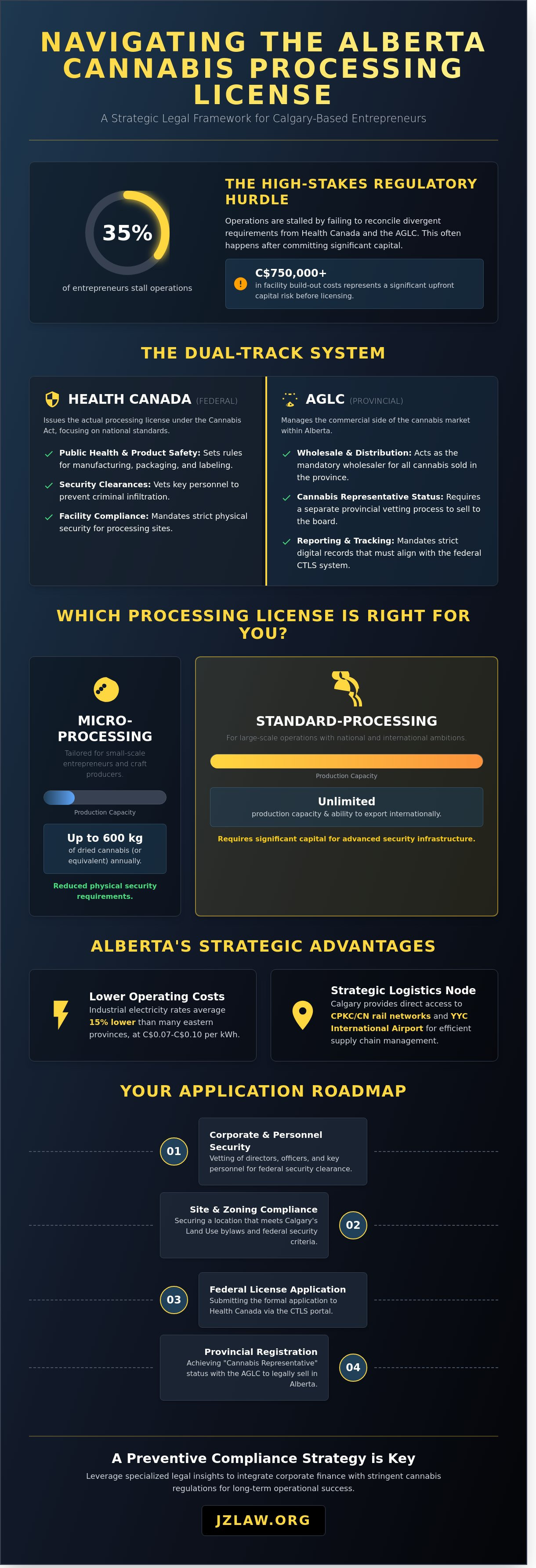
Did you know that as of January 2026, approximately 35% of entrepreneurs in Southern Alberta stall their operations because they fail to reconcile the divergent requirements of Health Canada and the AGLC? The alberta cannabis processing license application remains one of the most rigorous regulatory hurdles in the country; it demands a synergy of federal security standards and provincial retail compliance. You likely recognize that the capital risk is immense, particularly when C$750,000 or more in facility build-outs must often be committed before a single gram of product can be legally processed.
We understand that the pressure to secure a facility while simultaneously managing complex security clearance protocols can feel like a precarious financial gamble. This guide provides the strategic legal framework necessary to master this dual-track system, emphasizing a preventative approach to avoid common pitfalls for Calgary-based businesses. You'll gain a clear roadmap to achieving successful security clearances and establishing a fully compliant, operational processing facility that stands up to the strictest regulatory scrutiny.
Key Takeaways
Identify the precise regulatory requirements for Standard versus Micro-processing licenses to ensure your facility remains compliant with the 2026 Alberta market standards.
Master the dual-track alberta cannabis processing license application process by effectively balancing Health Canada’s security mandates with AGLC’s distribution and taxation protocols.
Navigate Calgary’s complex municipal landscape by securing site locations that satisfy both specific Land Use Redesignation bylaws and federal physical security criteria.
Implement a preventive compliance strategy to address the most common reasons for application failure, ranging from inadequate security plans to flawed corporate structures.
Leverage specialized legal insights to integrate corporate finance objectives with stringent cannabis regulations, providing a strategic foundation for long-term operational success.
Table of Contents Understanding the Cannabis Processing License in Alberta Step-by-Step: Navigating the Alberta Cannabis Processing License Application Federal vs. Provincial: Balancing Health Canada and AGLC Requirements Key Compliance Hurdles: Security, Zoning, and Personnel Strategic Legal Counsel for Alberta Cannabis Processors
Understanding the Cannabis Processing License in Alberta
The cannabis processing license represents the foundational legal authority required to manufacture, package, and label cannabis products within the Canadian regulatory framework. Successfully completing an alberta cannabis processing license application allows businesses to transform raw flower into value-added commodities such as oils, edibles, topicals, or concentrates. In the 2026 market, this license is the gatekeeper for any enterprise looking to move beyond simple cultivation into the high-margin sector of product formulation and brand development.
Securing a license in Alberta offers distinct competitive advantages. The province maintains industrial electricity rates that average between C$0.07 and C$0.10 per kWh, which is approximately 15% lower than rates found in many eastern provinces. Calgary specifically serves as a strategic logistics node, providing immediate access to the CPKC and CN rail networks and the YYC Calgary International Airport. These logistical benefits are essential for processors who must manage complex supply chains involving the transport of bulk biomass and the distribution of finished goods.
It's vital to distinguish between federal and provincial jurisdictions before beginning the process. Health Canada issues the actual processing license under the Cannabis Act, focusing on public health, security, and product safety. Conversely, the Alberta Gaming, Liquor and Cannabis (AGLC) commission manages the provincial distribution and wholesale market. You cannot legally sell a single gram of product in Alberta without satisfying both federal site requirements and provincial commercial agreements.
Standard vs. Micro-Processing: Which is Right for You?
Micro-processing licenses are tailored for small-scale entrepreneurs and craft producers. These licenses come with reduced physical security requirements; for instance, they don't require the same level of 24/7 visual monitoring for all perimeter areas that standard sites demand. Standard processing licenses require more significant capital for security infrastructure but offer unlimited production capacity and the ability to engage in international export markets. As of January 2026, the regulatory threshold between these two tiers is defined by an annual production limit of 600 kilograms of dried cannabis or its equivalent for micro-processors.
The Role of the AGLC in the Processing Supply Chain
While Health Canada oversees the alberta cannabis processing license application and safety standards, the AGLC acts as the mandatory wholesaler for all cannabis processed and sold within the province. Every processor must secure "Cannabis Representative" status to legally pitch and sell their inventory to the provincial board. This status is not granted automatically with a federal license; it requires a separate provincial vetting process.
This relationship necessitates strict adherence to the AGLC’s reporting and tracking systems, which integrate with the federal Cannabis Tracking and Licensing System (CTLS). For Calgary-based businesses, this means maintaining meticulous digital records of every milligram of extract and every unit of packaging. Failure to align provincial reporting with federal data can result in immediate administrative holds on inventory, highlighting the need for a preventative legal strategy during the initial setup phase.
Step-by-Step: Navigating the Alberta Cannabis Processing License Application
The path to obtaining a federal permit involves a rigid sequence of regulatory milestones. Success depends on a preventative legal strategy that addresses federal requirements and local Calgary municipal bylaws simultaneously. An alberta cannabis processing license application isn't merely a paperwork exercise; it's a demonstration of operational readiness and high-level security compliance.
Phase 1: Corporate and Personnel Security Clearances
The process begins with identifying "Key Personnel" who must undergo federal security screening. This group includes directors, officers, and any individual in a position to exercise control over the entity. Health Canada requires comprehensive financial disclosures and criminal record checks to mitigate the risk of organized crime infiltration. JZ Law assists clients by vetting directors early in the process. This proactive approach identifies potential red flags in a candidate's history before they trigger a multi-month delay in the alberta cannabis processing license application. We ensure your corporate structure is transparent and meets the C$20,000 minimum initial capital benchmarks often expected for viable startups.
Phase 2: The Site and Facility Build-Out
Since the regulatory shift in May 2019, Health Canada requires applicants to have a "substantially complete" facility before submitting their file. You can't apply based on blueprints alone. In Calgary, your site must strictly adhere to the Land Use Bylaw 1P2007, which dictates specific setback distances from schools and public parks. Essential components include:
High-efficiency particulate air (HEPA) filtration systems to manage odor.
Physical barriers and 24/7 high-definition visual monitoring of all storage areas.
Access control systems that log every entry and exit point.
Beyond these security measures, the mechanical efficiency of your production line is vital for long-term success; as you plan your facility's layout, you can discover Jealco International, Inc. for specialized industrial power transmission and material handling systems.
Architectural errors, such as improper vault specifications or inadequate camera coverage, account for approximately 35% of application rejections in the first review phase.
Phase 3: Developing the Quality Assurance (QA) Framework
Your Quality Assurance Person (QAP) is the most critical hire in this journey. This individual ensures that every batch produced meets Good Production Practices (GPP). You must draft exhaustive Standard Operating Procedures (SOPs) covering everything from sanitation to recall protocols. Our firm provides complex legal advisory services to review these SOPs, ensuring they're not just theoretical but legally robust and compliant with the Cannabis Act.
Once the physical build and documentation are ready, you'll navigate the Cannabis Tracking and Licensing System (CTLS) portal to submit your "Evidence of Package." This digital submission includes video walkthroughs and photographic proof that the facility is operational. After Health Canada's final review of this package and the completion of security clearances, the license is issued. This allows you to begin processing activities and participating in the Alberta provincial market, which saw over C$800 million in legal sales in the last fiscal year.
Federal vs. Provincial: Balancing Health Canada and AGLC Requirements
The regulatory framework for an alberta cannabis processing license application demands a sophisticated understanding of two distinct jurisdictions. Health Canada serves as the federal authority; it's primarily concerned with public health, product safety, and national site security. Conversely, the Alberta Gaming, Liquor and Cannabis Commission (AGLC) manages the commercial mechanics within provincial borders. This includes distribution, taxation, and retail oversight. Success depends on synchronizing these requirements early. While Health Canada utilizes the Cannabis Tracking System (CTS) to prevent illicit diversion, the AGLC requires separate, granular reporting for provincial excise tax and inventory management. Discrepancies between these two reporting streams often trigger administrative audits and delays.
Health Canada: The Gatekeeper of Production
Health Canada remains the primary hurdle for production standards and facility certification. Under the 2026 amendments to the Cannabis Act, processors must adhere to updated microbial testing protocols and stringent packaging restrictions designed to reduce environmental waste. The audit process for new Calgary facilities typically involves a 120 to 180 day review period after the evidence package submission. We ensure your facility meets these federal Good Production Practices (GPP) to prevent the need for costly structural retrofitting during the final inspection phase.
AGLC: The Gatekeeper of the Alberta Market
The AGLC controls access to Alberta’s 750 plus retail stores. Even with a federal license, you can't sell a single gram without an AGLC retail agreement and a registered SKU. Their "Social Responsibility" framework and strict anti-inducement regulations prevent processors from offering prohibited benefits to retailers. For Calgary-based processors, leveraging local distribution logistics requires early coordination with the AGLC’s supply chain division. This ensures your alberta cannabis processing license application aligns with provincial demand forecasts and delivery schedules.
JZ Law utilizes a "Dual-Track" communication strategy to manage these overlapping authorities. We don't recommend waiting for federal approval before engaging the province. Instead, our team initiates preliminary AGLC discussions while your application is still in the Health Canada queue. This proactive approach can reduce your total time-to-market by up to 90 days. We manage the technical correspondence with both regulators, ensuring that your security clearances satisfy federal law while your commercial strategy remains compliant with provincial retail requirements. This method provides the following advantages:
Regulatory Alignment: We ensure site security plans satisfy both Health Canada’s physical requirements and AGLC’s reporting standards.
SKU Readiness: We prepare product listing applications concurrently with facility build-outs.
Risk Mitigation: We identify potential provincial hurdles before you commit to federal production volumes.
Our role is to act as your strategic partner, navigating the friction between federal safety mandates and provincial market realities with precision and foresight.
Key Compliance Hurdles: Security, Zoning, and Personnel
Health Canada data from 2025 indicates that approximately 42% of initial rejections for the alberta cannabis processing license application stem from insufficient physical security descriptions. This high failure rate isn't usually the result of missing hardware; it's a failure to demonstrate a cohesive, closed-loop system that prevents unauthorized access and product diversion. A successful application requires a sophisticated narrative that explains how technology and human oversight interact to protect the integrity of the facility.
Physical Security: More Than Just Cameras
The Cannabis Regulations demand that every square inch of the facility's perimeter and all areas where cannabis is present be under 24/7 visual monitoring. This goes beyond simple recording; the system must function in low-light conditions and maintain a resolution high enough to identify any individual clearly. Intrusion detection systems must include redundant power supplies to ensure functionality during outages. Detailed access control logs are a legal necessity, and these records must be stored for at least two years to satisfy federal auditors. Security Clearance for Calgary processors requires a comprehensive federal background check conducted by the RCMP to ensure that no key personnel have links to organized crime or relevant criminal records.
Visual monitoring must provide unobstructed views of all entry and exit points.
Intrusion detection must be monitored by a central station capable of dispatching authorities immediately.
Record-keeping protocols must be digitized and backed up to prevent data loss.
Calgary Zoning: Finding the Right Industrial Pocket
The City of Calgary regulates cannabis operations through Land Use Bylaw 1P2007. Most processing facilities are restricted to I-G (General Industrial) or I-H (Heavy Industrial) zones. The primary challenge for 2026 applicants is the "Setback" requirement. Calgary enforces a 150-metre separation distance from schools and specific public parks, which significantly narrows the available real estate market. If a chosen site falls within these restricted zones, a Land Use Redesignation may be required. JZ Law manages the complexities of these municipal applications and provides strategic representation during Subdivision and Development Appeal Board (SDAB) hearings to secure your operational permits.
The Personnel and Financial Transparency Gap
Identifying a Quality Assurance Person (QAP) is often the final hurdle before submission. In the current 2026 Alberta market, a qualified QAP commands a salary between C$105,000 and C$140,000. This individual must possess the technical credentials to oversee sanitation, sampling, and testing protocols. Furthermore, corporate transparency is non-negotiable. Every shareholder with a 10% or greater interest must undergo a deep-dive financial audit. You'll need to provide documented proof of the source of your C$500,000+ in startup capital to ensure no illicit funds are entering the legal market. Failure to provide a clear paper trail for every dollar invested will result in an immediate application freeze.
Strategic Legal Counsel for Alberta Cannabis Processors
Navigating the technicalities of an alberta cannabis processing license application requires more than a generalist lawyer. Boutique firms like JZ Law provide high-touch, specialized attention that large corporate firms often struggle to deliver. John Zang bridges the gap between complex corporate finance and the rigid framework of the Cannabis Act. His approach ensures that your legal strategy isn't just a compliance checklist; it's a foundation for sustainable commercial growth.
For many ambitious processors, the initial license is only the first milestone. We focus on integrating your current licensing strategy with the long-term objective of taking your cannabis company public. This foresight prevents the need for costly corporate restructuring or "clean-up" work two years down the line when investors demand a transparent audit trail. We prioritize a preventative approach to mitigate operational risks. Administrative Monetary Penalties (AMPs) from the AGLC can reach C$10,000 per violation, while a single Health Canada product recall can cost a processor upwards of C$250,000 in lost inventory and logistics. Our counsel aims to identify these vulnerabilities before they manifest as financial liabilities.
Corporate Structuring and Tax Optimization
Choosing the right legal entity is vital for attracting Series A or B investment in 2026. We help Alberta processors manage inter-provincial tax complexities, especially when distributing product across different provincial jurisdictions with varying markup structures. Additionally, we safeguard your intellectual property (IP). If your team has developed a proprietary CO2 extraction method or a unique solventless process, we ensure that IP remains a protected asset on your balance sheet rather than a shared liability.
Ongoing Compliance and Regulatory Audits
The work doesn't end once your alberta cannabis processing license application is approved. Health Canada conducted 526 inspections in a recent fiscal year; many of these were unannounced. We prepare your Calgary or Edmonton facility for these audits through internal dry runs and rigorous SOP reviews. Managing personnel changes, such as appointing a new Responsible Person or Head of Security, requires legal precision to avoid license suspension. Our firm handles these filings to ensure your operations remain uninterrupted.
A critical component of passing these audits is providing up-to-date calibration certificates for all laboratory and processing equipment. Specialized firms, such as the Australian-based Zenith Sales & Calibrations Pty Ltd, offer a good example of the comprehensive instrumentation services required to maintain these exacting standards.
Contact JZ Law today for a comprehensive cannabis licensing consultation to secure your position in the Alberta market.
Navigating Your Path to Market Leadership in Alberta's 2026 Cannabis Sector
Securing a foothold in the Canadian cannabis market requires more than just operational capacity; it demands a rigorous adherence to the evolving standards set by Health Canada and the AGLC. As we navigate the 2026 regulatory landscape, the complexity of the alberta cannabis processing license application remains a significant barrier for many emerging enterprises. Success hinges on a precise alignment of physical security protocols, municipal zoning bylaws in Calgary, and the vetting of key personnel. It's essential to integrate these requirements into your business architecture early to avoid the significant financial setbacks often caused by preventable licensing delays.
JZ Law brings a unique dual-market perspective from our experience in the Calgary and San Francisco regulatory sectors, focusing specifically on complex corporate structures within the cannabis industry. We act as your strategic partner, offering the specialized insight necessary for those aiming to transition from private operations to going public on Canadian exchanges. Our firm ensures your compliance framework is robust enough to withstand federal scrutiny while maintaining the agility needed for rapid commercial growth.
Secure your Alberta cannabis processing license with JZ Law to transform these regulatory challenges into a distinct competitive advantage. Your vision for a premier processing facility is within reach when backed by a disciplined legal strategy.
Frequently Asked Questions
How much does an Alberta cannabis processing license application cost in 2026?
An Alberta cannabis processing license application involves a Health Canada fee of C$3,500 for micro-processing or C$25,000 for standard processing in 2026. These figures represent the base regulatory costs for the initial submission. You'll also need to budget for annual regulatory fees, which typically start at C$2,500 or a percentage of your gross revenue once operations begin.
Can I apply for a processing license if I already have a retail cannabis store in Alberta?
You can hold both a processing license and a retail cannabis store license in Alberta. However, you must operate these as separate legal entities to maintain regulatory compliance. The AGLC requires strict separation between your wholesale production activities and your retail storefront operations. This ensures that your business structure prevents anti-competitive behavior within the provincial market.
How long does the Health Canada processing license approval take?
Health Canada typically takes 180 to 240 days to process a standard application. Micro-processing applications move faster, often reaching approval within 120 to 150 days. These timelines depend on the completeness of your initial submission and the speed of security clearance background checks. It's vital to submit a perfect application to avoid the "Request for More Information" cycles that cause delays.
Do I need a fully built facility in Calgary before I submit my application?
You must have a fully built, site-ready facility in Calgary before submitting your alberta cannabis processing license application. Health Canada requires photographic and video evidence proving the site meets all Good Production Practices (GPP) and physical security requirements. Submitting an application for a site that's still under construction will result in an immediate rejection or significant administrative delays.
What is the difference between a Micro-processing and a Standard processing license?
The primary difference lies in production capacity and regulatory costs. Micro-processors are restricted to processing 600kg of dried cannabis per year, while Standard processors have no volume limits. Standard licenses require a more robust security infrastructure, including 24/7 visual monitoring of all areas. Micro-licenses have scaled-back physical security requirements, making them more accessible for boutique operations in Calgary.
Can an Alberta cannabis processor sell directly to consumers?
Alberta cannabis processors can't sell products directly to consumers from their production facility. All finished products must be sold to the Alberta Gaming, Liquor and Cannabis Commission (AGLC) for wholesale distribution. Alternatively, you can sell bulk product to other federally licensed processors for further refinement. Direct sales to the public are only permitted through licensed retail storefronts or the AGLC's official online platform.
What security clearances are required for directors of a cannabis processing company?
All directors, officers, and individuals in key positions like the Quality Assurance Person (QAP) must hold a valid federal security clearance. This process involves a comprehensive background check by the RCMP and CSIS. The investigation looks into criminal records, financial stability, and potential associations with organized crime over the last 10 years. It's a rigorous process that takes approximately 4 to 6 months to complete.
How does the AGLC SKU listing process work for new Alberta processors?
The AGLC SKU listing process begins with signing a Master Cannabis Agreement and obtaining a provincial wholesaler license. Once registered, you'll submit product specifications during the AGLC's scheduled product calls, which occur approximately every 8 to 12 weeks. Success depends on meeting the AGLC’s specific packaging, labeling, and laboratory testing standards. Your alberta cannabis processing license application is just the first step in this complex supply chain integration.


Comments