


Alberta Energy Regulator Compliance: A Strategic Guide for 2026
As of January 2024, the Alberta Energy Regulator’s shift toward a holistic assessment model has effectively rendered traditional, siloed compliance checklists obsolete. You likely recognize that the margin for error has narrowed; the reputational risk of appearing on the AER’s public non-compliance dashboard, coupled with the rising mandatory spend requirements of the Inventory Reduction Program, creates a precarious environment for even the most seasoned operators. We understand that the uncertainty surrounding Directive 088 and the complexities of liability management can hinder long term capital planning and asset liquidity.
This article provides a sophisticated legal framework for alberta energy regulator compliance specifically tailored for the 2026 landscape. It's designed to protect your energy assets and ensure operational continuity against a backdrop of increasing regulatory scrutiny. We'll provide a clear roadmap for navigating regulatory audits, strategies to shield your firm from administrative penalties, and the necessary steps for successful license transfers through robust liability management. By aligning your operational goals with these strategic legal insights, you can transform regulatory obligations into a competitive advantage for your organization.
Key Takeaways
Understand how the transition from Liability Management Rating (LMR) to the Holistic Assessment model fundamentally alters the AER’s evaluation of operational risk and asset integrity.
Master the nuances of alberta energy regulator compliance by differentiating between routine inspections and targeted audits within the 2026 Enhanced Production Audit Program (EPAP) framework.
Navigate the AER’s "ladder of enforcement" with precision to effectively manage the legal weight of noncompliance notices and mitigate potential administrative penalties.
Identify the critical components of a preventive legal strategy, including the implementation of a robust Compliance Management System and the protocols for Voluntary Self-Disclosure.
Position your energy assets for sustainable growth by aligning your operations with strategic legal counsel designed for the complexities of the 2026 regulatory environment.
Table of Contents The Shifting Landscape of Alberta Energy Regulator Compliance in 2026 How the AER Assures Compliance: Inspections, Audits, and Investigations Navigating AER Enforcement Tools: Warnings to Administrative Penalties Building a Preventive Legal Strategy for Regulatory Compliance Strategic Counsel for Alberta Energy Assets: The JZ Law Approach
The Shifting Landscape of Alberta Energy Regulator Compliance in 2026
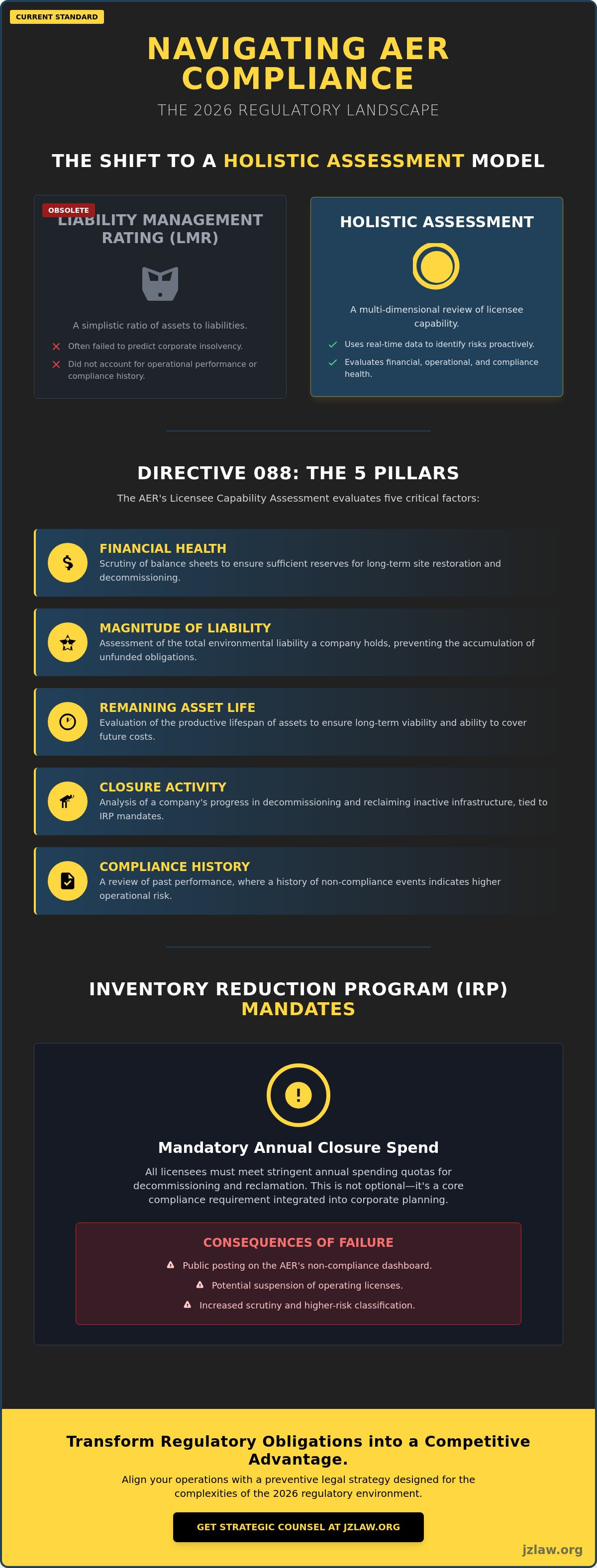
The Alberta Energy Regulator (AER) functions as the single, integrated authority overseeing the province's energy life cycle, from initial application to final reclamation. By 2026, the regulatory framework has fully transitioned away from the legacy Liability Management Rating (LMR) system. This old model relied on a simplistic ratio of assets to liabilities that often failed to predict corporate insolvency. Today, alberta energy regulator compliance is defined by the Holistic Assessment, a multi-dimensional review of a licensee's ability to manage its environmental and financial obligations. This shift marks a turning point in regulatory transparency. The AER now uses real-time data to identify risks before they manifest as orphaned wells. For operators, maintaining a "Satisfactory" status on the Compliance Dashboard is a strategic necessity. It's the primary metric that partners, lenders, and insurers use to gauge a company's reliability in a high-stakes market.
Directive 088 and the Licensee Capability Assessment
Directive 088 remains the cornerstone of the AER's modern oversight, utilizing the Licensee Capability Assessment to evaluate five critical factors: financial health, magnitude of liability, remaining asset life, closure activity, and compliance history. The regulator no longer views operational performance in a vacuum. Instead, it scrutinizes balance sheets to ensure that CAD (C$) reserves are sufficient for long-term site restoration. For firms engaged in asset acquisitions or license transfers in Calgary, these assessments are often the deciding factor. If a buyer doesn't meet the AER's financial resilience threshold, the regulator can demand significant security deposits or block the transfer entirely. This proactive approach prevents the accumulation of unfunded liabilities across the province.
The Inventory Reduction Program (IRP) Mandates
The Inventory Reduction Program (IRP) has established mandatory closure spend targets that all licensees must meet annually. By 2026, these quotas have become more stringent to address the backlog of inactive infrastructure. Companies must allocate a specific percentage of their total liability toward decommissioning and reclamation every calendar year. Failing to meet these annual closure quotas isn't just a minor oversight; it results in legal consequences that range from public non-compliance postings to the suspension of operating licenses. Savvy operators are now integrating these IRP requirements into their long-term corporate tax structuring. By aligning reclamation schedules with fiscal planning, firms can optimize their C$ expenditures while ensuring they remain in the AER's good graces. This disciplined approach to alberta energy regulator compliance transforms a mandatory cost into a predictable part of the business strategy.
How the AER Assures Compliance: Inspections, Audits, and Investigations
The Alberta Energy Regulator (AER) employs a sophisticated, risk-based oversight model that distinguishes between routine field presence and deep-dive forensic reviews. In 2026, the regulator has intensified its focus on data-driven targeting. While routine inspections typically focus on physical site integrity and immediate safety hazards, targeted regulatory audits examine the systemic health of an operator’s management systems. These audits are often triggered by anomalies in volumetric reporting or a history of low-risk non-compliance events that suggest a pattern of operational neglect.
The Enhanced Production Audit Program (EPAP) remains the cornerstone of alberta energy regulator compliance for 2026. Under Directive 017 and Directive 060, operators must submit annual declarations through the OneStop platform. This isn't merely a clerical task; it's a formal assertion that your internal controls are functioning. A "non-compliant" declaration or a failure to address previous deficiencies can move an operator from the routine inspection pool into the high-priority audit category. Calgary-based regulatory teams must ensure that field staff are trained for unannounced inspections, which the AER frequently conducts to verify that "on-the-ground" reality matches the digital data submitted in OneStop.
The Audit Process: From Notification to Final Report
Once a notification of audit is issued, the AER typically grants a 30-day window for document production. This timeline is rigid. Common pitfalls during this phase include data validation errors within the OneStop platform, such as mismatched facility IDs or inconsistent fuel, flare, and vent (FFV) volumes. If your team encounters conflicting interpretations of AER Directives, it's essential to reference the specific guidance in Manual 011. Discrepancies should be addressed through formal channels early in the process to prevent them from being categorized as "high-risk" non-compliance in the final report.
Investigations and Evidence Gathering
When the AER suspects a serious breach of the Oil and Gas Conservation Act (OGCA), the process shifts from a collaborative audit to a formal investigation. Under Section 98 of the OGCA, inspectors possess broad powers of entry and can demand any record relevant to the inquiry. It's vital to remember that while the regulator has these powers, they don't supersede solicitor-client privilege. Establishing a preventive compliance framework with legal counsel ensures that corporate interests are protected during employee interviews and site tours. Statements made during these high-pressure interactions can form the basis of administrative penalties or even quasi-criminal charges, making strategic representation a necessity rather than an option.
Routine Inspections: Focus on physical equipment, signage, and immediate leak detection.
Targeted Audits: In-depth reviews of measurement books, logs, and internal control effectiveness.
Formal Investigations: Triggered by environmental releases, safety incidents, or suspected fraudulent reporting.
Navigating AER Enforcement Tools: Warnings to Administrative Penalties
The Alberta Energy Regulator (AER) employs a graduated "ladder of enforcement" designed to ensure alberta energy regulator compliance through increasingly severe interventions. This model begins with the Notice of Noncompliance, which serves as a formal nudge to correct minor deviations. While it lacks immediate financial impact, it establishes a documented history. A formal Warning carries significantly more legal weight. It sits on the licensee’s permanent record and serves as an aggravating factor if future breaches occur, often leading to higher fine brackets during subsequent penalty calculations.
Strategic responses to Compliance Orders and Reasonable Care Orders must be immediate and legally sound. These aren't suggestions; they're mandatory directives that often require significant capital expenditure or operational shifts. When an operator is listed on the AER’s Compliance Dashboard, the damage extends beyond the balance sheet. In 2023, the dashboard became a primary source for ESG analysts and lenders assessing operational risk. Mitigating this reputational damage requires a transparent, documented remediation plan that demonstrates a commitment to returning to full compliance.
Notice of Noncompliance: A corrective tool focused on education and swift resolution.
Warning: A formal record that influences the severity of future enforcement actions.
Compliance Orders: Legally binding mandates that require specific actions within a strict timeframe.
Dashboard Listing: A public disclosure that can impact credit ratings and investor confidence.
Administrative Penalties and Sanctions
The AER calculates penalty amounts based on Directive 019, focusing on the severity of the impact and the licensee’s history. Fines can reach C$50,000 per day for certain contraventions, making the financial stakes immense. If your firm receives a penalty, you've a 30-day window to file a request for a regulatory appeal or an internal review. This process is highly technical; it's the primary opportunity to present evidence of due diligence. When a breach involves intentional defiance or catastrophic environmental harm, the AER may move toward quasi-criminal prosecution. This shifts the matter from administrative boards to the provincial court system, where penalties can include much larger fines and potential incarceration.
Declaration of a Named Individual
Section 106 of the Oil and Gas Conservation Act is perhaps the most significant personal risk for Calgary energy executives. This provision allows the AER to "name" directors, officers, or even controlling shareholders of a non-compliant licensee. Once named, these individuals can be held personally liable for the company’s debts to the AER, including abandonment and reclamation costs. The legal consequences are severe. A named individual may be barred from holding future licenses or being associated with any entity that holds one. To protect personal professional standing, executives must ensure that a preventative approach is deeply embedded in their corporate governance. Documenting every step of a compliance strategy is the only way to establish a "reasonable care" defense if the regulator begins a Section 106 investigation.
Building a Preventive Legal Strategy for Regulatory Compliance
Establishing a robust internal compliance management system (CMS) is the first line of defense against the increasingly automated oversight of the Alberta Energy Regulator. By 2026, the shift toward data-driven enforcement means that alberta energy regulator compliance is no longer a periodic check, it's a continuous operational requirement. A preventive strategy treats regulatory risk with the same rigor as financial risk, utilizing internal "shadow audits" to replicate AER inspection protocols. These audits identify vulnerabilities in wellbore integrity, methane emissions reporting, or water usage data before they trigger an official investigation. Identifying a gap internally allows for a controlled correction, whereas an AER-led discovery often results in mandatory orders or administrative penalties that can exceed C$50,000 per day per violation.
Legal protection extends beyond internal operations and must be reflected in your commercial partnerships. Integrating regulatory risk into oil and gas joint venture agreements is essential for modern operators. These contracts should clearly define which party holds the primary responsibility for AER reporting and who bears the financial burden of remediation. Without these specific legal frameworks, a single partner's negligence can jeopardize the licenses of the entire joint venture, leading to stalled production and reputational damage.
The Step-by-Step Protocol for Voluntary Self-Disclosure
When an internal audit reveals a breach, the legal protocol for Voluntary Self-Disclosure (VSD) becomes your most valuable tool for mitigation. Under AER Directive 019, the regulator may offer leniency or waive certain penalties if the operator discloses the non-compliance proactively. The process requires precision:
Assessment: Verify if the breach meets the AER’s criteria for self-disclosure, focusing on whether it was discovered before the regulator initiated an inspection.
Drafting the VSD: The disclosure must be drafted with legal oversight to ensure it provides a full account of the facts without making unnecessary admissions of liability that could be used in civil litigation.
Remediation: A detailed remedial action plan must accompany the disclosure, setting clear timelines for bringing the site back into compliance.
Audit Readiness and Document Control
Maintaining audit readiness requires a disciplined approach to document control within the OneStop platform. Operators should ensure that all records are not only accurate but also updated in real-time to reflect field changes. Training staff on the legal distinction between technical "compliance" and legal "admissions" is critical; field notes should be factual and objective to avoid misinterpretation during an audit. A designated rapid-response team should be trained to manage regulatory inquiries, acting as a single point of contact to ensure consistency in all communications with the AER. This structure prevents the fragmented reporting that often leads to avoidable enforcement actions.
To protect your assets and ensure long-term operational stability, contact us for
.
Strategic Counsel for Alberta Energy Assets: The JZ Law Approach
John Zang provides specialized legal expertise to help operators manage the shifting demands of alberta energy regulator compliance. His approach integrates technical legal knowledge with a clear understanding of the commercial realities in the Western Canadian Sedimentary Basin. As the industry moves toward 2026, the complexity of asset management increases. Success depends on aligning operational goals with a oil and gas law strategy that anticipates regulatory shifts before they impact the bottom line. This preventative mindset ensures that your business remains agile during periods of transition.
Integration of tax structuring with regulatory reporting to optimize cash flow.
Comprehensive audits of liability management ratings to prevent unexpected security deposit requests.
Alignment of corporate governance with the AER’s Directive 067 requirements.
Strategic defense during regulatory inquiries or enforcement actions.
Calgary-Based Expertise with Global Regulatory Perspective
Operators must manage the overlap between Alberta's provincial mandates and Canadian federal oversight. This dual-layer framework often creates friction during cross-border energy transactions or when navigating securities regulation. JZ Law bridges this gap. We help clients position their business for growth within the Alberta 2026 energy landscape by providing clarity on multi-jurisdictional requirements. Our counsel ensures that compliance isn't a hurdle but a foundation for expansion. You can reach out for a confidential consultation to review your current compliance framework and identify potential vulnerabilities.
Beyond Compliance: Strategic Partnering for Energy Success
Regulatory excellence acts as a powerful lever in mergers and acquisitions. When a firm demonstrates a flawless record in alberta energy regulator compliance, it increases asset liquidity and attracts premium valuations. We focus on the synergy between tax structuring, corporate transactions, and environmental liability. Ensuring your corporate structure supports the AER's evolving liability management requirements is essential for long-term viability.
Proactive legal frameworks prevent the sudden capital drains associated with unexpected reclamation orders or security deposit increases. We don't just react to notices; we build resilient enterprises. This involves a deep dive into the Lifecycle Management Program and the Mandatory Closure Spend targets set by the regulator. By treating these requirements as part of a broader corporate strategy, we help you secure long-term asset value. Contact JZ Law today to safeguard your energy operations and secure your future in the Alberta market.
Future-Proofing Your Energy Portfolio for 2026
The regulatory environment for Alberta’s energy sector is undergoing a fundamental shift as we approach 2026. Successful operators understand that reacting to AER inspections isn't enough; they need a proactive stance that integrates legal precision with operational reality. By prioritizing alberta energy regulator compliance through the lens of Directive 088, companies can mitigate the risks of administrative penalties and ensure long-term asset viability. It's about building a defensive perimeter around your investments before the audit notification arrives.
JZ Law provides the sophisticated legal frameworks necessary for navigating Calgary’s complex energy hubs. Our integrated approach combines deep oil and gas law expertise with strategic corporate transaction oversight to protect your interests, ensuring that every regulatory obligation is met with the same level of rigor applied to your most critical business deals. We don't just solve existing problems; we design preventive strategies that align with your broader business goals. Secure your energy assets with strategic regulatory counsel from JZ Law. Your commitment to excellence today ensures a stable and profitable future in Canada’s evolving energy market.
Frequently Asked Questions
What is the Alberta Energy Regulator (AER) Compliance Dashboard?
The AER Compliance Dashboard is a public online portal that provides transparent access to the regulator's enforcement activities and industry noncompliance records. It tracks all major incidents, administrative penalties, and investigation summaries issued under the Responsible Energy Development Act. By publishing this data, the regulator ensures that stakeholders can monitor how companies adhere to provincial standards; in 2023 alone, the dashboard recorded thousands of compliance activities to maintain public trust.
How does Directive 088 impact my ability to transfer energy licenses in Alberta?
Directive 088 mandates a holistic assessment of both the transferor and transferee’s financial health before the AER approves any license transfer. The regulator utilizes the Licensee Capability Assessment (LCA) to ensure the purchasing party can fulfill long-term abandonment and reclamation obligations. If a company's LCA score indicates high risk, the AER may require a security deposit in C$ to mitigate potential environmental liabilities before the transfer proceeds.
What are the potential penalties for failing to meet the Inventory Reduction Program (IRP) targets?
Failure to meet mandatory closure spend targets results in escalating enforcement actions, including administrative penalties that can reach C$50,000 per day per violation. Under the IRP, every licensee must spend a specific annual quota on decommissioning and reclamation activities. Missing these targets triggers a high-risk designation on the compliance dashboard, which often leads to restricted operations or the suspension of existing licenses until the shortfall is rectified.
Can I appeal an AER Administrative Penalty or Compliance Order?
You can request a regulatory appeal under Section 38 of the Responsible Energy Development Act within 30 days of receiving the decision. The request must be submitted through the AER’s Integrated Application Registry and precisely outline the legal or factual errors in the original order. Success in these proceedings requires a rigorous demonstration that the regulator's decision was inconsistent with established legislation or failed to consider material evidence provided during the initial assessment.
What is Voluntary Self-Disclosure, and when should I use it?
Voluntary Self-Disclosure is a formal process where a licensee reports its own regulatory breaches to the AER before they're discovered through a standard inspection. You should use this mechanism immediately upon identifying a noncompliance issue to potentially reduce or waive administrative penalties. This proactive strategy demonstrates a commitment to alberta energy regulator compliance and shifts the relationship from a punitive one to a collaborative remediation process.
How often does the AER conduct field inspections and audits?
The AER typically conducts between 10,000 and 15,000 field inspections annually, focusing on high-risk facilities and aging infrastructure. Frequency isn't uniform; it depends on a licensee's historical performance and the technical complexity of their operations. In 2024, the regulator significantly increased its oversight of methane emissions and pipeline integrity, performing over 2,000 targeted audits in those specific sectors to ensure environmental protection.
What is the difference between an AER inspection and a formal investigation?
An inspection is a routine assessment designed to verify that a facility is operating according to its permit conditions, whereas an investigation is a comprehensive inquiry triggered by a serious incident. Investigations focus on gathering evidence for potential prosecution or major administrative penalties. While an inspection might conclude with a simple notice of noncompliance, an investigation involves a specialized team and can lead to significant legal consequences under Alberta law.
How does the AER evaluate a licensee’s financial capability in 2026?
The AER evaluates financial capability through the Licensee Life-Cycle Management framework, which replaces simple liability ratios with a multi-factor Licensee Capability Assessment score. This assessment analyzes debt-to-equity ratios, cash flow health, and the total magnitude of inactive liabilities. Maintaining alberta energy regulator compliance in 2026 requires companies to provide transparent financial data to prove they possess the liquidity to cover the full cost of their environmental footprint.



Comments