


Shareholder Agreement Terms 2026: Strategic Governance for Calgary, NYC, and German Markets
Updated: May 4
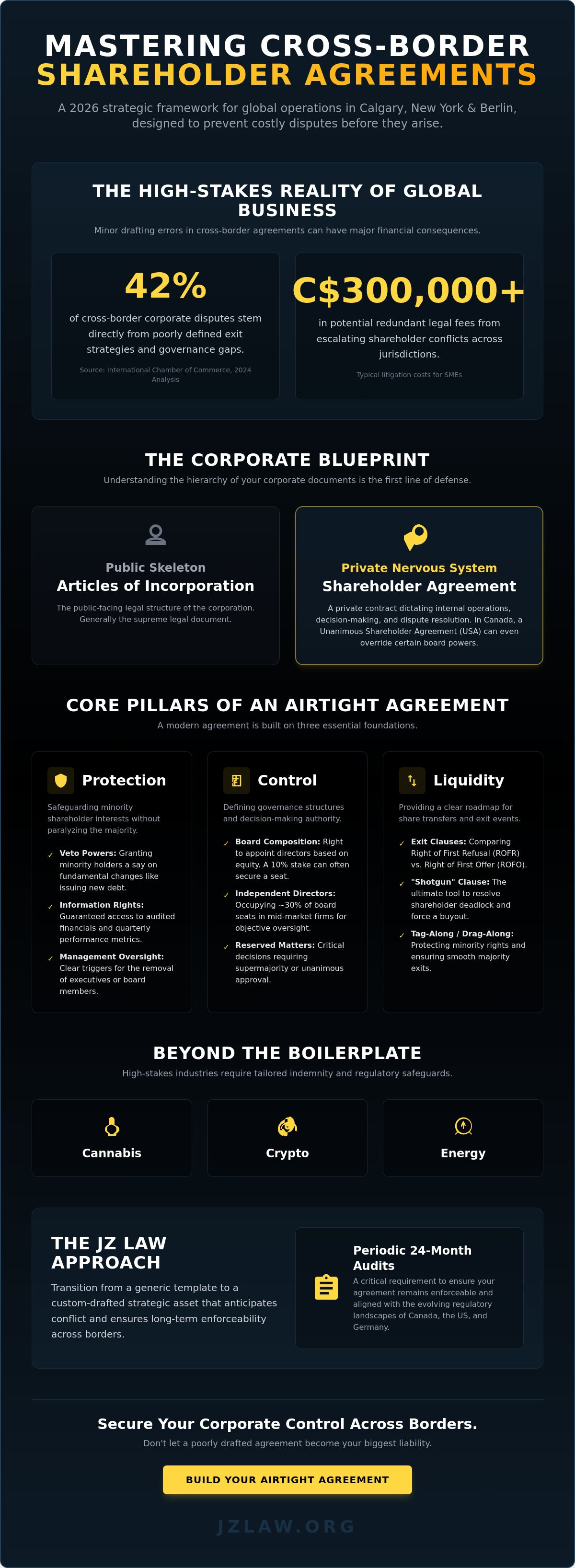
A 2024 analysis by the International Chamber of Commerce revealed that 42% of cross-border corporate disputes stem directly from poorly defined exit strategies and governance gaps. When your operations bridge the regulatory distance between Calgary and Frankfurt, a minor drafting error in your shareholder agreement terms can quickly escalate into litigation costs exceeding C$300,000 in redundant legal fees. You've likely felt the pressure of maintaining board control while trying to harmonize Alberta's Business Corporations Act with the rigid requirements of German corporate law.
It's a challenge that demands more than just legal compliance; it requires a preventive, strategic framework that anticipates conflict before it arises. We'll show you how to structure airtight clauses that protect your equity and provide a transparent roadmap for divestment or dispute resolution. This article breaks down the essential governance shifts for 2026, ensuring your interests remain secure whether you're negotiating in a Manhattan boardroom or a Calgary office.
Key Takeaways
Navigate the evolving global regulatory landscape of 2026 by implementing decentralized governance structures that align with the transparency requirements of both Canadian and European jurisdictions.
Secure your corporate control through strategic board composition and the implementation of veto rights for reserved matters, ensuring minority protections remain robust in cross-border operations.
Evaluate the tactical advantages of Right of First Refusal versus Right of First Offer and understand how "Shotgun" clauses serve as the ultimate liquidity tool during shareholder disputes.
Optimize your shareholder agreement terms by integrating industry-specific indemnity clauses and regulatory safeguards tailored for the high-stakes cannabis, crypto, and energy sectors.
Transition from generic templates to a custom-drafted strategic framework that requires periodic 24-month audits to ensure continued enforceability in Calgary, New York, and Berlin.
Table of Contents Understanding Shareholder Agreement Terms in 2026 Governance and Control: Board Composition and Voting Rights Transfer of Shares: Exit Strategies and Liquidity Events Industry-Specific Terms: Cannabis, Crypto, and Energy Drafting and Enforcement: The JZ Law Strategic Approach
Understanding Shareholder Agreement Terms in 2026
A Shareholders' agreement is a private contract between the owners of a company that functions as the internal operating manual for their professional relationship. While the Articles of Incorporation provide the public-facing skeleton of a corporation, this document serves as the private nervous system. It dictates how decisions are made, how shares are transferred, and how disputes are resolved behind closed doors. In the 2026 business environment, these contracts have evolved to address decentralized governance and the increasing demand for global regulatory transparency.
The 2026 landscape requires a sophisticated approach to shareholder agreement terms due to divergent international standards. For instance, German markets operate under the strict scrutiny of the Transparency Register (Transparenzregister), whereas Canadian firms must navigate the evolving disclosure requirements of the Canada Business Corporations Act (CBCA). Businesses operating in Calgary or New York must reconcile these differences to maintain compliance across borders. In Canadian law, a critical distinction exists between a standard agreement and a Unanimous Shareholder Agreement (USA). A USA is a powerful tool that can restrict the powers of directors and transfer them to shareholders, a feature not commonly found in other jurisdictions.
The Hierarchy of Corporate Documents
Determining which document takes precedence during a conflict is a cornerstone of corporate governance. Generally, the Articles of Incorporation are the supreme legal document, but a properly executed USA in Alberta or Ontario can override certain statutory board functions. It's essential to integrate your memorandum of understanding (MOU) into the final contract with surgical precision. Failure to align these documents often leads to expensive legal friction. When operating internationally, you must ensure consistency between the German Limited Liability Companies Act (GmbHG) and Canadian provincial statutes to avoid double-filing traps or conflicting fiduciary duties.
Core Objectives: Protection, Control, and Liquidity
In high-growth startups, the tension between minority protections and majority control is constant. Effective shareholder agreement terms establish a clear framework for board representation, ensuring a 15% minority holder has a meaningful voice without paralyzing the 51% majority's ability to pivot. These terms protect liquidity through "tag-along" and "drag-along" rights, which are vital when a company nears a C$50 million valuation or an exit event.
Minority Rights: Veto powers over fundamental changes like issuing new debt or changing the business line.
Management Oversight: Specific triggers for the removal of executive officers or board members.
Information Rights: Guaranteed access to audited financial statements and quarterly performance metrics.
A well-drafted agreement functions as a definitive preventive measure that isolates and resolves potential disputes before they can disrupt complex corporate transactions or lead to high-stakes litigation in hubs like Calgary and NYC.
Governance and Control: Board Composition and Voting Rights
Board composition serves as the foundation of corporate stability. Effective shareholder agreement terms in 2026 prioritize the right to appoint directors based on specific equity tranches. In Vancouver, a 10% stake often secures a board seat through cumulative voting provisions. Conversely, Berlin-based entities frequently adopt a dual-board system where the supervisory board oversees the management board. Independent directors now occupy approximately 30% of board seats in mid-market firms to provide objective oversight. These individuals mitigate risks during asset sales or when securing C$5 million or more in debt, where veto rights for "Reserved Matters" become critical. Non-managing shareholders depend on robust information rights to access quarterly audits and strategic forecasts. This transparency is vital according to the legal definition of a shareholder agreement, which emphasizes the contractual nature of these specific protections.
Voting Thresholds and Supermajorities
Ordinary resolutions typically pass with 50% plus one vote. Special resolutions, such as changing the company's articles or approving a merger, require 66.7% or even 100% in tightly held Calgary firms. Deadlocks occur when a 50/50 split halts operations. In NYC and Calgary, 2026 governance models favor "Texas Shootout" clauses or independent arbitration over lengthy litigation. A casting vote assigned to an independent chair can resolve a stalemate in under 14 days, ensuring the business remains operational during internal disputes.
Jurisdictional Nuances: Germany vs. North America
German law under the GmbHG grants shareholders extensive direct instruction rights over management. This concept is often foreign to North American boards. The Canada Business Corporations Act (CBCA) in Toronto and Vancouver maintains a stricter separation between ownership and day-to-day operations. Maintaining the "Corporate Veil" remains a priority in New York; co-mingling funds or ignoring corporate formalities can lead to personal liability. Businesses operating across these borders must harmonize their shareholder agreement terms to prevent jurisdictional friction. Professional strategic representation helps bridge these legal gaps during international expansions.
Precision in these clauses prevents the "oppression remedy" claims that increased by 12% in Canadian courts between 2023 and 2025. By defining exactly which decisions require a supermajority, founders protect their vision while giving investors the security they need to commit capital. This balance is the hallmark of a mature governance strategy in the current economic climate.
Transfer of Shares: Exit Strategies and Liquidity Events
Effective liquidity management requires precise shareholder agreement terms that balance individual exit rights with the stability of the corporate structure. In the Canadian private market, the Right of First Refusal (ROFR) remains the standard for protecting existing shareholders, as it allows them to match any external offer and prevent unwanted third parties from entering the cap table. Conversely, a Right of First Offer (ROFO) favors the selling shareholder by requiring them to offer shares to internal parties before seeking an outside buyer, which can accelerate the timeline for a 2026 exit. According to the authoritative definition of a shareholders' agreement, these provisions are essential for maintaining the intended control and ownership balance within a private entity.
Strategic flexibility often involves "Permitted Transfers," which allow shareholders to move equity into family trusts or holding companies without triggering ROFR or ROFO. This is a critical component of tax structuring, particularly for high-growth firms in Calgary or NYC looking to optimize capital gains exemptions. When an exit occurs, the valuation methodology determines the final payout. While formula-based pricing (such as a 4x or 5x EBITDA multiple) offers predictability, 2026 market volatility has led many firms to prefer Fair Market Value (FMV) determined by an independent chartered business valuator to ensure equitable results during a liquidity event.
Drag-Along and Tag-Along Rights
Drag-along rights empower a majority shareholder group, typically those holding 51% to 75% of voting shares, to force minority shareholders to participate in a total sale of the company. This ensures that a single minority holdout cannot block a lucrative acquisition. Tag-along rights serve the opposite function by allowing minority shareholders to "tag along" on a majority sale, ensuring they receive the same price and terms as the founders.
Mandatory Buy-Back Events
Corporate stability depends on addressing "mandatory trigger events" such as the death, permanent disability, or insolvency of a shareholder. "Bad leaver" provisions are also vital; these allow the company to repurchase shares at a discount if a shareholder is terminated for cause or breaches the shareholder agreement terms. To fund these buy-outs without depleting corporate cash reserves, firms often utilize key-person insurance policies, where the C$500,000 to C$2,000,000 payout covers the purchase price of the deceased or disabled party's equity. A shotgun clause acts as the ultimate "nuclear option" because it forces a definitive resolution by requiring one party to either purchase the other's interest or sell their own at a stated price, effectively eliminating gridlock through financial commitment.
Industry-Specific Terms: Cannabis, Crypto, and Energy
Standardized corporate governance often fails to address the volatile regulatory requirements of high-growth sectors. In 2026, effective shareholder agreement terms must function as a defensive perimeter for a company's most valuable assets: its licenses and intellectual property. We translate critical findings from our m&a due diligence checklist into specialized indemnity clauses. This ensures that historical compliance failures don't jeopardize the future capitalization of the firm. Whether operating in the tech corridors of Calgary or the financial hubs of NYC, your agreement should anticipate sector-specific shocks before they occur.
Cannabis Licensing and Regulatory Covenants
In the Canadian market, the AGLC and AGCO maintain strict oversight regarding who can hold significant interest in a licensed producer. We draft transfer restrictions to ensure every potential shareholder passes "fit and proper" tests mandated by cannabis licensing authorities. If a shareholder becomes a "disqualified person" due to criminal charges or regulatory breaches, forced divestment clauses trigger immediately. These provisions protect the corporate license from revocation. Reporting obligations must also be synchronized across Alberta, Ontario, and California to maintain global compliance standing.
Digital Assets and Cryptocurrency Governance
The 2026 legal environment requires precise shareholder agreement terms regarding the custody of digital assets. We incorporate specific provisions for the management of corporate private keys and the use of multi-sig wallets, requiring a defined quorum of directors for transactions exceeding C$100,000. Under current cryptocurrency law, tokens must be classified as equity, debt, or utility within the share structure to avoid tax surprises. For firms integrating Decentralized Autonomous Organizations (DAOs), we create a legal bridge that allows code-based governance to operate within a traditional corporate shell without sacrificing limited liability protection.
Oil and Gas Joint Venture Overlaps
Energy firms in Calgary and Denver face a unique challenge: aligning shareholder terms with existing Joint Operating Agreements (JOAs). Discrepancies between these documents can lead to gridlock during asset sales. Our drafting process ensures that oil and gas law requirements for environmental liability are reflected in shareholder indemnification. We clearly distinguish between a "working interest" in a field and an "equity interest" in the firm. This prevents confusion during 2026's complex divestment cycles. Precise language around cash calls and abandonment costs is essential to shield individual shareholders from the sector's inherent environmental risks.
Strategic governance requires more than just legal knowledge; it demands industry foresight. Consult with our specialists to tailor your shareholder agreement to your specific market sector.
Drafting and Enforcement: The JZ Law Strategic Approach
Precision in legal drafting isn't a luxury; it's a structural requirement for cross-border success. Relying on generic templates for shareholder agreement terms often leads to jurisdictional failure. A clause that satisfies a Calgary court might be struck down by a judge in New York or Berlin if it lacks specific limiting language. JZ Law prioritizes custom drafting to ensure every provision remains enforceable across North American and European legal landscapes.
Governance structures must evolve alongside the business. We recommend a comprehensive audit of your agreement every 24 months or immediately following a significant funding round. Statistics from mid-market exits suggest that firms with outdated agreements face a 25% higher risk of closing delays due to unresolved governance conflicts. Finalizing these documents requires more than a signature; it demands meticulous execution and immediate corporate minute book updates to maintain regulatory compliance in Ontario and Alberta.
Mitigating Litigation Risks Through Precision
Financial disputes often stem from vague terminology. We define "Net Profit" and "Working Capital" with surgical accuracy using specific accounting standards to prevent dividend conflicts before they start. Non-compete and non-solicitation clauses must remain "reasonable" to survive judicial scrutiny. In New York, courts frequently discard overly broad restrictions entirely. We ensure your protections are robust but legally defensible. Digital transparency also requires that confidentiality clauses align with global data laws, including GDPR in Germany and PIPEDA in Canada.
Strategic Counsel for Global Hubs
Jurisdictional Bridging: We harmonize legal requirements between Calgary, Toronto, NYC, and Germany to create a seamless governance framework.
Dispute Resolution: Choosing between public litigation in Toronto courts or private arbitration in Frankfurt depends on your privacy needs and asset locations.
Scaling for the Future: Our team facilitates the transition from private governance to the rigorous requirements for taking companies public.
Success in international markets requires a partner who understands the nuances of shareholder agreement terms and the mechanics of global enforcement. Don't leave your corporate structure to chance. Contact John Zang today to schedule a strategic consultation and ensure your business is built on a foundation of legal certainty and professional dignity.
Securing Your Enterprise in a Globalized Market
Success in 2026 demands more than just a standard contract; it requires a framework that anticipates the regulatory shifts of high-growth sectors like cannabis, crypto, and energy. Whether you're operating in Calgary, New York, or European hubs, the shareholder agreement terms you establish today will dictate your ability to scale and exit without friction. Precise board composition and clearly defined liquidity events aren't optional anymore. They're the foundation of asset protection and long-term stability, prompting many high-net-worth individuals to explore Cook Islands Trust as a robust layer of defense.
JZ Law brings specialized expertise to cross-border corporate transactions, bridging the gap between North American and European legal requirements. Our preventive legal philosophy focuses on litigation avoidance by identifying potential disputes before they arise. We don't just react to problems; we build structures that prevent them. By integrating strategic governance with industry-specific insights, we ensure your business remains resilient against market volatility.
Secure your corporate future with a strategic legal consultation at JZ Law. Your vision deserves a legal foundation that's as ambitious as your business goals. We're ready to help you build a legacy that lasts.
Frequently Asked Questions
What is the most important term in a shareholder agreement?
The buy-sell provision, frequently referred to as the shotgun clause, is the most critical element because it provides a definitive exit strategy during irreconcilable deadlocks. In Canadian corporate law, these clauses prevent litigation costs that often exceed C$50,000 in legal fees. A well-drafted clause ensures business continuity by allowing one party to buy out the other at a pre-determined or formula-based fair price.
Do I need a shareholder agreement if I only have two shareholders?
You definitely need a formal document with only two shareholders to prevent 50/50 deadlocks that can paralyze daily operations. Without these specific shareholder agreement terms, a simple disagreement over a C$15,000 capital expenditure could lead to corporate dissolution. Statistics from 2023 indicate that nearly 30% of small business failures in Alberta were attributed to internal partner disputes that lacked a formal resolution framework.
Can a shareholder agreement override the company’s bylaws?
A Unanimous Shareholder Agreement (USA) can legally override a company's bylaws and restrict the powers of directors under the Canada Business Corporations Act. This private contract takes precedence because it represents the collective will of all voting parties. It's a powerful tool for founders who want to retain control over specific 2026 strategic decisions regardless of what the standard corporate articles state.
How do tag-along and drag-along rights differ in practice?
Tag-along rights allow minority shareholders to join a sale if a majority owner exits, ensuring they receive the same price per share as the founders. Drag-along rights enable a majority shareholder to force minority owners to sell their stakes during a total company acquisition. These shareholder agreement terms are vital in Calgary tech hubs, where 85% of successful exits involve 100% equity transfers to institutional buyers.
What happens if a shareholder dies without a buy-sell agreement?
If a shareholder dies without an agreement, their shares typically pass to their estate or heirs according to the terms of their will. This often results in surviving founders managing the business with a deceased partner's spouse or children who may lack industry expertise. In Canada, this event can trigger immediate tax liabilities under deemed disposition rules, potentially forcing a fire sale of corporate assets.
To navigate the complexities of inheritance and ensure your business interests are protected during probate, check out Massingill Attorneys & Counselors at Law.
How often should a shareholder agreement be updated for a high-growth company?
High-growth companies should review their agreements every 18 months or immediately following any Series A or B funding rounds. As valuations shift from C$1 million to C$20 million, the original governance structures usually become obsolete. Data from 2024 suggests that firms updating their terms biennially reduce their risk of down-round litigation by 40% compared to those using static documents from their incorporation date.
Are shareholder agreements public documents in Canada or Germany?
Shareholder agreements are private contracts and aren't filed with Corporations Canada or provincial registries like Alberta's Corporate Registry. This privacy distinguishes them from the Articles of Incorporation, which are public. In Germany, while the GmbH list of shareholders is public via the Handelsregister, the specific internal voting and economic terms remain confidential, providing a strategic advantage in competitive European markets.
Can a shareholder agreement prevent a hostile takeover?
An agreement prevents hostile takeovers by including a Right of First Refusal (ROFR) that requires any shareholder to offer their shares to existing members before selling to an outsider. This mechanism ensures that 100% of the company's equity stays within the original group unless the board approves the transfer. It's the primary defense used by private Canadian firms to block unwanted competitors from gaining a seat at the table.



Comments