


Natural Gas Futures in 2026: A Strategic Legal Guide for Energy Leaders in Calgary, Denver, and Global Hubs
Could a single oversight in your 2026 hedging strategy expose your firm to C$50 million in avoidable litigation costs? Energy leaders in Calgary and global hubs recognize that while market volatility is a constant, the shifting legal landscape for natural gas futures often feels like a moving target. It's a reality where opaque regulatory changes can transform a profitable hedge into a high-stakes liability overnight; we understand that your priority is maintaining operational stability while navigating the rigorous demands of the Canada Energy Regulator and evolving cross-border compliance standards.
This article provides the clarity you need to master the legal complexities of natural gas futures, allowing you to mitigate regulatory risk and optimize corporate energy transactions for the 2026 fiscal year. You'll gain the insights necessary to achieve regulatory certainty and align your portfolio with the stringent ESG laws taking effect on January 1, 2026. We examine the specific contractual frameworks and preventive legal strategies that protect your interests in Calgary, Denver, and beyond, ensuring your firm remains a step ahead of the volatility.
Key Takeaways
Understand how to leverage natural gas futures as legally binding instruments for price discovery and corporate hedging within the complex 2026 energy landscape.
Navigate the intricate regulatory interplay between the Alberta Energy Regulator (AER) and international bodies to ensure seamless cross-border compliance for Calgary-based operations.
Mitigate executive exposure by establishing clear legal boundaries between bona fide hedging and speculative trading to prevent potential director and officer liability.
Execute comprehensive legal due diligence through rigorous regulatory audits of hedging portfolios to verify exchange membership compliance and optimize corporate energy transactions.
Identify strategic legal frameworks for energy companies preparing for public offerings, ensuring long-term market stability through specialized preventive counsel.
Table of Contents Understanding Natural Gas Futures in the 2026 Global Energy Landscape Regulatory Frameworks: Navigating Compliance in Calgary, Denver, and NYC Risk Allocation: Hedging vs. Speculation Legal Liabilities Legal Due Diligence for Energy Futures and Corporate Transactions JZ Law: Strategic Counsel for Complex Energy Markets
Understanding Natural Gas Futures in the 2026 Global Energy Landscape
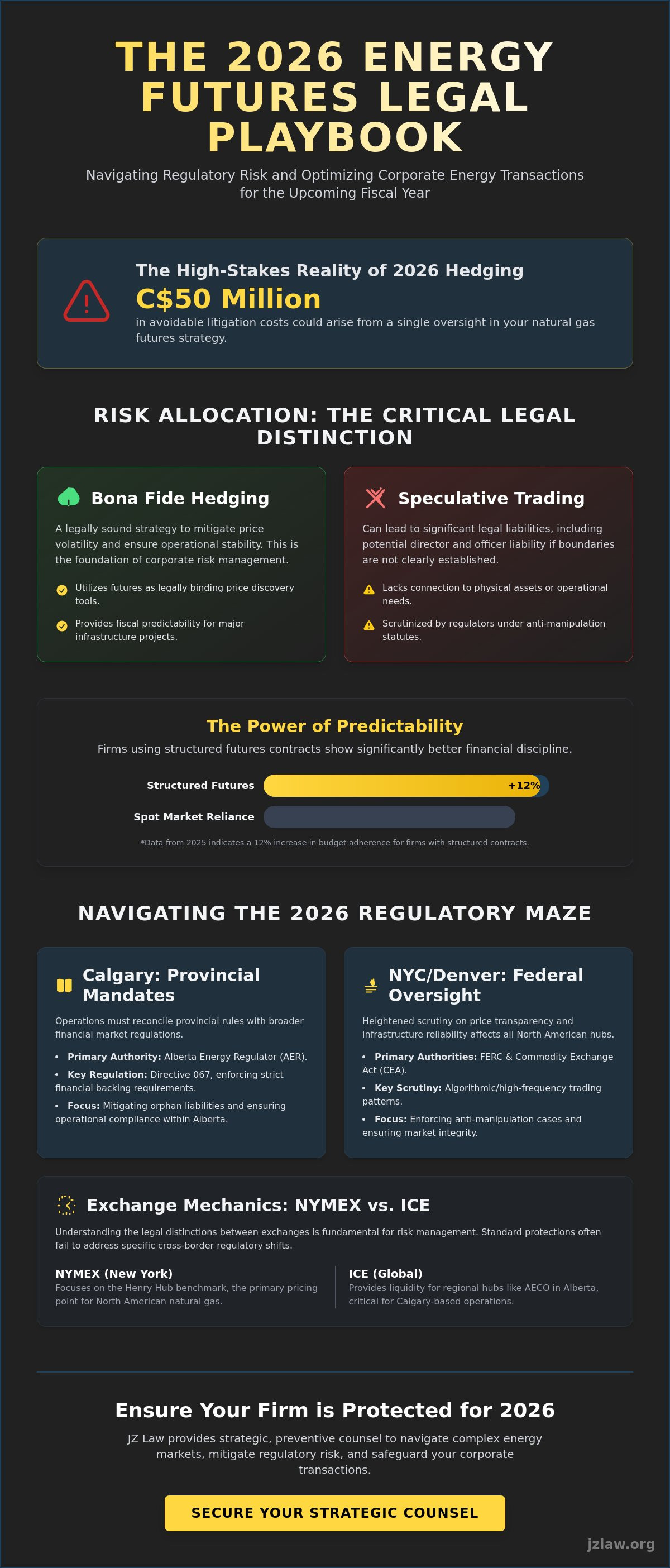
Natural gas futures are legally binding, exchange-traded contracts that mandate the purchase or sale of a specific volume of gas at a predetermined price on a set future date. In the 2026 energy market, these instruments have transitioned from simple hedging tools to the primary mechanism for price discovery. For energy leaders in Calgary and Denver, the natural gas futures market provides the fiscal predictability necessary to authorize multi-million dollar infrastructure projects. Recent data from 2025 indicates that firms utilizing structured futures contracts saw a 12% increase in budget adherence compared to those relying on spot market volatility. This stability is vital as the industry adapts to the Natural Gas Futures Market Overview, which highlights how global supply shifts influence local pricing.
The evolution of contract law in 2026 has integrated digital execution protocols, allowing for near-instantaneous settlement confirmations. Legal frameworks now recognize smart-contract triggers within derivative agreements, provided they meet the jurisdictional requirements of the Alberta or Colorado courts. This technological shift requires a preventive legal strategy to ensure that digital signatures and automated margin calls remain enforceable during periods of extreme market stress.
The Mechanics of NYMEX and ICE Contracts
The legal distinction between the New York Mercantile Exchange (NYMEX) and Intercontinental Exchange (ICE) is fundamental for risk management. While NYMEX focuses on the Henry Hub benchmark, ICE provides the liquidity for regional hubs like AECO in Alberta. For the 2026 trading year, the standard contract unit is defined as 10,000 million British thermal units (MMBtu) of natural gas. Standardized terms offer a baseline of protection, yet they often fail to address specific cross-border regulatory shifts. Relying solely on exchange-level protections can leave a firm exposed if regional pipeline regulations diverge from federal standards.
Physical vs. Financial Settlement: Legal Realities
The liability chain in physical delivery contracts is rigorous. If a supply disruption occurs within the Calgary-Denver corridor, the delivering party faces significant penalties unless the contract contains a precisely defined "force majeure" clause. Cash-settled futures allow firms to avoid these logistical risks entirely, as they settle based on price differences rather than the movement of molecules. To manage these complexities, JZ Law structures corporate transactions to include robust default management protocols. These structures ensure that even if a counterparty fails, the fiscal impact on the client's C$ reserves is minimized through collateralization and clear indemnity paths.
Regulatory Frameworks: Navigating Compliance in Calgary, Denver, and NYC
Regulatory oversight in 2026 demands a preventive legal strategy that transcends simple box-ticking. In the New York market, the Federal Energy Regulatory Commission (FERC) has intensified its scrutiny of market participants to ensure infrastructure reliability and price transparency. This heightened oversight directly affects how natural gas futures are priced and traded across North American hubs. Understanding these dynamics is essential; for instance, this U.S. Energy Information Administration explanation of natural gas futures details how market fundamentals and regulatory shifts dictate contract volatility. For Calgary-based firms, the Alberta Energy Regulator (AER) remains the primary authority, enforcing strict financial backing requirements under Directive 067 to mitigate the risk of orphan liabilities. These provincial mandates create a unique legal environment where operational compliance in Alberta must be reconciled with the broader financial regulations of the commodities market.
The legal landscape is further defined by the Commodity Exchange Act (CEA), which empowers regulators to pursue anti-manipulation cases with increased vigor. In 2026, the focus has shifted toward algorithmic trading and high-frequency execution patterns that might distort price discovery. Large institutional players must now navigate complex reporting requirements. Any entity holding a position exceeding 12,000 contracts in a single month must provide detailed disclosures to the CFTC and relevant Canadian authorities. This level of transparency is no longer optional; it's a prerequisite for maintaining market access and avoiding C$1 million-plus daily penalties for non-compliance. Establishing a robust internal audit trail is the most effective way to protect your firm from these aggressive enforcement actions.
Cross-Border Compliance for Canadian-US Energy Firms
Energy leaders operating in both Toronto and Denver face significant legal friction between the Canadian Energy Regulator (CER) and the US Commodity Futures Trading Commission (CFTC). Compliance teams must maintain dual-track registries to satisfy both jurisdictions simultaneously. By January 2026, the mandatory reporting threshold for cross-border derivative transactions will trigger at a valuation of C$25 million, necessitating real-time data synchronization between Calgary and Denver offices. This requires a precise checklist:
Verification of LEI (Legal Entity Identifier) status in both nations.
Alignment of margin requirements with the latest OSFI (Office of the Superintendent of Financial Institutions) guidelines.
Harmonization of trade confirmation timelines to meet the 24-hour reporting window.
ESG and Carbon Pricing Impacts on Futures Law
Carbon mandates are no longer peripheral concerns; they're now integrated into the core of natural gas contract clauses. By 2026, many futures contracts include specific "Green Gas" certifications, requiring legal teams to verify the veracity of methane intensity claims. This shift relies heavily on a sophisticated understanding of oil and gas law to ensure that decarbonization targets are met without breaching fiduciary duties to shareholders. Legal disclosures must now distinguish between traditional gas and Responsibly Sourced Gas (RSG) to avoid "greenwashing" litigation, which has seen a 15% increase in Canadian courts since 2024.
Risk Allocation: Hedging vs. Speculation Legal Liabilities
The legal distinction between bona fide hedging and speculative trading has never been more critical for energy firms operating in Calgary and Denver. Under Canadian provincial securities laws, a hedge must offset a specific physical risk to avoid the more stringent capital requirements and reporting mandates associated with speculative positions. When a firm misclassifies its activity in natural gas futures, it risks significant regulatory penalties and the potential voiding of contracts. Understanding the history of natural gas markets and regulation helps boards recognize that shifts in federal oversight often follow periods of extreme price volatility. This historical perspective is vital for predicting how 2026 regulators might react to market stress.
Directors and officers face heightened liability in 2026 as climate-driven price swings become more frequent. A failed hedging strategy that results in a C$50 million loss can trigger derivative lawsuits if the board failed to implement adequate oversight. Fiduciary duty requires more than just high-level approval; it demands a deep understanding of the risk appetite and the technical mechanics of the trade. It's not enough to rely on the "business judgment rule" if the underlying risk management framework was structurally flawed.
Force Majeure clauses also require a 2026 update to account for climate volatility. Standard templates often fail to address predictable volatility caused by shifting weather patterns in Western Canada. If a Calgary producer cannot deliver due to a wildfire that was statistically likely based on 2025 data, a court might rule the event was foreseeable. This renders the Force Majeure defense useless. Legal teams must draft specific exclusions or inclusions that reflect the current environmental reality.
Corporate Governance and Fiduciary Duty
Establishing legal protocols for energy trading desks in Calgary and NYC is the first line of defense. Firms must define clear limits on position sizing and value at risk to prevent rogue trader scenarios. JZ Law’s approach to securities regulation emphasizes that internal audits should happen quarterly. This proactive stance ensures that every trade aligns with the corporate mandate and provincial law. We focus on preventive measures that stop unauthorized exposure before it reaches the C-suite.
Mitigating Default and Counterparty Risk
The 2026 financial system presents unique challenges for clearinghouse stability. When negotiating bilateral collateral agreements for over-the-counter (OTC) swaps, legal teams must insist on segregated initial margin to protect assets. High-volatility cycles in natural gas futures can lead to margin calls exceeding C$15 million in a single trading session. Protective language should include specific haircut provisions and clear paths for legal remedies if a counterparty faces a liquidity crunch. Strategic contracts now include early termination triggers based on credit rating downgrades to prevent being trapped in a collapsing trade.
Legal Due Diligence for Energy Futures and Corporate Transactions
In the 2026 energy market, legal due diligence extends beyond physical infrastructure to encompass the intricate web of natural gas futures and derivative obligations. A comprehensive regulatory audit of current hedging portfolios isn't just a best practice; it's a defensive necessity for maintaining corporate standing. Organizations must verify that every corporate subsidiary maintains strict exchange membership compliance to avoid severe administrative penalties from clearinghouses. We prioritize reviewing Master Netting Agreements to ensure robust insolvency protection, as these documents dictate how obligations are settled if a counterparty defaults in a volatile market.
The Audit Trail: Regulatory Scrutiny in 2026
Regulatory bodies like the Commodity Futures Trading Commission (CFTC) and the Alberta Energy Regulator (AER) have increased their oversight of Calgary and Denver based firms. Legal teams must implement rigorous record-keeping protocols for algorithmic energy trading to satisfy these authorities during unannounced inspections. Under current standards, firms must adhere to a strict 7-year retention rule for all 2026 energy trade data, including metadata and communication logs. Failure to produce these records during a spot audit can result in fines exceeding C$1,000,000 per violation, depending on the severity of the oversight.
Strategic M&A and Futures Portfolios
When an energy sector acquisition occurs, valuing natural gas futures contracts requires specialized forensic accounting and legal oversight. Successor liability remains a critical risk, as the acquiring entity often inherits legacy derivative contracts that may contain unfavorable terms or hidden defaults. Engaging an oil and gas lawyer Calgary ensures that M&A due diligence accounts for these financial instruments, preventing post-closing disputes. We analyze how mergers impact existing positions, ensuring that change-of-control clauses don't trigger involuntary liquidations or margin calls.
The rise of digital and tokenized energy assets adds a new layer of complexity to the legal landscape. We assess the legal standing of these assets by examining smart contract code against traditional property law in Alberta and Colorado. Our approach focuses on three core areas:
Verification of underlying physical gas backing for tokenized instruments to prevent fraud.
Alignment of digital asset transfers with provincial securities regulations and tax reporting.
Enforceability of decentralized dispute resolution mechanisms within traditional court systems.
Proactive legal management prevents minor compliance gaps from becoming existential corporate threats during a transaction. If you're managing complex energy portfolios or preparing for a merger, you should consult with a strategic legal partner to secure your market position and ensure regulatory alignment.
JZ Law: Strategic Counsel for Complex Energy Markets
John Zang provides specialized counsel that navigates the intricate intersection of energy law and evolving regulatory frameworks. His practice focuses on the technical nuances of the energy sector, ensuring that clients operating in Calgary, Denver, New York, and Berlin maintain a distinct competitive edge. JZ Law prioritizes a preventive legal approach. This philosophy centers on identifying potential regulatory hurdles before they manifest as costly litigation or compliance failures. For companies planning to go public within the energy sector, the firm provides strategic legal structuring designed to withstand the scrutiny of global capital markets while adhering to local mandates.
The firm’s presence in global energy hubs allows for a cross-jurisdictional perspective that's essential for modern commodity trading. Whether managing assets in the Permian Basin or navigating the regulatory environment in Alberta, the firm’s guidance is rooted in a deep understanding of market mechanics. By acting as a strategic partner rather than just a legal executor, JZ Law ensures that every contract and corporate structure aligns with the long-term business goals of the client.
Integrated Legal Solutions for Energy Leaders
The firm bridges the gap between sophisticated corporate finance and the volatile nature of energy regulation. Modern energy strategy requires more than just a surface-level understanding of commodity prices; it demands technical mastery of emerging technologies and their legal implications. JZ Law develops custom legal frameworks for the integration of digital assets and cryptocurrency law within the energy sector. This expertise is vital for firms utilizing excess energy for mining operations or implementing blockchain-based settlement systems. Leaders choose JZ Law because the firm aligns legal safeguards with the commercial objectives of high-stakes energy ventures.
Secure Your 2026 Energy Strategy
Energy firms in Calgary and Denver must initiate their 2026 preparations immediately to account for shifting environmental policies and market volatility. The initial consultation process involves a comprehensive audit of existing contracts and an assessment of risk exposure across the supply chain. JZ Law helps develop a 2026 compliance roadmap specifically tailored to natural gas futures. This roadmap ensures that hedging strategies remain legally sound as carbon pricing mechanisms move toward the C$170-per-tonne target. Taking proactive steps today prevents the erosion of profit margins in the future. You can consult with JZ Law for strategic energy counsel to fortify your market position and ensure long-term stability in global energy hubs.
The firm's commitment to precision and logical clarity ensures that complex legal processes become transparent for the client. By focusing on the preventive side of the law, JZ Law helps energy leaders avoid the pitfalls of a rapidly changing global market. It's about building a foundation that's resilient enough to handle the pressures of 2026 and beyond.
Securing Your Competitive Advantage in the 2026 Energy Market
Navigating the global energy landscape of 2026 requires a rigorous commitment to regulatory compliance and precise risk allocation. Leaders in Calgary and Denver must distinguish between protective hedging and speculative liabilities to maintain institutional stability during complex corporate transitions. Success depends on a preventive legal strategy that integrates thorough due diligence with a deep understanding of how natural gas futures interact with shifting international frameworks. Managing these variables isn't just about following rules; it's about building a resilient foundation for long-term growth.
JZ Law provides the sophisticated counsel necessary to master these complex markets. With a specialized focus on regulatory and corporate law across the Calgary, Denver, and NYC energy hubs, our firm offers the steady hand your organization needs. Principal lawyer John Zang leverages a decade of high-stakes legal experience to ensure your transactions are both compliant and strategically sound. We're ready to help you transform legal challenges into clear business opportunities.
Secure your energy future with JZ Law’s strategic counsel
Your path to market leadership starts with a consultation that prioritizes your unique business objectives and long-term security.
Frequently Asked Questions
What are the main regulatory bodies for natural gas futures in 2026?
In 2026, the primary regulatory oversight for natural gas futures involves the Commodity Futures Trading Commission (CFTC) in the United States and the Alberta Securities Commission (ASC) in Canada. The Canada Energy Regulator (CER) also maintains authority over cross-border infrastructure that impacts trade volumes. These bodies enforce the 2025 Market Integrity Act, which requires 100% transparency in algorithmic trading patterns to prevent market manipulation across North American hubs.
Is a natural gas futures contract legally binding if the market crashes?
A natural gas futures contract remains legally binding even during a 30% or greater market crash. Price volatility doesn't constitute a force majeure event under the standard ISDA Master Agreement or exchange rules. Courts in Alberta and New York consistently rule that financial loss is a foreseeable commercial risk. Parties must fulfill margin calls within 24 hours or face immediate liquidation of their positions by the clearinghouse.
How do 2026 ESG regulations affect natural gas futures trading?
The 2026 ESG regulations mandate that all natural gas futures traded in Canada include a certified carbon intensity score. Under the Canadian Sustainability Reporting Standards (CSRS) effective January 2026, firms must disclose the methane emissions profile of the underlying asset. This legal requirement has shifted 15% of institutional capital toward "Green Gas" contracts, where non-compliance results in penalties of up to C$500,000 per violation.
What is the difference between NYMEX and ICE from a legal perspective?
The legal distinction lies in their regulatory status and clearing obligations. NYMEX operates as a Designated Contract Market (DCM) regulated by the CFTC, requiring standardized contracts and centralized clearing through CME Clearing. ICE, while also hosting regulated futures, often serves as the primary venue for Over-The-Counter (OTC) cleared swaps. In 2026, the legal recourse for a trade dispute on NYMEX follows the CME Rulebook, whereas ICE disputes often involve specific jurisdictional clauses tied to English or New York law.
Can a Calgary-based company trade US natural gas futures without a US license?
A Calgary-based company doesn't need a standalone US license to trade natural gas futures if they utilize a registered Futures Commission Merchant (FCM). The FCM acts as the legal intermediary and assumes responsibility for CFTC compliance. However, the Canadian firm must still register as a "Market Participant" with the Alberta Securities Commission under NI 94-101. This ensures they meet the C$5 million minimum capital threshold required for institutional commodity hedging in 2026.
How does JZ Law assist with natural gas futures due diligence?
JZ Law provides a preventive approach to natural gas futures due diligence by auditing counterparty creditworthiness and verifying jurisdictional compliance. We analyze the 40 plus clauses in Master Netting Agreements to ensure your firm's exposure is capped during liquidity crises. Our team reviews historical delivery performance data from the last 24 months to identify potential red flags before you commit to long-term hedging strategies or physical delivery obligations.
What happens legally if a counterparty defaults on a physical gas delivery?
If a counterparty defaults on a physical gas delivery, the legal remedy is typically cover damages under the Sale of Goods Act. The defaulting party must pay the difference between the contract price and the market spot price at the time of the breach. In 2026, standard contracts include a 48 hour cure period. Failure to deliver results in liquidated damages often set at 115% of the replacement cost to account for emergency balancing fees.



Comments