


IPO Lawyer San Francisco: Strategic Securities Counsel for 2026 Public Offerings
- jzanglaw
- Apr 28
- 12 min read
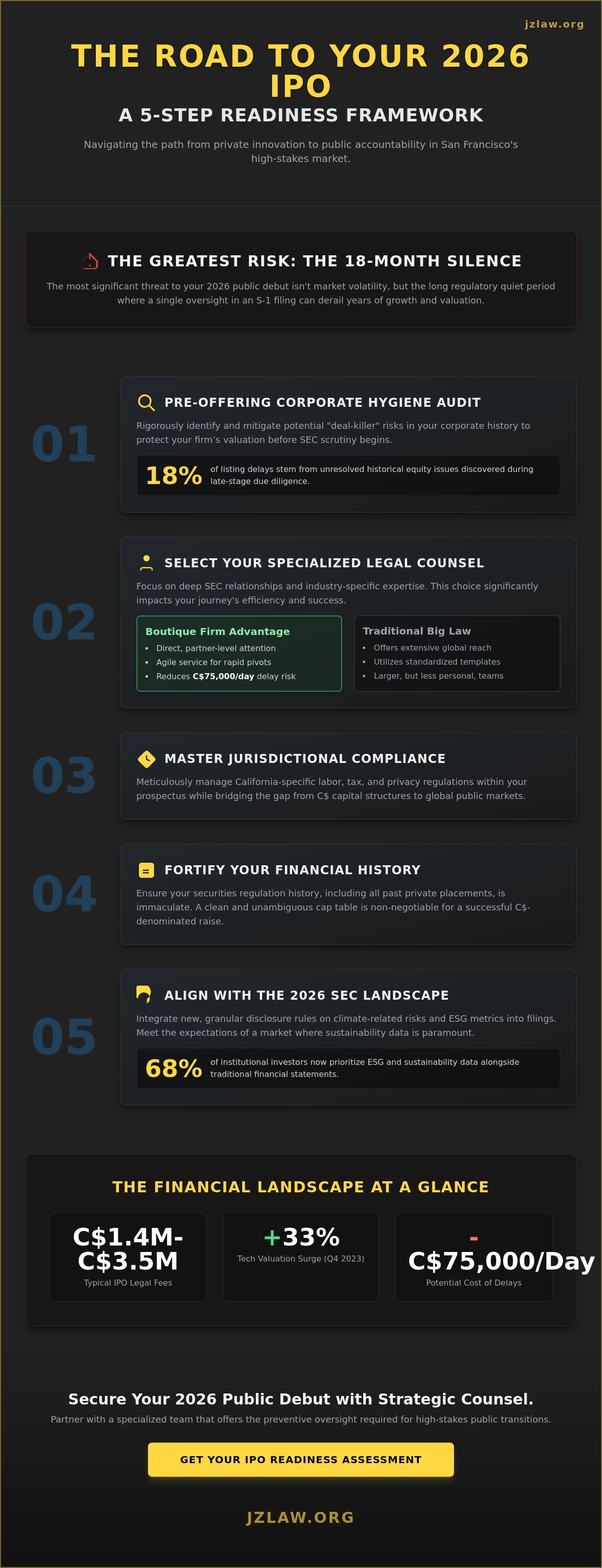
The most significant risk to your 2026 public debut isn't market volatility, but the eighteen months of regulatory silence that precede a potential SEC rejection. While the tech sector saw a 33% surge in valuation benchmarks during the final quarter of 2023, the complexity of cross border compliance means that a single oversight in an S-1 filing can derail years of growth. Partnering with a specialized ipo lawyer san francisco provides more than legal paperwork; it offers the strategic foresight necessary to bridge the gap between private innovation and public accountability. You likely recognize that the traditional Big Law model often lacks the personalized attention your specific industry nuances require, especially when managing the fiscal transition from C$ capital structures to global public markets.
We've designed this comprehensive guide to help you navigate the selection process and the intricate road to a public listing. You'll learn how to identify a partner who balances technical precision with market dynamics to minimize regulatory friction throughout the filing process. We will explore the essential criteria for legal counsel, the impact of multi jurisdictional compliance on your bottom line, and the strategic roadmap for a successful 2026 offering.
Key Takeaways
Identify and mitigate potential "deal-killer" risks through a rigorous pre-offering corporate hygiene audit designed to protect your firm’s valuation.
Evaluate the essential criteria for selecting a specialized ipo lawyer san francisco, focusing on deep SEC relationships and industry-specific expertise over general corporate counsel.
Navigate the complexities of California-specific labor, tax, and privacy regulations that must be meticulously managed within your public prospectus.
Implement a strategic 5-step readiness framework to ensure your securities regulation history is robust enough to support a successful C$-denominated capital raise.
Discover how a boutique, efficiency-driven approach to legal counsel provides the preventive oversight and strategic partnership required for high-stakes 2026 public transitions.
Table of Contents The Role of an IPO Lawyer in San Francisco’s 2026 Market Strategic IPO Readiness: A 5-Step Decision-Making Tool Evaluating IPO Attorneys: Key Selection Criteria Navigating San Francisco-Specific Legal Challenges JZ Law: Strategic IPO Counsel for Complex Sectors
The Role of an IPO Lawyer in San Francisco’s 2026 Market
Transitioning from a private entity to a public one requires more than a standard legal filing. An Initial Public Offering (IPO) is a transformative event that demands a lead counsel capable of architecting the entire corporate structure. While drafting the S-1 registration statement is a core task, a seasoned ipo lawyer san francisco acts as a strategic architect. They ensure that by early 2026, firms entering the public sphere have governance frameworks that withstand the scrutiny of institutional investors and federal regulators alike. This role involves a preventive approach; it's about identifying potential litigation triggers long before the first share is traded.
San Francisco remains the primary engine for high-growth public transitions in 2026, particularly for sectors like artificial intelligence and fintech. The local legal climate has evolved to handle the specific volatility of these industries. Founders must distinguish between general corporate counsel and specialized securities litigation experts. The former builds the foundation; the latter protects the company from the class-action risks that often follow a public debut. A specialized ipo lawyer san francisco bridges this gap, offering a comprehensive strategy that encompasses both the transaction and the long-term defense of the board.
Managing the relationship with underwriter counsel is a delicate equilibrium. While underwriters prioritize marketability and risk mitigation for the banks, the company's lawyer must protect the founder's vision and long-term equity. This involves negotiating lock-up agreements and indemnity clauses that could otherwise cost the firm millions. In 2026, legal fees for mid-market listings often range from C$1.4 million to C$3.5 million, making efficient management of these relationships essential for cost control and project timelines.
Navigating the 2026 SEC Regulatory Landscape
SEC requirements for emerging growth companies (EGCs) have shifted significantly by 2026. Disclosure rules now mandate granular data on climate-related risks and ESG metrics. For San Francisco's tech firms, this means legal teams must integrate technical audits into their securities filings. These 2026 mandates aim to provide transparency in a market where 68% of investors now prioritize sustainability data alongside traditional financial statements. Precise legal guidance ensures these disclosures don't become liabilities during the roadshow.
Boutique Strategic Counsel vs. Big Law
Choosing between a boutique firm and a Big Law department depends on the complexity of the industry. Boutique firms in San Francisco often provide direct partner-level attention that larger entities cannot guarantee. This high-touch service is vital for agile startups that require rapid pivots during the quiet period. While Big Law offers global reach, the personalized strategy of a boutique partner can reduce the risk of regulatory delays, which often cost companies up to C$75,000 per day in lost market momentum. The cost-benefit analysis favors partners who prioritize the client's specific business context over standardized legal templates.
Strategic IPO Readiness: A 5-Step Decision-Making Tool
Preparing for a public debut requires more than financial strength; it demands a rigorous internal assessment to prevent regulatory friction. An experienced ipo lawyer san francisco acts as a strategic architect during this phase, ensuring the foundation of the company is resilient enough for the scrutiny of both the SEC and the Canadian Securities Administrators. By 2026, the complexity of cross-border listings will necessitate a proactive approach to corporate hygiene, where identifying "deal-killers" early can save millions in aborted offering costs. Industry data from 2024 suggests that approximately 18% of listing delays stem from unresolved historical equity issues discovered during the eleventh hour of due diligence.
The role of securities lawyers involves a deep dive into the company's historical compliance. This includes evaluating your current securities regulation history to ensure no past private placements trigger rescission rights or administrative penalties. A clean cap table is non-negotiable. Any ambiguity in equity grants or vesting schedules often leads to litigation that can freeze a 2026 listing process indefinitely. Founders must also review the updated prospectus requirements, which now place a heavier emphasis on cybersecurity governance and climate-related risk disclosures for global hub participants.
Step 1-2: Corporate Governance and Securities Audit
The first phase involves a meticulous cleanup of board minutes and historical equity issuances before the mandatory quiet period begins. It's vital to identify "bad actor" disqualifications under Rule 506(d) or similar Canadian provincial standards that could halt an IPO. Our team ensures all prior corporate transactions, including M&A activity and debt conversions, are fully documented and compliant with current statutes. This preventive work builds the necessary trust with underwriters and regulators.
Step 3-5: Disclosure Strategy and Exchange Selection
Selecting the right exchange is a pivotal decision. While the NYSE and Nasdaq offer deep liquidity, the TSX remains a compelling option for 2026 founders due to its specialized listing requirements for the technology and resource sectors. Developing a narrative for the "Risk Factors" section of the prospectus requires a balance of transparency and strategic positioning. Finalizing the audit committee with independent directors who meet the 2026 independence standards is the final hurdle. If you're looking to solidify your governance structure, our specialized legal team provides the precision needed for a seamless transition to public life.
Evaluating IPO Attorneys: Key Selection Criteria
Selecting an ipo lawyer san francisco involves more than reviewing a firm's pedigree; it requires a cold assessment of their ability to manage the intersection of regulatory compliance and market timing. General corporate law firms often handle day-to-day contracts with excellence, but they frequently lack the specialized infrastructure to navigate the 1933 Securities Act. A dedicated IPO counsel understands the nuances of the lawyer-client relationship in IPOs, acting as a strategic bridge between the company's internal goals and the stringent demands of underwriters and federal regulators.
In the San Francisco district, proximity to SEC and FINRA regional offices provides a distinct advantage. Local counsel maintains an active dialogue with these bodies, which can expedite the review of S-1 filings. Efficiency is critical in 2026, as market windows for public debuts remain narrow and volatile. High-stakes workflows demand a legal team with the capacity to manage thousands of due diligence documents without delaying the printer's deadline. Regarding costs, firms are moving toward transparent, tiered fee structures. While initial retainers for mid-market offerings often start around C$150,000 to C$300,000, success fees tied to the final offering price ensure that legal interests align with the company's capital-raising targets.
Industry-Specific Legal Expertise
Founders in the digital asset space require specialized cryptocurrency law counsel to address the evolving SEC stance on tokenized securities. Similarly, taking your cannabis company public involves navigating a complex patchwork of cross-border regulations. A lawyer must demonstrate a proven track record in cannabis licensing and public listings to avoid 11th-hour compliance failures. This industry depth is equally vital for real estate and energy sectors, where asset valuation and environmental disclosures carry heavy legal weight.
Questions to Ask During an Initial Consultation
Before signing an engagement letter, use these targeted questions to vet your ipo lawyer san francisco:
How many S-1 or F-1 filings have you led as primary counsel in the last 24 months?
What's your specific process for resolving SEC comment letters within a 48-hour window?
How do you handle multi-jurisdictional tax structuring for public entities, particularly for Canadian firms listing on US exchanges?
Can you provide a detailed breakdown of estimated disbursements versus flat-fee legal services?
Who, specifically, will be the day-to-day lead on my filing, and what's their experience with FINRA's Corporate Financing Department?
Navigating San Francisco-Specific Legal Challenges
Success for a public offering in the Bay Area requires more than just federal compliance; it demands a deep understanding of the local regulatory ecosystem. An experienced ipo lawyer san francisco provides the complex advisory necessary to address the city's unique Gross Receipts Tax, which can significantly impact the financial projections presented in your S-1 filing. The San Francisco Regional Office of the SEC maintains a rigorous oversight posture, particularly regarding the valuation of intangible assets and R&D capitalization. Companies should anticipate detailed comment letters from this office, as their examiners possess specialized expertise in the software and life sciences sectors that dominate the local economy.
Regional investor expectations also dictate a specific governance profile. Institutional backers in Northern California often prioritize aggressive scaling over short-term profitability, yet they demand sophisticated voting structures. We ensure that your corporate charter balances these growth incentives with the protective provisions required to mitigate the high rate of securities litigation in the Northern District of California. This preventive strategy is essential for maintaining market confidence during the initial 180-day lock-up period. By aligning governance with local norms, issuers can avoid the friction that often stalls mid-market offerings.
California Regulatory Compliance
The California Consumer Privacy Act (CCPA) and its subsequent amendments represent a primary focus for the "Risk Factors" section of any modern prospectus. Issuers must demonstrate a robust data architecture that accommodates "Do Not Sell" requests and comprehensive data portability. Additionally, while certain state board diversity mandates have faced judicial scrutiny, the market reality in 2026 remains clear. Institutional investors frequently refuse to participate in offerings that fail to meet specific diversity benchmarks. Our firm assists in identifying and vetting candidates who satisfy both regulatory expectations and the strategic needs of your board.
Cross-Border Considerations for SF Tech
For San Francisco entities maintaining significant operations in Toronto or Calgary, the legal architecture becomes significantly more complex. Managing a dual-listing on the TSX and a US exchange involves reconciling disparate financial reporting standards and potentially incurring additional legal costs exceeding C$850,000 annually. The 2026 protocols under the US-Canada Income Tax Convention provide critical clarity on the withholding requirements for cross-border equity compensation, ensuring that Canadian-based talent isn't unfairly penalized by the listing process. Strategic counsel must synchronize these international requirements to prevent administrative friction. If you are preparing for a cross-border transition, consult our strategic securities team to ensure your corporate structure is optimized for both markets.
JZ Law: Strategic IPO Counsel for Complex Sectors
John Zang’s approach to securities law is defined by a commitment to precision and a preventive mindset. In the high-stakes environment of public offerings, JZ Law operates with a boutique efficiency that prioritizes direct results over billable hours. This model ensures that complex legal services remain accessible to growth-stage companies while maintaining the rigorous standards required for 2026 public listings. By focusing on the intersection of Canadian innovation and international capital markets, the firm provides a bridge for companies looking to scale beyond domestic borders.
The firm specializes in niche, highly regulated sectors where traditional legal frameworks often lag behind market realities. John Zang has extensive experience managing the unique regulatory hurdles of the cannabis industry, crypto-assets, and emerging technology. These sectors require more than just standard filings; they demand a strategic partner who understands how shifting provincial and federal barriers impact valuation and compliance. For a founder seeking an ipo lawyer san francisco, JZ Law delivers the cross-border expertise necessary to align Canadian corporate structures with the expectations of US investors and regulators.
Founder protection is a cornerstone of the firm’s strategy. During the transition from private to public status, corporate governance must be restructured to protect the visionaries who built the company. JZ Law works to secure founder equity and voting rights through meticulous drafting of articles and shareholder agreements. This ensures that the influx of capital doesn't lead to a loss of strategic control, a common pitfall in rapid public transitions.
Why Founders Choose JZ Law
Founders select JZ Law because they receive direct access to principal counsel John Zang throughout every phase of the IPO journey. Unlike larger firms where files are often handed down to junior associates, JZ Law ensures that a seasoned strategist handles the nuances of your prospectus. This hands-on approach fosters a preventive legal environment where potential SEC or CSA hurdles are identified and mitigated months before the first filing. The firm’s expertise spans both Canadian and US securities regulatory frameworks, making it a vital resource for firms targeting an ipo lawyer san francisco to facilitate a dual listing or a US-led offering. Our focus is on creating a seamless compliance path that minimizes delays and maximizes investor confidence.
Get Started with Your IPO Strategy
The path to a successful 2026 listing begins with a comprehensive audit of your current corporate health. JZ Law offers confidential strategy sessions to evaluate your public transition readiness. During these sessions, we review your current corporate structure for IPO suitability, identifying any governance gaps or capitalization table issues that could complicate a C$10 million or C$100 million raise. We don't just fill out forms; we build the legal infrastructure required for long-term market stability. Contact JZ Law today for a strategic IPO consultation to ensure your company is positioned for a successful debut on the public stage.
Securing Your 2026 Market Entry with Strategic Precision
Transitioning to a public entity in 2026 demands more than standard legal compliance; it requires a proactive strategy that anticipates shifting regulatory landscapes across North American markets. Success hinges on a rigorous 5-step readiness framework and the selection of counsel who understands the friction between innovative sectors and traditional securities law. Whether you're operating in the complex cannabis space or the evolving crypto market, your legal partner must bridge the gap between dual jurisdictions to protect shareholder value. Engaging a seasoned ipo lawyer san francisco ensures your firm manages cross-border complexities with the precision required for a high-stakes debut. JZ Law provides direct access to principal attorney John Zang, offering the sophisticated guidance necessary for companies navigating the dual demands of Canadian and American regulatory bodies. This level of personalized, strategic oversight minimizes risk while positioning your organization for long-term stability. We're ready to help you transform these legal hurdles into a competitive advantage for your upcoming offering.
Frequently Asked Questions
What is the average cost of an IPO lawyer in San Francisco in 2026?
Legal fees for a mid-sized public offering in 2026 typically range from C$1,350,000 to C$2,700,000 based on recent industry benchmarks for technology listings. These costs cover the preparation of the registration statement, corporate governance restructuring, and extensive due diligence. An ipo lawyer san francisco ensures these expenses stay within the projected budget by identifying regulatory hurdles early in the process, which prevents costly last-minute filing amendments.
How long does the IPO legal process typically take from start to finish?
The legal framework for a public offering usually requires six to nine months of active preparation before the listing date. This timeline begins with a three-month period of internal auditing and document preparation followed by several months of regulatory review by the SEC or provincial authorities. Companies often initiate their structural reorganization 12 months in advance to ensure all executive compensation plans and board structures meet 2026 compliance standards.
Can a boutique law firm handle a large-scale Nasdaq listing?
Boutique firms successfully manage large-scale Nasdaq listings by providing specialized securities expertise that matches the capabilities of larger global entities. While 70 percent of tech issuers previously gravitated toward "Big Law," many now choose specialized firms for direct access to senior partners. This focused approach is particularly effective for navigating the Nasdaq Global Select Market’s stringent liquidity requirements without the administrative delays often found in massive organizations.
What is the difference between a traditional IPO and a Direct Listing?
A traditional IPO involves the creation of new shares to raise capital, while a direct listing allows existing shareholders to sell their stakes directly to the public. In a traditional offering, underwriters guarantee the sale of shares at a specific price to institutional investors. Direct listings, used by approximately 15 percent of high-profile tech companies, skip the underwriting process and rely on market demand to set the opening price on the first day of trading.
How does an IPO lawyer help with SEC comment letters?
An ipo lawyer san francisco manages SEC comment letters by drafting technical responses that clarify the company's financial disclosures and business risks. Most issuers receive three to five rounds of comments after their initial filing. The lawyer coordinates with auditors and management to address these inquiries quickly; this ensures the registration statement reaches "effective" status without missing the company's targeted market window.
What are the most common legal mistakes companies make before going public?
The most frequent errors include failing to document historical equity grants and neglecting to secure formal intellectual property assignments from early employees. Data indicates that 40 percent of delays during the pre-filing phase stem from "broken" capitalization tables or incomplete corporate records. These oversights force companies to perform expensive corrective work just weeks before the roadshow, which can negatively impact the final valuation.
Do I need a separate lawyer for my underwriters?
You don't hire the underwriter's counsel, but the issuer is contractually required to pay their legal fees as part of the transaction expenses. The investment bank selects its own lawyers to protect its interests and verify the accuracy of the prospectus. These fees usually represent 15 to 25 percent of the total legal spend, and your own counsel will negotiate these costs to keep them within reasonable market rates.
What is a "Quiet Period" and how does my lawyer manage it?
The "Quiet Period" is a federally mandated timeframe that limits what a company can say publicly from the time it files its registration statement until 25 days after the listing. Its purpose is to prevent "gun-jumping," which is the artificial inflation of stock interest through promotional activities. Your lawyer manages this by reviewing every press release, social media post, and executive interview to ensure all communications stay within the strict boundaries of securities law.


Comments