


Alberta Shareholder Agreement: 2026 Strategic Guide
- jzanglaw
- 11 minutes ago
- 11 min read
Most Alberta entrepreneurs view their founding documents as a "set-and-forget" formality, yet failing to update a shareholder agreement alberta corporations use can become the single greatest threat to a company's 2026 valuation. You likely recognize that while your business partnership began with a shared vision, the friction of daily operations and shifting provincial regulations can quickly turn alignment into a costly deadlock. It's natural to feel uncertain about whether your current framework distinguishes correctly between provincial and federal corporate laws or if your exit strategy is truly airtight.
This strategic guide will help you master the complexities of the Alberta Business Corporations Act to protect your capital, ensure full regulatory compliance, and secure your company's future. We'll examine the latest 2026 legislative shifts, such as the removal of director residency requirements and the new two-thirds majority rules for written resolutions. By the end of this analysis, you'll have a clear roadmap for establishing robust buy-sell provisions and protecting minority shareholder rights within a modern, tax-efficient structure that respects the current 8% provincial corporate tax environment.
Table of Contents
What is a Shareholder Agreement in Alberta?
A shareholder agreement alberta businesses implement is far more than a standard legal template; it's a private, legally binding constitution that governs the internal affairs of a corporation with surgical precision. While the Alberta Business Corporations Act (ABCA) provides a default framework for corporate conduct, these general statutes are often insufficient for high-stakes ventures or complex partnerships. A Shareholders' agreement allows owners to customize their governance, defining everything from capital contribution requirements to the specific protections afforded to minority stakeholders. By establishing these rules at the outset, partners create a predictable environment that protects their individual investments and the company’s long-term stability.
ABCA vs. CBCA: Choosing the Right Jurisdiction
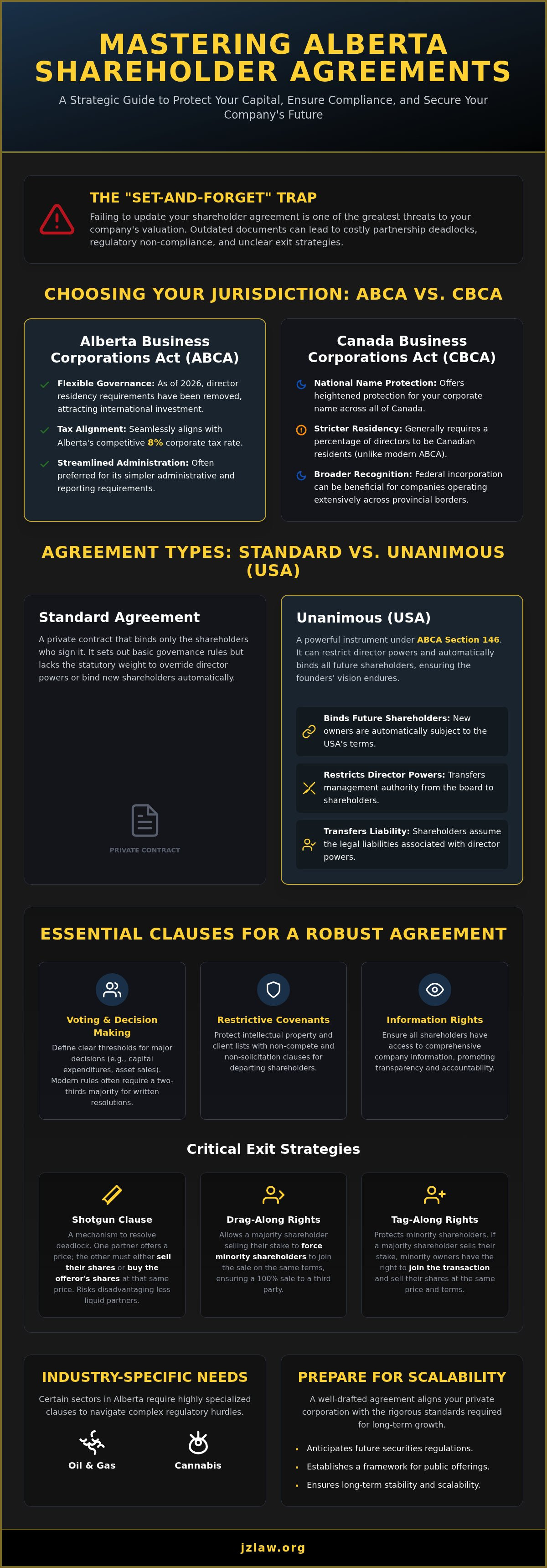
The choice between the Alberta Business Corporations Act (ABCA) and the Canada Business Corporations Act (CBCA) is a strategic decision with significant long-term implications for enforcement. As of 2026, Alberta remains one of the most flexible jurisdictions in North America, particularly after modernizing amendments removed the requirement for a specific percentage of directors to be resident Canadians. This change allows international investors to maintain tighter control over their Alberta subsidiaries without the administrative burden of sourcing local directors. While federal incorporation under the CBCA offers heightened name protection across the country, the provincial ABCA is often preferred for its streamlined administrative requirements and its seamless alignment with Alberta's competitive 8% corporate tax rate.
The Role of the Unanimous Shareholder Agreement (USA)
A Unanimous Shareholder Agreement, or USA, represents the highest level of internal corporate regulation under Section 146 of the ABCA. Unlike a standard shareholder agreement alberta law treats as a simple contract between specific parties, a USA is uniquely powerful because it can legally restrict or entirely remove the powers of directors to manage the business. This document is essential for closely-held corporations where owners wish to oversee daily operations or limit the board's decision-making authority on sensitive matters. A properly executed USA carries several distinct advantages:
Statutory Weight: It is recognized by the ABCA as a foundational document that overrides standard bylaws.
Binding Nature: It automatically binds any person who later acquires shares in the company, ensuring the original founders' vision remains intact.
Liability Transfer: When shareholders take over director powers, they also assume the associated legal liabilities, providing a clear chain of accountability.
This structural clarity is vital for preventing the ambiguity that often leads to litigation. By utilizing a USA, shareholders ensure that the "rules of the game" are fixed and enforceable against all current and future participants in the venture.
Essential Clauses for a Robust Alberta Shareholder Agreement
A robust shareholder agreement alberta corporations rely on must transcend basic templates to address the specific friction points of private ownership. Beyond administrative rules, these clauses serve as the mechanical heart of the company's governance. They ensure decision-making remains fluid even during periods of internal disagreement. Key pillars include precise voting thresholds for major capital expenditures and comprehensive information rights that ensure transparency. Additionally, restrictive covenants protect the corporation’s intellectual property and client base from departing members by enforcing non-compete and non-solicitation obligations.
The "Shotgun Clause" and Exit Strategies
The "shotgun" clause is a powerful, if blunt, instrument for resolving irreconcilable differences between shareholders. Under Alberta law, this provision allows one party to offer to buy out another at a specific price; the recipient must then either sell their shares at that price or buy out the offeror on the same terms. While this ensures a swift resolution to deadlock, it can disadvantage shareholders with lower liquidity. To mitigate this risk, many sophisticated agreements now incorporate independent valuation methods to establish a fair market value, providing a more equitable exit path that doesn't solely favor the party with deeper pockets.
Drag-Along and Tag-Along Rights
Strategic exit planning requires a balance between majority control and minority protection. Drag-along rights empower majority owners to force minority shareholders to join in a sale to a third party, ensuring that a single dissenting voice cannot block a lucrative acquisition. Conversely, tag-along rights protect minority stakeholders by allowing them to join a sale initiated by the majority, ensuring they receive the same valuation and terms. These provisions are particularly critical for firms looking to attract private equity, as they provide the structural certainty that institutional investors demand.
Tax Structuring and Shareholder Buyouts
Tax-efficient planning often determines the ultimate success of a buyout more than the purchase price itself. Professional corporate transactions often utilize life insurance policies to fund redemption agreements, providing the necessary liquidity to buy out a deceased shareholder's estate without straining the company's operating capital. Proactive tax structuring prevents unexpected capital gains liabilities by ensuring the buyout is classified as a tax-efficient share redemption or capital dividend whenever possible. Integrating these considerations early in the drafting process ensures that the transition of ownership doesn't inadvertently trigger a massive tax bill that devalues the remaining stakeholders' equity.
Standard vs. Unanimous Shareholder Agreements
Choosing between a standard contract and a Unanimous Shareholder Agreement (USA) is a pivotal decision in your firm's legal evolution. While both documents aim to regulate owner relations, their legal weight and enforcement mechanisms differ fundamentally under provincial law. A standard shareholder agreement alberta entrepreneurs often use is essentially a private contract governed by contract law. It only binds the specific individuals or entities who sign it. If a new investor joins without signing an accession agreement, they aren't automatically bound by the original terms, creating a potential gap in your governance.
A USA functions differently because it's a statutory instrument recognized under the Alberta Business Corporations Act (ABCA). It doesn't just bind the current signatories; it automatically binds any person who later acquires shares in the company, regardless of whether they've physically signed the document. This "constitutional" status makes the USA the gold standard for long-term stability. It ensures that the founding principles of the corporation remain enforceable as the cap table grows and evolves over time.
When to Use a Unanimous Shareholder Agreement
A USA is most effective for owner-operated businesses where the shareholders and directors are the same individuals. It's an ideal structure for startups where founders want to retain direct control over specific executive functions that would otherwise fall to a board of directors. Under the 2026 ABCA amendments, which allow for certain resolutions to pass with a two-thirds majority, a USA can be drafted to either reinforce or override these defaults. To be legally valid, every single shareholder must sign the document in writing, making it a true consensus-based framework for the corporation’s highest-level decisions.
Limitations and Risks of USAs
The primary risk of a USA is the mandatory transfer of liability. When shareholders use a USA to restrict director powers, they legally step into the directors' shoes. This means you assume all the fiduciary duties and personal liabilities that directors normally carry, including potential responsibility for unpaid corporate taxes or environmental obligations. Larger corporations or those with passive investors often stick to a standard shareholder agreement alberta law supports to keep these roles distinct. This separation protects passive owners from operational liabilities while still providing a contractual framework for their investment rights. Maintaining a USA also requires meticulous administrative hygiene, as any amendment must again receive unanimous approval to remain effective.
Industry-Specific Considerations for Alberta Businesses
A generic shareholder agreement alberta firms might use for a standard retail operation is often dangerously inadequate for sectors defined by heavy regulation or intense capital requirements. In Alberta’s 2026 economic landscape, the document must function as a regulatory shield as much as a governance tool. Whether you're managing the high-stakes compliance of a cannabis facility or the complex joint ventures of the energy sector, your agreement needs specialized clauses that anticipate industry-specific friction points and provincial oversight requirements.
Cannabis Licensing and Shareholder Vetting
In the cannabis sector, the corporation’s very existence depends on maintaining a valid license from the AGLC and Health Canada. A sophisticated shareholder agreement alberta cannabis firms implement must include "suitability" clauses. These provisions allow the corporation to forcibly buy back the shares of any individual who fails a security clearance or is deemed an "unsuitable person" by regulators. Without this mechanism, one shareholder's legal trouble could jeopardize the entire entity’s ability to operate. You should ensure your governance aligns with the latest standards found in our cannabis licensing guide 2026 to prevent regulatory bottlenecks during share transfers or equity raises.
Oil and Gas: Capital Calls and Governance
The energy sector requires a unique approach to liquidity and operational control. Given the capital-intensive nature of exploration and production, your agreement must clearly outline the mechanics of capital calls. These clauses dictate how and when shareholders are required to provide additional funding and the specific penalties, such as equity dilution, for those who fail to meet their obligations. Effective governance in this space also requires strict adherence to oil and gas law principles, particularly regarding the protection of proprietary energy-tech and the management of environmental liabilities. These agreements often mirror the complexity of Joint Operating Agreements (JOAs) to ensure that decision-making power remains proportional to the risks assumed by each partner.
For startups in the blockchain space, the agreement must also address FINTRAC reporting obligations and the specificities of cryptocurrency law. As digital assets become more integrated into corporate balance sheets, the way shares are valued and transferred must account for the volatility and security requirements inherent in the tech sector. This proactive approach ensures that your legal framework is resilient enough to handle the scrutiny of securities regulators as your company scales toward a potential public offering. If you're building a high-growth venture, establishing these specialized protections early is a vital strategic investment.
Drafting and Enforcing Your Agreement with JZ Law
At JZ Law, we approach corporate governance not merely as a set of restrictive rules, but as a strategic foundation for enterprise growth. A shareholder agreement alberta corporations utilize must be engineered to withstand the pressures of rapid scaling and the scrutiny of sophisticated investors. Our boutique firm specializes in high-stakes drafting where the stakes involve more than just dispute resolution; they involve the preservation of equity and the facilitation of future liquidity events. We act as a strategic partner, ensuring that every clause aligns with your long-term business objectives and the specific nuances of the Alberta Business Corporations Act.
Enforcement of these agreements in Alberta courts requires a document that is both precise and compliant with current judicial trends. While Alberta’s legal system generally upholds the freedom of contract, ambiguity in buy-sell triggers or valuation formulas can lead to protracted litigation. We focus on creating "self-executing" provisions that minimize the need for judicial intervention, providing clear paths for exit or capital injection that protect the corporation’s operational continuity. This level of detail is essential for maintaining the professional dignity of your partnership during times of transition.
Preparing for Future Securities Compliance
For high-growth ventures, the transition from a private entity to a public one begins with the initial drafting of the governance framework. We ensure your shareholder agreement alberta records are prepared with a meticulous eye toward taking companies public. This involves establishing voting structures and information rights that meet the rigorous standards of securities regulation long before an IPO is on the horizon. By integrating these standards early, we position your firm for seamless corporate transactions and M&A readiness, removing the legal bottlenecks that often stall mid-market deals.
The Importance of Periodic Reviews
The regulatory landscape of 2026 is vastly different from that of the pre-pandemic era, making the review of legacy agreements a matter of corporate survival. Recent shifts in Alberta’s tax law, including the maintenance of the competitive 8% provincial corporate rate, and modernizing amendments to the ABCA require a proactive update to your founding documents. A stagnant agreement is a liability in a shifting regulatory environment. We recommend a systematic review every twenty-four months to ensure your governance remains aligned with the latest provincial statutes and your evolving commercial interests, effectively neutralizing risks before they manifest as costly legal challenges.
Securing Your Corporate Legacy in Alberta's Evolving Economy
A sophisticated shareholder agreement alberta businesses implement today is the definitive safeguard against the operational deadlocks and regulatory shifts of tomorrow. We've explored how transitioning from standard contracts to Unanimous Shareholder Agreements provides the statutory weight necessary to protect your vision. By integrating industry-specific protections for high-stakes sectors like cannabis and energy, you ensure that your governance framework remains resilient under the scrutiny of 2026 provincial oversight. These documents aren't merely legal formalities; they're strategic assets that facilitate tax efficiency and prepare your firm for future public-market scalability.
With decades of experience in complex corporate law and specialized knowledge in the cannabis, crypto, and energy sectors, JZ Law offers the precision required for high-stakes drafting. Our approach provides comprehensive tax and securities integration, ensuring your corporate structure is both compliant and optimized for growth. Consult with JZ Law for Strategic Shareholder Agreements to fortify your partnership and secure your company's future. It's time to transform your legal framework into a proactive engine for commercial success.
Frequently Asked Questions
Is a shareholder agreement mandatory in Alberta?
A shareholder agreement is not legally required under the Alberta Business Corporations Act, but it is a fundamental necessity for any private corporation with multiple owners. Without this document, your business is governed by the default provisions of provincial law, which rarely address the specific needs of your partnership. Operating without one leaves your investment vulnerable to deadlocks and unpredictable outcomes during internal disputes.
What is the difference between a shareholder agreement and company bylaws?
Bylaws are administrative documents that outline the general rules for corporate operations, such as how meetings are called and how directors are elected. In contrast, a shareholder agreement alberta owners sign is a private contract that defines the specific rights and obligations of the shareholders. It addresses sensitive matters like share valuations, exit strategies, and restrictive covenants that are never included in public bylaws.
Can a shareholder agreement override the Alberta Business Corporations Act?
Yes, a Unanimous Shareholder Agreement can legally override many of the default rules found in the ABCA. Under Section 146 of the Act, shareholders can use a USA to restrict or entirely remove the powers of directors to manage the business. This allows for a bespoke governance structure that prioritizes the interests of the owners over the standard statutory framework, provided the agreement is in writing.
How do I remove a shareholder who is not contributing to the business?
Forcing a shareholder to exit is only possible if your shareholder agreement alberta framework contains specific "bad leaver" or performance-based buyout clauses. These provisions define the circumstances under which a shareholder must sell their equity back to the corporation or other owners. Without these clauses, you cannot legally compel a shareholder to relinquish their shares simply because they have ceased to contribute to daily operations.
Does a shareholder agreement need to be notarized in Alberta?
Notarization is not a legal requirement for a shareholder agreement to be enforceable in Alberta. The document is valid once it is signed by all parties, though having signatures witnessed is a standard professional practice. For high-stakes agreements, obtaining a certificate of independent legal advice for each shareholder is far more critical than a notary seal, as it prevents future claims that a party did not understand the contract.
What happens if we do not have a shareholder agreement and a dispute arises?
Disputes without a formal agreement often result in expensive, protracted litigation or a total corporate deadlock that can paralyze your operations. You will be forced to rely on the "oppression remedy" under the ABCA, which leaves the fate of your company in the hands of a judge. Courts may order a forced buyout or even the liquidation of the corporation if no other resolution is available.
Can a shareholder agreement be changed without everyone’s consent?
The ability to amend the agreement depends on the specific amendment clause included in the original document. Many agreements require 100% consensus for any changes, while others allow for modifications with a two-thirds or three-quarters majority. If the document is a Unanimous Shareholder Agreement, the ABCA typically requires every single shareholder to sign off on any amendments to maintain the document's special statutory status.
How does a shareholder agreement impact my personal tax situation?
The agreement dictates how share buyouts are structured, which directly influences whether the proceeds are taxed as capital gains or dividends. Proper drafting allows you to maximize the Lifetime Capital Gains Exemption or utilize corporate-funded life insurance to handle share redemptions tax-efficiently. These provisions are essential for ensuring that an exit or transition doesn't result in an unexpected and significant tax liability for the individual shareholders.


Comments