


Oil and Gas Transaction Legal Advice: 2026 Strategic Guide
- jzanglaw
- 2 days ago
- 11 min read
In the current energy climate, a competitive purchase price is merely a baseline, as the true value of an acquisition is frequently won or lost within the intricate layers of regulatory alignment and tax optimization. You understand that the complexity of today's market, where WTI crude trades near C$114.30 per barrel, requires more than just a handshake; it demands a rigorous defensive strategy against hidden liabilities. Obtaining expert oil and gas transaction legal advice has become a prerequisite for operators who intend to navigate the Alberta Energy Regulator's evolving requirements without incurring prohibitive delays.
It's clear that the pressure to balance aggressive growth with stringent methane emission mandates and inefficient cross-border structures has never been higher. This strategic guide promises to equip you with the sophisticated insights necessary to mitigate risk and safeguard your capital during asset transfers. We'll analyze the most effective methods for structuring deals to minimize tax exposure, ensure seamless regulatory approvals, and address the specific compliance hurdles that define the 2026 landscape.
Table of Contents
Navigating the Legal Complexity of Energy Transactions in 2026
The energy sector in 2026 has transitioned from a focus on pure extraction to the management of sophisticated, integrated energy portfolios. This shift requires a departure from the traditional mindset of simply "getting the oil out of the ground" toward a holistic view that incorporates carbon management, technological efficiency, and renewable offsets. When you're managing high-stakes deals, relying on standard corporate templates is a significant liability. These generic documents often fail to account for the unique subsurface risks, environmental indemnities, and complex royalty structures that define the industry. Precision in these documents isn't just about legal compliance; it's about protecting the economic viability of the asset.
Securing professional oil and gas transaction legal advice ensures that the gap between technical geological data and a finalized deal is effectively bridged. The lifecycle of these transactions, moving from the initial Memorandum of Understanding (MOU) through rigorous diligence to post-closing integration, demands a lawyer who understands the business intent as well as the statutory requirements. Without this alignment, technical findings regarding well integrity or reservoir pressure can get lost in translation during the drafting of the Purchase and Sale Agreement (PSA).
The Evolving Regulatory Landscape in Calgary and Denver
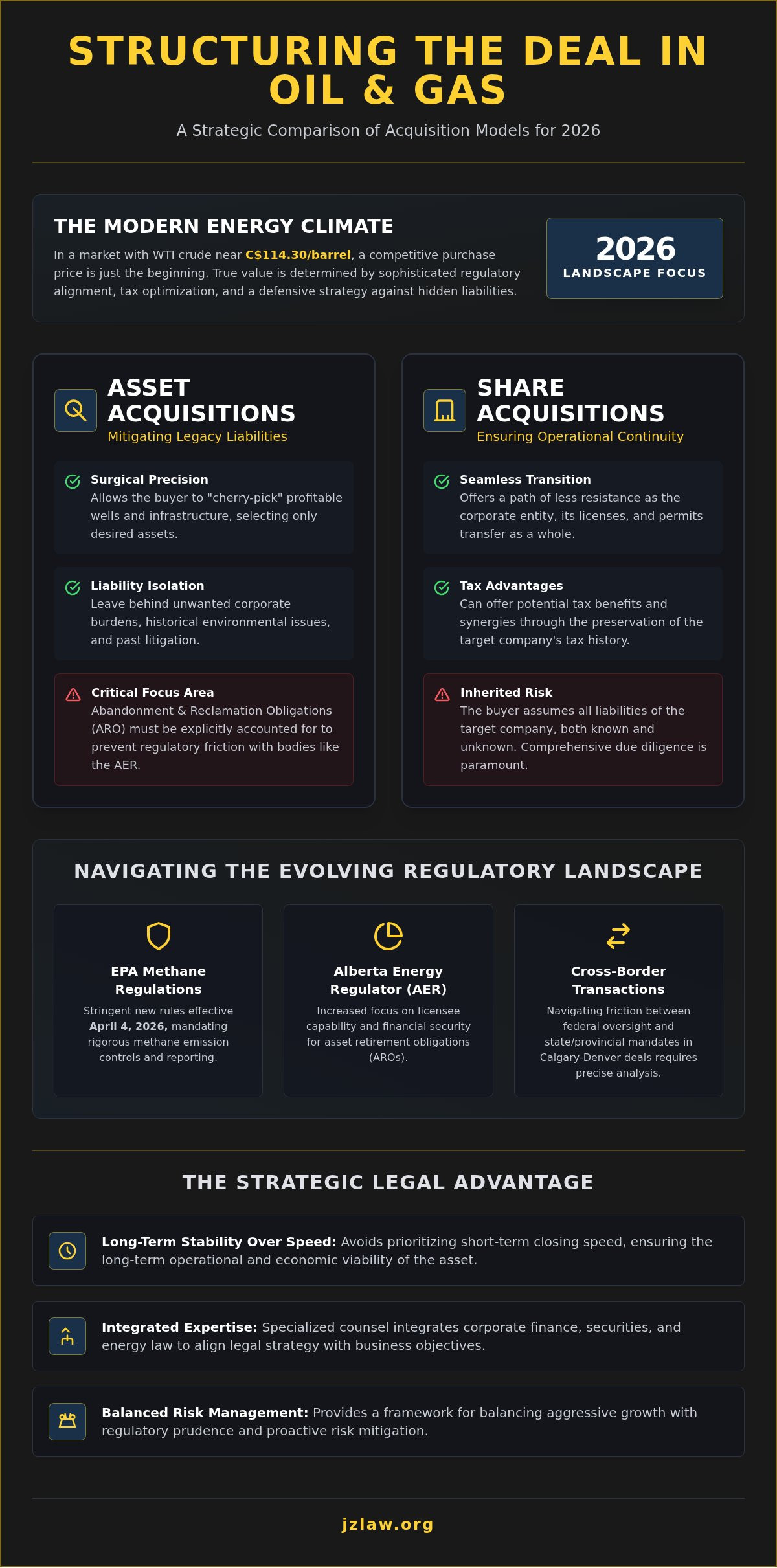
The regulatory environment in 2026 is defined by the April 4, 2026, EPA methane regulations and the Alberta Energy Regulator's (AER) increasingly stringent liability management requirements. For assets in Calgary, the AER focuses heavily on licensee capability and the financial security required for asset retirement obligations. These mandates can stall a transaction if not addressed proactively during the negotiation phase. In cross-border deals involving Denver, navigating the friction between federal oversight and state-level mandates requires precise jurisdictional analysis. You must account for these mandates during the valuation phase to avoid overpaying for assets with high latent liabilities.
Why Strategic Legal Advice Outperforms Generalist Counsel
Generalist lawyers often miss the nuances of industry-standard agreements, particularly regarding environmental "baskets" and title defect thresholds. Specialized expertise in oil and gas law allows for the identification of these pitfalls before they become deal-breakers. Strategic counsel doesn't just identify risks; it provides a framework for balancing aggressive growth with regulatory prudence. By integrating corporate finance knowledge with energy expertise, a strategic partner ensures that your oil and gas transaction legal advice serves your long-term business objectives. This approach prevents the common error of prioritizing short-term closing speed over long-term operational stability.
Structuring the Deal: Asset vs. Share Acquisitions in Oil and Gas
When seeking oil and gas transaction legal advice, the first strategic fork in the road is determining the most advantageous deal structure. This choice dictates how liabilities are partitioned, how taxes are optimized, and how efficiently operations can commence post-closing. In the Canadian energy landscape, the decision between an Asset Purchase Agreement (APA) and a Share Purchase Agreement (SPA) is never a mere administrative preference; it's a foundational risk management strategy that must align with your long-term capital objectives.
Asset Acquisitions: Mitigating Legacy Liabilities
Asset deals allow you to cherry-pick profitable wells and infrastructure while leaving behind unwanted corporate burdens. This requires surgical precision when drafting descriptions for mineral rights and surface leases to ensure no essential component is omitted. A critical focus in 2026 remains the Abandonment and Reclamation Obligations (ARO). Under AER guidelines, these liabilities don't simply vanish; they must be clearly accounted for in the contract to prevent future regulatory friction. Rigorous title and lien searches are essential, as even a minor oversight in encumbrance verification can compromise the economic viability of a multi-million C$ investment.
Share Acquisitions: Continuity and Regulatory Ease
Share sales offer a path of less resistance regarding operational continuity. Because the corporate entity remains intact, existing licenses and permits often transfer without the need for exhaustive re-application processes. This structure is frequently utilized in sophisticated corporate transactions where preserving the target's established identity and contractual relationships is paramount. However, the buyer inherits the target's entire history. This necessitates exhaustive due diligence into undisclosed corporate liabilities, pending litigation, and historical tax filings to ensure you aren't acquiring a "poison pill" alongside the production assets.
Public energy companies face an additional layer of complexity regarding securities law. Transactions involving reporting issuers must comply with stringent disclosure requirements, such as NI 51-101 in Canada, which governs the reporting of oil and gas reserves and resources. Generalist counsel often overlooks the intersection of energy regulations and securities mandates, potentially leading to costly compliance failures. Precision in these high-stakes scenarios is non-negotiable. If you're preparing for a complex acquisition, it's prudent to consult with a strategic legal partner who understands both the subsurface technicalities and the regulatory frameworks of the capital markets.
Strategic Joint Ventures: Legal Frameworks for Shared Energy Assets
In 2026, the pursuit of capital discipline has solidified Joint Ventures (JVs) as the primary vehicle for high-stakes exploration and infrastructure development. These partnerships allow operators to distribute the substantial financial burdens of modern drilling while leveraging shared technical expertise and diversified asset bases. However, the success of such ventures depends entirely on the clarity of the underlying legal framework. Expert oil and gas transaction legal advice is indispensable for ensuring that governance structures don't become an obstacle to operational efficiency. Whether you're appointing a sole operator or establishing a management committee, the allocation of authority must be precise and legally enforceable to prevent operational paralysis during critical project phases.
Drafting the Joint Operating Agreement (JOA)
The Joint Operating Agreement (JOA) serves as the constitutional document of an energy partnership. It dictates every facet of the relationship, from the initial geological assessment to final decommissioning. A well-drafted JOA must address the following critical components:
Area of Mutual Interest (AMI): Clearly defining the geographic scope prevents partners from competing for adjacent leases outside the venture, protecting the integrity of the shared investment.
Cash Calls and Funding: Establishing rigorous timelines for capital contributions ensures that the operator has the liquidity needed to maintain production schedules without interruption.
Non-Consent Penalties: These provisions protect the venture's momentum by allowing active partners to proceed with operations when one party chooses not to participate, typically involving a significant recoupment penalty from the non-consenter's share of production.
Dispute Resolution in Complex Energy Partnerships
Cross-border energy deals, particularly those involving assets in Alberta and the United States, require sophisticated dispute resolution mechanisms. Relying on standard litigation is often inefficient and risks exposing sensitive technical data to the public record. Arbitration remains the preferred method for resolving disagreements over cost overruns or technical failures. Managing deadlock situations is equally vital; without clear "buy-sell" or "shotgun" provisions, a fundamental disagreement between partners can halt production and erode the asset's value. Securing specialized oil and gas transaction legal advice early in the partnership ensures these exit strategies and intellectual property protections are in place long before a conflict arises. This foresight ensures the partnership remains a strategic asset rather than a legal liability, even when the business objectives of the partners begin to diverge.
Mitigating Risk through Comprehensive Regulatory and Tax Due Diligence
In the high-stakes Calgary-Denver corridor, due diligence has evolved from a routine checklist into a sophisticated valuation tool. To protect your capital, you must address the "Three Pillars" of energy diligence: Title, Environmental, and Regulatory. Overlooking a single encumbrance or a pending reclamation order can instantly erode the projected ROI of a multi-million C$ acquisition. Effective oil and gas transaction legal advice integrates these pillars to uncover hidden liabilities that technical teams might miss. For energy startups, this process must also ensure strict adherence to securities regulation to maintain investor confidence and avoid punitive oversight during the early stages of growth.
Environmental and Regulatory Audit
The regulatory landscape shifted significantly with the April 4, 2026, EPA methane final rule, which introduced technical changes to flaring and vent gas monitoring requirements. In Alberta, the AER's intensified focus on asset retirement obligations means that future reclamation costs must be mathematically factored into today's purchase price. You aren't just buying production; you're buying the legal obligation to remediate. Additionally, the November 10, 2026, deadline for California’s Climate Disclosure regarding Scope 1 and 2 emissions illustrates the growing pressure for transparent reporting across North American energy hubs. An audit must evaluate how these mandates and evolving carbon pricing mechanisms affect the asset's long-term economic viability.
Precision Tax Structuring for Energy Deals
Maximizing the efficiency of a transaction requires a deep understanding of cross-border tax implications and incentive programs. In Canada, utilizing flow-through shares and exploration expense deductions remains a critical strategy for enhancing liquidity. When structuring deals between Canadian and US entities, managing withholding taxes and minimizing capital gains is essential for preserving deal value. For US-based assets, the 2026 bonus depreciation rate of 60% for tangible equipment provides a significant, though tapering, advantage that must be captured in the closing documents. Sophisticated tax structuring acts as a force multiplier for your investment. It ensures that fiscal leakage doesn't undermine operational success. If your current transaction lacks this level of fiscal precision, it's time to consult with a strategic legal advisor who can harmonize your corporate goals with the latest tax codes and market conditions.
Strategic Legal Counsel for High-Stakes Energy Transactions
Securing the right oil and gas transaction legal advice is the final, most critical step in transforming a potential deal into a realized asset. In the complex market of 2026, the most successful operators are those who recognize that legal counsel must function as a strategic partner rather than a mere document processor. JZ Law provides a unified approach that integrates corporate finance, securities regulation, and technical energy law. This multidisciplinary perspective ensures that every deal structure is not only compliant with current AER and EPA mandates but is also optimized for long-term growth and capital efficiency. We don't just identify risks; we engineer solutions that align with your business objectives.
The "John Zang" approach is defined by precision, strategy, and a business-centric mindset. It's a methodology that prioritizes the economic intent of the transaction while maintaining a rigorous defensive posture against regulatory friction. By balancing the aggressive pursuit of market share with a conservative approach to liability management, we help clients navigate the volatility of global energy hubs. Whether you're managing a cross-border acquisition between Calgary and Denver or restructuring a domestic portfolio, our counsel is designed to provide the clarity and security necessary for decisive action.
From Private to Public: Scaling Your Energy Business
As energy companies mature, the transition from private ownership to a public listing becomes a viable path for accessing institutional capital. Preparing for the rigors of taking companies public requires more than just financial auditing; it demands the establishment of a robust corporate governance framework that can withstand intense scrutiny. We guide energy issuers through the complexities of continuous disclosure, investor relations, and compliance with NI 51-101 standards. This proactive preparation ensures that when the market window opens, your organization is positioned as a transparent, well-governed, and attractive investment opportunity.
Partnering with JZ Law for Your Next Deal
Our presence in major energy hubs like Calgary and Denver provides us with a unique vantage point on the regulatory and economic trends shaping the industry. Clients at JZ Law benefit from direct access to principal counsel, ensuring that high-level strategic decisions are informed by deep industry expertise and a thorough understanding of the local market conditions. We manage the intricate details of transaction planning so you can focus on operational execution. To secure your next transaction and ensure your deal structure is built for the future, visit the JZ Law Homepage to initiate a consultation. Let us provide the sophisticated legal framework your high-stakes energy assets deserve.
Securing Your Energy Legacy in a Volatile Market
Success in the 2026 energy sector requires a transition from reactive compliance to proactive strategic alignment. We've examined how precise deal structuring, combined with rigorous regulatory and tax due diligence, forms the essential foundation for any high-stakes acquisition. Navigating the Alberta Energy Regulator's evolving mandates or managing complex cross-border tax flows isn't just a legal necessity; it's a critical component of your investment's long-term ROI. Professional oil and gas transaction legal advice ensures that technical geological findings are perfectly harmonized with your business's financial objectives.
JZ Law brings decades of experience in complex regulatory sectors and maintains a strategic presence in global hubs including Calgary, Denver, and New York. Our expertise spans the entire lifecycle of an energy company, from private M&A to the sophisticated requirements of public securities. We're ready to serve as your strategic partner, providing the precision and business-centric counsel your portfolio demands. Consult with JZ Law for your next energy transaction to safeguard your capital and ensure a seamless path to closing. Your future growth depends on the legal frameworks you build today.
Frequently Asked Questions
What are the most common legal risks in oil and gas transactions?
The primary legal risks include undisclosed environmental liabilities, title defects in mineral rights, and failure to comply with evolving mandates like the 2026 methane regulations. Operators often face significant financial exposure if the purchase agreement doesn't precisely define indemnity thresholds or abandonment obligations. Strategic oil and gas transaction legal advice identifies these pitfalls early, ensuring that legacy issues from aging assets don't compromise your capital reserves or operational permits.
How does the Alberta Energy Regulator (AER) impact asset transfers?
The AER acts as a gatekeeper by evaluating the financial health and capability of the acquiring licensee under the Liability Management Framework. Asset transfers aren't automatic; they require formal approval, which often hinges on the buyer's ability to cover asset retirement obligations (ARO). If the regulator deems the transfer poses a high risk of "orphaned" wells, it may demand substantial security deposits, potentially altering the deal’s economic feasibility and closing timeline.
What is the difference between an Asset Purchase and a Share Purchase in energy?
An Asset Purchase allows a buyer to select specific wells and infrastructure while excluding unwanted corporate burdens. Conversely, a Share Purchase involves acquiring the entire corporate entity, which preserves existing permits and contracts but also transfers all historical liabilities and tax history. While asset deals offer cleaner risk partitioning, share deals often provide greater regulatory ease and continuity for established operations, requiring exhaustive due diligence to manage inherited corporate risks.
Is a Joint Operating Agreement (JOA) legally binding in cross-border deals?
Yes, a Joint Operating Agreement is a legally binding contract that remains enforceable in cross-border transactions through specific choice-of-law and dispute resolution clauses. These agreements dictate how costs and rewards are shared between partners in Calgary and Denver. To avoid jurisdictional conflicts, the JOA must explicitly state whether arbitration will occur under Canadian or US rules, ensuring the constitutional document of the partnership remains robust across diverse legal landscapes.
How can tax structuring improve the ROI of an energy transaction?
Tax structuring enhances ROI by utilizing specific incentives such as flow-through shares and Canadian Exploration Expense (CEE) deductions. By optimizing the deal to minimize capital gains and cross-border withholding taxes, operators can retain more capital for drilling and infrastructure development. Expert oil and gas transaction legal advice ensures these structures are integrated into the deal's foundation, preventing fiscal leakage and maximizing the net present value of the acquired energy assets.
What happens if environmental liabilities are discovered after a deal closes?
Post-closing environmental liabilities are governed by the indemnification provisions and survival periods established in the Purchase and Sale Agreement. If a buyer discovers soil contamination or methane leaks after closing, their ability to seek recourse depends on the contract’s specific baskets and liability caps. Without precise drafting, the buyer may be forced to absorb the full cost of reclamation and remediation required by the AER or EPA standards.
Can JZ Law assist with taking an energy company public in 2026?
JZ Law specializes in taking companies public by managing the intersection of energy law and securities regulation. We assist energy issuers in building robust corporate governance frameworks and ensuring compliance with continuous disclosure requirements like NI 51-101. Our strategic approach prepares your organization for the rigors of an IPO or a major acquisition, ensuring you're positioned as a high-value, transparent investment opportunity for institutional capital in the current market.
How long does legal due diligence typically take for an oil and gas deal?
The timeline for legal due diligence typically ranges from 30 to 90 days, depending on the volume of assets and the complexity of the target’s title history. A comprehensive audit of mineral rights, environmental permits, and regulatory compliance records requires systematic review to uncover latent risks. Rushing this process often leads to significant oversights; therefore, a methodical approach is essential to ensure every C$ invested is protected by a legally sound structure.


Comments