


Removing a Co-Founder in Toronto: 2026 Legal Guide
- jzanglaw
- 2 days ago
- 12 min read
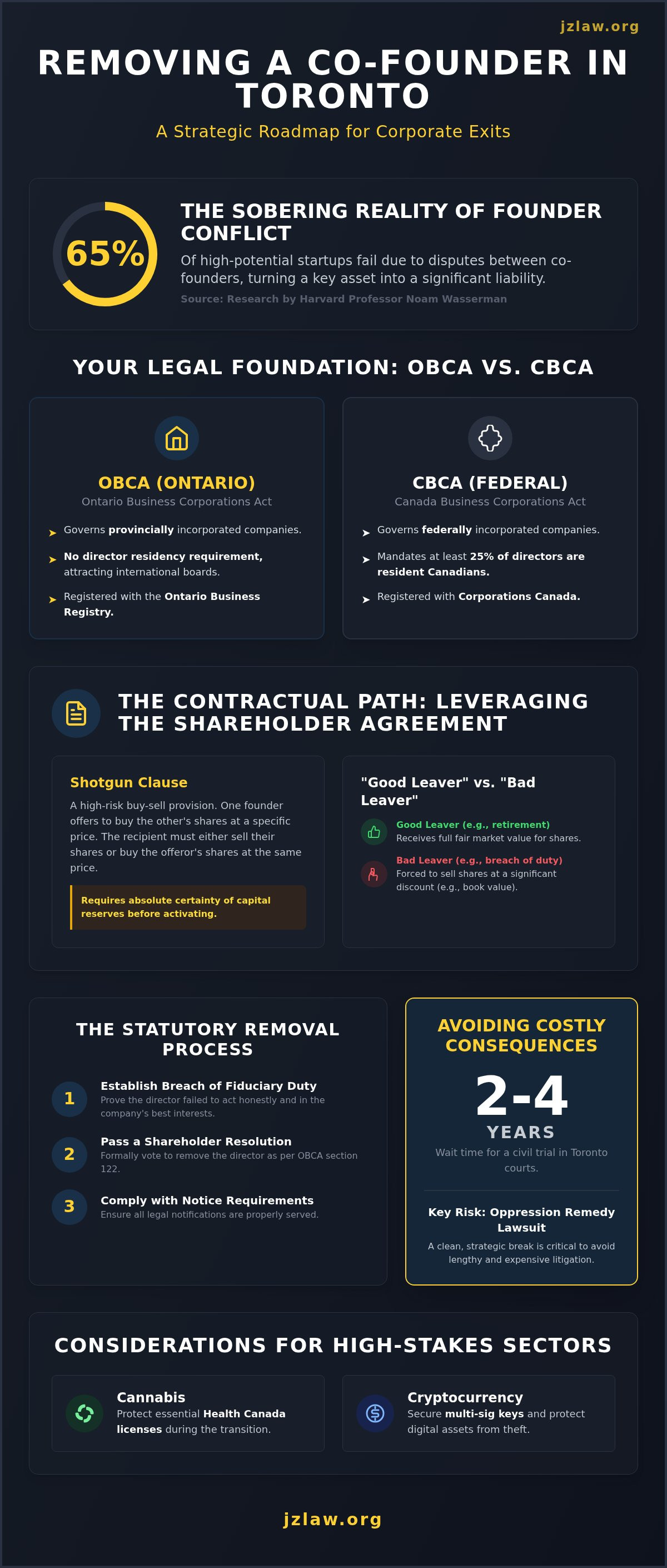
Research by Harvard professor Noam Wasserman indicates that 65% of high-potential startups fail because of co-founder conflict. It's a sobering reality for any entrepreneur who realizes their business partner has transitioned from an asset to a significant liability. When a professional relationship reaches an impasse, understanding the precise legal steps to remove a co-founder in Toronto is the only way to preserve your corporation's future and reputation.
You're likely concerned that a forced exit will trigger a costly oppression remedy lawsuit or result in the theft of your intellectual property. It's natural to feel uncertain about the validity of your Shareholder Agreement when your company's stability is at stake. This 2026 guide provides a strategic roadmap to navigate the Ontario Business Corporations Act with surgical precision. We'll explore how to achieve a clean break while securing your client lists and minimizing exposure to Toronto courts, where civil trial wait times currently range from two to four years. You'll gain the clarity needed to protect your corporate interests and maintain your strategic momentum.
Table of Contents
Understanding the Legal Framework: OBCA vs. CBCA in Toronto
The landscape of Canadian corporate law divides governance between provincial and federal statutes. If your venture is incorporated under the Ontario Business Corporations Act (OBCA), your procedural path differs significantly from those governed by the Canada Business Corporations Act (CBCA). Identifying your governing statute is the first of several legal steps to remove a co-founder in Toronto. Each framework establishes a distinct standard of care and specific shareholder rights that dictate how a removal must be executed to avoid liability. For high-stakes disputes involving significant corporate assets or regulatory licenses, the Toronto Commercial List serves as the specialized venue where judges with deep commercial expertise adjudicate these complex matters.
Under Section 248 of the OBCA, the oppression remedy is a powerful statutory tool that allows a court to intervene when corporate conduct is found to be unfairly prejudicial or shows a disregard for the interests of a shareholder, director, or officer.
Determining Your Governing Statute
You can identify your governing statute by reviewing your Articles of Incorporation; provincial companies are registered with the Ontario Business Registry, while federal ones fall under Corporations Canada. The 2026 regulatory landscape confirms that OBCA amendments removing director residency requirements remain a cornerstone of Ontario's business-friendly environment. It's a preferred choice for international boards. In contrast, the CBCA still mandates that at least 25% of directors be resident Canadians. This jurisdictional choice impacts the just cause threshold for removal, as federal corporations often face more stringent federal court precedents regarding director tenure and shareholder expectations.
Key jurisdictional markers include:
Registration with the Ontario Business Registry for provincial entities.
Filing requirements with Corporations Canada for federal entities.
Adherence to the 25% resident director rule, which applies only to CBCA corporations.
The Threshold of Fiduciary Duty
Every co-founder acting as a director owes a fiduciary duty to the corporation, requiring them to act honestly, in good faith, and with a view to the best interests of the company. A breach of this duty, such as diverting corporate opportunities or mishandling sensitive intellectual property, provides the legal basis for removal. JZ Law assesses these breaches through a strategic lens, especially in sectors like cannabis or crypto, where a co-founder's conduct might jeopardize essential regulatory licenses. We determine if the actions have fundamentally undermined the corporate purpose, creating a clear path for a removal that stands up to judicial scrutiny in Ontario. JZ Law provides the strategic counsel necessary to execute the legal steps to remove a co-founder in Toronto while protecting the firm's long-term interests. If you don't establish this breach clearly, you risk costly litigation.
The Contractual Path: Leveraging the Shareholder Agreement
While provincial statutes provide the baseline, a robust Shareholders’ Agreement (SHA) serves as the definitive tactical manual for corporate separation. When you initiate the legal steps to remove a co-founder in Toronto, the specific language within your SHA often overrides general statutory defaults. A common, albeit high-risk, mechanism is the "Shotgun Clause." This buy-sell provision allows one founder to offer a specific price for the other’s shares, forcing the recipient to either sell their stake or purchase the proposer's shares at that exact valuation. It's a blunt instrument that demands absolute certainty regarding your capital reserves before activation.
The distinction between "Good Leaver" and "Bad Leaver" provisions fundamentally dictates the financial outcome of the exit. Good leavers, typically those departing due to health issues or agreed-upon retirement, usually receive the full fair market value for their equity. Conversely, bad leavers, who are terminated for cause or breach of duty, may be contractually bound to sell their shares at a significant discount, such as book value or original cost. Understanding these Shareholder Rights under the CBCA or the OBCA equivalent is essential for protecting the corporation's treasury during a dispute.
Vesting schedules also provide a critical defense by allowing the company to reclaim unvested equity from a departing partner. Before triggering these clauses, it's prudent to conduct a Strategic Corporate Transaction review to ensure the move doesn't inadvertently trigger "change of control" defaults in your existing debt or lease agreements. If you're unsure how your current agreement aligns with 2026 standards, consulting with a specialized corporate counsel can prevent unforeseen contractual breaches.
Triggering 'Bad Leaver' Clauses
In the Toronto corporate context, "bad faith" involves more than simple personality clashes; it requires documented evidence of non-performance, fraud, or a direct conflict of interest. You must maintain a precise record of misconduct to satisfy the high evidentiary bar required by Ontario courts. We recommend engaging an independent business valuator early in the process. This proactive step establishes an objective baseline for share prices, which significantly reduces the likelihood of a successful "undervaluation" claim during subsequent litigation.
Enforcing Non-Compete and Non-Solicitation
By 2026, Ontario's legal landscape regarding non-compete clauses has become increasingly nuanced. While general employment non-competes are largely prohibited, specific exceptions remain for "fiduciary" founders and the sale of a business. Protecting your client lists and trade secrets is paramount, especially when dealing with Cryptocurrency assets or proprietary tech IP. Ensuring that multi-sig access and intellectual property assignments are fully secured before the final notice is served prevents a disgruntled founder from compromising the company’s digital infrastructure during their exit.
The Statutory Process: Removing a Director and Officer
When contractual agreements lack clarity, you must rely on the rigid statutory framework provided by Ontario law. Executing the legal steps to remove a co-founder in Toronto requires a precise sequence of corporate actions to ensure the transition remains beyond legal reproach. While a co-founder often wears multiple hats, you must address their removal as a director and their termination as an officer as two distinct legal events. Failing to maintain this separation is a common catalyst for the "dual capacity" disputes that frequently appear before the Ontario Superior Court of Justice.
The process typically follows a four-step progression:
Step 1: You must call a special meeting of shareholders. This requires providing a formal notice that explicitly states the purpose of the meeting is the removal of a specific director.
Step 2: Shareholders must pass an ordinary resolution to remove the director under OBCA s. 122. This usually requires a simple majority of 50% plus one vote, unless your Articles of Incorporation mandate a higher threshold.
Step 3: The remaining Board of Directors must convene to pass a resolution terminating the co-founder’s status as an Officer (such as President or CTO).
Step 4: You must file a Notice of Change (Form 1) with the Ontario Business Registry within 15 days. While there's no government fee for this filing, its timely submission is critical for updating the public record.
Adhering to these Corporate Governance Laws and Regulations ensures that the corporation remains compliant and avoids the procedural pitfalls that invite judicial intervention.
Procedural Fairness and Notice Requirements
Meeting notices are the most vulnerable point in the removal process. If your notice doesn't provide sufficient detail or fails to meet the statutory timeframe, the entire removal could be voided by a court. You must also respect the co-founder’s statutory right to be heard. They're entitled to attend the meeting and present a statement explaining why they shouldn't be removed. If the co-founder refuses to attend, the meeting can still proceed, provided you can prove the notice was served correctly. Precision at this stage prevents a disgruntled partner from claiming they were "blindsided," a common argument in oppression remedy claims.
Removing an Officer vs. Terminating an Employee
The "dual capacity" problem arises when a founder is both an officer and a salaried employee. While removing an officer is often an "at-will" board decision, terminating their employment triggers the complexities of the Employment Standards Act. To mitigate wrongful dismissal claims, JZ Law often recommends a strategic severance package that accounts for both statutory minimums and common law notice periods. It's often simpler to strip a co-founder of their officer title through a board resolution than it is to defend a termination for cause in a courtroom where civil trial wait times can exceed three years. We focus on a clean break that prioritizes corporate stability over emotional retribution.
Mitigating Risks in Specialized Sectors: Cannabis and Crypto
High-growth sectors like cannabis and cryptocurrency introduce layers of regulatory risk that standard corporate statutes don't address. When you initiate the legal steps to remove a co-founder in Toronto within these industries, you're managing a regulatory event as much as a corporate one. For cryptocurrency firms, the immediate priority is securing multi-sig access and private keys. If a departing founder retains sole access to cold storage or proprietary code, the corporation faces existential risk that no court order can immediately rectify. Similarly, ensuring that your tax structuring remains intact during a forced share redemption is vital to avoid triggering unintended capital gains liabilities or "change of control" tax consequences that could deplete corporate reserves.
Cannabis License Compliance (Health Canada/AGCO)
Maintaining your Cannabis License requires strict adherence to federal and provincial reporting timelines. Health Canada mandates that any "significant change" to your board or executive team must be reported within 10 days. This includes the removal of any individual who holds a security clearance. If a new director is appointed to replace the departing founder, they must undergo the rigorous security screening process immediately. Failing to update the regulator can result in license suspension or revocation, effectively halting your operations. Board-level conflict shouldn't be allowed to jeopardize your standing with the Alcohol and Gaming Commission of Ontario (AGCO), as regulatory bodies prioritize stability and compliance over internal shareholder disputes.
Securities and IPO Implications
For firms on the path to Taking it Public, a founder removal is a "material change" that necessitates immediate disclosure to investors and securities regulators. These high-stakes legal steps to remove a co-founder in Toronto can disrupt an IPO timeline if not handled with extreme discretion. You must manage investor relations carefully, as the exit of a "Key Person" often triggers clauses in investment agreements or impacts your insurance premiums. JZ Law provides the strategic counsel necessary to navigate these disclosures while maintaining the confidence of your stakeholders. If your company operates in a regulated sector and you're facing a founder dispute, contact JZ Law for a strategic consultation to protect your licenses and assets.
Strategic Resolution: Why JZ Law is Your Partner in Founder Exits
JZ Law’s methodology is built on the principle that while aggressive litigation is sometimes necessary, discrete negotiation often yields the most sustainable results. The legal steps to remove a co-founder in Toronto shouldn't inevitably lead to a public courtroom battle that damages your brand equity. We focus on structuring settlements that serve as a definitive bar to future litigation. By drafting comprehensive Mutual Release agreements, we ensure that neither "Oppression" nor "Derivative" actions can be resurrected months after the separation is finalized. John Zang’s deep experience in oil and gas law, as well as cryptocurrency regulation, allows our firm to anticipate the technical hurdles that generalist practices often overlook. Whether you are re-drafting your Real Estate holding agreements or revising your master corporate documents, we ensure your new foundation is resilient.
Negotiated Settlements vs. Court Battles
With civil trial wait times in the Ontario Superior Court currently stretching between two and four years, a negotiated settlement isn't just a preference; it's a financial necessity. JZ Law structures share buy-backs with a meticulous focus on tax structuring to maximize efficiency for the corporation. We prioritize preserving your reputation in the press, managing the narrative of the exit so that clients and competitors see a transition of strength rather than a fracture of leadership. A well-timed settlement prevents the discovery process from exposing sensitive corporate data to the public record. We act as your strategic partner to ensure the finality of the break is absolute and legally airtight. Our approach balances the need for a swift resolution with the requirement for precise, long-term protection.
Securing the Future of Your Corporation
Once the co-founder has exited, the work of stabilization begins immediately. You must update your minute book and corporate registry to reflect the new reality of your board, ensuring that no lingering authority remains with the former partner. We also revisit securities compliance for the remaining directors to ensure that no technical defaults remain from the previous regime. This is the moment to move forward with a cleaner, more focused vision for your company's growth. If you are ready to initiate the legal steps to remove a co-founder in Toronto, contact JZ Law for a confidential strategy session to discuss your specific corporate needs. We provide the clarity and expertise required to navigate these high-stakes transitions with confidence.
Securing Your Corporate Legacy and Future Growth
Navigating the removal of a business partner requires a surgical approach that balances statutory compliance with long-term strategic interests. You've seen how the distinction between provincial and federal law dictates your procedural path, while a well-drafted Shareholder Agreement provides the most efficient exit route. In 2026, the legal steps to remove a co-founder in Toronto must account for evolving regulatory landscapes in sectors like cannabis and digital assets to prevent catastrophic license suspensions or intellectual property loss. Precision at this stage is the only way to avoid the crushing delays of a multi-year oppression remedy lawsuit.
JZ Law offers a boutique focus on these complex, high-stakes transactions. Our expertise in OBCA and CBCA corporate litigation ensures that your transition is handled with the professional dignity and precision it deserves. We provide strategic counsel specifically tailored for the cannabis, crypto, and securities sectors, helping you maintain compliance while resolving internal board fractures. Schedule a confidential consultation with JZ Law to resolve your founder dispute and protect the integrity of your corporation. Taking proactive control of your board's composition is the essential first step toward a more stable and profitable future.
Frequently Asked Questions
Can I remove a co-founder if we don't have a Shareholder Agreement?
Yes, you can proceed by following the default statutory provisions of the Ontario Business Corporations Act (OBCA). Without a private contract, you must rely on calling a special meeting of shareholders to pass an ordinary resolution for removal. It's important to realize that while you can remove them as a director, forcing the sale of their ownership stake is significantly more complex without a pre-existing buy-sell agreement.
What is the difference between an ordinary and a special resolution in Ontario?
An ordinary resolution requires a simple majority of 50% plus one vote to pass at a shareholder meeting. In contrast, a special resolution mandates a two-thirds majority of at least 66.7%. Under the OBCA, removing a director typically only requires an ordinary resolution, whereas fundamental changes like amending the company's Articles of Incorporation generally require a special resolution to be valid.
Can a co-founder sue for 'Oppression' if they are voted out?
Yes, any shareholder can initiate an oppression remedy claim if they believe the removal violates their reasonable expectations or is unfairly prejudicial. Courts will examine whether the board acted in bad faith or disregarded the founder's interests. This litigation risk is why following the formal legal steps to remove a co-founder in Toronto with precise documentation is vital for your corporation's defense.
How much severance is a co-founder entitled to if they are also an employee?
Severance is governed by the Ontario Employment Standards Act and common law notice requirements. If there is no written employment contract, a founder may be entitled to "reasonable notice" based on their age, length of service, and the nature of their role. This entitlement is entirely separate from their rights as a shareholder and must be settled to avoid a wrongful dismissal claim in Toronto courts.
What happens to the co-founder’s shares after they are removed as a director?
The individual remains a shareholder even after they lose their seat on the board. Removal as a director does not automatically trigger a transfer of equity unless your Shareholder Agreement specifically includes a "forced sale" or "call" option. Without such a clause, the departing founder continues to hold their shares, retains voting rights on certain matters, and is entitled to any dividends the company declares.
Can I lock a co-founder out of the office and email server immediately?
You should avoid immediate lockouts until the formal removal process is complete. Unilateral action taken while a founder is still a director or officer can be characterized as oppressive conduct and may lead to an emergency court injunction. It's safer to wait until the shareholder resolution is passed and a formal termination notice is served before you revoke their access to corporate infrastructure and sensitive data.
How long does the legal process of removing a co-founder typically take in Toronto?
A standard statutory removal can be completed in approximately 21 to 30 days if you strictly follow the notice periods for a special meeting. However, if the co-founder contests the move or if negotiations over share value become protracted, the process can last several months. Completing the legal steps to remove a co-founder in Toronto requires patience to ensure every procedural requirement is met to prevent future litigation.
Does removing a co-founder affect our FINTRAC or Health Canada registration?
Yes, you must report changes to your board or executive team to Health Canada within 10 days for cannabis licenses. Similarly, FINTRAC requires updates regarding any individual with significant control over the corporation. Failing to disclose these changes within the mandated 15-day window for federal or provincial registries can result in significant administrative penalties or the suspension of your essential regulatory operating licenses.


Comments