


Toronto SaaS Outside General Counsel: 2026 Strategic Guide
- jzanglaw
- 3 days ago
- 12 min read
For a Toronto SaaS founder in 2026, the greatest threat to a successful exit isn't a competitor's feature set, but a "clean-up" bill from a traditional law firm that arrives just as you're trying to close a major funding round. You've likely realized that the old model of reactive, hourly billing doesn't align with the velocity required to scale a modern software company. Engaging an outside general counsel for SaaS companies Toronto offers a sophisticated alternative to the binary choice between a costly full-time executive and disjointed legal advice. It's a strategic partnership designed to integrate legal precision directly into your growth metrics, ensuring that your corporate structure is always prepared for the next stage of investment.
This guide provides a comprehensive framework for de-risking your operations and protecting your core intellectual property before high-stakes transactions arise. We'll explore how to establish predictable legal costs and build contract structures that withstand the scrutiny of global investors. By the end of this analysis, you'll understand how to navigate a Canadian tech ecosystem that has already attracted over C$32.2 billion in venture capital with the confidence that your regulatory foundations are secure. We'll detail the transition from legal as a cost center to legal as a primary driver of company valuation.
Table of Contents
The SaaS Legal Landscape in Toronto: Challenges for 2026
Within the current Toronto ecosystem, the software market has evolved into a high-stakes arena where revenue projections must be matched by legal durability. By 2026, the complexity of Canadian privacy standards and the maturation of Bill C-27 have made data-driven SaaS models a primary focus for regulators. Founders can't rely on the informal agreements that served them during the bootstrap phase. As your company approaches Series A, the gaps in your legal architecture become visible liabilities that can derail institutional investment or complicate cross-border expansions.
Regulatory Shifts in Ontario's Tech Sector
The regulatory environment in Ontario has become increasingly rigorous, particularly regarding data residency and consumer protection. SaaS platforms must now navigate a landscape where the Ontario small business tax rate was reduced to 2.2% in July 2026, yet compliance costs for data-heavy operations continue to rise. Engaging an outside general counsel for SaaS companies Toronto allows leadership to integrate these shifting standards directly into their product roadmap. A strategic advisor functions much like What is a General Counsel, ensuring that every line of code and every customer contract aligns with both federal PIPEDA requirements and evolving provincial standards. This proactive stance is essential for maintaining a competitive edge in a market where Canadian SaaS revenue is projected to grow to USD $80.9 billion by 2033.
From Seed to Scale: The Legal Growing Pains
Rapid growth often generates significant "legal debt" that remains hidden until a high-stakes transaction occurs. This debt usually includes incomplete intellectual property assignments or generic Master Service Agreements (MSAs) that fail to protect margins as you scale into the US or EU markets. Traditional law firms often lack the agility required for these transitions, frequently relying on hourly billing models that don't scale with your business needs. To manage the C$32.2 billion in venture capital currently circulating in the Canadian SaaS market, you need a partner who understands that legal precision is a valuation driver.
Transitioning from reactive fixes to a strategic corporate framework involves addressing several critical areas simultaneously:
Managing the prorated tax changes and increased small business limits effective in 2026.
Updating privacy policies to meet the enforcement standards of the Safe Social Media Act (Bill C-34) where applicable.
Structuring IP portfolios to withstand the rigorous due diligence of a potential M&A or IPO.
Developing standardized Service Level Agreements (SLAs) that balance customer expectations with operational realities.
By shifting away from the disjointed advice of traditional firms, Toronto founders can build a foundation that supports aggressive growth while minimizing the friction of regulatory compliance.
What is Outside General Counsel for SaaS Companies?
The Outside General Counsel (OGC) model represents a shift from reactive legal spending to a proactive executive partnership. Unlike traditional law firms that operate on a transactional basis, an outside general counsel for SaaS companies Toronto functions as a fractional member of your leadership team. This role provides the senior-level legal oversight typically associated with a C-suite executive but without the C$161,000 to C$261,000 annual salary burden of a full-time hire. For a scaling software company, this means having a dedicated advisor who understands your growth metrics, churn rates, and burn, ensuring that legal decisions support rather than stifle your momentum.
An OGC manages the entire legal lifecycle of the business. This includes overseeing board governance, managing capitalization tables, and negotiating complex commercial contracts with enterprise clients. By integrating into your daily operations, they identify risks before they manifest as costly litigation or failed due diligence. They act as a central point of contact, coordinating with specialized tax or patent counsel when necessary, which prevents the fragmented advice that often plagues early-stage startups.
The Strategic Advantage of Fractional Legal Leadership
The primary benefit of the fractional model is the alignment of legal strategy with specific business KPIs and fundraising milestones. A fractional general counsel acts as a legal quarterback, translating complex regulatory requirements into actionable business logic. Outside general counsel for SaaS is a sophisticated hybrid of executive-level business strategy and rigorous legal oversight designed to scale alongside your MRR. This approach ensures that as you hit your growth targets, your legal infrastructure is already prepared for the next tier of scrutiny. It's about building a "transaction-ready" company from day one, rather than scrambling to fix structural issues during a 48-hour diligence window.
JZ Law’s Approach to General Counsel Services
JZ Law delivers this fractional leadership by combining deep industry knowledge with a focus on high-stakes corporate transactions. Whether you're preparing for an IPO or navigating a merger, our involvement ensures your corporate records and contract structures are bulletproof. For fintech and blockchain-enabled platforms, we integrate specialized expertise in cryptocurrency law to address the unique regulatory hurdles of 2026. Having a principal like John Zang involved in strategic decision-making provides a level of maturity and foresight that generic legal services cannot replicate. If you're ready to move beyond reactive legal fixes, consider how a strategic legal partnership can accelerate your scaling efforts.
Comparing Legal Models: OGC vs. In-House vs. Traditional Firms
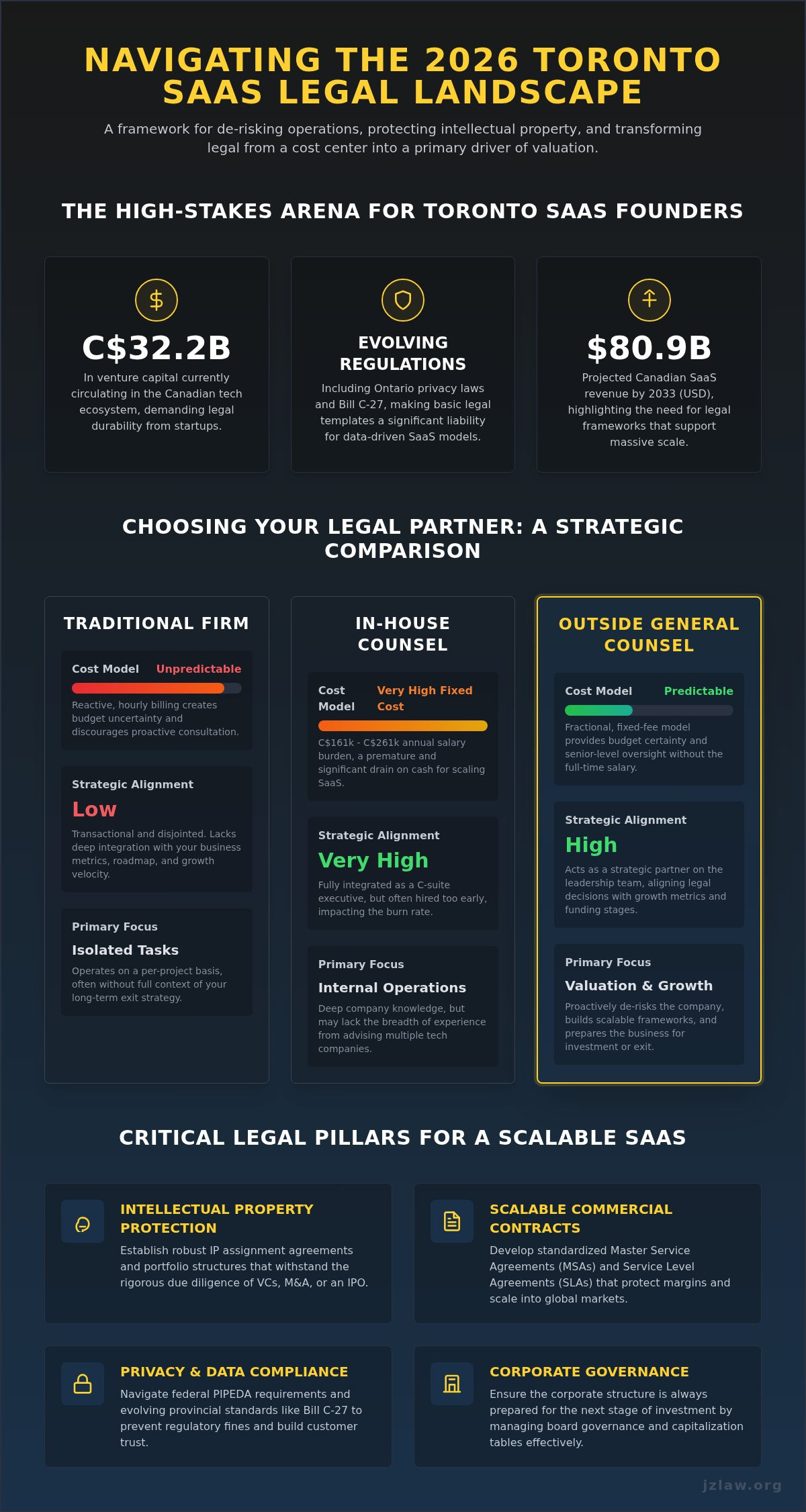
Selecting a legal framework is a critical decision that impacts a SaaS company's burn rate and long-term valuation. Toronto founders usually navigate three distinct models: traditional big-law firms, full-time in-house counsel, or the fractional outside general counsel for SaaS companies Toronto model. Each has its merits, yet for companies scaling between 20 and 150 employees, the strategic alignment often favors the fractional approach. Traditional big-law firms operate on the billable hour, a model that often stifles innovation. When every phone call or strategic inquiry carries a high hourly cost, founders tend to delay seeking advice, which inevitably leads to the accumulation of legal debt.
Committing to a full-time in-house hire is a significant financial undertaking. In 2026, the salary for a senior General Counsel in Toronto ranges from C$161,000 to over C$261,000. When you factor in bonuses, benefits, and overhead, the total compensation package can easily exceed C$350,000. For a startup focused on aggressive growth, these funds are often better allocated to engineering or sales until the legal workload consistently exceeds 40 hours per week. The OGC model provides a balanced alternative, offering the seniority of a C-suite executive with the fiscal flexibility of a monthly retainer.
Cost Predictability and Value Alignment
Budget certainty is essential for maintaining healthy SaaS growth metrics. The OGC model replaces unpredictable hourly invoices with fixed monthly retainers, often ranging from C$3,000 to C$10,000 depending on the scope of work. This transparency allows leadership to integrate legal costs into their financial modeling with precision. Relying on non-specialized lawyers for SaaS-specific issues, such as complex data residency requirements or multi-jurisdictional compliance, often results in expensive "do-over" costs when institutional investors conduct their due diligence. A specialized OGC ensures that every contract and corporate structure is built correctly the first time.
Depth of Business Integration
Unlike transactional firms that only see the business through the lens of a specific deal, an OGC maintains deep institutional knowledge of your operations. They act as the central quarterback, managing external specialists in intellectual property, tax structuring, or employment law more efficiently than a founder could. This integration significantly boosts investor confidence. During a high-stakes transaction, having a legal partner who can immediately speak to the nuances of your cap table and contract history suggests a level of operational maturity that increases your company's perceived value. It's about moving from a vendor relationship to a strategic partnership that understands both law and SaaS growth metrics.
Critical Legal Pillars for Scaling Your Toronto SaaS
Scaling a software venture requires a shift from operational hustle to structural discipline. For an outside general counsel for SaaS companies Toronto, the focus moves toward four critical pillars: intellectual property, commercial contracts, employment equity, and securities compliance. IP protection must extend beyond basic trademarks to include strategic patenting and the rigorous documentation of trade secrets. Similarly, Master Service Agreements (MSAs) and Service Level Agreements (SLAs) aren't just legal formalities; they are financial instruments that protect your margins and define your liability in a competitive market. Managing global remote teams introduces another layer of complexity, particularly regarding stock option plans and multi-jurisdictional employment laws. An OGC ensures that your equity incentives are structured to attract top talent while remaining compliant with Canadian tax laws and international regulations.
Data Privacy and Cybersecurity Compliance
By 2026, the enforcement of Bill C-27 and updated Ontario privacy standards has made "Privacy by Design" a mandatory requirement rather than a luxury. For data-driven SaaS models, this means implementing rigorous Transfer Impact Assessments for cross-border data flows and ensuring written agreements with all service providers. An OGC manages these complexities, transforming compliance into a competitive advantage when selling to enterprise clients who demand strict data residency and security protocols. Proactive risk management includes developing a comprehensive breach response plan, which is essential for maintaining trust and avoiding the significant penalties associated with modern Canadian privacy legislation. This oversight prevents the "clean-up" costs that often surface during the late stages of a deal.
Preparing for Corporate Transactions
Proactive legal hygiene is the most direct way to increase company valuation before a liquidity event. Whether your roadmap leads to a strategic acquisition or a public listing, your corporate records must be impeccable. Understanding the nuances of securities regulation is vital even for private companies, as it ensures that every fundraising round is compliant and that your cap table remains clean. JZ Law specializes in this level of sophistication, providing the expertise necessary for taking companies public and navigating complex corporate transactions. If you're planning a major exit or a Series B round, you can consult with our team to ensure your legal pillars are ready for the highest level of scrutiny.
Strategic Growth with JZ Law: Your Toronto SaaS Partner
Selecting an outside general counsel for SaaS companies Toronto is a decision that defines the maturity of your leadership team. While many founders initially gravitate toward large, multi-national firms, they often find their accounts managed by junior associates who lack the business acumen required for strategic scaling. JZ Law offers a boutique alternative where principal-led oversight is the standard. This ensures that every corporate move is filtered through a lens of high-stakes experience. John Zang’s background in securities and complex regulatory environments provides a unique blueprint for success in a software market that projected C$32.5 billion in revenue last year. We don't just process paperwork; we build the structural integrity necessary for your company to thrive in 2026's competitive landscape.
The transition from viewing legal as an overhead cost to a strategic growth partnership is fundamental for Series A and B startups. Our process begins with a rigorous legal audit and the creation of a customized roadmap. This roadmap identifies existing "legal debt" and outlines the steps needed to prepare your company for institutional scrutiny. By integrating legal precision into your daily operations, we allow you to focus on product development and market expansion while we manage the regulatory complexities beneath the surface.
A Partnership Built on Expertise
Hybrid SaaS models, specifically those that intersect with physical assets or infrastructure, benefit from our sophisticated understanding of real estate law. This cross-sector expertise is rare in the Toronto tech scene and provides a significant advantage for platforms managing digital-physical integrations. Our communication style prioritizes professional dignity and strategic clarity during board meetings, ensuring that your legal representation reflects the prestige of your brand. Founders receive direct access to principal counsel for all high-stakes decision making, which is essential when navigating the rapid growth cycles common in the Ontario tech hub.
De-Risking Your Exit Strategy
Every contract signed today must be drafted with tomorrow’s acquisition or IPO in mind. JZ Law specializes in aligning current commercial structures with future liquidity goals. This proactive approach includes managing the intricate nuances of securities regulation during aggressive growth phases. We ensure that your cap table remains clean and your intellectual property assignments are bulletproof, which directly impacts your company's valuation during due diligence. By de-risking your corporate framework now, you eliminate the friction that often stalls major transactions. Secure your company's future with JZ Law's strategic counsel.
Securing Your SaaS Legacy: The Path to Institutional Maturity
Navigating the Ontario tech ecosystem in 2026 requires a shift from operational agility to structural discipline. The maturation of Bill C-27 and the increasing complexity of cross-border data flows have made reactive legal fixes a liability for scaling startups. Engaging an outside general counsel for SaaS companies Toronto transforms legal oversight from a cost center into a primary driver of company valuation. This partnership ensures that your intellectual property, commercial contracts, and corporate governance are consistently aligned with the expectations of global institutional investors.
JZ Law provides the sophisticated, principal-led guidance necessary for high-stakes growth. Led by John Zang, our firm offers specialized expertise in taking companies public and managing complex securities regulation within the most innovative sectors. We focus on creating a bulletproof corporate framework that de-risks your exit strategy while you focus on market dominance. It's time to elevate your legal strategy to match your growth ambitions. Schedule a Strategic Consultation with JZ Law today to secure your company's future with precision and foresight.
Frequently Asked Questions
What does an outside general counsel do for a SaaS company?
An OGC manages the entire legal lifecycle of a software business, serving as a fractional C-suite executive. They oversee corporate governance, board management, and high-stakes commercial negotiations. By integrating into the leadership team, they identify regulatory risks before they impact growth metrics. This role ensures that every contract and structural decision aligns with the company's long-term exit strategy. This model provides the senior-level oversight necessary for sustainable scaling in competitive markets.
When is the right time for a Toronto SaaS startup to hire an OGC?
The optimal time to engage an outside general counsel for SaaS companies Toronto is typically when the organization scales between 20 and 150 employees. This phase usually follows a Series A round when legal complexities outpace the capacity of founders but don't yet justify a C$161,000 annual salary for a full-time hire. If your contract volume or regulatory scrutiny is increasing, a fractional model provides the necessary maturity to protect your interests.
How much does outside general counsel cost compared to a full-time hire?
Engaging an OGC is significantly more cost-effective than committing to a full-time senior legal executive in the Toronto market. While a full-time General Counsel might require a total compensation package exceeding C$350,000, an OGC typically operates on a predictable monthly retainer. This model allows startups to access senior-level strategic advice while maintaining the fiscal flexibility required to allocate capital toward engineering and sales. It eliminates the unpredictable hourly billing of traditional big-law firms.
Can an outside general counsel help with US or international expansion?
Yes, an OGC is essential for managing multi-jurisdictional compliance as a SaaS platform expands into the US or EU. They coordinate with local specialists to address specific tax, employment, and data residency requirements in new markets. This centralized oversight prevents fragmented legal advice and ensures that the core corporate structure remains compliant with both Canadian standards and international regulatory frameworks. Strategic counsel ensures that cross-border operations don't create unforeseen liabilities during future fundraising rounds.
How does JZ Law handle SaaS-specific intellectual property issues?
JZ Law prioritizes a strategic approach to intellectual property that goes beyond simple trademark registration. We focus on securing robust IP assignments from all founders and contractors while documenting trade secrets and proprietary algorithms. Our team ensures that your IP portfolio is structured to withstand the rigorous due diligence of venture capital partners, protecting the primary valuation drivers of your software platform. This proactive hygiene is vital for maintaining a clean cap table during corporate transactions.
What is the difference between a SaaS lawyer and an outside general counsel?
A SaaS lawyer typically handles transactional tasks like drafting Terms of Service or reviewing individual contracts. In contrast, an outside general counsel for SaaS companies Toronto provides holistic, executive-level leadership across all legal functions. While the former focuses on specific documents, the OGC manages board relations, securities compliance, and the overall legal roadmap. They act as a strategic partner who understands how legal decisions affect your business growth metrics and long-term valuation.
Does JZ Law assist with SaaS mergers and acquisitions (M&A) in Toronto?
JZ Law specializes in guiding companies through complex corporate transactions, including mergers and acquisitions. We manage the entire lifecycle of a deal, from initial due diligence and cap table cleanup to final negotiations. Our experience in taking companies public and handling securities regulation ensures that your SaaS startup is positioned for a high-stakes exit that maximizes value. We provide the sophisticated representation required to navigate the interests of sophisticated buyers and institutional investors.
How does an OGC help with Canadian privacy law compliance like PIPEDA?
An OGC implements "Privacy by Design" to ensure compliance with federal PIPEDA requirements and provincial standards like Ontario's evolving regulations. They manage Transfer Impact Assessments and draft written agreements with service providers to mitigate data risks. By 2026, proactive compliance has become a competitive advantage, allowing SaaS companies to satisfy the strict security demands of enterprise clients. This oversight protects your brand reputation and prevents the significant financial penalties associated with modern privacy breaches.


Comments