


Alberta Unanimous Shareholder Agreement (USA): 2026 Strategic Legal Guide
- jzanglaw
- 3 days ago
- 12 min read
Could a single shift in provincial regulation or an unforeseen internal dispute render your entire corporate governance structure obsolete? Many business owners across Alberta operate under the assumption that standard articles of incorporation provide a sufficient safety net, yet they often find themselves paralyzed by shareholder deadlock or blindsided by personal liability when interests diverge. You've invested significant capital and years of effort into your enterprise; the last thing you need is for legal ambiguity to threaten your legacy or your personal assets.
By mastering the complexities of a sophisticated alberta unanimous shareholder agreement, you can effectively redefine the boundaries of control and establish a clear, legally binding framework for every critical decision. This 2026 strategic guide provides the clarity you need to handle the latest Alberta Business Corporations Act amendments, including corporate opportunity waivers and the rigorous requirements for enforceable shotgun clauses. We will examine how to tailor these instruments for high-stakes sectors like energy, cannabis, and digital assets, ensuring your corporation remains resilient and your vision stays protected in a shifting economic climate.
Table of Contents
What is an Alberta Unanimous Shareholder Agreement? (ABCA Section 146)
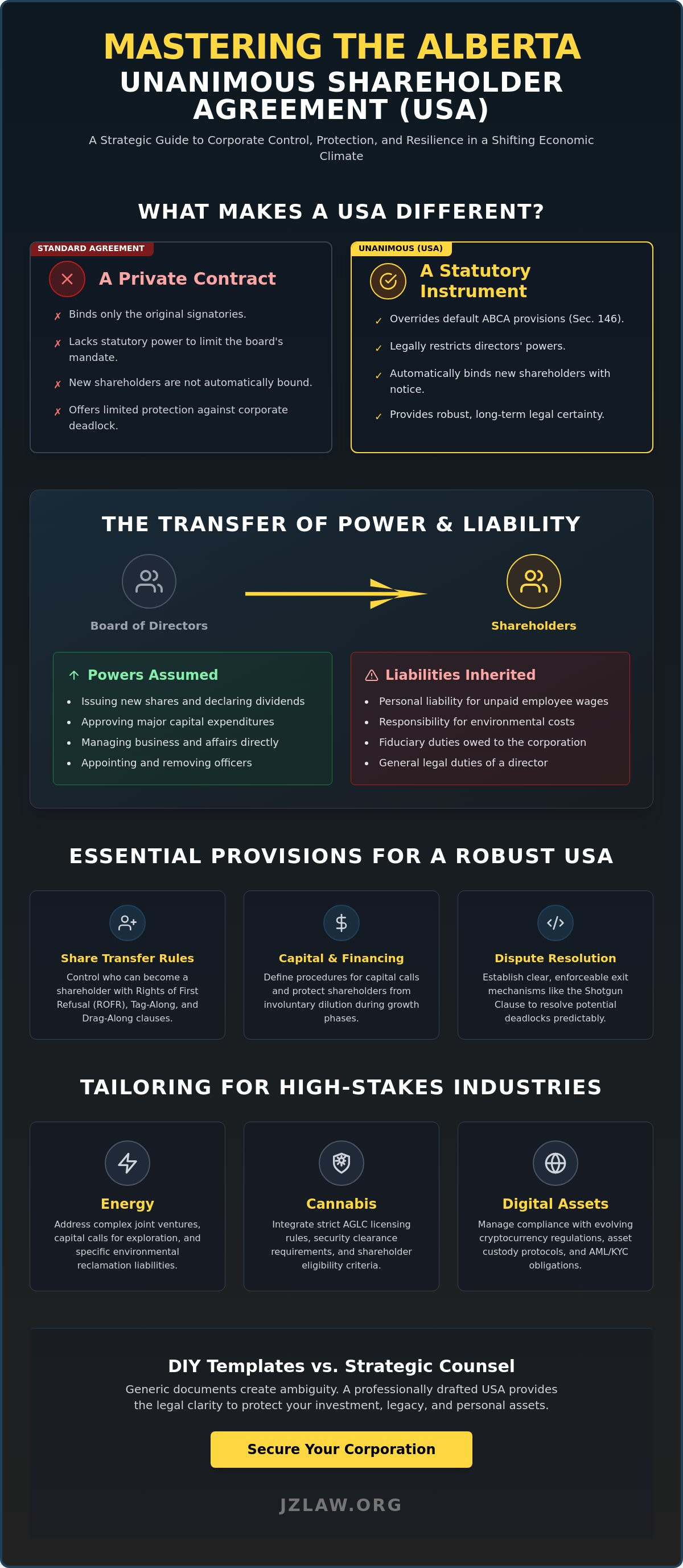
Under the Alberta Business Corporations Act (ABCA), an alberta unanimous shareholder agreement (USA) is a specialized written agreement among all shareholders of a corporation. While standard bylaws provide a general framework for corporate conduct, Section 146 of the ABCA empowers shareholders to fundamentally restructure the governance of their entity. This isn't merely a private contract; it is a statutory instrument that can restrict the powers of directors to manage, or supervise the management of, the business and affairs of the corporation. It allows for a level of customization that ensures the corporate structure reflects the actual intent of the founders rather than the default settings of provincial law.
For a document to qualify as a USA, it requires the unanimous consent of every shareholder at the time of its execution, regardless of whether their shares carry voting rights. This high threshold of agreement ensures that the fundamental rights of every participant are acknowledged before the statutory powers of the board are altered. One of the most potent features of an Alberta USA is its automatic binding nature. Under Alberta law, a person who acquires shares in a corporation that is subject to a USA is deemed to be a party to that agreement, provided they had notice of it. This creates a level of continuity and security that standard shareholder contracts simply cannot match.
The Statutory Shift of Power and Liability
Section 146 facilitates a profound transfer of authority. By implementing a USA, shareholders can strip the Board of Directors of specific powers, such as the ability to issue shares, declare dividends, or approve major capital expenditures. This move transforms the traditional corporate hierarchy, placing strategic control directly into the hands of the owners. However, this authority comes with significant professional weight. When shareholders assume director powers via a USA, they also inherit the associated legal liabilities. This means shareholders may become personally responsible for unpaid employee wages or environmental reclamation costs, as the fiduciary duties typically reserved for directors shift alongside the decision-making power. You aren't just taking control; you are stepping into the legal shoes of the fiduciaries.
USA vs. Shareholder Agreement: The Key Differences
Many founders mistake a standard shareholder agreement for a unanimous shareholder agreement, yet the legal distinction is vast. A standard agreement is a private contract that binds only the signatories; it lacks the statutory teeth required to limit the board's legal mandate. Conversely, a USA acts as a constitutional document for your Alberta corporation, overriding default ABCA provisions. While a simple voting trust or buy-sell agreement might suffice for minor administrative coordination, a USA is the superior choice when you need a robust framework to protect minority rights, define long-term vision, or manage complex exit strategies in highly regulated industries. It provides a level of certainty that survives the entry of new investors and the exit of founding members.
Essential Provisions for a Robust USA in 2026
A robust alberta unanimous shareholder agreement serves as the operational manual for your corporation. It must anticipate friction before it arises. Beyond the statutory framework, the most effective agreements in 2026 prioritize clarity in share transfer restrictions. Rights of First Refusal (ROFR) prevent unwanted third parties from entering the cap table, while Tag-Along and Drag-Along rights ensure that minority shareholders aren't left behind or, conversely, cannot block a lucrative exit. These provisions are vital for protecting the integrity of the corporate transactions pipeline and ensuring that the equity remains in the hands of those committed to the long-term vision.
Information rights also play a pivotal role in maintaining harmony. Non-managing shareholders require transparency to monitor their investment effectively. This includes guaranteed access to quarterly financial statements and details of any significant contracts. Without these explicit rights, minority partners often feel marginalized, which is a leading cause of expensive litigation. For those seeking an in-depth legal analysis of USAs, academic research highlights how these contractual safeguards prevent the erosion of trust in closely-held corporations. Integrating confidentiality and non-compete clauses further secures the company's proprietary methods and market position.
Decision-Making and Veto Rights
Governance isn't just about majority rule. You must establish specific thresholds for "Special Resolutions," such as selling the business or altering the articles of incorporation. In Alberta business hubs like Calgary or Edmonton, defining "Quorum" is essential to prevent meetings from being held in the absence of key stakeholders. For 50/50 ownership structures, we recommend pre-negotiated tie-breaking mechanisms to avoid the paralyzing deadlocks that standard bylaws fail to address. Protecting minority shareholders with veto powers over major capital expenditures ensures that the original corporate vision remains intact and that the board doesn't overextend the company's resources.
Capital Contributions and Dilution
Future growth often requires fresh capital. Your alberta unanimous shareholder agreement should clearly distinguish between mandatory and optional capital injections. If a shareholder cannot meet a capital call, the agreement must outline a fair dilution formula to reflect the new equity reality. This precision is critical for maintaining compliance with securities regulation during future public offerings. Handling "defaulting" shareholders requires a methodical approach, often involving a right for other shareholders to purchase the shortfall at a predetermined valuation. Strategic foresight in these areas minimizes risk; if you're currently reviewing your corporate structure, consulting with a specialist in corporate transactions can help ensure your provisions are both enforceable and tax-efficient.
Tailoring USAs for High-Stakes Industries: Cannabis, Crypto, and Energy
High-stakes industries in Alberta demand a level of legal precision that exceeds standard corporate templates. In sectors like cannabis, cryptocurrency, and energy, a generic alberta unanimous shareholder agreement often fails to account for the rigorous oversight of provincial and federal regulators. Bespoke drafting ensures that your corporate governance aligns with the specific mandates of the Alberta Business Corporations Act (ABCA) while shielding the entity from the actions of individual shareholders. For instance, in oil and gas law partnerships, USAs often include specialized joint venture provisions that address decommissioning and reclamation liabilities, preventing a single partner's financial distress from jeopardizing the entire project's standing.
Similarly, entities operating within the scope of cryptocurrency law must manage shareholder exits with extreme care to avoid complications with FINTRAC. If an outgoing shareholder's source of funds or transfer method triggers anti-money laundering concerns, the corporation needs pre-negotiated protocols to stall or restructure the buyout until compliance is verified. Investing in a regulatory-heavy USA might seem like a high upfront cost, but it pays for itself by preventing the catastrophic loss of an operating license or the freezing of corporate assets during a compliance audit. These agreements act as a protective barrier between the individual's regulatory profile and the company's legal existence.
Licensing and Eligibility Triggers
In the cannabis and gaming sectors, a USA must allow for the forced removal of "unsuitable" shareholders to protect the corporate license. This protection is typically achieved through mandatory share redemption clauses that trigger automatically if a shareholder fails to meet the "Fit and Proper" requirements for cannabis licensing in Alberta. While the ABCA removed Canadian residency requirements for directors in March 2021, governance structures must still account for the mandatory appointment of an Alberta-resident agent for service. These triggers ensure that a single individual's regulatory failure doesn't result in the provincial government revoking the corporation's right to operate or participate in the market.
Future-Proofing for an IPO or M&A
Preparation for a liquidity event begins years before the actual filing. A strategic USA structures share classes today to prevent legal hurdles during complex real estate law acquisitions or cross-border mergers. If your goal involves taking companies public on the TSX or NASDAQ, the agreement should include pre-negotiated "Liquidation Preferences" to satisfy early-stage investors while maintaining the flexibility required by securities regulators. Standardizing these rights early minimizes the friction often found during the due diligence phase of high-value corporate transactions, allowing for a smoother transition from a private entity to a reporting issuer.
Exit Strategies and Dispute Resolution: The Shotgun Clause Explained
A well-drafted alberta unanimous shareholder agreement serves as much as a pre-nuptial agreement as it does an operating manual. While we previously discussed governance and industry-specific triggers, the true test of a USA occurs when partners reach an irreconcilable impasse. To avoid the public and protracted nature of Alberta courts, strategic agreements prioritize private dispute resolution mechanisms like mediation and arbitration. These methods maintain corporate confidentiality while providing a structured path to either reconciliation or a clean separation, ensuring that the business remains a going concern throughout the process.
The mechanics of the Right of First Refusal (ROFR) and the Right of First Offer (ROFO) are fundamental to controlling the cap table. A ROFR allows existing shareholders to match any third-party offer, ensuring that shares don't end up in the hands of a competitor. In contrast, a ROFO requires a departing shareholder to offer their stake to internal partners before even approaching the market. Determining the price during these transfers remains a point of contention. We often see founders struggle with choosing between a fixed annual valuation, a formula based on EBITDA multiples, or a third-party independent appraisal. Each has its merits, but consistency is key to avoiding valuation disputes during a high-stress exit. If you find yourself facing an internal stalemate, you should consult with a legal strategist to evaluate which exit mechanism best protects your equity.
Managing Shareholder Deadlock
Dispute resolution triggers must be clearly defined to prevent minor disagreements from escalating into a "deadlock." A deadlock typically occurs when a 50/50 vote remains unresolved over two consecutive meetings or when a required special resolution fails to pass. While some agreements utilize a "casting vote" given to a neutral third party or the chairman, many sophisticated founders prefer the finality of an exit mechanism. Ensuring that the corporation’s day-to-day operations continue during an active dispute is paramount; your alberta unanimous shareholder agreement should include provisions that mandate business as usual until the deadlock is broken.
The Shotgun Clause: Pros and Cons
The Shotgun clause is frequently described as the "Great Equalizer" because it forces the party initiating the buyout to name a fair price. Since the receiving party can choose to either sell at that price or buy out the offeror at the same valuation, the offeror is discouraged from lowballing. However, this clause carries significant risk for shareholders with less liquidity. A wealthier partner could potentially force out a less-capitalized founder by making an offer they know the other cannot match. If you're concerned about the financial imbalance between partners, you might consider alternatives like put/call options or staged buyouts which provide more predictable outcomes for all parties involved.
DIY vs. Strategic Counsel: Evaluating the ROI of John Zang Services
The decision to rely on a generic template for an alberta unanimous shareholder agreement often carries a hidden price that only becomes apparent during a crisis. While automated platforms offer a perceived cost saving, they frequently employ imprecise language that fails to withstand the scrutiny of a litigation process. High-net-worth founders in Calgary recognize that a boutique firm provides a level of strategic depth that software can't replicate. At JZ Law, we ensure that every agreement is a reflection of your specific business objectives, integrating comprehensive tax structuring directly into the document to optimize the flow of dividends and manage future capital gains. This proactive approach transforms the USA from a reactive safety net into a proactive instrument for wealth preservation.
When you engage in high-risk corporate transactions, the quality of your shareholder agreement determines the extent of your personal exposure. We focus on mitigating director liability by clearly defining the boundaries of authority and indemnity. This level of precision is essential for founders who manage complex portfolios and can't afford the legal or financial fallout of an inadequately defined governance structure. By choosing bespoke counsel, you're investing in a structure that anticipates conflict and provides a clear, pre-negotiated path to resolution.
Risk Mitigation and Asset Protection
A truly strategic USA must be resilient enough to survive the most challenging corporate environments, including insolvency or shareholder bankruptcy. We design these frameworks to ensure that the corporation's intellectual property remains protected and that the "Corporate Veil" provided by the ABCA remains impenetrable. By codifying these protections within the alberta unanimous shareholder agreement, we safeguard the entity against the individual financial failures of its members. This ensures that the corporate vision survives even when individual stakeholders face external legal pressures or personal financial distress.
Strategic Partnership for Growth
Beyond serving as a defensive document, a well-structured USA sets the stage for your first major financing round. Investors look for clarity and stability; a professionally drafted agreement signals that the founders have considered every contingency. Working with a Calgary-based lawyer provides the added benefit of local market intelligence, particularly regarding the Alberta Energy Regulator (AER) and the specific nuances of our provincial economy. It's about more than just compliance. It's about building a foundation for scalable success. If you're ready to secure your corporate future, consult with JZ Law for a strategic Alberta Unanimous Shareholder Agreement.
Securing Your Corporate Legacy in Alberta's Evolving Economy
Establishing a robust alberta unanimous shareholder agreement is a fundamental step toward long-term corporate stability and professional peace of mind. These instruments allow you to transcend default provincial regulations, providing a tailored framework for governance and high-stakes exit strategies. By anticipating the unique regulatory requirements of the cannabis, cryptocurrency, and energy sectors, you ensure your business remains resilient against internal deadlock and rigorous compliance audits. The shift of liability and the precision of tax structuring shouldn't be left to chance or generic templates.
At JZ Law, our Calgary-based boutique practice, led by principal John Zang, specializes in navigating these intricate legal landscapes. We provide the specialized expertise needed to protect your personal assets while maintaining the integrity of your corporate vision. We don't just draft documents; we build strategic partnerships that facilitate growth and mitigate risk. If you're ready to secure a framework built for scalable success, Protect Your Corporate Future with JZ Law. Your commitment to legal clarity today provides the essential foundation for your organization's success tomorrow.
Frequently Asked Questions
What is the difference between a USA and a regular shareholder agreement?
A USA is a statutory instrument defined under Section 146 of the ABCA that has the power to restrict director authority, whereas a regular shareholder agreement is merely a private contract. While a standard agreement only binds those who sign it, a USA is a foundational governance document that carries statutory weight and can fundamentally reassign the board's legal mandate to the shareholders.
Is a Unanimous Shareholder Agreement mandatory for Alberta corporations?
No, an alberta unanimous shareholder agreement isn't a mandatory requirement for incorporation under provincial law. Most sophisticated founders choose to implement one because the default provisions of the ABCA are often too general to protect minority rights or manage the specific complexities of high-growth industries like energy or tech. It's a strategic choice for stability, not a legal filing requirement.
Does a USA automatically bind future shareholders who purchase shares?
Yes, one of the most significant features of an Alberta USA is that it automatically binds any person who acquires shares in the corporation. As long as the purchaser has notice of the agreement’s existence, they're deemed a party to it. This ensures that the original founders’ vision and governance rules remain intact even as the cap table evolves through new investment rounds.
Can a USA remove all powers from the Board of Directors in Alberta?
Yes, Section 146 specifically allows a USA to restrict or entirely remove the powers of the Board of Directors to manage or supervise the corporation. It's important to remember that if shareholders take over these powers, they also assume the associated legal liabilities. You're effectively stepping into the directors' shoes, inheriting both their decision-making authority and their fiduciary responsibilities under the law.
How does a "Shotgun Clause" work in an Alberta USA?
A Shotgun Clause is a high-stakes exit mechanism where one shareholder offers to buy out another at a specific price per share. The shareholder who receives the offer must then choose to either sell their shares at that price or buy out the offering shareholder’s stake at that same valuation. This structure forces the person initiating the buyout to name a fair price, as they don't know whether they'll end up as the buyer or the seller.
What happens if a shareholder refuses to sign a USA?
If a single shareholder refuses to sign, the document cannot qualify as a "unanimous" agreement under the ABCA. Without every signature, the agreement fails to achieve statutory status, meaning it won't automatically bind future shareholders or have the power to strip the board of its legal authority. It may still be enforceable as a private contract among those who did sign, but it loses its constitutional weight.
How much does it cost to have a lawyer draft a USA in Calgary in 2026?
The cost to draft an alberta unanimous shareholder agreement in Calgary depends on the complexity of your corporate transactions and the regulatory requirements of your industry. A bespoke agreement for a cannabis or crypto entity requires significantly more strategic analysis and custom drafting than a simple holding company. You should prioritize the return on investment that comes from preventing future litigation rather than seeking the lowest possible fee.
Are shareholder agreements tax-deductible for Alberta businesses?
Legal fees for drafting foundational corporate documents are generally treated as capital expenditures rather than current business expenses under Canadian tax law. While these costs typically aren't fully deductible in the year they're incurred, they can often be amortized or added to the adjusted cost base of the shares. You should consult with a tax professional to determine the specific treatment based on your corporation’s financial structure.


Comments