


Legal Requirements for Selling a Business in Alberta: A Strategic 2026 Guide
- jzanglaw
- 5 minutes ago
- 13 min read
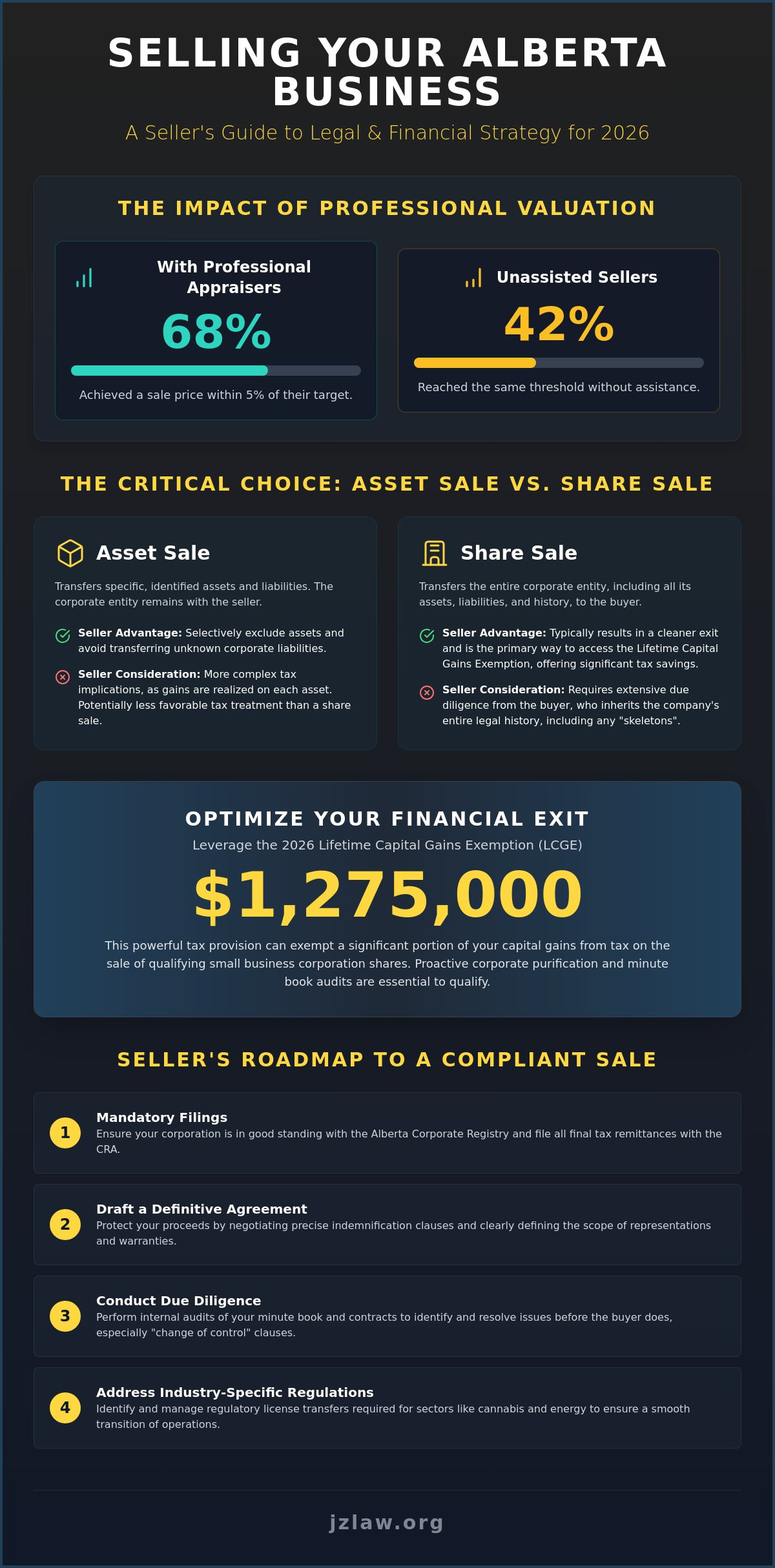
According to research from the Canadian Institute of Chartered Business Valuators, 68% of businesses that engaged professional appraisers achieved a sale price within 5% of their target, whereas only 42% of unassisted sellers reached that same threshold. This disparity highlights a fundamental truth in the current market: a successful exit is never the result of chance, but rather the product of meticulous regulatory alignment and strategic preparation. It's understandable that you might feel a sense of apprehension regarding the intricate legal requirements for selling a business in alberta, especially when faced with the dual pressures of maximizing your proceeds and eliminating residual liabilities.
This article provides the clarity and technical precision necessary to manage the complex contractual and tax landscapes of 2026 with absolute confidence. We'll show you how to structure your transaction to secure a clean exit while ensuring your business remains fully compliant with both provincial and federal statutes. Our analysis explores the critical distinction between asset and share sales, the optimization of the $1,275,000 Lifetime Capital Gains Exemption, and the specific due diligence protocols that protect your interests long after the final signatures are dry.
Table of Contents
Legal Structures of a Business Sale: Asset vs. Share Transactions
Regulatory and Tax Obligations: CRA and Alberta Provincial Compliance
Strategic Preparation: Due Diligence and Tax Structuring for Sellers
Drafting the Definitive Agreement: Key Legal Provisions and Protections
Industry-Specific Requirements: Cannabis, Energy, and Regulatory Transfers
Legal Structures of a Business Sale: Asset vs. Share Transactions
Selecting the appropriate transactional vehicle is the most consequential decision a vendor makes. This choice defines the distribution of risk and determines the finality of the exit. Complying with the legal requirements for selling a business in alberta involves a choice between two primary pathways: the Asset Purchase Agreement (APA) or the Share Purchase Agreement (SPA). Each structure carries distinct implications for liability and tax treatment under the 2026 regulatory framework. While an asset sale allows for a "cherry-picking" approach to corporate property, a share sale involves the transfer of the corporation's entire history. The Alberta Business Corporations Act (ABCA) governs these transfers, providing the statutory rules for director approvals and shareholder resolutions that must be documented in your corporate minute book to ensure a valid transition.
The strategic distinction between Asset vs. Share Transactions often centers on the concept of "successor liability." In a share sale, the buyer inherits the corporation's legal persona, including potential "skeletons" like past environmental infractions or pending litigation. Consequently, buyers often prefer asset sales to shield themselves from historical risks. For the seller, however, a share sale is typically the superior route. It not only facilitates a cleaner break from the business but also aligns with 2026 tax strategies by potentially qualifying the transaction for the Lifetime Capital Gains Exemption.
The Asset Purchase Agreement (APA) Framework
An APA focuses on the transfer of specific, identified items. These include tangible property like equipment and real estate, alongside intangible assets such as trademarks and customer lists. You can deliberately designate "excluded assets," such as personal vehicles or specific investment accounts, to remain in your possession post-closing. However, you must be cautious of successor liability under Alberta law. The Alberta Employment Standards Code and specific provincial tax statutes can sometimes hold an asset purchaser liable for the seller's unpaid wages or certain tax arrears if the transaction isn't structured with protective indemnities. Precision in drafting these schedules is vital to avoid post-sale disputes over what exactly was included in the purchase price.
Share Purchase Agreement (SPA) Nuances
A Share Purchase Agreement is the legal mechanism that transfers the entire corporate persona, encompassing all historical liabilities and operational assets, from the seller to the purchaser. This structure ensures high business continuity since the corporation remains the contracting party for all existing relationships. You must, however, conduct a rigorous review of "change of control" clauses in your commercial leases and service contracts. Many Alberta-based agreements require the landlord's or vendor's prior consent before a share transfer can proceed. Failing to secure these consents is a common hurdle that can delay or even derail the closing of a transaction. Because the buyer takes on the entity's full history, expect the due diligence process for an SPA to be significantly more intrusive than for an asset sale.
Regulatory and Tax Obligations: CRA and Alberta Provincial Compliance
To satisfy the legal requirements for selling a business in alberta, a vendor must look beyond the private agreement and address the mandatory obligations owed to the Crown. Before the transaction can even reach the closing table, the purchaser will typically demand a Certificate of Status from the Corporate Registry. This document serves as definitive proof that your corporation is in good standing and hasn't been struck for failing to file annual returns. Maintaining this status is a non-negotiable prerequisite for any legitimate transfer of ownership. Post-closing, the administrative burden shifts to ensuring the public record reflects the new reality of the business, protecting you from future liabilities associated with the entity's operations.
CRA Compliance and Account De-registration
Managing Federal tax accounts requires strict adherence to specific timelines. Final payroll remittances must be submitted within seven days of the business's final day of operation, and T4 or T4A slips are generally due within 30 days of the account's closure. For many vendors, the GST/HST election under Section 167 of the Excise Tax Act is a vital tool. This election allows the sale to proceed as a "going concern" without the immediate cash-flow burden of charging and remitting tax on the sale price. In 2026, the CRA has increased its scrutiny of significant ownership changes, requiring more detailed reporting on the beneficial ownership of the corporation during the final tax year. Failing to reconcile these accounts can leave a trail of personal liability for directors that persists long after the sale is finalized.
Alberta Corporate Registry and CORES Requirements
Alberta's provincial requirements are managed through the Corporate Registry, usually via a CORES service provider. It's critical to file a "Notice of Change of Directors" and a "Notice of Change of Address" immediately after the sale is executed. These filings aren't mere formalities; they're the legal trigger that removes your name from the public record of responsibility. If you're undertaking an asset sale, the Guide to Asset Transactions emphasizes that the vendor corporation remains responsible for its filings until it's formally dissolved or redirected. During the negotiation phase, you must keep the corporation's registered office active in Alberta to receive legal service. Neglecting these provincial filings can result in administrative dissolution, which complicates the transfer of assets and can potentially trigger breach of contract claims from the purchaser.
Efficiently managing these regulatory hurdles ensures that your exit remains clean and your financial exposure is minimized. Engaging a partner for Corporate Transactions and tax structuring can prevent the administrative oversights that often lead to post-sale litigation. Taking a proactive approach to these filings is the only way to ensure the transition is legally airtight.
Strategic Preparation: Due Diligence and Tax Structuring for Sellers
Strategic preparation is the bridge between a valuation and a successful closing. While many vendors view due diligence as a buyer-led process, sophisticated sellers engage in "reverse due diligence" to identify and remediate vulnerabilities before they reach the negotiating table. This involves a rigorous audit of corporate minute books, share registries, and material contracts to ensure that all legal requirements for selling a business in alberta are met without last-minute complications. Aligning your internal protocols with international standards, as detailed in Strategic Corporate Transactions 2026: A Legal Guide for Global Business Hubs, ensures your business is attractive to both domestic and global investors. Identifying potential "deal-killers," such as undisclosed litigation or restrictive change-of-control clauses in key supply agreements, allows you to resolve these issues on your own terms rather than under the pressure of a buyer's timeline.
Maximizing the Lifetime Capital Gains Exemption
As of 2026, the Lifetime Capital Gains Exemption (LCGE) for qualified small business corporation (QSBC) shares has reached an indexed amount of approximately $1,275,000. To access this benefit, your corporation must satisfy several rigorous tests. At the time of sale, 90% or more of the fair market value of the corporation's assets must be used in active business. Throughout the 24 months preceding the sale, more than 50% of the assets must have been used primarily in an active business while the shares were held by you or a related person. This often necessitates a "purification" process to strip the company of excess cash or passive investments that could disqualify the shares. Strategic tax structuring can potentially save a seller hundreds of thousands of dollars in tax liabilities by maximizing available exemptions.
Seller-Side Due Diligence and Data Rooms
A well-organized virtual data room is your primary tool for controlling the narrative of the sale. It should house all intellectual property registrations, material contracts, and employment agreements. In Alberta, it's essential to verify that every employee and contractor has executed a comprehensive confidentiality and IP assignment agreement. Without these documents, a buyer may perceive a risk that the business doesn't truly own its core innovations. Before any sensitive data is uploaded, you must secure a robust Non-Disclosure Agreement (NDA) to protect your proprietary information should the deal fail to close. This proactive stance satisfies the legal requirements for selling a business in alberta while demonstrating a level of professional maturity that builds buyer confidence.
Drafting the Definitive Agreement: Key Legal Provisions and Protections
The definitive agreement serves as the final codification of the commercial intent and the primary defense against future litigation. While the earlier stages of the process focus on valuation and preparation, this document translates the legal requirements for selling a business in alberta into specific, enforceable obligations. It's during this phase that the seller's strategic foresight is most visible; the drafting process determines exactly how much liability remains attached to the vendor after the proceeds are distributed. Achieving a clean exit requires a sophisticated approach to risk allocation, ensuring that promises made during negotiations are limited by precise legal boundaries.
Representations, Warranties, and Indemnities
Negotiating "Survival Periods" is a critical exercise in limiting your long-term exposure. While general representations regarding the condition of equipment might only survive for 12 to 24 months, fundamental warranties concerning share ownership or tax compliance often persist until the relevant statute of limitations expires. You should insist on "Knowledge Qualifiers" to protect yourself from defects that were genuinely unknown at the time of the sale. To further insulate yourself, use a "Disclosure Schedule" to list every known exception to your warranties. This schedule acts as a legal shield; if a buyer is notified of an issue in the schedule, they generally cannot claim a breach of warranty for that specific item later. We also recommend implementing "baskets" to prevent nuisance claims and "caps" to ensure your total liability never exceeds a predetermined percentage of the purchase price.
Restrictive Covenants and Enforceability
In Alberta, the enforceability of restrictive covenants depends entirely on the concept of "reasonableness." Courts in this province are hesitant to uphold non-compete clauses that are overly broad or punitive. To be enforceable, a non-compete must be limited in duration, typically not exceeding two to three years, and restricted to a specific geographic area where the business actually operates. The goal is to protect the "goodwill" the buyer has purchased without infringing on your fundamental right to earn a living. Similarly, non-solicitation clauses must be drafted with precision to cover both the client base and key Alberta-based employees. These provisions ensure that the value of the business remains intact for the purchaser while providing you with the clarity needed to pursue future ventures without the threat of legal injunctions.
Managing these complex contractual layers requires a partner who understands the intersection of market standards and provincial law. Our expertise in Securities Regulation and Corporate Transactions provides the high-level representation necessary to secure your financial legacy. By addressing these provisions proactively, you transform a standard transaction into a strategically protected exit.
Industry-Specific Requirements: Cannabis, Energy, and Regulatory Transfers
General legal requirements for selling a business in alberta provide the foundation for most transactions, yet specialized sectors demand a higher degree of regulatory precision. In industries like energy, cannabis, and cryptocurrency, the transaction isn't just between two private parties; it's a tripartite negotiation involving provincial or federal regulators. Failure to account for these industry-specific hurdles can lead to indefinite delays or even the revocation of operating licenses. A strategic partner must understand that in these high-stakes sectors, the transfer of regulatory "permission to operate" is just as valuable as the physical assets themselves. Each sector has its own gatekeepers, and their approval is often a condition precedent to closing the deal.
Cannabis Retail and Licensing Transfers
The Alberta Gaming, Liquor and Cannabis (AGLC) commission enforces a rigorous "Change of Control" application process that can take several months to complete. Sellers must ensure that the prospective buyer is capable of passing intensive background checks and financial disclosures before the deal progresses too far. Adhering to the Cannabis Licensing Guide 2026: Navigating Regulatory Frameworks in Global Hubs is essential for maintaining compliance throughout the transition. Beyond provincial approval, the buyer must also satisfy municipal zoning requirements and meet specific 2026 security standards for the physical premises. The sale remains conditional until the AGLC issues formal written consent for the license transfer, making the timing of this application a critical path item in your closing schedule.
Energy Sector Assets and AER Compliance
In the oil and gas sector, the Alberta Energy Regulator (AER) plays a decisive role in asset transfers. The primary concern for both parties is the Licensee Liability Rating (LLR) program, which assesses whether the purchaser has sufficient financial strength to cover potential reclamation costs. If the buyer's LLR falls below a certain threshold, the AER may require a significant security deposit, which often impacts the final purchase price or the structure of the holdback. As outlined in Oil and Gas Law: Strategic Legal Frameworks in Calgary, Denver, and Global Energy Hubs, managing environmental liabilities and Surface Rights Board (SRB) notifications is a prerequisite for a clean exit. Landowner consents must also be reviewed to ensure that access rights transfer seamlessly to the new operator without triggering disputes.
Cryptocurrency and Emerging Tech
Selling a cryptocurrency or fintech business introduces unique challenges regarding digital asset custody and FINTRAC compliance. Vendors must demonstrate that their anti-money laundering (AML) and know-your-customer (KYC) protocols are robust and current. During the sale, the transfer of private keys and the assignment of multi-signature wallets require technical and legal coordination to prevent loss or theft. Ensuring the buyer is registered as a Money Services Business (MSB) where necessary is a vital component of the legal requirements for selling a business in alberta within the digital economy. These technical nuances require a proactive legal strategy that anticipates the scrutiny of federal financial regulators and ensures the secure migration of sensitive data.
Securing Your Financial Legacy through Strategic Alignment
Executing a successful business transition in 2026 demands more than just a willing buyer; it requires a deep understanding of the evolving regulatory landscape. You've learned that the choice between asset and share sales, combined with proactive tax structuring like the Lifetime Capital Gains Exemption, can fundamentally alter your final financial outcome. Precision in these early stages ensures that you meet all legal requirements for selling a business in alberta while maintaining a posture of strength during the due diligence process. Whether you're managing complex energy assets or a specialized cannabis retail operation, your exit strategy must be as robust as the business you've built.
Expertise in high-stakes securities and corporate law is essential for navigating these intricate environments with confidence. With decades of experience and a boutique approach tailored to the unique regulatory nuances of Alberta, we provide the strategic foresight needed to protect your interests. Consult with John Zang for Strategic Counsel on Your Business Sale to ensure your legacy is secured with the highest level of professional dignity. Your transition is a significant milestone, and with the right preparation, it can be the gateway to your next great venture.
Frequently Asked Questions
Do I have to pay GST when I sell my business in Alberta?
GST is generally applicable to the sale of business assets, but you can often avoid an immediate tax outlay by filing a joint election under Section 167 of the Excise Tax Act. This election allows the transaction to proceed without GST if you're selling "substantially all" of the assets required to carry on the business as a going concern. It's a vital mechanism for preserving cash flow during the transition for both parties.
What is the difference between a share sale and an asset sale for tax purposes?
A share sale often allows the seller to utilize the 2026 Lifetime Capital Gains Exemption of approximately $1,275,000, which can make a significant portion of the proceeds tax-free. In contrast, an asset sale treats the proceeds as corporate income, which might trigger capital gains or the recapture of capital cost allowance. These choices are central to the legal requirements for selling a business in alberta when optimizing your financial exit.
How much notice must I give my employees when selling the business?
Under the Alberta Employment Standards Code, you're required to provide termination notice or pay in lieu based on each employee's length of service. If the purchaser intends to continue employing your staff, the transition can be seamless, but the definitive agreement must clearly define which party is responsible for historical service liabilities. Failing to address these obligations can lead to significant post-sale claims for wrongful dismissal or severance pay.
Can I sell my business if it has outstanding debt or a lien against it?
You can sell a business with outstanding debt, but most purchasers will insist that all liens are discharged at or before the closing date. You'll typically use a portion of the sale proceeds to pay off secured creditors, ensuring the buyer receives clear title to the assets or shares. This process involves conducting thorough searches under the Personal Property Security Act (PPSA) to identify and address any registered interests against your company.
How long does the legal process of selling a business typically take in Calgary?
The legal process for a standard business sale in Calgary typically spans three to six months from the initial Letter of Intent to the final closing. Complex transactions involving regulatory transfers in the energy or cannabis sectors can take longer due to provincial approval timelines. Maintaining an organized data room and addressing corporate record cleanup early are the most effective ways to accelerate this professional timeline.
Is a Letter of Intent (LOI) legally binding in Alberta?
A Letter of Intent is generally not legally binding regarding the final purchase price or terms, but it usually contains binding provisions for confidentiality and exclusivity. These specific clauses prevent you from negotiating with other buyers while the current party invests time in due diligence. It's essential to clearly distinguish which sections are intended to be enforceable to avoid creating premature legal obligations during the preliminary stages of the sale.
What happens to my commercial lease when I sell my business?
Your commercial lease typically requires the landlord's formal written consent before it can be assigned to a new owner. Many Alberta leases include a "change of control" clause that treats a share sale as an assignment, necessitating early communication with your landlord to avoid delays. We recommend reviewing these provisions at the start of your sale process to ensure the lease doesn't become a barrier to a successful closing.
Do I need a Certificate of Status from the Alberta Corporate Registry to sell?
Yes, obtaining a Certificate of Status is a standard part of the legal requirements for selling a business in alberta. This document serves as definitive proof that your corporation hasn't been dissolved and is current with all mandatory annual filings. Buyers and their financial lenders will invariably demand this certificate as a condition of closing to verify the entity's legitimacy and good standing within the provincial registry.


Comments