


Avoiding Common Startup Legal Mistakes: A Strategic Guide for High-Stakes Founders
- jzanglaw
- 2 days ago
- 12 min read
What if the very legal structure you designed to protect your innovation is actually the silent liability that will stall your Series A due diligence? For high-stakes founders, avoiding common startup legal mistakes isn't merely a matter of administrative hygiene; it's a fundamental requirement for preserving the valuation you've built. You've likely felt the weight of confusion over multi-jurisdictional laws or the anxiety of potential co-founder disputes that could derail years of progress. It's a common pressure point for those who prioritize growth but recognize that a single oversight in securities regulation or IP assignment can be catastrophic.
This strategic guide provides the clarity you need to secure your venture's future by identifying and neutralizing critical legal risks before they compromise your scalability or exit potential. We'll explore the essential steps for maintaining a clean cap table ready for VC investment and ensuring your 409A valuations meet the strict 12-month safe harbor requirements. By the end, you'll have a robust roadmap for regulatory compliance that transforms legal stability into a strategic competitive advantage.
Table of Contents
Architecting the Foundation: Co-Founder Agreements and Corporate Structure
Navigating High-Stakes Regulatory Frameworks (Cannabis, Crypto, and Beyond)
Intellectual Property and Contractual Integrity: Protecting Your Competitive Edge
Equity Compensation and Employment Law: Avoiding the Messy Cap Table
Strategic Scaling: Preparing for Mergers, Acquisitions, and Going Public
Architecting the Foundation: Co-Founder Agreements and Corporate Structure
Establishing a high-growth enterprise requires more than a disruptive idea; it demands a resilient legal architecture that can withstand the pressures of rapid scaling. Avoiding common startup legal mistakes starts with the realization that your initial agreements are the structural load-bearers of your venture. A co-founder agreement is not merely a formality but a legally binding document that dictates equity allocation, operational roles, and the precise terms of a potential exit. It serves as the primary defense against the internal friction that often emerges during high-stakes pivots or capital raises.
In dynamic markets such as Calgary or Berlin, founders frequently succumb to the allure of "handshake deals" during the initial excitement of creation. This informality is a significant risk. Without documented terms, a venture’s growth becomes its greatest liability when valuation increases. Beyond roles, these documents must include intellectual property assignments to ensure the entity, not the individual, owns the core assets. Understanding Startup company fundamentals involves recognizing that institutional investors prioritize legal certainty over founder chemistry. A robust foundation includes vesting schedules and buy-sell provisions that protect the company if a partner departs prematurely.
The Perils of Equal Equity Splits
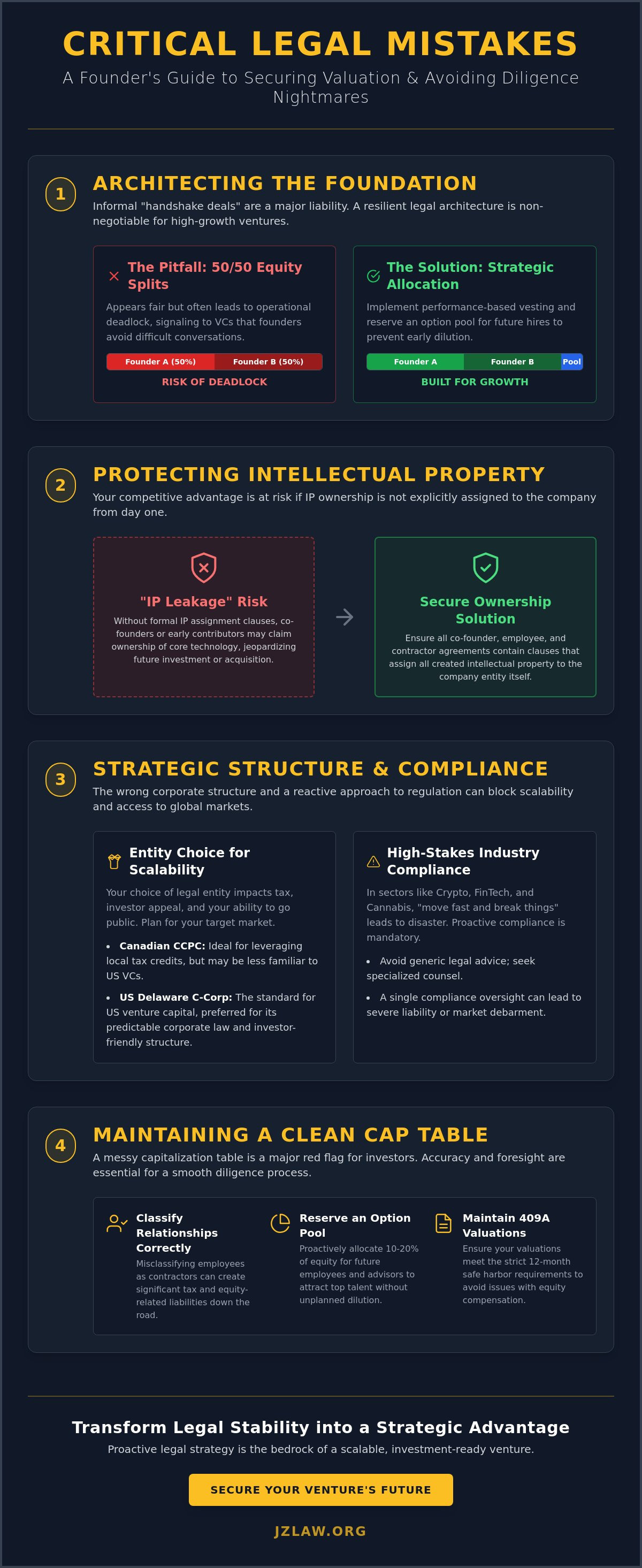
While a 50/50 equity split may feel equitable at the outset, it's a configuration that frequently leads to operational deadlocks. Venture capitalists often view equal splits as a sign that founders are avoiding difficult conversations. To ensure long-term alignment, sophisticated founders implement performance-based milestones for equity vesting. This approach ensures that equity is earned through continued contribution rather than mere presence. It's also vital to reserve a strategic allocation for future hires and advisor pools, typically between 10% and 20%, to prevent unnecessary dilution during early hiring phases.
Choosing a Structure for Global Scalability
The choice between a Canadian Controlled Private Corporation (CCPC) and a US Delaware C-Corp depends heavily on your funding trajectory. For those operating between hubs like Toronto and New York, tax structuring becomes a complex exercise in balancing Canadian tax credits against the preferences of American investors. A standard incorporation might suffice for a local boutique, but it rarely supports the requirements of international securities regulation. Your initial entity choice directly impacts your future ability to execute corporate transactions or successfully navigate the process of taking your company public on major exchanges like the TSX or NASDAQ. Proactive planning ensures that your corporate shell remains a vehicle for growth rather than a barrier to global markets.
Navigating High-Stakes Regulatory Frameworks (Cannabis, Crypto, and Beyond)
For founders operating at the vanguard of innovation, the traditional tech mantra of "moving fast and breaking things" is often a recipe for regulatory disaster. In sectors like fintech, cannabis, and blockchain, the legal environment is not a mere backdrop; it's a primary operational constraint. Avoiding common startup legal mistakes in these high-stakes industries requires a fundamental shift from reactive problem-solving to proactive compliance. When dealing with regulated financial products or controlled substances, a single procedural oversight can lead to permanent debarment from the market or severe personal liability for directors. Generic legal advice that applies to a standard SaaS company will likely lead to catastrophic failure when applied to these specialized niches.
Cannabis Licensing: Beyond the Application
As we move through 2026, the cannabis licensing landscape in North American hubs has shifted toward rigorous post-licensure oversight. In jurisdictions like Alberta and California, the primary challenge isn't just obtaining the permit. It's the continuous maintenance of operational integrity. Regulators now look far beyond the initial application to verify that standard operating procedures (SOPs) are strictly followed during daily operations. Common disclosure errors regarding ownership changes or investment sources frequently trigger license revocations. Founders must treat their compliance department as a core business unit, ensuring every pivot is vetted against current provincial or state regulations to protect their hard-won market access.
Cryptocurrency and Securities Regulation
The evolution of cryptocurrency law across Calgary, New York, and Berlin has clarified how securities regulations apply to digital assets. In 2026, the Howey Test remains the definitive framework for determining if a token is a security, but its application has become increasingly nuanced. Startups must navigate a complex web of Anti-Money Laundering (AML) and Know Your Customer (KYC) requirements dictated by international bodies and domestic agencies like FINTRAC. Protecting your underlying technology while remaining transparent with regulators is a delicate balance. Utilizing USPTO startup resources can help you secure your intellectual property while you focus on these heavy regulatory demands. Strategic compliance acts as a shield during due diligence, ensuring that potential investors see a clean, low-risk entity. If you're managing a venture in these complex sectors, seeking specialized legal counsel ensures your growth isn't hampered by avoidable regulatory bottlenecks.
Intellectual Property and Contractual Integrity: Protecting Your Competitive Edge
A startup's valuation is fundamentally an assessment of its proprietary advantages and the legal certainty of its contracts. While the technical execution of a product is paramount, the legal ownership of that execution is what institutional investors actually buy during a liquidity event. Avoiding common startup legal mistakes in this area means moving beyond a "handshake culture" and standardizing your contractual ecosystem. This includes drafting non-disclosure agreements that provide actual recourse rather than mere psychological deterrents. It also involves scrutinizing commercial leases in high-rent markets like Vancouver or Denver, where inflexible terms can become an anchor during a necessary pivot or a rapid expansion phase.
Contractual integrity is about more than just defense; it's a tool for scaling. Standardizing your customer and vendor agreements early minimizes the risk of protracted litigation that can drain capital and distract leadership. When every agreement is a bespoke negotiation, you create a fragmented legal landscape that is difficult to manage and even harder to audit during due diligence. Precision in your initial drafting ensures that your focus remains on market penetration rather than legal firefighting.
The IP Assignment Trap
The most critical oversight founders face is "IP leakage." Many assume that paying a developer or consultant automatically transfers ownership of the code or design to the company. It doesn't. Under many international jurisdictions, the default owner of a creative work is the creator unless a written assignment is specifically executed. You've got to ensure every founder, employee, and contractor signs a comprehensive IP assignment agreement. This document should include "Work for Hire" language tailored to local laws. Conducting an internal IP audit before your first major funding round is a non-negotiable step to demonstrate that your venture owns every line of code it claims to possess.
Negotiating Strategic Corporate Transactions
Growth often necessitates complex corporate transactions that go far beyond basic templates. Standardized forms rarely protect minority interests or account for the specific liability profiles of high-tech firms. When drafting Master Service Agreements (MSAs), the focus should shift to indemnification clauses and limitations of liability. These terms don't just manage risk; they directly affect company valuation by defining the potential downside for a buyer or investor. Tailoring these agreements ensures that your organization remains a lean, attractive target for acquisition rather than a liability-laden entity that investors feel the need to avoid.
Equity Compensation and Employment Law: Avoiding the Messy Cap Table
Investors don't just buy your code; they buy your cap table. A "messy" table, cluttered with unrecorded promises or poorly documented grants, is a primary reason deals fail during due diligence. Avoiding common startup legal mistakes often requires a forensic look at how equity was promised in the early days. If your ownership structure is fragmented or lacks clear documentation, sophisticated VCs will likely walk away rather than attempt to untangle the web of claims. This becomes particularly complex for remote-first startups managing teams across provincial or state borders, where labor laws vary significantly. Every equity grant must be recorded with precision to maintain the integrity of your corporate records.
Structuring Employee Stock Option Plans (ESOPs) for cross-border teams adds another layer of complexity. Founders operating in both New York and Toronto need to balance different tax regimes to ensure that equity remains a valuable incentive rather than a future tax liability for employees. Without a strategic approach to tax structuring, you risk creating a plan that is non-compliant in one or more jurisdictions. Proper management of these plans ensures that your organization remains attractive to top-tier talent while staying ready for the scrutiny of institutional investors.
The Contractor vs. Employee Debate
Misclassifying a worker as an independent contractor is a multi-thousand dollar error that often surfaces during an audit or acquisition. The CRA and IRS use specific criteria to determine status, focusing on the degree of autonomy the worker possesses and the financial risk they carry. The financial risks of misclassification include significant liabilities for back-taxes, unpaid payroll contributions, and statutory penalties. The control test in employment law evaluates whether the employer dictates how, where, and when the work is performed to determine the true nature of the relationship. Ensuring correct classification from the start protects your cash flow and your reputation with regulators.
Securities Compliance in Equity Grants
Every option grant is a securities transaction. You've got to ensure these grants comply with local securities exemptions, such as the "Friends and Family" or "Accredited Investor" exemptions. For ventures with a US presence, maintaining a valid 409A valuation is critical to receive safe harbor protection. According to current 2026 standards, this valuation must be updated at least every 12 months or after any material event, such as a new funding round. Preparing your cap table for the intense scrutiny of an IPO or a reverse merger requires proactive management of these filings and a deep understanding of securities regulation to avoid costly delays during your exit phase.
Strategic Scaling: Preparing for Mergers, Acquisitions, and Going Public
The final stage of a startup's journey isn't just about the product's market fit; it's about the maturity of its corporate governance. Transitioning from a founder-led environment to a compliance-ready organization is a prerequisite for any significant liquidity event. Avoiding common startup legal mistakes in the early years pays dividends when you finally face the rigorous scrutiny of an M&A team or a public market regulator. Whether your goal is a strategic acquisition or taking the company public, the strength of your securities regulation compliance will be the primary factor in determining your success. Investors and buyers look for entities that have minimized their risk profile through meticulous legal hygiene.
Exchanges like the TSX or NASDAQ require a level of transparency and documentation that many early-stage companies find daunting. This is where strategic tax structuring becomes vital. You don't want to realize at the point of sale that your corporate architecture is tax-inefficient, potentially costing founders and investors millions in avoidable liabilities. Your choice of legal counsel in the initial stages often dictates which exit options remain open to you. A partner who understands the endgame can help you build the necessary infrastructure from the first day of incorporation, ensuring that your corporate transactions are handled with a view toward the eventual exit.
The Road to the Public Markets
The path to an IPO involves reaching several legal milestones, from financial restatements to the formalization of independent board committees. As your organization scales, your physical footprint often expands, necessitating a sophisticated understanding of real estate law to manage multi-jurisdictional leases or property acquisitions. These expansions must be handled with the same precision as your cap table, as any unresolved property dispute can become a red flag in a prospectus filing. A clean legal history is the foundation of a successful filing, ensuring that regulators and underwriters can move forward without hesitation or costly delays.
Due Diligence Readiness
Sophisticated founders maintain a virtual data room (VDR) from day one. This repository should house every contract, IP assignment, and board minute mentioned in the previous sections of this guide. Common "deal-killers" during M&A due diligence often include unresolved co-founder disputes or "leaky" IP that wasn't properly assigned during the development phase. JZ Law provides the strategic counsel necessary to navigate these complex corporate transactions, ensuring that your data room is a testament to your organization's integrity. By treating compliance as a strategic asset rather than a hurdle, you position your venture for the highest possible valuation at the point of exit.
Securing Your Exit: The Path to Institutional Readiness
The transition from a disruptive concept to a successful public listing or acquisition is paved with deliberate, high-stakes legal decisions. Avoiding common startup legal mistakes requires a shift from reactive problem-solving to a pro-active, strategic mindset that prioritizes long-term valuation over short-term expediency. By formalizing co-founder relationships, securing intellectual property, and maintaining a clean cap table, you ensure that your venture remains prepared for the scrutiny of institutional investors at every stage of growth.
Regulatory landscapes in innovative sectors such as cannabis, cryptocurrency, and oil and gas continue to evolve with significant complexity. Navigating these multi-jurisdictional frameworks across North America and Europe demands more than just basic compliance; it requires a partner who understands the intricate process of taking companies public. JZ Law offers the sophisticated expertise needed to manage these transitions with precision and professional dignity. If you're ready to solidify your corporate foundation and prepare for global scaling, consult with JZ Law for strategic corporate counsel. Your vision deserves a legal architecture that supports its full potential.
Frequently Asked Questions
What is the most common legal mistake founders make during incorporation?
The most frequent error is the reliance on informal verbal agreements or "handshake deals" regarding equity splits and vesting schedules. Without a legally binding shareholders' agreement, founders risk catastrophic internal disputes when valuation increases. Avoiding common startup legal mistakes at this stage requires a formal structure that dictates roles, intellectual property assignment, and precise exit terms from the first day of incorporation to ensure institutional readiness.
How do I protect my startup’s intellectual property if I use offshore developers?
Protecting your technology requires a comprehensive IP assignment agreement that explicitly transfers ownership from the individual developer to the corporate entity. Standard contracts in international jurisdictions often default ownership to the creator unless a written waiver is executed. You've got to ensure these agreements include specific "Work for Hire" language and are enforceable in the developer's home country to prevent "IP leakage" during future due diligence.
Is it legal to give equity to advisors without a formal agreement?
While you can technically promise equity, doing so without a formal Advisor Stock Option Agreement (ASOA) creates significant liability. Verbal promises are difficult to quantify and often lead to an over-diluted or "messy" cap table that scares away venture capital investors. A formal agreement should specify the vesting schedule, the nature of the services provided, and the specific securities exemptions being utilized for the grant.
What are the risks of misclassifying employees as independent contractors in Canada?
The primary risks include substantial liabilities for unpaid Canada Pension Plan (CPP) contributions, Employment Insurance (EI) premiums, and provincial workers' compensation fees. The CRA applies a rigorous control test to determine the true nature of the relationship, regardless of the label used in the contract. Misclassification can result in statutory penalties and interest that jeopardize a startup's cash flow and its reputation with regulatory bodies.
Do I need a specialized securities lawyer to raise my first seed round?
Engaging specialized counsel is essential because every capital raise is a securities transaction that must comply with specific exemptions. Seed rounds often rely on "Accredited Investor" or "Friends and Family" exemptions, which require precise filings and disclosures. Failing to adhere to these regulations can lead to a right of rescission for investors, effectively allowing them to demand their money back if the venture's value decreases.
How does cannabis licensing differ between Canada and the United States in 2026?
In 2026, Canada operates under a unified federal framework governed by Health Canada, while the United States remains a fragmented landscape of state-specific regulations. This means a Canadian license provides a clearer path to national scaling, whereas US based founders must navigate conflicting state and federal laws. Strategic compliance in North American hubs requires a deep understanding of these divergent jurisdictional requirements to maintain operational integrity and license validity.
What legal documents are essential before I pitch to venture capitalists?
You must have a formalized shareholders' agreement, executed IP assignment documents for all contributors, and a clean, updated cap table. Investors also expect to see a comprehensive virtual data room containing your articles of incorporation and any material service agreements. Having these documents ready demonstrates that you are prioritizing avoiding common startup legal mistakes and that your organization is mature enough for institutional investment.
Can a startup go public on the TSX Venture Exchange without a full IPO?
Startups can utilize the Capital Pool Company (CPC) program or execute a reverse takeover (RTO) to list on the TSX Venture Exchange. These alternative pathways allow emerging growth companies to access public markets with a lower initial capital requirement than a traditional IPO. However, these transactions still require rigorous securities regulation compliance and a clean legal history to satisfy exchange listing requirements and prospectus filing standards.


Comments