


How to Structure a Joint Venture in Alberta: A Strategic Legal Guide for 2026
- jzanglaw
- 1 day ago
- 12 min read
In the eyes of the Alberta court system, your strategic joint venture isn't a legal entity; it's a fragile contractual arrangement that can accidentally collapse into a high-liability partnership if you're not careful. Most business leaders in the energy and tech sectors recognize the immense power of synergy, but they also dread the "deemed partnership" trap under the Alberta Partnership Act. Learning how to structure a joint venture in Alberta requires more than just a handshake. It demands a proactive legal framework that strictly separates your corporate assets from your partner's potential debts and separate liabilities.
You likely want the benefits of tax flow-through and shared expertise without the anxiety of regulatory non-compliance or shared liability. This guide will help you master the legal nuances of these agreements to maximize project efficiency while insulating your business from unintended risks. We'll examine the latest 2026 regulatory updates, including the Expedited 120-Day Approvals Act, and provide a roadmap for clear governance that ensures your venture remains a strategic asset rather than a legal burden. We'll also address specific compliance hurdles for those operating under the AER or AGLC to ensure your project moves forward without delay.
Table of Contents
Understanding the Alberta Joint Venture: Contract vs. Partnership
A Joint venture in Alberta is a strategic, project-specific arrangement between two or more "venturers" who combine their expertise, assets, or capital to achieve a specific commercial goal. It is vital to understand that, unlike a corporation, a joint venture is not a separate legal entity. It remains a contractual relationship where each party retains its distinct corporate identity. When determining how to structure a joint venture in Alberta, the primary objective is often to maintain separate tax identities while leveraging project synergy. This structure allows each participant to report their share of income and expenses independently, providing a significant advantage for capital-intensive sectors like oil and gas or large-scale real estate development.
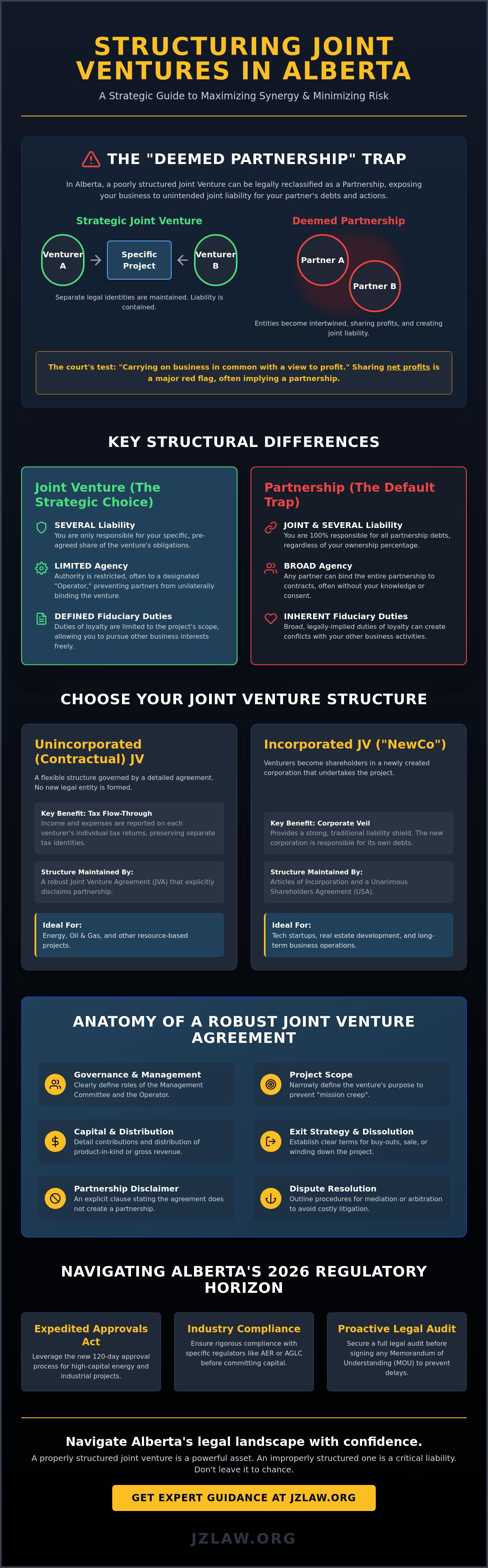
However, this flexibility comes with a significant legal hazard. The Alberta Partnership Act can "deem" your joint venture to be a partnership if the structure is poorly defined. If a court reclassifies your venture, you lose the insulation of several liability and become jointly responsible for your partner's actions and debts. Avoiding this reclassification requires a meticulous approach to governance, financial distribution, and the language used in your foundational documents.
The Danger of Deemed Partnerships
Alberta courts apply the "carrying on business in common with a view to profit" test to distinguish between these two structures. A critical factor in this analysis is the distinction between sharing gross returns and sharing net profits. If venturers share net profits, the law frequently presumes a partnership exists. To protect your firm, your agreement should focus on the distribution of product-in-kind or gross revenue. While a written disclaimer stating that the parties don't intend to form a partnership is standard practice, it isn't a silver bullet. If your daily operations look like a partnership, the court will treat it as one regardless of your contract's labels.
Joint Venture vs. Partnership: Key Differences
The choice of structure fundamentally alters your exposure to risk and your ability to control the project. Understanding these differences is essential for long-term asset protection.
Liability: Partners face joint and several liability for all partnership debts. In a joint venture, liability is typically several, meaning you're only responsible for your specific percentage of the venture's obligations.
Agency: In a partnership, any partner can bind the others to third-party contracts. A joint venture limits this power, usually vesting specific, narrow authority in a designated "Operator" through the agreement.
Fiduciary Duties: Partnership law imposes broad, inherent duties of loyalty and disclosure. A well-structured joint venture agreement can limit these duties to the specific project scope, preventing "mission creep" and allowing venturers to maintain their independent business interests elsewhere.
Choosing Your Structure: Unincorporated vs. Incorporated JVs
Deciding how to structure a joint venture in Alberta requires a careful evaluation of your project's duration, capital requirements, and risk tolerance. There isn't a universal solution; instead, there are two primary paths that offer distinct advantages. The unincorporated, or contractual, joint venture remains the dominant choice for resource-based projects, while the incorporated joint venture, often referred to as a "NewCo," provides a traditional corporate veil that appeals to tech startups and real estate developers. In 2026, with Alberta's general provincial corporate tax rate holding at 8%, the financial implications of this choice are more significant than ever.
The Alberta Law Reform Institute analysis on Joint Ventures highlights that the lack of a separate legal personality in unincorporated structures is precisely what creates their greatest benefit: tax flow-through. Choosing the wrong path can lead to trapped tax credits or unexpected liability exposure, making it essential to align your structure with your long-term exit strategy.
The Unincorporated (Contractual) Joint Venture
In an unincorporated structure, venturers own project assets directly as tenants-in-common. This direct ownership is a cornerstone of oil and gas law, as it allows each participant to claim their own Capital Cost Allowance (CCA) and resource deductions. This flexibility is invaluable; it means one partner can be in a loss position while the other is profitable, and both can manage their tax filings according to their own fiscal year-ends. It's a lean approach that avoids the $275 government incorporation fee and the ongoing administrative burden of maintaining a separate corporate entity. However, without a corporate shield, your protection relies entirely on the precision of your "several liability" clauses.
The Incorporated Joint Venture (Corporate JV)
When project risks are high or the venture involves multiple third-party contracts, forming a NewCo is often the safer strategic move. This distinct corporation holds all assets, signs all leases, and employs the workforce, effectively insulating the parent companies' existing assets from project-specific lawsuits. A corporate JV is governed by a robust shareholders' agreement, which provides a familiar framework for governance and dispute resolution. Banks and institutional lenders often prefer this structure because the corporation can offer a clean security interest in its assets without tangling with the parent companies' existing debt covenants. While this adds a layer of complexity, particularly regarding the 2% provincial small business tax rate thresholds, the liability shield it provides is often worth the additional compliance cost. If you're weighing these options for a high-stakes project, consulting with a strategic legal partner can clarify which model best serves your specific commercial interests.
The Anatomy of a Robust Joint Venture Agreement (JVA)
The Joint Venture Agreement (JVA) serves as the operational constitution of your project. While the choice of a contractual or corporate model provides the legal skeleton, the JVA dictates the daily reality of how parties interact, share costs, and resolve disputes. It's within these pages that you articulate exactly how to structure a joint venture in Alberta to ensure operational efficiency while maintaining the necessary distance between co-venturers. A well-drafted agreement doesn't just list obligations; it anticipates friction points before they escalate into litigation.
Precise definitions of the "Specific Project" are a primary defense against the reclassification risks discussed in previous sections. A vague scope often leads to mission creep, where the venture's activities expand into general business territory, increasing the risk of being deemed a partnership. In 2026, precise tax structuring within the JVA is essential for ensuring that revenue and expense allocations are recognized by the CRA. This includes clear provisions for capital contributions and "cash calls," which are formal requests for additional funding. Without these, a project can stall indefinitely if one party lacks the liquidity to meet unexpected costs.
Governance and Decision-Making
Effective governance hinges on the balance of power between the Management Committee and the designated Operator. The Management Committee provides strategic oversight, while the Operator handles day-to-day execution. Your agreement must clearly define voting thresholds. While simple majorities work for routine operational decisions, Fundamental Changes, such as taking on significant debt or changing the project's core objective, should require a higher threshold or even unanimous consent. Deadlocks are a reality in high-stakes ventures. To prevent paralysis, many Calgary-based firms utilize "Shotgun" clauses or mandatory independent mediation to force a resolution or a buyout when parties reach an impasse.
Default and Exit Strategies
An exit strategy is just as important as the entry plan. You must account for the "Non-Participating Venturer" who fails to meet a cash call. Common remedies include the dilution of their interest or the temporary suspension of their voting rights. Transfer of interests should be strictly controlled through Rights of First Refusal (ROFR) to ensure you aren't forced to work with an undesirable new partner. As the project concludes, the winding-up provisions must detail the orderly distribution of assets and the settlement of any remaining liabilities, ensuring a clean break for all participants.
Industry-Specific Structuring: Cannabis, Tech, and Energy
A "one size fits all" template is a liability when deciding how to structure a joint venture in Alberta's highly regulated economic sectors. While the foundational principles of liability and tax flow-through remain constant, the regulatory overlay from bodies like the Alberta Energy Regulator (AER) or the Alberta Gaming, Liquor and Cannabis Commission (AGLC) adds layers of complexity that a standard agreement cannot address. In 2026, the maturity of these markets demands a bespoke approach that anticipates regulatory audits and licensing hurdles from the outset.
In the technology sector, the April 2026 Alberta Technology and Innovation Strategy 2.0 has introduced new dynamics, including the possibility of government entities taking minority equity stakes. This shift necessitates precise language regarding Intellectual Property (IP) ownership and data sovereignty, particularly in ventures involving cryptocurrency law. Failure to clearly define IP rights can lead to protracted disputes that stifle innovation and deter future investment. A robust JVA must delineate who owns the core technology versus the project-specific improvements developed during the venture's lifespan.
Cannabis and Liquor: AGLC Compliance
Operating within the cannabis or liquor space requires satisfying stringent "Associate" disclosure requirements. The AGLC must vet every significant participant in a venture to ensure they meet suitability standards. If you're navigating cannabis licensing, your JVA must include provisions that allow for the immediate removal of a partner if they lose their eligibility or fail an AGLC audit. While the June 10, 2026 updates eased rules around product sampling and recordkeeping, the core requirement to prevent "inducements" remains. Revenue splits must be structured as legitimate fee-for-service or profit-sharing arrangements that don't trigger regulatory red flags or jeopardize the retail license.
Oil & Gas: The CAPL Operating Procedure
In the energy sector, most venturers rely on the Canadian Association of Petroleum Landmen (CAPL) operating procedures. While these forms are industry standard, they must be carefully integrated into your bespoke JVA to address modern challenges like environmental reclamation and the new Expedited 120-Day Approvals Act. Passed on May 6, 2026, this Act accelerates project timelines for qualified strategic investments exceeding $250 million. To benefit from these expedited windows, your joint venture must be structured to meet provincial priority criteria from day one. You must also account for the "one project, one review" process under the latest federal-provincial cooperation agreements, ensuring your Operator is equipped to handle consolidated environmental assessments. Strategic alignment with these regulations isn't just about compliance; it's about competitive advantage. If your current agreement lacks these industry-specific safeguards, you should consult with a strategic legal partner to protect your project’s long-term viability.
Navigating Alberta Compliance: Why JZ Law is Your Strategic Partner
Successfully determining how to structure a joint venture in Alberta is a task that extends far beyond the initial selection of a contractual or corporate model. Theoretical knowledge provides the foundation, but safe execution requires a meticulous legal audit before any Memorandum of Understanding (MOU) or Term Sheet is signed. At this early stage, a project is most vulnerable to structural flaws that could trigger unintended tax consequences or partnership liabilities. Our firm specializes in the delicate intersection of high-stakes corporate transactions and the niche regulations governing Alberta’s most innovative sectors. We provide the sophisticated legal insulation necessary to protect your existing assets while you pursue new market opportunities.
Choosing a boutique firm like JZ Law ensures that your venture receives the level of detail and strategic foresight typically reserved for the largest multinational corporations. We understand that in 2026, a joint venture isn't just a project; it's often a precursor to a public offering or a significant corporate exit. We align your governance documents with future securities requirements from the first draft, ensuring that your path to liquidity remains unobstructed by historical compliance gaps.
The JZ Law Approach: Beyond the Template
We reject the "one-size-fits-all" mentality that often leads to the "Deemed Partnership" triggers discussed earlier in this guide. Our proactive risk mitigation strategy involves a deep dive into your operational plans to ensure that your revenue sharing and management control don't inadvertently cross legal thresholds. By working directly with John Zang, you gain access to specialized expertise in regulatory defense and corporate finance. This direct partner-level involvement is critical for ventures in the energy, cannabis, or tech sectors, where a single regulatory misstep can jeopardize millions in capital investment. We don't just draft contracts; we build strategic frameworks that anticipate the evolution of your business and the shifting Alberta regulatory environment.
Getting Started with Your Alberta Joint Venture
The process of building a resilient structure begins with a comprehensive initial consultation. You should come prepared with your preliminary financial projections, a clear definition of the project scope, and any existing correspondence with your potential co-venturers. This data allows us to draft an MOU that sets a firm foundation for the final Joint Venture Agreement. A well-structured MOU prevents misunderstandings during the more intensive negotiation phases and signals to your partners that you're committed to a professional, legally sound collaboration. If you're ready to move from concept to execution, secure your project’s future with strategic counsel from JZ Law. We'll ensure your venture is built for synergy, compliance, and long-term commercial success.
Securing Your Competitive Advantage in Alberta’s 2026 Market
Building a successful collaborative project requires more than just identifying a market opportunity; it demands a legal framework that prioritizes asset protection and regulatory precision. By mastering how to structure a joint venture in alberta, you ensure that your business benefits from project synergy without falling into the "deemed partnership" trap. Whether you opt for the tax flow-through benefits of an unincorporated structure or the robust liability shield of a corporate NewCo, your Joint Venture Agreement must anticipate the specific hurdles of your industry. From AER compliance in the energy sector to AGLC suitabilities in cannabis, the details of your governance and exit strategies will define your long-term stability.
JZ Law provides the high-stakes corporate experience of a major firm within a boutique environment that values direct, expert access. We specialize in navigating the complex intersection of regulatory defense and corporate finance, offering tailored guidance for IPO-track startups and established industrial players alike. Don't leave your project’s future to chance with generic templates or overlooked compliance triggers. Consult JZ Law for Strategic Joint Venture Structuring and move forward with the confidence that your assets are insulated and your venture is positioned for growth.
Frequently Asked Questions
Is a joint venture a separate legal entity in Alberta?
No, a joint venture is not a separate legal entity in Alberta. It's a contractual arrangement where participants maintain their distinct corporate identities. This lack of legal personality is why participants own assets as tenants in common rather than through a shared entity. It provides the flexibility to combine resources for a specific project without the administrative overhead of a new corporation.
What is the biggest risk of a joint venture in Alberta?
The most significant risk is the court reclassifying your venture as a "deemed partnership" under the Alberta Partnership Act. If this occurs, you lose the protection of several liability and become jointly responsible for your partner's debts and actions. Learning how to structure a joint venture in alberta with precise language is the only way to mitigate this high stakes exposure.
Do I need a written agreement for a joint venture to be valid?
While the law doesn't strictly require a written contract for a joint venture to exist, operating without one is professionally reckless. A comprehensive Joint Venture Agreement (JVA) is the only way to define the project scope and explicitly disclaim a partnership. Without a written document, proving that you aren't jointly liable for your partner's separate business debts becomes nearly impossible.
How are joint ventures taxed in Canada?
Joint ventures utilize a "flow through" tax model where the venture itself doesn't file a tax return. Instead, each participant reports their proportionate share of income, expenses, and capital cost allowance on their own corporate tax filings. This allows firms to manage their tax positions independently. It's a primary reason why many energy companies prefer this structure over a traditional corporation.
Can a joint venture hire employees in Alberta?
An unincorporated joint venture typically doesn't hire employees directly. Instead, the designated Operator or one of the venturers hires the staff and charges the associated costs back to the venture as a project expense. If your project requires a large, independent workforce, an incorporated joint venture might be more appropriate as the "NewCo" can act as a legal employer.
What happens if my joint venture partner goes bankrupt?
If a partner enters bankruptcy, the Joint Venture Agreement usually triggers a default clause. This allows the solvent partners to buy out the insolvent partner's interest or take over their share of the project to ensure continuity. Without these specific provisions, the bankrupt partner's creditors could potentially interfere with project assets, causing significant delays and legal complications.
How do I end a joint venture agreement early?
Ending a venture early requires following the specific termination or withdrawal clauses outlined in your agreement. Most robust contracts include "shotgun" clauses or buy sell provisions that allow one party to exit under predetermined financial terms. Understanding how to structure a joint venture in alberta with a clear exit strategy ensures that you can dissolve the relationship without resorting to expensive litigation.
Is a joint venture better than a partnership for a small project?
A joint venture is generally superior to a partnership because it limits your liability to your specific share of the project. In a partnership, you're "jointly and severally" liable for every debt incurred by the business, even those you didn't authorize. For small, high risk projects, the several liability of a joint venture provides a much safer strategic foundation for all participants.


Comments