


Appealing a Cannabis License Denial in Toronto: A 2026 Strategic Legal Guide
A Notice of Proposal (NOP) from the Alcohol and Gaming Commission of Ontario (AGCO) isn't a terminal verdict on your corporate ambitions, but rather a critical pivot point that demands a sophisticated legal response. You've likely spent months or years securing capital and scouting locations, only to face the sudden risk of a total investment loss due to "public interest" concerns or integrity questions. Successfully appealing a cannabis license denial in Toronto requires moving beyond simple frustration to embrace a structured, evidence-based strategy before the License Appeal Tribunal (LAT).
We understand that your company's long-term value, including potential IPO plans, depends on maintaining a pristine regulatory record. In this guide, we'll detail the precise steps needed to challenge an AGCO decision, from meeting the strict 15-day filing deadline to navigating the typical 4-8 month LAT timeline. You'll learn how to address the regulator's specific objections, protect your brand's reputation, and ultimately secure the Retail Store Authorization (RSA) necessary to operationalize your investment in Ontario's evolving market. By treating this denial as a regulatory hurdle rather than a failure, you can safeguard your corporate assets and maintain your trajectory toward market leadership.
Table of Contents
Understanding the AGCO’s Notice of Proposal (NOP) in Toronto
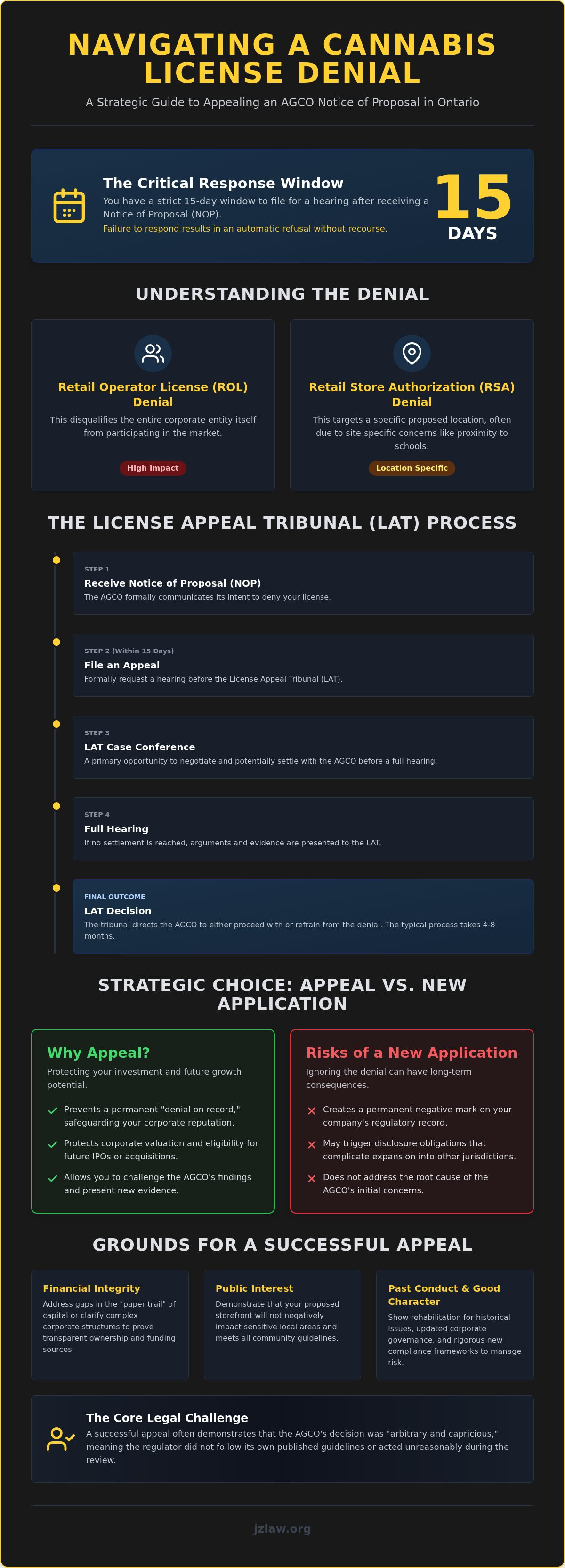
The regulatory architecture of Ontario’s cannabis market relies on the Cannabis Licence Act, 2018, which empowers the Registrar to issue a Notice of Proposal (NOP) when an application fails to meet statutory requirements. Receiving an NOP is a formal indication that the Alcohol and Gaming Commission of Ontario (AGCO) intends to refuse your license. It's vital to distinguish between a Retail Operator License (ROL) denial, which disqualifies the corporate entity itself, and a Retail Store Authorization (RSA) denial, which typically targets a specific location. While an RSA refusal may be based on site-specific concerns, an ROL denial creates a significant barrier to any future participation in the industry.
Time is your most critical asset once an NOP is served. You have a strict 15-day window from the date of receipt to request a hearing. Failure to act within this timeframe results in the Registrar automatically carrying out the proposal, effectively ending your current application without further recourse. When appealing a cannabis license denial in Toronto, this initial response phase determines whether your corporate investment remains viable or faces immediate liquidation. A denial on record doesn't just halt your current plans; it can create disclosure obligations that complicate future ventures in other jurisdictions.
Common Reasons for License Refusal in Ontario
The AGCO maintains high standards for corporate transparency and community impact. Refusals often stem from several recurring issues:
Financial Integrity: Gaps in the "paper trail" of capital or complex corporate structures that obscure true ownership and funding sources.
Public Interest: Failure to satisfy the Registrar that a specific Toronto storefront won't negatively impact local sensitive areas, such as schools or community centers.
Past Conduct: Historical legal or regulatory issues involving directors, officers, or major shareholders that suggest a lack of honesty or integrity in business dealings.
The Role of the License Appeal Tribunal (LAT)
The License Appeal Tribunal (LAT) serves as an independent, quasi-judicial body. It operates entirely separate from the AGCO to ensure procedural fairness. Under the Cannabis Licence Act, 2018, the LAT has the jurisdiction to review the Registrar’s proposal through a fresh lens. It's not a perfunctory endorsement of the regulator’s initial stance. The tribunal has the authority to either direct the Registrar to carry out the proposal or order them to refrain from doing so. Understanding this distinction is essential for any business appealing a cannabis license denial in Toronto, as the LAT focuses on whether the applicant can currently meet the law's requirements, rather than just reviewing past administrative findings.
Legal Grounds for Challenging a Cannabis License Refusal
When you decide to dispute the attached Notice of Proposal, your strategy must rest on substantive legal grounds rather than mere disagreement with the result. The AGCO's decision to deny a license isn't immune to scrutiny. In the administrative law context, the Registrar must act within the bounds of reasonableness and procedural equity. Successful challenges often hinge on demonstrating that the regulator overstepped its authority or applied the Cannabis Licence Act, 2018 in a manner that was inconsistent with established precedents. Protecting your corporate investment requires a precise audit of the AGCO’s reasoning to find these vulnerabilities.
One of the most complex areas of dispute involves "Good Character" assessments. The regulator often cites historical conduct or past associations of directors and shareholders as grounds for denial. However, these assessments aren't meant to be permanent bans for past mistakes. We focus on demonstrating rehabilitation, updated corporate governance, and the implementation of rigorous compliance frameworks. By reframing historical issues as managed risks, we can often overcome the "public interest" objections that frequently stall appealing a cannabis license denial in Toronto.
Arbitrary and Capricious Grading in 2026
As the Ontario market has matured, the licensing process has increasingly relied on merit-based scoring systems. We define arbitrary grading as a failure to apply uniform standards across Toronto applicants. This often occurs when the AGCO utilizes third-party graders who may not have a consistent understanding of the local regulatory environment. If your application was scored lower than a competitor with nearly identical protocols, you may have grounds to challenge the decision as arbitrary. Identifying these scoring discrepancies is a specialized task that requires comparing your application against the AGCO’s own published evaluation rubrics.
Procedural Fairness and Constitutional Challenges
Procedural fairness is a cornerstone of Canadian administrative law. It ensures you have the right to be heard and the right to an impartial decision-maker. If the AGCO relied on evidence you weren't permitted to see, or if the decision-maker exhibited a clear bias, the entire proposal may be legally void. In cases where the LAT process doesn't yield a just result, we may pursue a judicial review. This is a higher-level court process that examines whether the tribunal’s decision infringed upon the principles of fundamental justice. Ensuring your cannabis licensing strategy accounts for these high-stakes legal maneuvers is essential for long-term corporate stability.
Strategic Assessment: Appeal vs. New Application
Deciding between appealing a cannabis license denial in Toronto and submitting a fresh application is a high-stakes decision for your corporate structure. While a new application might appear to be a path of less resistance, it fails to address the "Denial on Record" status. This status must be disclosed in every future licensing endeavor, both in Ontario and internationally. A formal appeal through the Licence Appeal Tribunal usually takes between four and eight months. Starting over doesn't guarantee a faster result and often invites deeper scrutiny from the AGCO during the re-application process.
The cost-benefit analysis must go beyond immediate legal fees. You should consider the potential daily revenue of a high-traffic Toronto retail location. Every month of delay represents a quantifiable loss in market share. Protecting your company’s reputation through a successful appeal preserves investor trust and maintains the valuation of your corporate assets. It's often more cost-effective to resolve a denial than to let a refusal stand and risk the permanent devaluation of your brand.
Regulatory Clean-up for Future IPOs
Regulatory hygiene is non-negotiable for firms with ambitions of taking companies public on major exchanges like the TSX or NYSE. A history of unresolved license denials acts as a significant red flag for securities regulators and institutional investors. Clearing your record through the appeal process ensures that your path to a public offering remains unobstructed by past administrative hurdles. We prioritize this "clean-up" approach to ensure that your current licensing challenges don't become permanent liabilities on your balance sheet.
Toronto Municipal Factors and Location Strategy
It's essential to determine if the AGCO’s proposal was triggered by the operator’s suitability or the specific location. Toronto’s dense urban landscape presents unique challenges regarding proximity to schools and community centers. If the denial is strictly location-based, a strategic pivot might involve abandoning the contested site while aggressively defending the Retail Operator License (ROL). This approach preserves your ability to secure a Retail Store Authorization (RSA) elsewhere in the city without the stigma of a failed operator application. We help you evaluate whether a site is worth the fight or if your capital is better deployed at a different Toronto intersection.
The LAT Appeal Process: From Filing to Hearing
The procedural path to overturning an AGCO decision is governed by the Rules of Practice of the Licence Appeal Tribunal. It begins with the formal filing of the Notice of Appeal, specifically Form 02027E, accompanied by a non-refundable $106 filing fee. You must also serve this notice on the AGCO and file a Certificate of Service with the LAT to prove the regulator has been officially notified. This initial filing is the foundation of your case. It must clearly articulate the errors in the Registrar’s proposal and set the stage for the strategic arguments that follow. Missing these technical requirements can end your appeal before it truly begins.
The exchange of disclosure and witness statements follows the initial filing. This phase is where both parties reveal the evidence they intend to rely upon during the hearing. It's a transparent process designed to prevent "trial by ambush" and to encourage early resolution. If the matter doesn't settle during the preliminary stages, it proceeds to a full hearing where evidence is presented before a Tribunal member. This is a quasi-judicial environment. Witnesses are cross-examined, and legal arguments are made with the same level of precision found in a traditional courtroom. Successfully appealing a cannabis license denial in Toronto requires a meticulous approach to every procedural gate.
Building a Robust Evidence Package
Expert testimony is often the deciding factor in complex licensing disputes. We frequently engage regulatory consultants and forensic financial auditors to provide independent verification of an applicant’s integrity and operational readiness. Documentary evidence, including audited financial statements and rigorous corporate bylaws, serves to build a narrative of compliance. A successful evidence package must counter every specific point raised in the NOP. By presenting a proactive and organized defense, you demonstrate to the Tribunal that your organization is capable of operating within the strict confines of the law. If your investment is at risk, securing professional cannabis legal representation is the most effective way to manage this complex evidentiary burden.
The Case Conference Strategy
The case conference is a mandatory meeting that serves as a primary opportunity for settlement. Instead of a full, adversarial hearing, we often use this session to negotiate specific terms and conditions that can be attached to your license. This might involve presenting a comprehensive remediation plan that directly addresses the AGCO’s concerns regarding past conduct or location-specific risks. The role of legal counsel here is to facilitate a high-level regulatory settlement that satisfies the public interest while protecting your corporate assets. Resolving the matter at this stage can save months of litigation and allow your retail operations to begin much sooner than a contested hearing would allow.
Strategic Regulatory Counsel: How JZ Law Protects Your License
At JZ Law, we view a license denial as a solvable regulatory obstacle rather than a definitive failure. Our approach to appealing a cannabis license denial in Toronto is rooted in a deep understanding of the city's unique market dynamics and the AGCO’s evolving expectations. We don't just act as legal representatives; we function as strategic partners who integrate every appeal into a comprehensive cannabis licensing strategy. This holistic view ensures that your immediate response to a Notice of Proposal aligns with your long-term corporate objectives and operational stability.
Specialized counsel is essential in high-stakes regulatory environments where the margin for error is non-existent. We provide the technical precision required to navigate the LAT while maintaining a proactive stance on risk management. By identifying potential compliance gaps before they lead to further AGCO interventions, we help you build a resilient corporate foundation. Our firm’s presence in Toronto allows us to provide localized insights that are often the difference between a successful reversal and a permanent market exit.
Beyond Litigation: A Corporate Perspective
Our methodology prioritizes business outcomes over mere courtroom victories. A legal win is of little value if the process devalues your brand or alienates your investors. To prevent this, we coordinate closely with your corporate finance and tax structuring teams to ensure the appeal process supports your overall fiscal health. Whether you're navigating Toronto’s municipal zoning or aligning with global regulatory standards, our focus remains on preserving the integrity of your corporate assets. This integrated perspective allows our clients to maintain their competitive edge even when facing intense regulatory scrutiny.
Secure Your Business’s Future in Toronto
Protecting your investment requires swift, expert representation from a firm that understands the intersection of law and commerce. If you've received a Notice of Proposal, the clock is already ticking on your 15-day window to respond. Contact John Zang for a strategic consultation to evaluate your options for appealing a cannabis license denial in Toronto. By taking decisive action now, you can mitigate the risks of a permanent refusal and secure your company’s future in Ontario’s capital. Don't let administrative hurdles derail your corporate vision; let us provide the strategic counsel necessary to operationalize your investment.
For businesses facing immediate AGCO deadlines, we recommend the following next steps:
Review the specific grounds for denial listed in your Notice of Proposal with extreme precision.
Gather all relevant corporate documentation, including director histories and financial records.
Initiate a strategic legal review immediately to ensure your appeal is filed before the 15-day window expires.
Protecting Your Investment Through Strategic Regulatory Appeals
A Notice of Proposal from the AGCO represents a significant hurdle, but it doesn't have to be the end of your retail ambitions. By prioritizing the strict 15-day filing window and leveraging the quasi-judicial environment of the License Appeal Tribunal, you can effectively challenge arbitrary denials and protect your brand's reputation. Successfully appealing a cannabis license denial in Toronto ensures that your corporate record remains clean, which is a vital prerequisite for future growth or potential public offerings on global exchanges.
Our firm provides the specialized expertise in cannabis licensing and regulation required to navigate these high-stakes environments. We maintain a strong presence in Toronto and other global business hubs, allowing us to offer a strategic corporate focus that goes beyond simple litigation. We're committed to helping you secure your Retail Store Authorization while safeguarding your long-term business interests. To take the next step in defending your operations, Consult with JZ Law on Your Cannabis License Appeal. We're ready to help you turn a regulatory setback into a structured path toward operational success.
Frequently Asked Questions
How long do I have to appeal a cannabis license denial in Toronto?
You've exactly 15 days from the date you receive the Notice of Proposal (NOP) to file your appeal with the Licence Appeal Tribunal (LAT). This is a rigid statutory deadline under the Cannabis Licence Act, 2018. If you fail to submit your request within this window, the Registrar’s proposal to deny your license becomes final automatically. It's vital to act immediately to preserve your right to a hearing and protect your corporate investment.
Can I still operate my business while a cannabis license appeal is pending?
You can't operate a cannabis retail business if you haven't yet secured a valid license or authorization. For new applicants, a denial means you don't have the legal authority to open your doors. If you're appealing a suspension or revocation of an existing license, you might be able to request a "stay" from the LAT. This would allow continued operations while the appeal is pending, but such requests require specific legal arguments regarding irreparable harm.
What are the most common reasons for the AGCO to deny a retail store authorization?
The AGCO frequently denies Retail Store Authorizations (RSA) due to proximity issues with schools or other sensitive community areas. They also look closely at "public interest" concerns expressed by the municipality. Other common triggers include a lack of transparency in corporate financing or historical conduct issues involving key directors. Identifying the specific reason is the first step in appealing a cannabis license denial in Toronto, as it shapes your entire evidence package for the tribunal.
How much does it cost to appeal a cannabis license denial at the LAT?
The filing fee for the Licence Appeal Tribunal is currently $106 per license being appealed. This fee is non-refundable and must be paid at the time you submit your Notice of Appeal. While the filing fee itself is modest, the total cost of an appeal includes expert witness fees, forensic audits, and professional legal representation. These costs should be viewed as a necessary investment to safeguard your capital and maintain your company’s valuation.
Do I need a lawyer for a License Appeal Tribunal hearing in Ontario?
While you aren't legally required to have a lawyer for a LAT hearing, the process is highly technical and quasi-judicial. The AGCO will be represented by experienced counsel who understand the intricacies of administrative law. Navigating witness cross-examinations and the rules of evidence without professional help puts your business at a significant disadvantage. Engaging a strategic partner like JZ Law ensures your case is presented with the precision required to overturn a denial.
What happens if the LAT upholds the AGCO’s decision to deny my license?
If the LAT upholds the AGCO’s proposal, the denial remains in effect and becomes part of your corporate record. This decision can be challenged through a judicial review in the Divisional Court, though this process focuses on legal errors rather than a re-evaluation of the facts. A final denial can significantly impact your ability to secure licenses in other jurisdictions. It's often better to seek a negotiated settlement during the preliminary case conference stage.
Can I re-apply for a cannabis license after a previous denial?
You can re-apply for a cannabis license in Ontario, but you must disclose the previous denial on your new application. The AGCO will scrutinize your fresh submission to see if the original grounds for refusal have been fully remediated. Simply submitting the same application again will likely result in another denial. A successful strategy usually involves a combination of appealing a cannabis license denial in Toronto and addressing the underlying regulatory concerns before making a new attempt.
What is the success rate for cannabis license appeals in Toronto?
Specific success rates for cannabis license appeals aren't publicly documented by the LAT or the AGCO. However, outcomes depend heavily on the quality of the evidence package and the strength of the legal arguments presented. Cases involving procedural errors or arbitrary grading often have a better chance of reversal than those involving clear statutory violations. We focus on building a robust defense that addresses every specific objection raised by the regulator to maximize your chances.


Comments