


Cryptocurrency Lawyer Calgary Cost: A 2026 Guide to Legal Fee Structures
In the high-stakes regulatory environment of 2026, the most expensive legal counsel is often the one who charges the least up front but fails to insulate your firm from a sudden Alberta Securities Commission enforcement action. Many innovators in the digital asset space find that calculating the cryptocurrency lawyer calgary cost is fraught with uncertainty, which often becomes a significant barrier to scaling operations. It's understandable to feel trepidation when facing unpredictable invoices while simultaneously managing the rigorous compliance demands of the new Crypto-Asset Reporting Framework. You deserve a strategic partner who views legal services through a lens of risk mitigation and business growth rather than just billable hours.
This guide provides a comprehensive analysis of Calgary's legal fee landscape to help you build a predictable and defensive budget. We'll examine how specialized fee structures are evolving to match the complexity of blockchain technology and the latest FINTRAC requirements. By the end of this article, you'll understand how to evaluate legal expertise as a strategic asset that ensures your business remains bulletproof against regulatory shifts while maintaining a clear, professional relationship with your counsel.
Table of Contents
Navigating the Calgary Cryptocurrency Regulatory Landscape
Calgary has transitioned from a traditional energy hub into a sophisticated center for digital asset innovation. This evolution is driven by a unique synergy between the province's power infrastructure and a forward-thinking regulatory environment. The Alberta Securities Commission (ASC) maintains rigorous oversight of any crypto-asset that functions as a security or derivative, requiring businesses to navigate a complex web of registration and prospectus requirements. Understanding Cryptocurrency legality in Canada is the first step for any founder, but local execution requires a deeper grasp of how provincial mandates intersect with federal FINTRAC obligations.
The 2026 implementation of the Crypto-Asset Reporting Framework (CARF) marks a significant shift in the landscape. This framework mandates that service providers report specific transaction data to the Canada Revenue Agency, effectively turning compliance into a continuous operational overhead. For many firms, the cryptocurrency lawyer calgary cost reflects this increased demand for precise, recurring reporting and the high stakes of federal audit protection. It's no longer enough to be "legally aware"; firms must be "operationally compliant" to survive the current level of scrutiny.
The Calgary Advantage for Blockchain Startups
Calgary's specific economic profile offers distinct advantages, particularly for crypto mining operations that leverage the region's energy expertise. JZ Law provides a strategic bridge between these traditional industrial sectors and the digital economy. By focusing on corporate transactions and securities regulation, John Zang ensures that startups don't just launch, but scale within a legally sound framework. This boutique approach provides senior-level counsel that addresses the nuances of tokenized assets without the prohibitive overhead often associated with massive national firms.
Regulatory Compliance as a Fixed Business Requirement
In 2026, legal counsel is a fundamental business requirement rather than an optional expense. Robust Anti-Money Laundering (AML) frameworks and FINTRAC registrations are essential to maintaining banking relationships and investor confidence. A primary challenge remains the accurate classification of tokens. If the ASC deems an offering an unregistered security, the resulting penalties and forced pivots can be catastrophic. Proactive legal structuring identifies these risks during the design phase of a project. JZ Law prioritizes this preventative mindset, ensuring that your tokenomics are compliant from the first block. This strategic foresight prevents the expensive mid-project corrections that often inflate the cryptocurrency lawyer calgary cost for unprepared firms.
Understanding Fee Structures: How Crypto Lawyers Charge
Transparency in legal billing is a cornerstone of a functional partnership, especially in a sector as volatile as digital assets. While the legal profession has traditionally been anchored to the billable hour, the 2026 landscape shows a clear shift toward value-based pricing. This transition allows blockchain founders to align their cryptocurrency lawyer calgary cost with specific business outcomes rather than just chronological time. In Calgary's competitive market, firms are increasingly offering hybrid models that provide both the depth of senior expertise and the predictability required for venture capital reporting.
Senior legal counsel in major Canadian hubs like Calgary, Toronto, and Vancouver typically follow fee structures that reflect the complexity of securities regulation and international tax law. However, a boutique approach often allows for more creative arrangements that large, high-overhead firms cannot match. It's essential to view these fees not as an administrative hurdle, but as a strategic investment in your firm's long-term viability.
Hourly vs. Flat-Fee vs. Retainer Models
Choosing the right billing model depends entirely on the nature of the legal work required. Hourly billing remains the standard for unpredictable matters, such as responding to an ASC inquiry or navigating complex multi-jurisdictional litigation. In these cases, the scope of work is fluid, making a fixed price difficult to determine without compromising the quality of the defense.
Conversely, flat-fee arrangements are highly effective for well-defined, procedural tasks. These often include standard corporate incorporations, FINTRAC registration filings, or the drafting of foundational terms of service. For ongoing support, many firms utilize a retainer model. This provides you with a dedicated strategic partner who understands your business logic, ensuring you have immediate access to counsel when regulatory shifts occur. If you're seeking this level of integrated support, consulting with a specialized crypto lawyer can provide the clarity your project needs to scale safely.
Disbursements and Hidden Legal Costs
A professional legal invoice is divided into professional fees and disbursements. Disbursements are out-of-pocket expenses the firm pays on your behalf to third parties. In the crypto space, these frequently include ASC filing fees, corporate search charges, and specialized software costs for blockchain forensic analysis. You should expect your counsel to provide a clear breakdown of these costs to avoid surprises. Managing your legal spend effectively involves clear communication regarding which tasks require senior-level attention and which procedural elements can be handled more efficiently.
Factors That Determine the Cost of Crypto Legal Services
Every blockchain project presents a unique risk profile that directly influences the final invoice. The primary drivers of your cryptocurrency lawyer calgary cost are the complexity of your underlying technology and the breadth of your market reach. If your protocol involves intricate smart contracts or novel tokenomics, your counsel must invest significant time in technical due diligence to ensure the logic aligns with Alberta's securities laws. Projects operating solely within Calgary face a more streamlined path than those targeting multi-province or international users, as the latter requires harmonizing with various provincial regulators and federal bodies like FINTRAC.
Urgency also acts as a significant cost multiplier in the legal sector. While a methodical approach to compliance allows for a more predictable budget, "fast-tracking" an application to meet a specific launch date or exchange listing often requires a firm to reallocate senior resources. This proactivity is essential. Waiting for a regulatory inquiry from the Alberta Securities Commission (ASC) before seeking counsel invariably leads to higher crisis-management fees compared to a pre-emptive compliance strategy. A well-paced, strategic approach is always more cost-effective than reactive damage control.
Corporate Structure and Tax Planning
The way you organize your enterprise today dictates your exit opportunities tomorrow. Strategic tax structuring is essential for digital asset firms that anticipate significant growth or a future IPO. Choosing the correct entity, whether a traditional corporation or a more specialized vehicle, impacts your long-term legal overhead. A private sale of tokens involves different regulatory filings than a public offering, and the legal costs scale accordingly. JZ Law focuses on setting these foundations correctly the first time, preventing the need for expensive corporate reorganizations during a merger or acquisition.
Regulatory Filings and Licensing
Operational legality requires more than just a standard business license. If your business facilitates virtual currency transactions, you must navigate the rigorous process of Money Services Business (MSB) registration. This involves drafting robust Anti-Money Laundering (AML) policies and ensuring your Privacy Policies for DeFi platforms meet Canadian standards. Responding to regulatory inquiries or audits from the ASC requires a high level of precision and professional dignity. Specialized counsel ensures these interactions are handled methodically, protecting your reputation while managing the logistical costs of compliance.
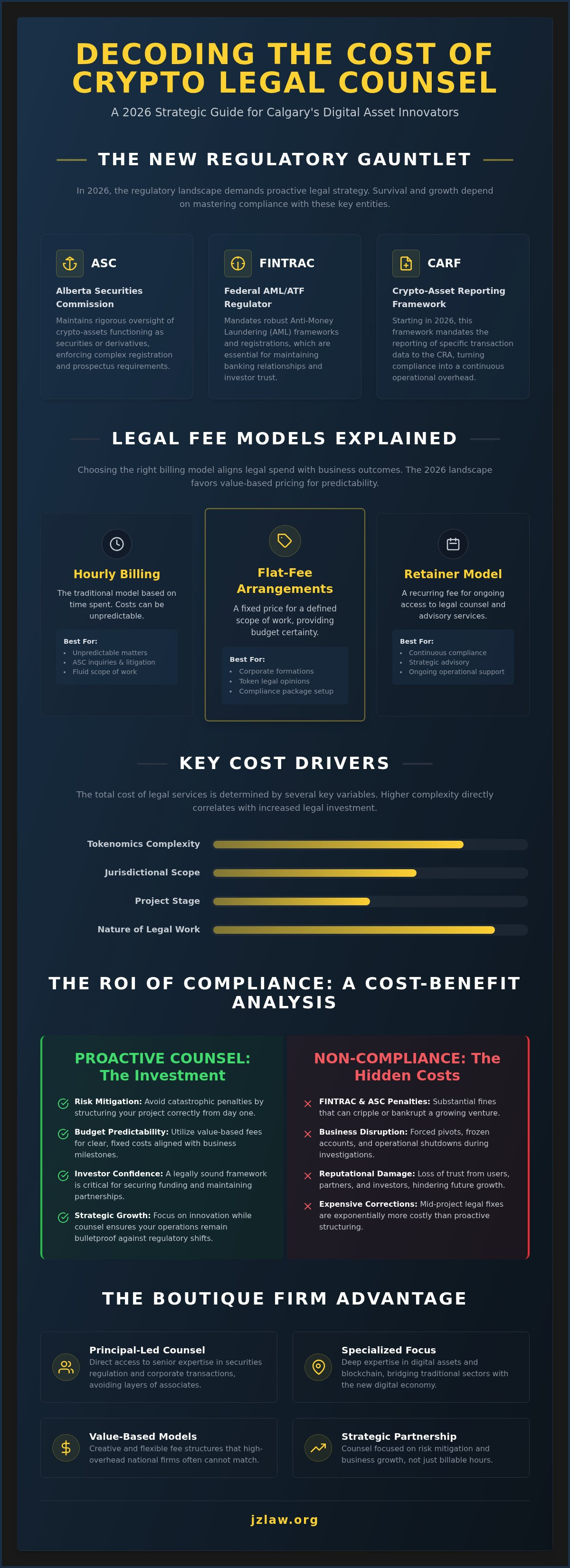
The Hidden Expenses of Non-Compliance vs. Professional Counsel
Many founders view the cryptocurrency lawyer calgary cost as a sunk expense, yet the true financial weight lies in the alternative. An unregistered securities offering in Alberta can lead to administrative penalties that dwarf any legal retainer. Beyond the immediate fines from the ASC, a regulatory freeze often results in a total cessation of operations, effectively incinerating your burn rate while your assets are locked. This disruption isn't just a pause; it's a profound loss of market momentum that most startups can't survive. Reputational damage in the digital asset space is permanent, often blacklisting founders from future fundraising rounds and institutional partnerships.
"Cheap" legal advice from generalists often leads to the most expensive litigation later. If a foundational contract or token distribution is structured incorrectly, the cost to remediate those errors under the pressure of a regulatory audit is astronomical. It's far more efficient to invest in a defensive, proactive legal strategy from the outset. This approach ensures your capital is spent on growth rather than on reactive damage control and legal defense funds.
Risk Mitigation as a Revenue Driver
Compliance shouldn't be viewed as a hurdle but as a fundamental asset that increases company valuation. A clean legal opinion is often the deciding factor for traditional financial institutions considering a partnership or for venture capitalists conducting due diligence. In the 2026 market, sophisticated investors prioritize ventures with bulletproof regulatory foundations. Understanding the nuances of cryptocurrency law across jurisdictions like Calgary and Toronto ensures your enterprise is viewed as a stable, long-term investment. This proactivity transforms legal fees into a competitive advantage during fundraising rounds.
Avoiding the 'Generic Lawyer' Trap
Hiring a generalist corporate lawyer often proves to be a false economy. You'll essentially be paying to educate them on the mechanics of blockchain, smart contracts, and the specific reporting requirements of the CARF. This lack of industry-specific knowledge leads to more billable hours and a higher risk of missing critical regulatory nuances. John Zang’s principal-led approach eliminates this learning curve. By working with a specialist who already understands the digital asset ecosystem, you reduce the total hours required for complex filings and strategic advice. Real-world examples abound of projects that failed not because of their technology, but because of poor legal foundations that couldn't withstand an audit.
If you're ready to secure your firm's future with senior-level expertise, contact JZ Law for a strategic consultation.
Strategic Legal Solutions: The JZ Law Approach
Managing your cryptocurrency lawyer calgary cost effectively requires a model that prioritizes senior-level efficiency over administrative bloat. Unlike massive national firms where clients often feel like a file number handled by junior associates, JZ Law operates on a principal-led basis. This means you receive direct access to John Zang’s expertise in every phase of your project's lifecycle. By eliminating the heavy overhead associated with "Big Law" structures, the firm delivers sophisticated counsel that remains agile and responsive to the rapid shifts in the digital asset market. This boutique efficiency ensures that every billable hour is focused on high-value strategic work rather than internal firm bureaucracy.
Our approach integrates deep expertise in securities regulation with a modern understanding of corporate finance. We don't view legal services as a series of isolated transactions; we view them as a long-term strategic partnership. This perspective is vital for blockchain ventures that require consistent guidance as they move from initial seed rounds to potential public offerings or acquisitions. By aligning our interests with your business growth, we help you build a predictable legal budget that supports, rather than hinders, your innovation.
Tailored Counsel for High-Stakes Tech
Every tech venture has a unique trajectory, and your legal fees should reflect that reality. JZ Law develops custom fee structures that respect the financial constraints of the startup lifecycle while providing the "bulletproof" protection necessary for institutional scaling. We maintain a proactive monitoring system for the Calgary market, staying ahead of ASC policy changes before they impact your operations. This commitment to precision in corporate transactions ensures that your smart contracts, token sales, and internal governance are defensible in any jurisdiction.
Next Steps: Securing Your Digital Future
To minimize your cryptocurrency lawyer calgary cost, preparation is essential before your initial consultation. We recommend organizing your technical whitepaper, current corporate records, and a clear summary of your jurisdictional goals. This transparency allows us to provide a more accurate assessment of your compliance needs from day one. During our strategic legal assessment, we'll discuss fee transparency openly, ensuring there's a mutual understanding of the project scope and the expected ROI of our counsel. Securing your firm's future in the 2026 regulatory environment starts with a conversation about risk, reward, and the legal foundations required for global success.
If you're ready to transition from reactive compliance to proactive growth, contact JZ Law to discuss your strategic legal assessment.
Securing Your Competitive Advantage in the Digital Economy
The 2026 regulatory landscape requires a shift from viewing legal expenses as a burden to recognizing them as a strategic shield. By understanding the variables that influence a cryptocurrency lawyer calgary cost, you can build a business that's both innovative and bulletproof against ASC scrutiny. A boutique, principal-led approach ensures your enterprise receives the high-stakes regulatory expertise it requires without the inefficiency of larger firms. Success in the blockchain sector depends on the precision of your corporate foundations and your ability to adapt to federal reporting mandates.
JZ Law provides the specialized focus and principal-level attention necessary to navigate these complexities with confidence. Whether you're structuring a private token sale or ensuring your FINTRAC registration is flawless, your legal counsel should be a partner in your growth. Take the next step in fortifying your project's longevity. Schedule a Strategic Consultation with JZ Law to align your regulatory strategy with your long-term business objectives. Let's build a secure future for your digital assets together.
Frequently Asked Questions
What is the typical hourly rate for a crypto lawyer in Calgary?
Industry data indicates that hourly rates for specialized counsel in major Canadian hubs like Calgary often reflect the practitioner's experience and the firm's overhead. While rates for senior legal expertise can vary, they typically align with the complexity of navigating Alberta Securities Commission mandates and federal FINTRAC registrations. You should always request a clear fee schedule during your initial consultation to ensure your budget aligns with the firm's professional standards and technical proficiency.
Do crypto lawyers in Alberta offer flat-fee packages for startups?
Flat-fee arrangements are frequently available for well-defined, procedural legal tasks that offer high predictability. These packages often cover standard business incorporations, the drafting of foundational Terms of Service, and initial FINTRAC registration filings. For many startups, this model provides essential budget certainty during the early stages of growth. However, more fluid matters, such as customized tokenomics structuring or responding to active regulatory inquiries, are usually handled through traditional hourly billing.
How can I reduce my legal costs when launching a token?
You can significantly lower your cryptocurrency lawyer calgary cost by arriving at your consultation with organized technical documentation. Providing a finished whitepaper, a detailed breakdown of your token's utility, and a list of target jurisdictions allows your lawyer to bypass the initial discovery phase. When you consolidate your questions and provide feedback in single, comprehensive batches, you minimize the administrative hours billed to your file while maintaining a focused strategic trajectory.
Is a retainer necessary for a cryptocurrency business?
A monthly retainer is highly recommended for enterprises operating in a rapidly shifting regulatory environment. This structure ensures you have immediate access to senior counsel when the ASC issues new guidance or when federal reporting requirements change under the 2026 CARF implementation. It transforms the legal relationship from a series of reactive transactions into a strategic partnership. This proactive oversight is often more cost-effective than hiring a lawyer only when an urgent crisis occurs.
Does the complexity of my blockchain tech affect the legal bill?
The intricacy of your underlying technology is a primary driver of professional fees. If your project involves novel decentralized finance protocols or complex smart contract logic, your lawyer must conduct a detailed analysis to ensure compliance with provincial securities law. Each layer of technical complexity requires additional time for due diligence and risk assessment. Projects utilizing standard utility tokens generally require fewer billable hours for regulatory clearance than those pioneering new asset classes.
What are the common disbursements in a crypto legal project?
Common disbursements include government filing fees, corporate search charges, and specialized software costs for blockchain analysis. In Alberta, you'll encounter specific ASC filing fees for prospectus exemptions or registration applications. Additionally, some projects require third-party audits to verify asset custody or technical security. These out-of-pocket expenses are paid by the firm on your behalf and are clearly itemized on your professional invoice to ensure complete financial transparency throughout the engagement.
Why is a specialized crypto lawyer more cost-effective than a generalist?
A specialist is more efficient because they don't require you to pay for their education on blockchain fundamentals. Generalists often spend billable hours researching basic concepts like gas fees or decentralized autonomous organizations. A specialized firm like JZ Law understands the technical and regulatory landscape from day one. This deep industry knowledge allows for more precise drafting and faster turnaround times, which ultimately reduces the total hours billed to your project.
Can legal fees for cryptocurrency compliance be tax-deductible in Canada?
Legal fees incurred for the purpose of earning business income are generally tax-deductible for Canadian corporations. This typically includes costs related to regulatory compliance, contract drafting, and strategic tax structuring. However, the deductibility of fees related to capital transactions or the initial issuance of tokens may follow different rules under the Income Tax Act. You should always consult with a qualified tax professional to confirm how these expenses apply to your specific corporate structure.


Comments