


Corporate Reorganization in Alberta: 2026 Legal Guide
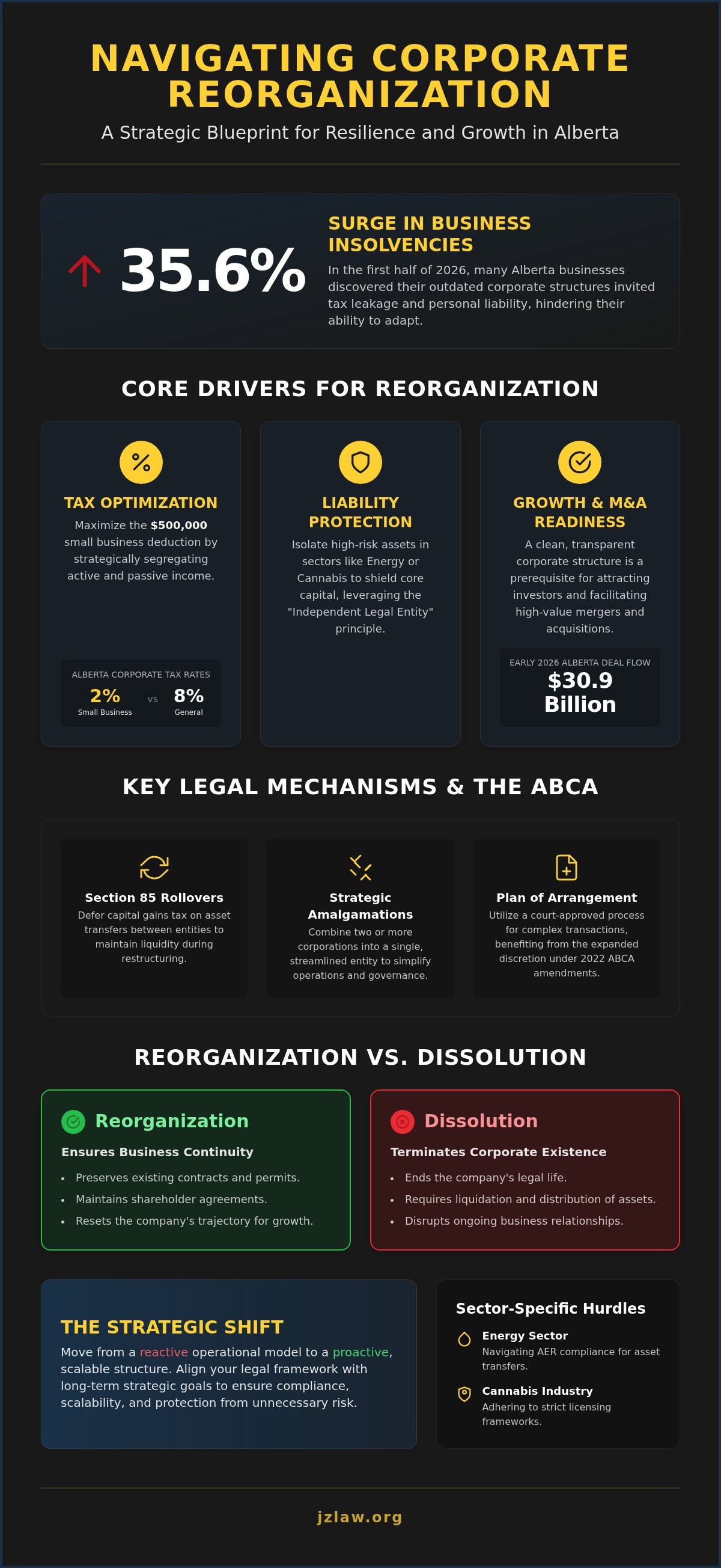
With business insolvencies in the province surging by 35.6% in the first half of 2026, many directors have come to a hard realization: the corporate structure that supported their initial growth is often the very thing inviting tax leakage and personal liability today. You likely feel the weight of an outdated framework that struggles to adapt to the shifting regulatory demands of Alberta’s energy or cannabis sectors. While a corporate reorganization in Alberta is a powerful tool for resilience, it requires a level of precision that goes beyond simple asset transfers; it’s about transforming a reactive necessity into a proactive strategic advantage.
This guide ensures you master the legal mechanisms and strategic advantages of restructuring your business to optimize for tax efficiency, liability protection, and long-term growth. We will examine the expanded court discretion under the Business Corporations Act (ABCA) and the sophisticated tax-deferred rollovers that protect your capital during transition. You'll gain a clear preview of how to align your corporate architecture with 2026 standards, ensuring your business remains compliant, scalable, and shielded from unnecessary risk.
Table of Contents
Understanding Corporate Reorganization in the Alberta Market
At its core, Corporate restructuring involves a fundamental recalibration of a company's legal, ownership, or operational framework to better align with its commercial objectives. In the current economic climate, a corporate reorganization in Alberta is rarely a matter of simple administrative preference; it's a strategic response to the rigidities of the Alberta Business Corporations Act (ABCA) and the evolving demands of the provincial market. Central to this process is the "Independent Legal Entity" concept. By maintaining a distinct separation between the corporation and its stakeholders, a well-executed structure acts as a primary shield for asset protection. When a business outgrows its initial formation, the legal architecture must evolve or risk becoming a liability itself.
Strategic drivers in 2026 often include preparing for an IPO, facilitating intergenerational wealth transfers, or executing rapid market pivots. You might notice early warning signs that your current structure is hindering growth, such as an inability to attract venture capital, excessive tax leakage on inter-company dividends, or a lack of clarity in director liability. Addressing these issues through a formal reorganization allows for a logical realignment of resources and legal obligations.
Why Businesses Restructure in 2026
The motivation for restructuring often stems from a need for precision in tax and risk management. With Alberta’s general corporate tax rate at 8% and the small business rate at 2%, the financial incentive to maintain an optimal structure is quantifiable. Strategic reorganization allows firms to:
Optimize for Tax Efficiency: Properly segregating active business income from passive investment income to maximize the small business deduction threshold of $500,000.
Isolate High-Risk Assets: In sectors like Oil and Gas or Cryptocurrency Law, it's vital to separate volatile operational risks from the parent entity's core capital.
Streamline for M&A: A clean, transparent structure is a prerequisite for the high-value mergers and acquisitions that characterized Alberta's $30.9 billion deal flow in early 2026.
The Distinction Between Reorganization and Dissolution
It's essential to distinguish reorganization from dissolution. While dissolution terminates a company's existence, a corporate reorganization in Alberta ensures the continuity of the business entity. This continuity is vital for maintaining existing contracts, permits, and shareholder agreements without the disruption of starting anew. Throughout the transition, the corporation must maintain a valid "Agent for Service" to ensure ongoing regulatory compliance and the receipt of legal notices. A successful reorganization doesn't just change the paperwork; it preserves the company's history while resetting its trajectory for future scalability.
The Legal Framework: Navigating the Business Corporations Act (Alberta)
The Business Corporations Act (Alberta) serves as the structural bedrock for every corporate entity in the province. It defines the parameters within which a company can evolve, ensuring that growth doesn't come at the expense of legal integrity. The amendments that came into force on May 31, 2022, fundamentally altered the landscape for a corporate reorganization in Alberta. These changes introduced significant flexibility, allowing businesses to pivot with less procedural friction than was previously required. For directors, this environment demands heightened vigilance. Your fiduciary duties and duty of care remain paramount during any restructuring; you must ensure the process serves the corporation's best interests while respecting the rights of creditors and stakeholders alike.
Shareholder rights provide a necessary counterweight to board-led initiatives. In the context of major structural changes, shareholders may exercise dissent and appraisal rights, allowing them to be paid the fair value of their shares if they object to the proposed transition. Balancing these interests requires a structured approach to governance. A Plan of Arrangement under the ABCA is a court-approved procedure designed to facilitate complex transactions that cannot be practically completed under other provisions of the Act. This mechanism is often the preferred route for high-stakes evolutions where certainty is required.
Court Discretion and Plans of Arrangement
Alberta courts now possess broader powers to approve creative reorganization schemes that align with modern commercial realities. The process typically begins with an interim court order to establish meeting parameters and notice requirements, followed by a final order once shareholder approval is secured. In specific reorganization types, the court can even reduce the statutory burden for shareholder approval if the arrangement is deemed fair and reasonable to all parties involved. This judicial oversight provides a layer of security that simple administrative filings cannot match.
Compliance with Registry Agents and NUANS Requirements
The administrative execution of your strategy is just as critical as the legal framework itself. Filing Articles of Amendment or Articles of Amalgamation with registry agents requires meticulous precision to avoid delays. If your reorganization involves a name change, a NUANS name search report is mandatory to ensure your distinctive elements remain compliant with provincial standards. Throughout this evolution, maintaining a consistent "Agent for Service" is vital for preserving your corporate standing and ensuring the receipt of legal notices. For those overseeing complex transitions, engaging a strategic legal partner ensures these administrative nuances don't compromise your operational timeline.
Key Mechanisms: Rollovers, Amalgamations, and Tax Structuring
Executing a corporate reorganization in Alberta requires a precise selection of legal mechanisms to achieve specific financial and structural goals. Section 85 rollovers remain a primary tool for deferring capital gains tax when transferring assets from a sole proprietorship or partnership into a corporate entity. By electing a transfer price equal to the tax cost of the asset, you ensure that capital isn't prematurely depleted by tax liabilities during the transition. This mechanism is particularly effective for businesses looking to formalize their structure before a significant growth phase or an external investment round.
Strategic consolidation often involves choosing between vertical and horizontal amalgamations. Vertical amalgamations merge a parent company with its wholly owned subsidiaries, whereas horizontal amalgamations unify sibling corporations under the same ownership. Under the Alberta Business Corporations Act, these procedures are designed to be efficient, allowing for the consolidation of resources without the administrative burden of multiple filings. Beyond simple mergers, the "Continuance" process allows a corporation to migrate its legal jurisdiction into or out of Alberta, ensuring the entity remains in the most favorable regulatory environment for its specific industry.
To attract venture capital or prepare for public offerings, businesses often utilize share swaps and capital structure reorganizations. These maneuvers allow for the creation of different share classes with varied voting rights and dividend preferences, providing the flexibility needed to negotiate complex investment terms. By recalibrating the equity framework, directors can align shareholder interests with the long-term vision of the corporation.
Tax Structuring for Business Growth
Sophisticated tax structuring often involves the strategic use of holding companies to insulate retained earnings from the operational risks of active subsidiaries. For family-owned Alberta businesses, "Estate Freezes" are a vital mechanism for intergenerational transfers. This process locks in the current value of the business for the founders while allowing future appreciation to accrue to the next generation. This approach mitigates immediate tax hits during asset reallocation and ensures the business's capital remains available for reinvestment rather than being diverted to satisfy tax obligations.
Amalgamation: Streamlining Multiple Entities
An amalgamation results in the legal merger of two or more corporations into a single surviving entity. It's critical to understand the principle of successor liability; the resulting corporation inherits all assets, but it also becomes responsible for all debts and legal obligations of the predecessor companies. Following the merger, streamlining the board of directors and harmonizing corporate bylaws is essential to establish a cohesive governance model. This administrative cleanup ensures that the new entity operates with a unified strategy and a clear chain of command.
Sector-Specific Challenges: Energy, Cannabis, and Tech
A corporate reorganization in Alberta is rarely a uniform procedure; it's a highly specialized evolution that must satisfy both the ABCA and industry-specific regulators. For companies in high-stakes sectors, structural changes must be synchronized with external compliance mandates to avoid operational paralysis. In the energy sector, for instance, Alberta Energy Regulator (AER) compliance is a critical hurdle during asset transfers. Alberta recorded 67 M&A deals in the second quarter of 2026, many of which required the transferee to demonstrate sufficient financial security for abandonment and reclamation obligations. Failure to secure AER approval before finalizing a reorganization can lead to the suspension of production or significant delays in license transfers.
Similarly, the cannabis industry operates under a microscope. Maintaining licensing and regulatory standing during ownership changes is mandatory. Even internal restructures that shift control between parent and subsidiary entities often require disclosure to AGLC or Health Canada to ensure all "key individuals" remain vetted. In the tech space, where Alberta's ecosystem value reached $28.7 billion USD in early 2026, reorganization often involves cryptocurrency law and FINTRAC registration. A structural shift that inadvertently breaks the chain of AML/KYC protocols can result in heavy fines or the loss of essential banking relationships.
Regulatory Continuity in Regulated Industries
The primary risk during a corporate restructuring is the unintentional revocation of operating licenses. Many provincial and federal licenses are non-transferable or require explicit pre-approval from regulatory bodies before the reorganization is finalized. Directors must also review "Change of Control" clauses in industry-specific contracts, such as joint venture agreements or master service agreements, which may be triggered by the restructure. Proactive engagement with regulators ensures the transition is viewed as a continuation of the business rather than a transfer of risk.
Taking Companies Public from Alberta
For tech and energy firms seeking to scale, converting a private Alberta corporation into a public entity is a common strategic goal. This process involves meeting the stringent structural requirements for a TSX or TSX-V listing, including specific board composition and auditing standards. Securities regulation plays a dominant role here; the reorganization must be designed to facilitate the transparency and reporting duties required of public issuers. If you're preparing for this level of evolution, consulting with a strategic legal partner is essential to ensure your structure meets the rigorous demands of the public markets.
Executing Your Reorganization: The JZ Law Approach
A corporate reorganization in Alberta is a high-stakes evolution that demands more than mere administrative filing; it requires a strategic partner who understands the friction between legal theory and commercial reality. Large, multi-service firms often treat restructuring as a volume-based task, but at JZ Law, we approach each project as a bespoke legal architecture. Our methodology is built on three pillars: strategic assessment, tax integration, and regulatory execution. We don't just move assets; we recalibrate your entire corporate framework to ensure it supports your 2026 growth targets while remaining resilient against market volatility.
Managing the timeline is essential to prevent operational drift. From the initial consultation to the final registry filings, our process is disciplined and transparent. We prioritize the proactive identification of potential shareholder or creditor disputes, which can often derail a restructure if not addressed in the early planning stages. By analyzing your existing shareholder agreements and debt covenants before any formal steps are taken, we mitigate the risk of litigation and ensure a smooth transition that preserves your business's reputation and its capital.
John Zang Services: Expertise Beyond the Basics
Leveraging deep experience in complex corporate transactions, JZ Law provides a level of sophistication typically reserved for global entities, delivered with the agility of a boutique firm. We focus on strategic outcomes. This means we don't just ensure you're compliant with the ABCA; we ensure your new structure actually drives value, whether through improved cash flow or enhanced liability protection. We act as the bridge between rigid legal compliance and your broader business strategy, ensuring that every amendment and amalgamation serves a specific commercial purpose.
Next Steps for Your Alberta Business
The first step toward a more efficient future is a comprehensive corporate structure audit. This diagnostic process identifies inefficiencies, such as redundant entities or structures that trigger unnecessary tax liabilities. To begin, you should gather your essential documentation, including up-to-date minute books, current financial statements, and detailed shareholder lists. These records form the foundation of any successful corporate reorganization in Alberta. Once your records are organized, scheduling a targeted consultation allows us to discuss your specific goals and design a roadmap for your company's evolution. Efficiency isn't found in the status quo; it's built through deliberate, strategic change.
Securing a Scalable Future for Your Enterprise
The landscape of Alberta business in 2026 demands a corporate structure that is as dynamic as the markets it serves. By leveraging the flexibility of the Business Corporations Act and employing sophisticated tax-deferred mechanisms, you can transform your legal framework from a rigid constraint into a strategic asset. Strategic corporate reorganization alberta planning ensures that your business remains tax-efficient, protected from operational liabilities, and perfectly positioned for future scaling or public listing.
Success requires a partner who understands the nuance of sector-specific regulations and the complexities of high-stakes transactions. It's vital to have counsel with decades of experience in Alberta corporate law and specialized expertise in Energy, Cannabis, and Tech. JZ Law provides the strategic oversight necessary to navigate these evolutions while bridging the gap between regulatory compliance and your broader business objectives, ensuring every structural change adds measurable value to your enterprise.
Take the proactive step to secure your organization's long-term health. Consult with JZ Law for your Alberta corporate reorganization to begin your structural audit today. We look forward to supporting your continued growth and success.
Frequently Asked Questions
What is the primary difference between a corporate rollover and an amalgamation?
A Section 85 rollover is a tax mechanism used to transfer specific assets into a corporation in exchange for shares, allowing for a deferral of capital gains tax. Conversely, an amalgamation involves the legal fusion of two or more existing corporations into a single surviving entity. While rollovers focus on tax-efficient asset reallocation, amalgamations result in a unified balance sheet where the new entity inherits all predecessors' rights and obligations.
Does a corporate reorganization in Alberta require court approval?
Most administrative changes, such as simple amalgamations or share capital amendments, do not require judicial intervention. However, complex corporate reorganization alberta strategies involving a Plan of Arrangement under the ABCA must receive an interim and final court order. The court ensures the proposed arrangement is fair and reasonable to all stakeholders, providing a layer of legal certainty that standard registry filings cannot offer.
How long does a typical corporate reorganization take to complete in Alberta?
The timeline varies significantly based on the complexity of the transaction. A straightforward amalgamation or share class amendment can typically be finalized within four to six weeks, including the time required for shareholder resolutions and registry filings. More intricate reorganizations involving court-supervised Plans of Arrangement or multi-jurisdictional continuances often take three to six months to navigate the necessary judicial hearings and regulatory pre-approvals.
Can I reorganize my company to avoid existing debts or legal liabilities?
No, reorganization is not a valid mechanism for evading existing legal obligations or debts. In an amalgamation, the surviving corporation automatically inherits all liabilities of the predecessor companies under the successor liability principle. Attempting to move assets to frustrate creditors may be challenged under provincial fraudulent preference legislation. Strategic restructuring focuses on optimizing future growth and liability segregation rather than escaping current financial responsibilities.
What are the tax implications of moving assets between subsidiaries?
Moving assets between subsidiaries can trigger immediate capital gains unless specific tax-deferred mechanisms, such as rollovers, are utilized. In 2026, Alberta's general corporate tax rate remains 8%, making tax-efficient transfers essential for preserving liquidity. Properly structured transfers allow for the reallocation of capital without depleting the corporation's cash reserves, ensuring that inter-company movements align with the overall strategic tax plan of the parent organization.
How does the Alberta Business Corporations Act (ABCA) protect minority shareholders during a reorganization?
The ABCA provides several safeguards, most notably dissent and appraisal rights, which allow minority shareholders to demand the corporation purchase their shares at fair value if they object to fundamental changes. Additionally, the oppression remedy allows shareholders to seek court intervention if the reorganization is conducted in a manner that is unfairly prejudicial or disregards their interests. These protections ensure that majority-led restructures remain equitable.
Do I need to update my NUANS report during a corporate restructuring?
You must obtain a new NUANS report if the reorganization involves changing the corporation's name to a new, distinctive title. A NUANS report is valid for 90 days and ensures your proposed name doesn't conflict with existing trademarks or corporate entities in Alberta. If the restructure preserves the existing name or uses a numbered corporation, a new report is generally not required for the filing of Articles of Amalgamation.
What role does the Alberta Energy Regulator (AER) play in oil and gas business reorganizations?
The Alberta Energy Regulator (AER) oversees the transfer of well, pipeline, and facility licenses during a reorganization. For energy companies in Calgary, the AER requires the transferee to demonstrate sufficient financial health to cover abandonment and reclamation costs before approving license transfers. This regulatory oversight ensures that corporate changes don't result in orphaned liabilities, making AER compliance a critical component of any oil and gas restructuring timeline.


Comments