


Buying a Cannabis Business in Alberta: The 2026 Legal & Regulatory Guide
The most valuable asset in your acquisition isn't the storefront or the inventory, but the continuity of the license itself. In the current market, buying a cannabis business in alberta means you're acquiring a specific regulatory standing that requires pre-emptive legal engineering to survive the transaction. You likely recognize the anxiety of facing a rigorous AGLC background check or the confusion of balancing municipal zoning with provincial mandates. It's a high-stakes environment where a single procedural error can jeopardize your C$3,000 deposit and halt operations for months.
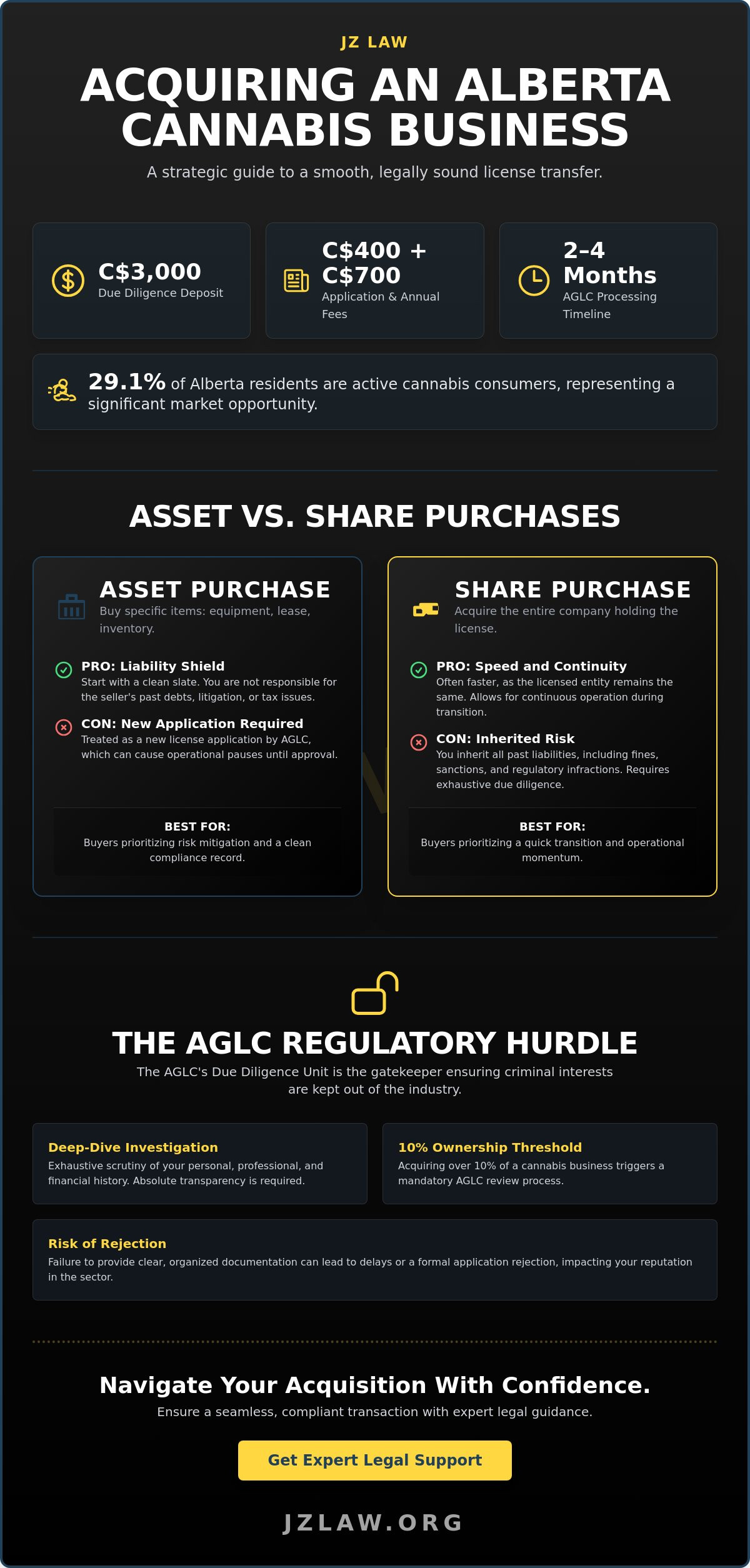
This guide offers a strategic framework to help you achieve a smooth, legally sound transfer while minimizing the risk of license suspension during the handover. We'll clarify the total acquisition costs, including the C$400 application fee and C$700 annual fee, and explain how the March 31, 2026, removal of the Qualified Cannabis Worker requirement impacts your staffing strategy. You'll gain a comprehensive understanding of the two to four month processing timeline and the structural differences between asset and share purchases to protect your investment in a province where 29.1% of residents are active consumers.
Key Takeaways
Identify the strategic advantages of asset versus share purchases to determine which deal structure best protects your capital and aligns with your long-term fiscal objectives.
Master the AGLC background check process when buying a cannabis business in alberta, including the management of the mandatory C$3,000 due diligence deposit.
Implement a preventative legal audit to verify the target’s compliance history and ensure the license remains in good standing with both provincial and federal authorities.
Navigate the distinct regulatory requirements for retail dispensaries under the AGLC and production facilities governed by Health Canada’s federal framework.
Establish a robust corporate foundation that facilitates scaling your retail footprint and prepares your enterprise for the complexities of taking the company public.
Table of Contents
Navigating Alberta Cannabis Acquisitions: Asset vs. Share Purchases
The structure of your transaction dictates your regulatory risk profile for years to come. When buying a cannabis business in alberta, you must choose between acquiring specific physical assets or purchasing the shares of the existing corporation. This isn't merely a technical preference; it's a strategic decision that determines whether you start with a clean regulatory slate or inherit the previous owner's standing with the AGLC. In 2026, as the provincial market matures and the AGLC continues its red tape reduction initiatives, understanding the nuances of Cannabis Regulation in Alberta is the difference between a seamless handover and a stalled application.
Ownership changes trigger mandatory reporting and review processes. The AGLC Due Diligence Unit scrutinizes any individual or entity acquiring more than 10% of a cannabis business. If the deal structure isn't engineered correctly, you risk a license suspension during the handover period, which can lead to a total loss of retail momentum and customer loyalty. Precision in these Corporate Transactions ensures that the legal entity remains compliant while the beneficial ownership shifts.
The Asset Purchase Model
In an asset purchase, you're buying the equipment, the lease, and the inventory, but the license itself doesn't simply transfer to the new owner. The AGLC typically treats this as a new application. While this provides a "clean break" from the seller's past corporate liabilities, it requires you to undergo the full licensing gauntlet.
Pros: You aren't responsible for the seller's hidden debts, past litigation, or historical tax issues. You only buy what adds value to your portfolio.
Cons: You must submit a new application, pay the C$400 fee, and provide the C$3,000 background check deposit. Operations may need to pause until the new license is issued.
Liability Protection: This model is the ultimate preventive tool for buyers who are wary of the seller's previous compliance record or financial history.
The Share Purchase Model
Share purchases involve taking over the entire legal entity that holds the license. This is often the preferred route for investors seeking speed and continuity. Since the corporation remains the licensee, the business can often continue operating throughout the transition, provided the AGLC approves the change in directors and shareholders.
Speed of Transition: Share deals can be faster because you're maintaining the existing corporate identity, which already has established relationships with the AGLC and suppliers.
Due Diligence Risks: You inherit every administrative sanction, fine, or regulatory infraction the company ever incurred. A violation from 2024 stays on the corporate record even after you take control.
Strategic Tax Structuring: We utilize advanced Tax Structuring to ensure the acquisition doesn't trigger unnecessary tax events while positioning the business for future growth or a potential public offering.
Choosing the right model requires a balance of risk tolerance and capital efficiency. Whether you're cherry-picking assets or taking over a legacy corporation, your legal framework must prioritize the survival of the retail license above all else.
The AGLC Regulatory Hurdle: Background Checks and Financial Scrutiny
The AGLC Due Diligence Unit serves as the primary gatekeeper for the provincial market. Their mandate is to ensure that criminal interests do not infiltrate the industry, a task they perform with exhaustive precision. When you're buying a cannabis business in alberta, this unit will conduct a deep-dive investigation into your personal, professional, and financial history. It's a rigorous process that demands absolute transparency and a well-organized paper trail. Failure to provide clear documentation doesn't just delay your start; it can lead to a formal rejection that stains your reputation in the sector.
A non-negotiable component of this process is the C$3,000 background check deposit. This isn't a flat application fee, but rather a draw-down account used to fund the investigative work required for your clearance. If the investigation is straightforward, the AGLC refunds the unused portion. However, if your corporate structure involves international entities or complex holding companies, the costs can quickly exceed the initial amount. You must also account for the C$400 non-refundable application fee per location and the C$700 annual license fee, ensuring these costs are factored into your initial capital allocation.
Screening isn't limited to the individual buyer. Every director, officer, and shareholder holding more than 10% interest in the corporation must undergo this personal and financial scrutiny. Even in 2026, with the AGLC's ongoing commitment to red tape reduction, the typical regulatory lead time remains two to four months. Planning for this window is essential to avoid unnecessary capital burn while your acquisition sits in regulatory limbo.
Financial Transparency Requirements
The AGLC requires an undeniable "source of funds" trail. They don't just want to see the balance in your bank account; they need to know exactly how that capital was earned or acquired. This scrutiny extends to your "Associates," meaning your investors' backgrounds matter as much as your own. Common red flags include large, unexplained cash deposits or involvement with individuals who fail the AGLC's integrity standards. We provide strategic Cannabis Licensing support to help you audit your financial disclosures before they reach the regulator's desk.
Municipal Approval and Zoning
Provincial approval is only one side of the coin. You must also secure municipal consent from local authorities in cities like Calgary or Edmonton. Local bylaws often enforce strict separation distances, such as the 100-meter rule from schools or provincial health care facilities. Before finalizing a deal, you must verify that the existing location's land-use permit is transferable and that no recent zoning changes have rendered the site non-compliant. Securing a municipal business license is a mandatory prerequisite that must be satisfied before the AGLC will issue your provincial retail license.
Evaluating Business Types: Retail Dispensaries vs. Production Facilities
The choice between retail and production isn't just a business preference; it's a choice between two entirely different regulatory universes. When buying a cannabis business in alberta, you must distinguish between the provincial oversight of the AGLC and the federal oversight of Health Canada. In 2026, the smart money is diversifying. While major urban centers like Calgary or Edmonton may feel saturated, rural growth areas and specialized micro-processing facilities offer significant opportunities for those with a long term strategic vision.
Vertical integration remains a complex area of law. As of 2026, Alberta's regulatory framework still maintains strict limitations on the relationship between producers and retailers. These rules prevent a single entity from dominating the entire supply chain, ensuring that retail shelf space remains accessible to various brands. Understanding these "financial interest" restrictions is vital if you plan to scale your footprint across both sectors. Our Cannabis Licensing expertise helps you navigate these boundaries to ensure your corporate structure remains compliant as you expand.
Buying a Retail Cannabis Store
Retail stores are primarily governed by the AGLC and the Alberta Retail Cannabis Store Handbook. When you evaluate a target location, your due diligence must extend beyond the balance sheet. You must audit their inventory management systems to ensure perfect synchronization with AGLC reporting requirements. A major regulatory shift occurred on March 31, 2026, when the AGLC removed the requirement for staff to be certified as "Qualified Cannabis Workers." This change reduces administrative friction during the hiring process, but it doesn't lower the operational bar. You must also verify the value of the lease and ensure the municipal zoning is "grandfathered," protecting the location from newer, stricter separation distance bylaws.
Acquiring Production or Cultivation Sites
Acquiring a cultivation or micro-processing site involves coordination with Health Canada under the federal Cannabis Act. These licenses don't simply transfer upon sale. The buyer and all key personnel must undergo rigorous federal security clearances. As of February 2026, there were 92 federally licensed producers in Alberta, and the valuation of these businesses often hinges on facility design. Facilities built to EU-GMP standards are particularly valuable, as they allow for international export into European medical markets. We provide Corporate Transactions support to manage the intricate handoff of these federal assets, ensuring that "Key Positions" like the Responsible Person or Head of Security meet all federal integrity requirements during the transition.
The Buyer’s Legal Due Diligence Checklist
A standard financial audit isn't enough when buying a cannabis business in alberta. You're acquiring a highly regulated entity where past mistakes can trigger future license revocations. Your primary objective is to verify the "Good Standing" of the license with both the AGLC and, if applicable, Health Canada. Precision is paramount. While a balance sheet reflects financial health, the regulatory history reveals the true operational integrity of the store. You must confirm that all administrative sanctions or fines have been disclosed and resolved before capital changes hands.
Commercial lease agreements require specific scrutiny under Real Estate Law. Many Alberta landlords include restrictive clauses that may prohibit the transfer of a lease for a cannabis-related tenant or demand a percentage of the gross revenue. You must ensure the lease is "cannabis-friendly" and that the term is long enough to justify your investment. Additionally, your due diligence should cover intellectual property, such as trademarks and proprietary genetics, alongside employee contracts that include robust non-compete agreements for the previous owners to protect your market share.
The Compliance Audit
A Regulatory Compliance Audit is a mandatory step for any 2026 acquisition to ensure that the licensee’s history doesn't jeopardize the buyer’s future standing. This process involves a deep dive into the AGLC bulletin history for the specific location to identify any patterns of non-compliance. You must also audit the "Seed-to-Sale" tracking software. Data integrity within these systems is a requirement for maintaining your license; any discrepancies found after the purchase will become your legal responsibility. For a thorough review of these risks, our Corporate Transactions team provides the forensic oversight necessary to secure your investment.
Inventory and Supply Chain Verification
Valuing existing stock is a common point of friction during acquisitions. You must distinguish between the AGLC wholesale pricing and the projected retail value while accounting for product shelf-life and consumer trends. Your checklist should include:
Reviewing active supply agreements with the AGLC and any permitted private wholesalers to ensure continuity of stock.
Verifying that every product on-site is legally sourced and bears the appropriate federal excise stamps.
Auditing the storage area to confirm it meets the AGLC’s strict security and physical separation requirements.
Ensuring all promotional materials comply with the clarified advertising rules established in November 2024.
A successful acquisition depends on your ability to uncover what isn't on the balance sheet. By following a structured preventative legal framework, you eliminate the uncertainty that often stalls cannabis deals in the Alberta market.
Strategic Growth: From Acquisition to Taking the Company Public
The completion of your transaction is not the end of your legal journey; it's the commencement of your corporate evolution. Successfully buying a cannabis business in alberta provides you with a beachhead in one of Canada's most active markets, but scaling requires a transition from a single-store mindset to a sophisticated corporate strategy. We position ourselves as strategic partners who don't just facilitate a sale but engineer a preventative legal framework designed for rapid expansion. When you're buying a cannabis business in alberta with the intention of a future exit or public listing, the initial deal structure is the most critical factor in your long term success.
Scaling your Alberta footprint involves more than just duplicating store layouts. Managing multiple retail licenses under a single corporate umbrella requires precise Securities Regulation and Tax Structuring to maintain compliance while optimizing cash flow. As you grow, the complexity of your reporting to the AGLC increases, especially when managing inter-retailer wholesale transactions, which are now permitted under 2026 regulations. A robust corporate foundation allows you to absorb new locations without the administrative friction that often slows down less prepared competitors.
Securities and Corporate Finance
Preparing your enterprise for external investment or an IPO requires a level of transparency and structural integrity that must be established long before you approach the markets. We specialize in Taking Your Cannabis Company Public, ensuring your governance meets the stringent requirements of the TSX or international exchanges like the NASDAQ. This involves rigorous auditing of your corporate history and ensuring that your Securities Regulation compliance is beyond reproach. Institutional investors demand a clear, documented path of regulatory adherence, a necessity for attracting significant capital in the cannabis sector.
The JZ Law Advantage
Our firm provides a bridge between traditional legal dignity and modern business agility. John Zang’s recognized expertise in cannabis licensing ensures that your regulatory standing remains secure at every stage of growth. We offer comprehensive support for strategic corporate transactions, drawing on our deep experience in complex sectors like energy and technology to provide a unique advantage to cannabis entrepreneurs. Every decision we make is rooted in a preventative mindset, helping you avoid the pitfalls that lead to license suspensions or failed audits. Contact us today to secure your Alberta cannabis investment and begin building a legacy in this dynamic industry.
Securing Your Position in the Alberta Cannabis Market
Securing a foothold in this sector requires more than operational talent; it demands a sophisticated legal foundation. Successfully buying a cannabis business in alberta hinges on your ability to navigate the two to four month AGLC approval timeline and manage the C$3,000 background check deposit with absolute transparency. Whether you choose an asset purchase to minimize historical liability or a share purchase for operational continuity, your decision today determines your ability to scale tomorrow. We've seen that the removal of the Qualified Cannabis Worker requirement on March 31, 2026, has shifted the focus toward corporate integrity and robust financial disclosure.
A preventative legal strategy isn't just about passing a single audit. It's about building a structure capable of handling complex corporate transactions and future public listings on major exchanges. Our team offers specialized expertise in both AGLC and Health Canada frameworks, positioning your enterprise for sustainable growth and long term compliance. Consult with JZ Law for your Alberta cannabis acquisition to ensure your investment is protected by a strategic partner who understands the intersection of regulatory hurdles and high-stakes corporate finance. Your vision for a market leading brand deserves a legal framework as ambitious as your business goals.
Frequently Asked Questions
How much does a cannabis retail license cost in Alberta in 2026?
The initial cost for a retail license includes a non-refundable C$400 application fee and a C$700 annual license fee. Applicants must also provide a C$3,000 initial deposit to cover the costs of the AGLC background check. This financial commitment ensures that all investors are properly vetted while covering the administrative expenses of provincial oversight.
Can a non-resident of Canada buy a cannabis business in Alberta?
Non-residents can acquire an interest in a cannabis business, but they must pass the same rigorous AGLC Due Diligence Unit screening as domestic buyers. Any individual or entity holding more than 10% interest in the licensee must undergo a full personal and financial background check. This process maintains the integrity of the Alberta market by ensuring all beneficial owners meet provincial standards.
How long does it take to transfer a cannabis license to a new owner?
The AGLC estimates a processing time of approximately two to four months for most license applications and ownership transfers. This timeline allows the regulator to complete background checks and verify municipal approvals for the new owners. When buying a cannabis business in alberta, you should plan for this lead time to ensure there's no gap in your retail operations.
Do I need a separate license for each cannabis store location in Alberta?
Yes, the AGLC requires a unique license and a separate C$400 application fee for every retail location you operate. Each site must independently meet provincial requirements for physical security, including an alarm system and video surveillance. This ensures that every store under your corporate umbrella maintains the same high standard of regulatory compliance.
What happens to the existing cannabis inventory during a business sale?
In a share purchase, the inventory remains with the corporation, but an asset purchase requires a more complex transfer process. You must ensure that all stock on-site is legally sourced and bears the correct federal excise stamps before the handover. All inventory transfers must be documented within your seed-to-sale tracking software to maintain data integrity for the AGLC.
Can I sell both cannabis and alcohol in the same retail store in Alberta?
No, provincial regulations require that a retail cannabis store must be physically separate from any other business. You cannot co-locate cannabis sales with alcohol, tobacco, or general merchandise within the same premises. This separation is a standing regulation designed to keep cannabis retail environments dedicated and age-restricted for customers 18 and older.
What is the AGLC background check deposit and is it refundable?
The C$3,000 background check deposit is used by the AGLC to fund the investigative work required for your security clearance. It's not a flat fee; the regulator draws from this deposit to cover actual investigative costs and refunds any unused portion to the applicant. If your corporate structure is complex or involves international entities, you may be required to provide additional funds.
Are there limits on how many cannabis retail stores one person can own in Alberta?
Alberta has shifted toward a more deregulated market, and there's currently no hard provincial cap on the total number of retail licenses a single entity can hold. However, your expansion when buying a cannabis business in alberta is still subject to municipal zoning and the AGLC’s ongoing monitoring of corporate concentration. Each new location must still satisfy all individual licensing and security requirements.



Comments