


Cannabis Retail License Consultant NYC: Strategic Legal Guidance for 2026
- jzanglaw
- May 5
- 13 min read
While over $3 billion in retail sales have been recorded through April 2026, the reality is that the New York market has shifted from a speculative race to a disciplined legal marathon. With only 599 legal dispensaries currently operational statewide, the barrier to entry isn't just the $2,000 application fee; it's the ability to withstand a rigorous regulatory backlog. Partnering with a dedicated cannabis retail license consultant NYC is no longer a luxury for the ambitious. It's a fundamental requirement for any entrepreneur who views their retail license as a high-value corporate asset rather than a mere permit. You've likely felt the frustration of opaque OCM requirements and the fierce competition for zoning approval that has sidelined thousands of applicants since 2023.
We understand that the risk of application denial due to a minor technicality is a direct threat to your capital and your future. This article provides a strategic roadmap to securing your adult-use retail license by focusing on rigorous legal stewardship and scalable corporate structuring. We'll examine the critical steps for successful community board hearings, the implications of the May 7, 2026 Cannabis Control Board meeting, and how to prepare your business for the next available licensing window.
Key Takeaways
Understand the 2026 regulatory shift from justice-involved priorities to general licensing rounds and how to position your application for the next window.
Learn why engaging a cannabis retail license consultant NYC is essential for safeguarding sensitive operational data through attorney-client privilege.
Master the specific local mandates of the five boroughs, including the mandatory 30-day Community Board notice and strict real estate proximity rules.
Identify the legal frameworks required for 280E tax mitigation and the corporate structuring necessary to support long-term profitability.
Discover the principles of post-licensing stewardship to maintain 24/7 compliance and facilitate the strategic scaling of your retail footprint.
Table of Contents The Evolving Landscape of NYC Cannabis Retail in 2026 Why a Legal Consultant is Essential for NYC Retail Licensing Evaluating Cannabis Retail License Consultants: A Decision Framework The NYC-Specific Obstacles: Zoning, Community Boards, and OCM Compliance Strategic Cannabis Licensing with JZ Law: Beyond the Application
The Evolving Landscape of NYC Cannabis Retail in 2026
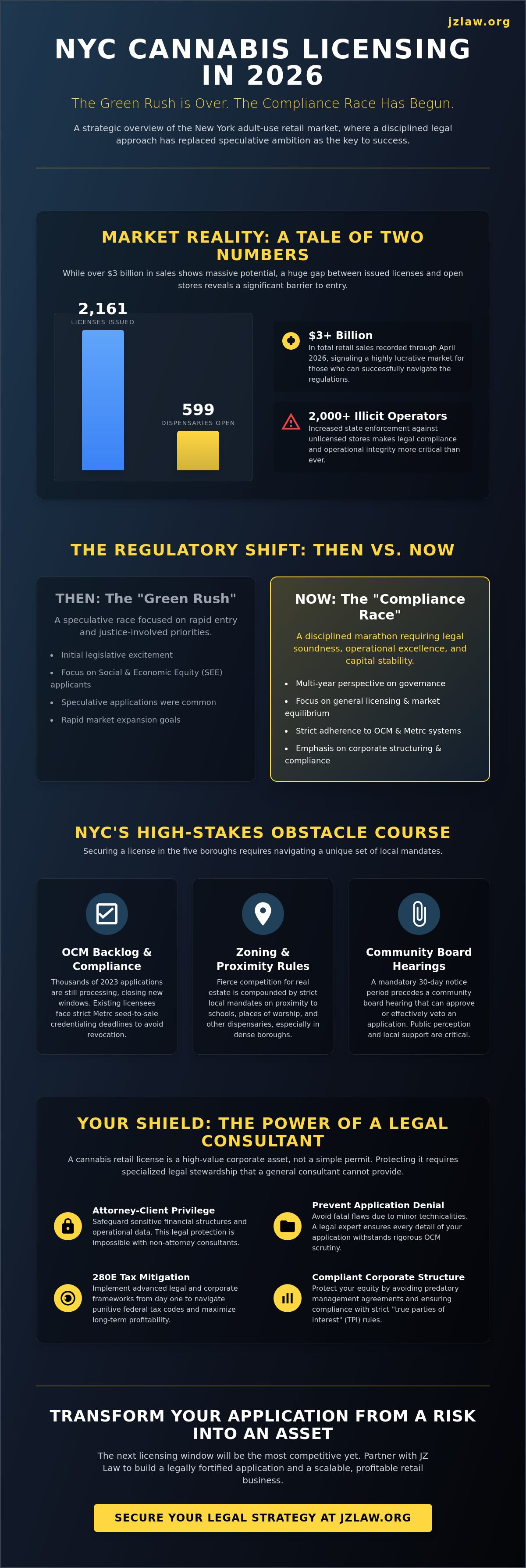
The New York cannabis market has reached a pivotal juncture in May 2026. While the initial legislative excitement has cooled, the operational reality has intensified. As of May 1, 2026, the Office of Cannabis Management (OCM) has issued 2,161 adult-use licenses statewide, yet only 599 dispensaries have successfully navigated the transition to open doors. This discrepancy highlights a fundamental shift. We aren't just looking at a "Green Rush" anymore; we're witnessing a "Compliance Race" where only the most legally sound structures survive. The era of speculative application is over. Success now requires a disciplined, multi-year perspective on corporate governance and regulatory adherence.
The current landscape is defined by the OCM's focus on processing the massive backlog of thousands of applications submitted in 2023. This administrative bottleneck means that new application windows remain closed, making the stewardship of existing provisional licenses more critical than ever. While Social and Economic Equity (SEE) applicants still represent 56% of all awarded licenses, the market is maturing toward a general licensing environment where operational excellence and capital stability are the primary filters for longevity. Proactive legal positioning is no longer optional in a saturated urban market where enforcement against the 2,000+ illicit operators has become a top priority for the state.
New York Adult-Use Market Maturity
Understanding the History of Cannabis Legalization in New York is vital for contextualizing why Manhattan and Brooklyn face such high retail density today. The 2026 supply chain is more stable, but retail density in core NYC boroughs has made application scoring significantly more competitive. The OCM's role has shifted from rapid expansion to maintaining market equilibrium. They're now prioritizing the enforcement of the Metrc seed-to-sale system, which required all licensees to be credentialed by December 17, 2025. If you're operating in this space, your legal strategy must account for these granular technical requirements to avoid the revocations that have recently impacted the total license count.
The Legal Necessity of Expert Counsel
In this environment, a general consultant isn't enough. A specialized cannabis licensing strategy requires the precision of a legal firm. Utilizing a cannabis retail license consultant NYC who understands the interplay between state OCM mandates and the city's specific municipal codes is a strategic imperative. Unlike non-legal application writers, an attorney provides attorney-client privilege. This is essential when you're disclosing sensitive financial structures or multi-jurisdictional holdings. Relying on a consultant without a legal background leaves your corporate strategy vulnerable to discovery and lacks the preventive, strategic depth needed to navigate the community board hearings that often decide a retail store's fate.
Why a Legal Consultant is Essential for NYC Retail Licensing
A specialized legal consultant serves as the definitive safeguard against regulatory forfeiture, ensuring that a single administrative oversight doesn't dismantle years of capital investment. While the temptation to use general business consultants is high, the NYC market requires a level of precision that only a legal framework can provide. Licensing isn't a mere filing exercise; it's a high-stakes corporate transaction where every disclosure carries permanent legal weight. Engaging a cannabis retail license consultant NYC with a legal background transforms the application from a hopeful submission into a protected corporate asset.
The industry has seen a rise in predatory management agreements where third-party operators attempt to seize disproportionate control. These contracts often violate the strict "true parties of interest" (TPI) rules established by the NYS Office of Cannabis Management. Without a rigorous legal review, retail owners risk signing documents that lead to automatic license revocation. We prioritize the integrity of your corporate structure, ensuring that your ownership remains compliant while protecting your long-term equity from aggressive outside interests.
Privilege and Confidentiality
Maintaining attorney-client privilege is critical during the sensitive phase of corporate structuring and fundraising. General consultants don't offer this protection; their records and communications can be subpoenaed in future disputes or audits. By contrast, a legal practice ensures that your trade secrets and proprietary operational plans remain shielded from public disclosure. This confidentiality is vital when negotiating with investors or discussing internal financial models that define your competitive edge in the Manhattan or Brooklyn markets.
Regulatory Precision in NYC
Zoning in New York City is notoriously complex, requiring an expert interpretation of the latest OCM guidance on retail proximity. A successful application must account for the exact distance from schools and houses of worship, often measured down to the inch. We ensure that every Standard Operating Procedure (SOP) meets these strict legal standards before submission. If you're concerned about how these regulations impact your specific location, a consultation with a strategic legal partner can identify these risks before you commit to a lease. This preventive approach mitigates the technicalities that caused many of the thousands of pending applications from 2023 to stall in the current backlog.
Real estate remains the most significant hurdle for NYC retailers. We focus on lease contingencies that protect the tenant if a license is denied or delayed. Without these specific legal protections, an entrepreneur could be held liable for a multi-year commercial lease in a high-rent district without the legal right to operate. Our role is to bridge the gap between municipal real estate law and state cannabis regulations, creating a seamless path to operational status.
Evaluating Cannabis Retail License Consultants: A Decision Framework
Selecting a cannabis retail license consultant NYC is a decision that defines the structural integrity of your enterprise. It's not merely about administrative assistance; it's about securing a strategic partner who understands that a license is the foundation for a multi-million dollar corporate asset. You need a representative who navigates the local political dynamics of New York’s 59 community boards with the same precision they apply to complex tax codes. As highlighted in the NYC Cannabis Licensing Information portal, the process involves distinct municipal hurdles that require more than just state-level knowledge.
When evaluating potential partners, prioritize these four pillars of expertise:
Local Political Literacy: Success in Manhattan or Queens often hinges on community board approval. Your consultant must possess the diplomatic weight to present your business as a community asset rather than a neighborhood disruption.
Tax and 280E Mitigation: Federal tax limitations remain a primary threat to retail margins. A consultant must demonstrate deep knowledge in tax structuring to optimize your position.
Cross-Border Capability: If your capital comes from international sources or you plan to expand into other states, your corporate structure must be compliant across multiple jurisdictions from day one.
Regulatory Muscle: Look for a track record in other rigorously regulated sectors like securities or cryptocurrency law. This ensures they can handle the OCM’s shifting requirements with professional composure.
Consultant vs. Law Firm: The Strategic Difference
Many entrepreneurs discover too late that a consultant’s work often ends at the submission button. A law firm’s engagement is a continuous partnership built on professional accountability. We provide a level of liability and security that application-only firms simply can't match. While a consultant might offer "advice," an attorney provides "counsel" that is legally actionable and protected by privilege. This distinction becomes vital during the post-licensing phase when operational compliance determines whether you keep your shop open or face the revocations that impacted the total license count in early 2026.
The Role of Tax and Securities Expertise
Clean corporate hygiene is the prerequisite for any future exit or expansion. Investors prioritize entities that have been structured with the same rigor required for taking companies public. If your initial licensing documents are riddled with inconsistencies, you'll spend more fixing them during due diligence than you would have spent on proper legal guidance from the start. We ensure your corporate bylaws, operating agreements, and TPI disclosures are investor-ready. This allows you to scale your NYC footprint without the friction of past regulatory errors or structural flaws.
The NYC-Specific Obstacles: Zoning, Community Boards, and OCM Compliance
Navigating the administrative maze of New York City requires more than state-level compliance; it demands a mastery of municipal friction. While the OCM sets the broad rules, the city’s 59 individual Community Boards and the Department of Buildings (DOB) create the granular hurdles that often determine a project's viability. The most critical local requirement is the mandatory 30-day "Notice to Municipalities." This isn't a mere notification. It's a legal trigger that initiates a period of intense community scrutiny. Engaging a cannabis retail license consultant NYC ensures that your municipal notice is framed to minimize local opposition before the public hearing even begins.
The physical build-out of a Manhattan or Brooklyn storefront involves more than just aesthetics. You must satisfy the FDNY’s fire safety codes and the DOB’s strict occupancy requirements. These departments operate independently of the OCM, meaning a retail owner could possess a valid state license but be legally barred from opening due to a local building permit issue. We bridge this gap by coordinating the legal requirements of your lease with the physical realities of NYC’s infrastructure.
Mastering the Community Board Hearing
Success at a Community Board hearing requires a "Community Impact Plan" that addresses the specific anxieties of NYC residents. These boards often harbor concerns regarding foot traffic, security, and neighborhood character. We develop legal strategies for rebutting unfounded objections, ensuring that the board’s recommendation is based on facts rather than stigma. Local political intelligence is vital here. Each board in the five boroughs has its own internal culture and history with the cannabis licensing process. We help you navigate these nuances with the professional dignity and precision your brand deserves.
Zoning and Real Estate Contingencies
NYC Zoning Resolution maps are notoriously intricate, and the distance requirements for cannabis retail are absolute. A storefront must be at least 500 feet from a school and 200 feet from a house of worship. These measurements are often contested, and a mistake of a few inches can lead to an immediate application rejection. We focus on drafting "cannabis-contingent" leases that protect your capital. These contracts ensure that your financial obligations are tied to the successful issuance of your license and the approval of your specific location. If you're currently evaluating potential sites, our team can review your NYC zoning suitability to ensure your capital isn't tied to a non-compliant location.
Ensuring the physical premises meet OCM security mandates is the final step in this phase. From reinforced entry points to specific camera placement, the legal standards for a 24/7 retail environment are rigorous. We provide the preventive oversight needed to ensure your site plan is approved on the first attempt, avoiding the costly delays that have plagued thousands of applicants since the market’s inception.
Strategic Cannabis Licensing with JZ Law: Beyond the Application
Securing your adult-use retail license is the commencement of a complex corporate journey, not its conclusion. In the high-velocity NYC market of 2026, the focus must shift from acquisition to stewardship. Maintaining a license in a 24/7 retail environment requires a preventive legal posture that anticipates regulatory shifts before they manifest as violations. Choosing a cannabis retail license consultant NYC who offers the strategic depth of John Zang Services ensures that your operation isn't just compliant today, but remains an attractive, scalable asset for years to come. We view your license as a foundation for broader corporate transactions, requiring the same rigor as any other high-value security.
The operational reality in New York now demands absolute precision in inventory tracking. All retail licensees were required to be credentialed in the Metrc seed-to-sale system by December 17, 2025, and associate existing inventory with package identifiers by January 12, 2026. Failure to maintain these records with 100% accuracy is the fastest route to an OCM audit and potential revocation. Our role is to provide the oversight that keeps your business operational while you focus on the marketplace.
Continuous Compliance and Audit Readiness
Operational hygiene is the only defense against the OCM’s increasing focus on enforcement. We implement internal legal audits that mirror the state’s own inspection protocols, ensuring your Metrc data and physical inventory package identifiers are beyond reproach. Beyond inventory, managing employee relations through mandatory Labor Peace Agreements is a critical municipal requirement in New York that requires careful contract drafting. Ongoing legal counsel is the fundamental prerequisite for retail survival in an environment where minor administrative errors lead to immediate license suspension.
Corporate Evolution and Exit Strategies
Scaling your footprint across the five boroughs requires a sophisticated application of real estate law to manage multi-site retail ownership effectively. As Multi-State Operators (MSOs) look to acquire established NYC brands, the value of your exit depends entirely on the cleanliness of your corporate records. We structure your business for high-value transactions, ensuring that your tax positioning and securities filings are investor-ready from the start. Our commitment is to a long-term strategic partnership that views your dispensary not just as a shop, but as a cornerstone of a robust corporate portfolio.
Securing Long-Term Prosperity in the New York Cannabis Market
The transition from the initial licensing backlog to a stable, $3 billion retail market in 2026 has redefined the requirements for success. It's clear that securing a storefront in Manhattan or Brooklyn requires more than just administrative filing. It demands a sophisticated legal strategy that addresses the 30-day community notice triggers and the absolute zoning requirements of the New York City Zoning Resolution. By engaging a cannabis retail license consultant NYC who operates with the precision of a corporate law firm, you transform a regulatory permit into a protected enterprise. We provide the principal-led expertise of John Zang to navigate these hyper-local hurdles while building a comprehensive corporate and securities law foundation for your brand.
Your retail operation deserves a strategic partner who understands the nuances of Metrc compliance and the complexities of 280E tax mitigation. Whether you're navigating your first community board hearing or preparing for a high-value exit to a Multi-State Operator, we provide the stability your capital requires. Secure Your NYC Cannabis Future with JZ Law and ensure your business is built on a foundation of legal integrity and strategic foresight. The future of NYC retail belongs to those who prioritize compliance today.
Frequently Asked Questions
What is the role of a cannabis retail license consultant in NYC?
A consultant provides the strategic framework necessary to navigate the Office of Cannabis Management's shifting regulations while ensuring your business structure is legally sound. They manage the technicalities of the application process, coordinate with municipal bodies, and oversee the implementation of required systems like Metrc. This role is essentially a safeguard for your capital in a high-stakes regulatory environment where administrative errors lead to immediate disqualification.
How much does it cost to apply for a cannabis retail license in New York in 2026?
The non-refundable application fee for a standard adult-use retail dispensary license is $2,000 as of May 2026. This fee is strictly for the application submission and doesn't include costs for legal counsel, real estate acquisition, or the build-out of the physical premises. Licensees must also account for renewal fees every two years upon approval by the Cannabis Control Board, which held its most recent meeting on May 7, 2026.
Do I need a lawyer or just a consultant for my NYC dispensary application?
While a consultant can assist with paperwork, a lawyer provides attorney-client privilege and professional liability that a standard consultant cannot offer. Engaging a cannabis retail license consultant NYC with a legal background ensures your corporate disclosures and "true parties of interest" structures are protected from public discovery. This legal oversight is vital for long-term corporate transactions and preventing regulatory forfeiture during the sensitive application phase.
How long does the NYC cannabis retail licensing process take?
The timeline is currently extended due to the OCM processing a significant backlog of thousands of applications submitted in 2023. There's no fixed timeline for new applicants as the state focuses on operationalizing the 2,161 licenses already issued as of May 1, 2026. Applicants should prepare for a multi-stage process that includes mandatory community board reviews and OCM technical evaluations that can span several months or longer.
What are the main reasons NYC cannabis license applications are denied?
Applications are frequently denied due to technical errors in zoning proximity or inconsistencies in "true party of interest" disclosures. Failure to provide a compliant 30-day notice to the local Community Board or submitting non-compliant Standard Operating Procedures also leads to rejection. In early 2026, many applicants faced delays or denials simply for failing to meet the strict Metrc credentialing deadlines required for retail inventory association.
Can I own multiple cannabis retail locations in New York City?
New York regulations allow for multi-site retail ownership, though specific rules regarding vertical integration and total store counts apply. As of May 2026, the focus has shifted toward building scalable corporate structures that can support several locations across the five boroughs. Strategic legal planning is required to ensure each site meets individual municipal and zoning requirements without compromising the parent entity's license or equity structure.
What are the zoning requirements for a dispensary in Manhattan?
A retail dispensary in Manhattan must be located at least 500 feet from any school grounds and 200 feet from any house of worship. These measurements are absolute and based on the NYC Zoning Resolution maps. Additionally, you must ensure the physical premises meet OCM security and layout mandates, which often require specific DOB and FDNY approvals that operate independently of state cannabis licensing.
How do I prepare for a NYC Community Board hearing for my cannabis license?
Preparation begins with developing a comprehensive "Community Impact Plan" that addresses local concerns regarding security, foot traffic, and neighborhood character. You must submit your 30-day notice to the board with precision and be prepared to rebut objections with factual, legal arguments during the public hearing. Success often depends on demonstrating that your business is a professional, compliant addition to the local Manhattan or Brooklyn community.


Comments