


Colorado MED License Renewal Requirements: The 2026 Compliance Checklist
A Colorado MED renewal is no longer a mere administrative formality; it's a high-stakes regulatory audit that determines whether your business assets remain protected or become liabilities. Many operators, including Canadian firms with significant cross-border holdings, approach this cycle with a sense of dread, fearing that a single clerical error or a misunderstood disclosure could lead to an immediate license suspension. This anxiety is well-founded, especially as the Marijuana Enforcement Division moves toward a more rigorous, digitally-driven oversight model. Understanding the specific Colorado MED license renewal requirements is the only way to ensure your operations remain uninterrupted in an increasingly scrutinized market.
You deserve the peace of mind that comes from a meticulously prepared filing. This guide provides a strategic legal checklist designed to help you master the 2026 shifts, from the new Unified Application Option to the complex residual solvent testing disclosures. We'll examine the latest rule changes adopted on September 10, 2026, and break down the digital transformation of employee licensing, including the shift to the $162 renewal fee and electronic-only badges. By the end of this article, you'll have a clear roadmap to navigate these regulatory hurdles with the precision of a seasoned strategist, significantly reducing your risk of a post-renewal audit.
Table of Contents
The 2026 Colorado MED Regulatory Landscape: What Has Changed?
The Colorado Marijuana Enforcement Division (MED) has moved beyond its early role as a simple gatekeeper. In 2026, the division functions as a sophisticated, data-driven regulator focused on public health and financial transparency. This shift is clearly reflected in the evolving Colorado MED license renewal requirements, which now demand a higher level of technical and legal precision from operators. To understand the current climate, it helps to look at the history of cannabis legalization in Colorado; the state has transitioned from a pioneering experimental market to a mature industrial sector that requires rigorous oversight.
Rescheduling and Federal Compliance Shifts
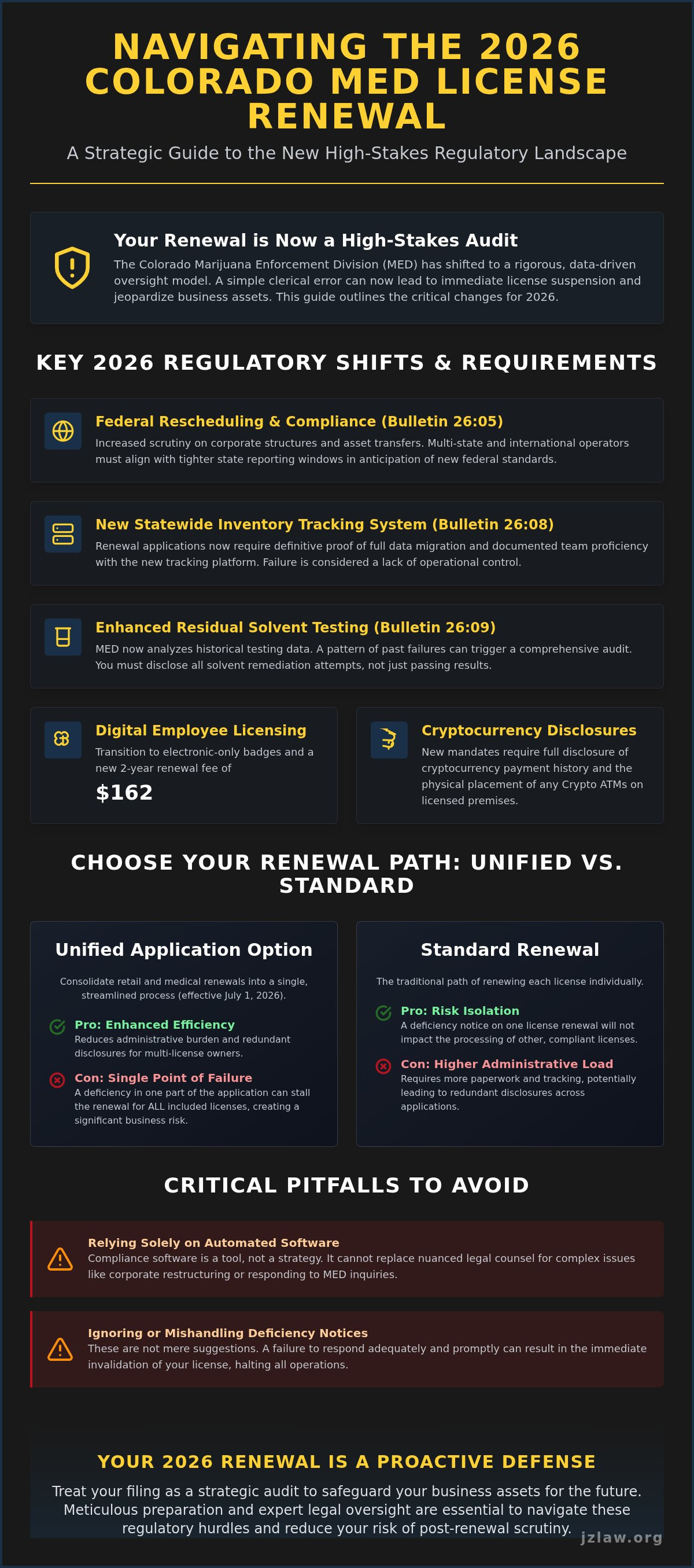
Bulletin 26:05, the Attorney General Rescheduling Order, represents a pivotal moment for Colorado licensees. While federal rescheduling offers a glimpse of future normalization, its immediate impact on state-level reporting is complex. For multi-state operators or Canadian firms with Colorado interests, this order changes how corporate structures and asset transfers must be disclosed during renewal. You can't assume that federal shifts relax state duties. Instead, the MED is tightening its reporting window to ensure state records align with anticipated federal standards. Strategic positioning of your cannabis assets now requires a dual-track approach that satisfies Colorado's strict disclosure rules while preparing for a new era of interstate commerce.
New Inventory and Testing Standards
The technical hurdles for 2026 renewals have expanded significantly. Bulletin 26:08 announced the transition to a new Statewide Inventory Tracking System, requiring licensees to prove full data migration and system proficiency as part of their renewal package. Simultaneously, Bulletin 26:09 introduced enhanced residual solvent testing requirements. Compliance isn't just about current batches; the MED now looks at your historical testing data. A pattern of failures in the previous year can now trigger a comprehensive renewal audit. You must provide granular evidence of solvent remediation protocols. Additionally, the 2026 fee schedule reflects these administrative shifts, with employee renewal fees currently set at approximately C$162 for the two-year term.
Testing Failures: Historical data is now a primary indicator of operational fitness.
Documentation: Operators must disclose all remediation attempts, not just final passing results.
System Migration: Proof of training on the new inventory platform is now a prerequisite for a successful filing.
Failing to address these technical shifts in your application isn't just a clerical error. It's seen as a failure of operational control. This can lead to immediate deficiency notices that stall your business for weeks. Professional oversight ensures that your renewal isn't just a form you fill out, but a strategic defense of your business assets.
Unified Application vs. Standard Renewal: Selecting Your Path
The introduction of the Unified Application Option on July 1, 2026, represents a significant step by the Colorado Marijuana Enforcement Division (MED) toward regulatory modernization. This path allows operators to merge their retail and medical renewals into one consolidated process. It's designed to reduce the administrative burden on businesses that have grown through vertical integration or multi-license ownership. Yet, mastering the Colorado MED license renewal requirements under this new framework requires more than just filling out a new form. It demands a high-level understanding of how the MED's internal review priorities have shifted for the 2026 cycle.
Pros and Cons of Consolidation
Administrative overhead is a constant drain on cannabis resources. By consolidating, you can theoretically reduce the time spent on redundant disclosures and align your expiration dates. While this simplifies long-term compliance tracking, the "single point of failure" risk is substantial. If the MED identifies a deficiency in one license within a unified application, the entire package may be stalled. This could leave your other, compliant licenses in a state of administrative limbo. Processing timelines for unified applications are intended to be faster, but a single error can trigger a cascade of delays across your entire portfolio.
Efficiency: Reduced clerical work and synchronized renewal dates for vertically integrated firms.
Risk: A deficiency notice on one license can halt the approval of all licenses in the unified group.
Fees: While the total C$ amount remains consistent with individual filings, the number of transactions is reduced.
Strategic Selection Framework
Choosing the right path requires a pre-application audit. You should only choose the unified path if every license in the group is "clean." If a specific license has a history of testing failures or unresolved deficiency notices, the standard renewal path is often safer. You don't want a minor issue at a single retail location to jeopardize your cultivation or manufacturing licenses. Operators should evaluate their internal records against the current 2026 standards before committing to a unified filing. This proactive approach prevents a small oversight from becoming a systemic business threat.
Consulting a cannabis business lawyer allows you to perform this risk assessment with professional objectivity. They can help you determine if the administrative savings outweigh the potential for a catastrophic delay. If your business involves complex corporate transactions or cross-border ownership, the standard path might still be the most defensive strategy. For a comprehensive review of your 2026 renewal strategy, reaching out to JZ Law can ensure your business remains resilient against these regulatory shifts.
The 2026 MED Renewal Checklist: Essential Documentation
Precision is the hallmark of a successful application. As you prepare your filing, remember that the Colorado MED license renewal requirements for 2026 demand an exhaustive look at your corporate veil and financial touchpoints. The Marijuana Enforcement Division has signaled a move away from simple self-attestation toward a model of verified transparency. This means that every document you submit must be cross-referenced against your actual operational history to prevent discrepancies that trigger post-renewal audits.
Ownership and Beneficial Interest Disclosures
One of the most frequent causes for renewal delays is the failure to properly identify "Indirect Beneficial Interest Owners." In complex corporate structures, especially those involving multi-national parent companies or private equity partners, the distinction between a passive investor and a beneficial owner can become blurred. The MED now requires granular data on any individual or entity that exerts control or receives a percentage of profits. Undisclosed passive investors, even those with minor holdings, represent a significant risk. If your firm has undergone recent changes in equity or debt financing, reviewing the legal implications of strategic corporate transactions is essential to ensure your disclosure matches the MED's 2026 expectations.
Financial Transparency and Crypto Compliance
Financial scrutiny has expanded to include emerging payment technologies. Industry Bulletin 26:04 specifically addresses the MED's focus on crypto fraud and the strict regulation of Crypto ATMs on licensed premises. If your business accepts cryptocurrency or hosts a third-party ATM, your renewal package must include a comprehensive payment history and a copy of the service agreement. You must demonstrate robust anti-money laundering (AML) protocols that specifically address digital asset volatility and anonymity risks. Simply providing a spreadsheet of transactions is no longer enough; you need a documented compliance framework that explains your source of funds and customer verification processes.
Beyond financial records, ensure your lease agreements and local jurisdictional approvals are current. The MED will cross-reference your state application with local records in Denver or other municipalities to ensure perfect alignment. Finally, your security and surveillance plans must meet the updated 2026 hardware and data retention standards. This includes verified cloud-backup protocols and enhanced camera resolution requirements that weren't mandatory in previous cycles. Missing even one of these technical details can result in a deficiency notice that puts your entire operation at risk. Professional legal oversight ensures these moving parts function as a single, compliant machine.
Avoiding Common Renewal Pitfalls and MED Audits
Relying solely on automated systems often leads to the "DIY Trap." While compliance software is a useful tool for tracking day to day inventory, it doesn't offer a valid legal defense when Colorado MED license renewal requirements aren't met due to complex technical nuances. Since January 1, 2020, Colorado has eliminated the 90 day grace period for expired business licenses. If your application is rejected because of a clerical error or a missed disclosure, your license becomes immediately invalid. This creates a catastrophic risk where your business could be forced to cease operations overnight without the ability to sell or transfer remaining inventory.
Synchronization issues between state and local jurisdictions represent another frequent pitfall. Denver and other municipalities often have their own specific timelines and documentation standards that don't perfectly align with the MED's 2026 schedule. If your local permit isn't in good standing at the moment of your state submission, the MED may flag your file for an immediate audit. You've got to ensure that every municipal approval is verified and uploaded as a proactive measure rather than a reactive correction.
The Legal Deficiency Process
When the MED identifies a disclosure gap, they issue a formal deficiency notice. You usually have a very narrow window to provide a supplemental filing. This isn't just about providing the missing data; it's about how you frame the response to prevent further scrutiny. Handling these responses through legal counsel helps protect attorney-client privilege during the disclosure process. In high stakes scenarios where a renewal is contested, negotiating an administrative stay is often the only way to prevent a total business closure while the legal dispute is resolved.
Tax and Regulatory Alignment
State tax good standing is a mandatory prerequisite for any successful renewal. The intersection of federal 280E pressures and state level requirements creates a complex financial environment for Colorado operators. Strategic tax structuring ensures that your financial disclosures don't inadvertently trigger a broader regulatory audit. Forensic accounting plays a vital role here, allowing you to verify that your records are beyond reproach before the MED begins its review. This proactivity is essential for businesses managing high volumes, such as the C$2.03 billion in retail sales the market has seen in peak years.
Don't leave your business's future to the whims of a software algorithm or a clerical oversight. For expert guidance on managing these risks and securing your operations, contact JZ Law for a strategic compliance review today.
Strategic Counsel for High-Stakes Cannabis Renewals
Navigating the Colorado MED license renewal requirements is a strategic undertaking that extends far beyond administrative compliance. While the Marijuana Enforcement Division provides basic forms, the agency functions as a regulator, not a business advocate. For high-stakes operations, especially those involving complex corporate entities or cross-border investment from hubs like Toronto or Vancouver, a standard filing is rarely sufficient. JZ Law positions itself as a strategic partner, ensuring your renewal serves as a defensive wall against future audits rather than a point of vulnerability.
Our approach integrates multiple legal disciplines to protect your operational continuity. We recognize that a cannabis license doesn't exist in a vacuum; it's tethered to physical assets and corporate structures. By incorporating expertise in real estate law and zoning, we ensure your premises remain compliant with shifting local ordinances in Denver and beyond. This boutique focus allows us to handle the intricate needs of multi-license holders who require more than a "one size fits all" software solution.
Proactive Risk Mitigation
The most effective way to manage a renewal is to conduct a comprehensive pre-filing legal audit. We examine every facet of your business operations to identify and correct past compliance errors before the MED discovers them. This proactive stance allows us to build a robust regulatory defense file that anticipates the division's 2026 scrutiny. If our audit reveals a disclosure gap or a technical testing anomaly, we address it through a structured legal framework. This ensures that your eventual submission is clean, verified, and backed by a logical foundation that discourages further inquiry from state investigators.
Next Steps for Your 2026 Renewal
Timing is the most critical factor in a successful renewal strategy. Engaging counsel at least six months before your license expiration is the gold standard for high-stakes entities. This window provides the necessary time to coordinate with local licensing authorities and verify that your corporate restructuring or financial disclosures align with the latest industry bulletins. We manage the complexity so you can focus on market growth and operational efficiency.
Don't wait for a deficiency notice to realize your application was incomplete. A single oversight can lead to the immediate invalidation of your license, jeopardizing millions in assets. Contact JZ Law today for a confidential regulatory assessment. We'll help you navigate the 2026 compliance landscape with the precision and professional dignity your business deserves.
Securing Your Operational Future in a Shifting Market
The 2026 regulatory shift in Colorado demands more than just clerical diligence; it requires a sophisticated legal strategy that anticipates the Marijuana Enforcement Division's data-driven oversight. By understanding the nuances of the Unified Application Option and the expanded disclosures for indirect beneficial owners, you'll protect your business from the risk of immediate license invalidation. Successfully managing the Colorado MED license renewal requirements is the foundation of long-term asset protection in this mature market.
JZ Law provides the boutique expertise necessary to navigate high-stakes legal challenges, ensuring that your corporate transactions and tax structuring remain beyond reproach. Our strategic approach to regulatory compliance allows you to correct potential deficiencies before they trigger an audit, providing a level of security that automated software simply can't match. It's about turning a mandatory process into a strategic advantage that safeguards your equity.
Secure your business legacy with strategic cannabis counsel at JZ Law. With the right partnership, your 2026 renewal becomes a powerful instrument for growth rather than a source of operational anxiety. Your commitment to compliance today ensures your market leadership tomorrow.
Frequently Asked Questions
How far in advance should I start the Colorado MED renewal process in 2026?
Engagement should begin at least six months prior to your expiration date. While the MED requires submission 30 days before the deadline, the complexity of 2026 filings makes early preparation essential. This window allows for a thorough pre-audit of your corporate records and local Denver permits. Since there's no grace period for expired licenses, starting early is the only way to prevent a sudden cessation of business operations.
What is the Unified Application Option, and should my business use it?
The Unified Application Option, effective July 1, 2026, allows vertically integrated firms to consolidate their medical and retail renewals into a single filing. You should use it if your licenses have a clean compliance history. However, it's risky for businesses with pending deficiency notices. A single issue can stall the entire unified group, so a strategic risk assessment is necessary before choosing this path over standard renewals.
Can I renew my license if I have an ongoing MED investigation?
You can still apply for renewal during an investigation, but the approval process will likely be delayed. The MED often places such applications under advisement until the matter is resolved. Full disclosure of the investigation is a mandatory part of the Colorado MED license renewal requirements. Attempting to omit this information can lead to a denial based on a lack of candor, which is far more damaging than the investigation itself.
Do I need to disclose cryptocurrency payments in my license renewal?
Yes, according to Industry Bulletin 26:04, you must disclose all cryptocurrency payment history and the presence of any Crypto ATMs. The MED is focused on preventing fraud and ensuring robust anti-money laundering protocols. You'll need to provide detailed transaction records and service agreements for any digital asset hardware on your premises. Failure to document these modern financial touchpoints can lead to immediate deficiency notices during the review cycle.
What happens if my renewal application is submitted late?
Submitting late results in the immediate invalidation of your license upon its expiration date. Colorado removed the 90-day grace period in 2020, meaning there's no safety net for administrative delays. Once a license expires, you're legally prohibited from cultivating, manufacturing, or selling cannabis products. You can't even move inventory within the tracking system, which often leads to a total loss of business assets and market position.
How does the 2026 rescheduling order affect my Colorado license status?
The 2026 rescheduling order, detailed in Bulletin 26:05, primarily affects state-level reporting and corporate positioning. While it signals a shift in federal attitudes, it doesn't reduce your state compliance obligations. In fact, the MED has used this transition to refine its disclosure rules for multi-state and international operators. You must ensure your current corporate structure aligns with these new reporting standards to avoid triggering a comprehensive regulatory audit during your renewal.
What are the specific residual solvent testing requirements for 2026 renewals?
Bulletin 26:09 introduced more stringent standards for residual solvent testing, requiring operators to disclose pass/fail histories and remediation protocols. Your renewal package must prove that your manufacturing processes meet these updated safety benchmarks. The MED now reviews historical testing data to identify patterns of non-compliance. If your facility had multiple failures in the previous year, you'll likely face a more intense level of scrutiny and possible on-site inspections.
Can JZ Law assist with renewals involving complex international ownership?
JZ Law specializes in high-stakes renewals for complex corporate entities with international footprints in hubs like Toronto, Vancouver, and Denver. We provide strategic counsel for businesses managing cross-border ownership and intricate corporate transactions. Our boutique approach ensures that your renewal is handled with the precision required to satisfy both state regulators and international investors. We focus on proactive risk mitigation to protect your global business interests during the Colorado renewal process.


Comments