


Contingency Fee Debt Collection in Canada: 2026 Guide
With total Canadian consumer debt reaching a staggering $2.64 trillion in the second quarter of 2026, the pressure on corporate liquidity has reached a critical threshold. You've likely watched stagnant cash flow from unpaid invoices disrupt your strategic planning, yet the fear of compounding these losses with unpredictable legal fees often leads to paralysis. It's a legitimate concern; nobody wants to risk more capital on a debt that might prove uncollectible. This guide demonstrates how to master the contingency fee debt collection canada model to protect your balance sheet without the traditional burden of upfront costs.
By aligning legal incentives directly with your recovery outcomes, you can pursue outstanding arrears with a strategic partner who shares your financial risk. We'll examine the specific 2026 provincial regulations, from the two year statute of limitations in Ontario and British Columbia to the nuances of wage garnishment exemptions. This comprehensive overview provides the clarity needed to navigate complex provincial laws while ensuring your business maintains strict regulatory compliance and secures the funds it's owed.
Table of Contents
What is Contingency Fee Debt Collection in Canada?
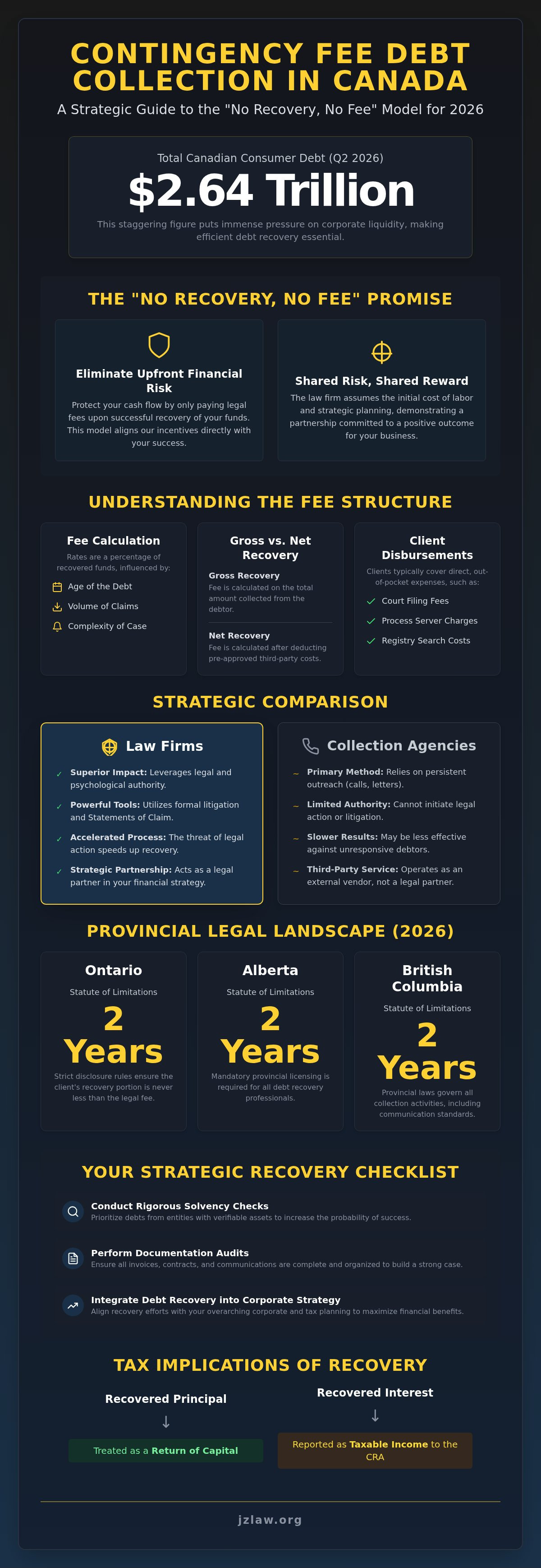
The "No Recovery, No Fee" model is a performance based legal arrangement where the representative’s compensation is tied directly to the successful retrieval of outstanding funds. In the current economic climate, contingency fee debt collection canada has become the primary mechanism for businesses to pursue high value arrears without depleting their remaining cash reserves. This model ensures that the legal professional and the client share the financial risk of the pursuit; if no funds are recovered, the client owes no legal fees for the time spent on the matter. The concept of Debt collection has evolved from simple persistent outreach to a sophisticated legal strategy that prioritizes corporate liquidity.
Fee structures are typically calculated as a percentage of the total amount recovered. These rates are not arbitrary. They are carefully calibrated based on the age of the debt, the volume of the claims, and the complexity of the debtor's corporate structure. Older debts often command higher percentages because the statistical probability of recovery decreases over time. It's also vital to distinguish between gross and net recovery in these agreements. A gross recovery fee is calculated on the total amount collected, while a net recovery agreement applies the percentage only after specific out of pocket costs are deducted. In 2026, this model is the standard for B2B recovery because it provides a clear, risk adjusted path to restoring balance sheet integrity.
The Mechanics of "No Win, No Fee" Agreements
In a contingency arrangement, the firm assumes the upfront labor costs and strategic planning required to secure a settlement or judgment. While legal fees are contingent on success, clients typically remain responsible for disbursements. These are third party expenses such as court filing fees, process server charges, and registry search costs. This structure creates a powerful incentive for the legal team to resolve matters efficiently. It also allows corporate controllers to forecast cash flow with greater precision, as the cost of recovery is always proportional to the capital actually returned to the business.
Tax Implications of Recovered Corporate Debt
Recovering a long standing debt is more than a simple cash infusion; it carries specific reporting obligations under the Canada Revenue Agency (CRA) guidelines. When funds are recovered, the principal amount is generally treated as a return of capital, while any recovered interest must be reported as taxable income. Strategic use of tax structuring allows businesses to manage the transition from a bad debt write off to a successful recovery without creating an unnecessary tax burden. Proper documentation ensures that the recovery process supports your broader fiscal health rather than complicating your annual filings.
Provincial Regulations and Legal Compliance in 2026
The Canadian regulatory environment for debt recovery is a patchwork of provincial statutes that demand meticulous attention to detail. In 2026, the landscape has shifted toward enhanced transparency, particularly in major economic hubs like Toronto, Vancouver, and Calgary. While federal guidelines exist to help businesses know your rights, the actual enforcement of contingency fee debt collection canada relies on provincial Collection and Debt Settlement Services Acts. These laws dictate everything from calling hours in Quebec to the specific wording required in a demand letter in Ontario. Recent updates in August 2026 have specifically targeted digital communications, requiring clear opt-out mechanisms for email and SMS outreach to ensure that corporate recovery efforts don't inadvertently breach privacy standards.
Navigating the Alberta and Ontario Legal Landscapes
Alberta requires recovery professionals to maintain specific provincial licensing, which is essential for any firm operating in the Calgary or Edmonton markets. The province maintains a strict two year statute of limitations for commencing legal action, making time a critical factor in your recovery strategy. In Ontario, the Law Society has implemented rigorous disclosure rules for contingency agreements. These regulations ensure that the legal fee never exceeds the amount the client actually receives, protecting the financial interests of the creditor. When dealing with US-based debtors, Canadian firms must navigate the intersection of provincial law and the American Fair Debt Collection Practices Act. This complexity is why many organizations choose to consult with a strategic legal partner to ensure their cross-border interests remain protected.
FINTRAC and Large-Scale Corporate Recoveries
High-value commercial recoveries often trigger reporting obligations under the Proceeds of Crime (Money Laundering) and Terrorist Financing Act. Firms must adhere to FINTRAC protocols, especially when handling significant cash settlements or assets involving cryptocurrency law. Compliance requires the thorough identification of beneficial owners to prevent money laundering through debt settlement channels. Maintaining these AML protocols is not just a legal requirement; it's a foundational element of professional dignity in 2026. During high-stakes negotiations, every settlement must be vetted against current sanctions lists and anti-corruption standards to ensure the recovered funds are legally beyond reproach.
Collection Agencies vs. Law Firms: A Strategic Comparison
Choosing between a traditional agency and specialized legal counsel is a decision that fundamentally alters the trajectory of your recovery efforts. Most collection agencies rely on high-volume, automated processes that focus on persistence rather than legal leverage. While this may suffice for small consumer debts, high-stakes corporate arrears require a more sophisticated approach. The psychological impact of a formal letter from a law firm shouldn't be underestimated; it signals to the debtor that you've moved beyond simple reminders and are prepared for formal contingency fee debt collection canada through the court system. Debtors who routinely ignore agency calls often prioritize settlements the moment a Statement of Claim is served.
The strategic advantage of a law firm lies in its ability to handle complex disputes that involve intricate contract law or securities regulations. Unlike agencies, which are limited to administrative pressure, a law firm provides the protection of solicitor-client privilege. This ensures that your internal communications and strategic discussions remain confidential throughout the recovery process. This level of professional dignity and legal security is indispensable when navigating the modern Canadian business environment.
Enforcement Capabilities and Judgments
A law firm’s primary differentiator is the power of the provincial court system. If initial negotiations fail, legal counsel can transition seamlessly from collection to active litigation. This process involves obtaining a court-ordered judgment, which serves as the foundation for aggressive enforcement measures. In Ontario, these arrangements are governed by Ontario's Contingency Fee Agreement Regulations, which provide a transparent framework for how these costs are structured. Once a judgment is secured, the lawyer’s toolkit expands to include wage garnishment, bank account freezes, and the seizure of assets; tools that are simply unavailable to third party collection agencies.
When to Escalate from Agency to Legal Counsel
Identifying the point of escalation is vital for protecting your corporate interests. Accounts that involve significant sums or debtors who dispute the underlying contract are rarely resolved through agency intervention. This is particularly true in matters involving real estate law, where the complexity of property titles and liens requires precise legal oversight. Escalating to legal counsel doesn't just increase the likelihood of recovery; it protects your brand reputation by ensuring all actions are conducted with the highest level of professional conduct and regulatory adherence.
Assessing Your Debt Portfolio for Contingency Recovery
Identifying which accounts are viable for recovery requires a methodical audit of your ledger. The first step involves a rigorous analysis of the debt's age and the supporting documentation. In Canada, most provinces, including Ontario and Alberta, enforce a strict two year limitation period to commence legal action. If you've allowed a debt to sit beyond this window without a written acknowledgement or partial payment, your legal recourse may be extinguished. Collecting and organizing your contracts, Memorandums of Understanding, and email threads is essential before pursuing contingency fee debt collection canada. A well documented file doesn't just speed up the process; it provides the evidentiary weight needed to secure a settlement.
Performing a solvency check on the debtor is the second critical phase. There's little utility in obtaining a judgment against a shell company with no reachable assets. We look for tangible indicators of value, such as equipment fleets in oil and gas law or registered titles in real estate. Once solvency is confirmed, you must evaluate the cost-benefit ratio of the contingency model versus standard hourly billing. While contingency protects your immediate cash flow, hourly rates might be more efficient for straightforward, undisputed debts where the debtor simply needs a formal nudge. Finally, preparing a comprehensive "proof of claim" ensures your legal counsel can move immediately to the demand phase.
Identifying High-Probability Recovery Targets
Strategic recovery focuses on debtors with seizable assets rather than those facing total insolvency. Beyond physical assets, we examine the debtor's position within their industry cycle. A company currently undergoing a merger or acquisition is often more motivated to settle outstanding arrears to avoid complicating their due diligence process. Maintaining a clean paper trail is your strongest asset; a well documented proof of claim that includes every signed agreement and delivery receipt significantly reduces the time required for legal review. This proactive approach minimizes the risk of throwing good money after bad.
Risk Assessment for Complex Industry Debt
Recovery in highly regulated sectors demands a nuanced understanding of industry specific risks. For instance, debts related to cannabis licensing or unpaid capital in securities and IPO transactions often involve complex regulatory hurdles that standard agencies can't navigate. Timing your demand letters to coincide with corporate reporting cycles or funding rounds can create the necessary pressure for a swift resolution. If your portfolio contains high value, disputed arrears in these sectors, you should request a professional portfolio review to determine the most effective path forward.
Strategic Debt Recovery with JZ Law
Effective debt recovery in 2026 requires more than persistence; it demands a deep integration into your broader corporate legal strategy. At JZ Law, we don't view outstanding arrears as mere lost capital, but as a strategic transaction that must be resolved to restore balance sheet integrity. By aligning our interests through contingency fee debt collection canada, we provide a high-stakes negotiation framework that prioritizes results while maintaining your professional dignity. John Zang’s approach focuses on identifying the most efficient path to settlement, whether through sophisticated mediation or decisive litigation in the provincial courts.
Our firm specializes in sectors where the regulatory environment is as complex as the debt itself. We understand that a tech startup, a cannabis producer, or an energy firm faces unique liquidity challenges that a generic collection agency simply isn't equipped to handle. We treat every recovery as an extension of your corporate transactions, ensuring that the process respects your industry standing and long-term business goals. This boutique focus allows us to move beyond the high-volume, low-impact tactics of traditional agencies to deliver a level of representation that reflects the prestige of your organization.
A Boutique Approach to Commercial Collections
Specialized industries demand a representative who understands the underlying mechanics of their business. For clients in the emerging markets, our recovery strategies often draw on John Zang’s extensive experience in taking companies public. This background is invaluable when dealing with debtors in the securities or cannabis sectors, where an outstanding debt might impact a firm's regulatory standing or future IPO prospects. We provide customized reporting and clear, systematic communication, ensuring that your executive team is always informed of the progress and the strategic reasoning behind every move.
Securing Your Business’s Financial Future
Our commitment to your organization extends beyond the immediate recovery of funds. We take a proactive, megelőző szemléletmód (preventative approach) to minimize the risk of future bad debt. This involves a thorough review of your existing corporate framework, from drafting more robust shareholder agreements to refining your service contracts. By strengthening the legal foundations of your business today, we help you avoid the pitfalls of uncollectible arrears tomorrow. If you're ready to transform your recovery efforts into a strategic asset, we invite you to consult with JZ Law for a strategic debt assessment. Our team is prepared to analyze your portfolio and implement a risk-adjusted plan that secures your financial future.
Restoring Balance Sheet Integrity with Strategic Legal Partnership
Navigating the complexities of the 2026 regulatory landscape requires more than persistence; it demands a sophisticated understanding of how debt recovery intersects with corporate and tax strategy. By prioritizing accounts with verifiable solvency and leveraging the litigation power of a law firm, you can effectively resolve stagnant invoices without the burden of upfront costs. The contingency fee debt collection canada model ensures that your legal counsel is fully invested in your success, transforming outstanding receivables into a catalyst for renewed cash flow.
Led by principal lawyer John Zang, our firm brings specialized expertise to complex regulatory and corporate sectors, maintaining a strategic presence across major Canadian and global business hubs. We don't just collect funds; we protect your professional dignity and secure your financial future. Secure Your Corporate Recovery with JZ Law and take the first step toward reclaiming your corporate liquidity today. You have the right to protect your assets, and we have the expertise to help you succeed.
Frequently Asked Questions
What is the typical contingency fee for debt collection in Canada?
Fees for contingency fee debt collection canada are typically calculated as a percentage of the amount successfully recovered. This percentage varies based on the age of the debt and the complexity of the legal work required. While agencies often range between 15% and 50%, legal counsel fees are structured to reflect the strategic nature of the recovery. Each agreement must comply with provincial regulations to ensure the fee remains proportional to the result achieved.
Can a lawyer collect debt across different provinces?
Legal counsel can manage recoveries across different provinces by navigating the specific statutes of each jurisdiction. Our firm coordinates these efforts across major economic hubs like Calgary, Toronto, and Vancouver to ensure strict compliance with local Collection and Debt Settlement Services Acts. This multijurisdictional reach is essential for corporate clients whose debtors may move assets across provincial lines, requiring a unified legal strategy to secure the funds and protect your interests.
How long does the contingency fee debt recovery process take?
The timeline for the contingency fee debt collection canada process depends on the debtor’s responsiveness and the complexity of their asset structure. A successful negotiation might conclude within 30 to 90 days. However, if the matter requires formal litigation or the enforcement of a court judgment, the process can extend to a year or more. We prioritize a methodical approach that balances the need for speed with the thoroughness required to secure a binding settlement.
What happens if the debtor goes bankrupt during the collection process?
If a debtor files for bankruptcy, the collection process is paused by a legal stay of proceedings. This freeze prevents creditors from continuing individual recovery actions. In these instances, we pivot to filing a formal proof of claim within the bankruptcy estate. Our expertise in corporate transactions and tax structuring allows us to analyze the debtor’s remaining assets and determine the likelihood of receiving a dividend payment through the court appointed trustee or receiver.
Are there any upfront costs when hiring a contingency fee lawyer?
While the contingency model eliminates hourly legal fees, clients are generally responsible for disbursements. These are third party expenses such as court filing fees, process server charges, and registry search costs. We maintain transparency by outlining these anticipated out of pocket expenses before starting the case. This ensures that the financial risk is shared appropriately, allowing the legal team to focus on recovery strategy while the client maintains control over the litigation budget and cash flow.
Can I recover the legal fees from the debtor in Canada?
In several Canadian provinces, a successful litigant can be awarded costs, which represent a portion of their legal expenses. These court awarded amounts rarely cover the full contingency fee. The ability to recover these costs often depends on the specific language in your original service agreement or the rules of the provincial court. We review your contracts to identify clauses that might allow for the recovery of collection costs, providing an additional layer of financial protection for your business.
Is contingency fee debt collection available for international debts?
Contingency fee recovery is available for international debts, particularly when dealing with major hubs like New York City or Denver. Our presence in global business centers allows us to manage cross-border disputes by leveraging international treaties and the reciprocal enforcement of judgments. This global perspective is indispensable for Canadian companies in the tech or energy sectors that maintain international client bases and require representation that understands both domestic and foreign regulatory environments and enforcement mechanisms.
What documents do I need to start a contingency fee collection case?
To initiate a case, you must provide a comprehensive paper trail that validates the debt. Essential documents include signed contracts, invoices, and proof of service completion. We also require a detailed record of all previous communication with the debtor, such as emails and formal notices of default. This documentation forms the evidentiary basis for a Statement of Claim and allows us to perform an initial solvency check to ensure the debt is collectible before proceeding with litigation.


Comments