


Corporate Finance Law Firm in Denver: A Guide to Choosing Counsel
The largest firm isn’t automatically the best fit for a financing or corporate transaction. A search for a corporate finance law firm Denver businesses can evaluate should start with a practical question: does counsel’s experience match the transaction, the jurisdictions involved, and the level of cost certainty the business needs?
Those concerns are well founded. A transaction may involve corporate, securities, or tax-structuring issues, while the jurisdictions involved can affect what legal support is appropriate. Firm size alone won’t answer those questions. JZ Law is a small Calgary practice led by John Zang, a member of the Law Society of Alberta since 1992. The firm has served Calgary since 2000, and John brings over 25 years of experience. Its fixed-fee approach provides cost certainty.
This guide compares counsel by transaction fit, jurisdictional scope, relevant experience, and pricing model, with Denver businesses’ needs in view. These considerations also matter for businesses with connections to Calgary, Toronto, Vancouver, Hamburg, Berlin, Frankfurt, or New York City. JZ Law’s principle is clear: WE ARE HERE FOR THE LITTLE GUY, fighting the big guy on behalf of clients.
Table of Contents
Choosing a Corporate Finance Law Firm in Denver: Start With the Business Need
Corporate Finance Legal Services: Match Counsel to the Transaction
How to Compare Denver Corporate Finance Counsel Without Choosing by Firm Size
Prepare for a Corporate Finance Law Firm Discussion in Denver
JZ Law’s Fixed-Fee Approach and the Next Step for Denver Businesses
Choosing a Corporate Finance Law Firm in Denver: Start With the Business Need
A financing decision can affect ownership, control, future obligations, and a company’s ability to pursue growth. Choosing counsel before clarifying the transaction can make it harder to identify the experience and jurisdictional knowledge the matter calls for. For a Denver business considering options from a corporate finance law firm Denver search, the useful first step is to define the business objective and the transaction under consideration.
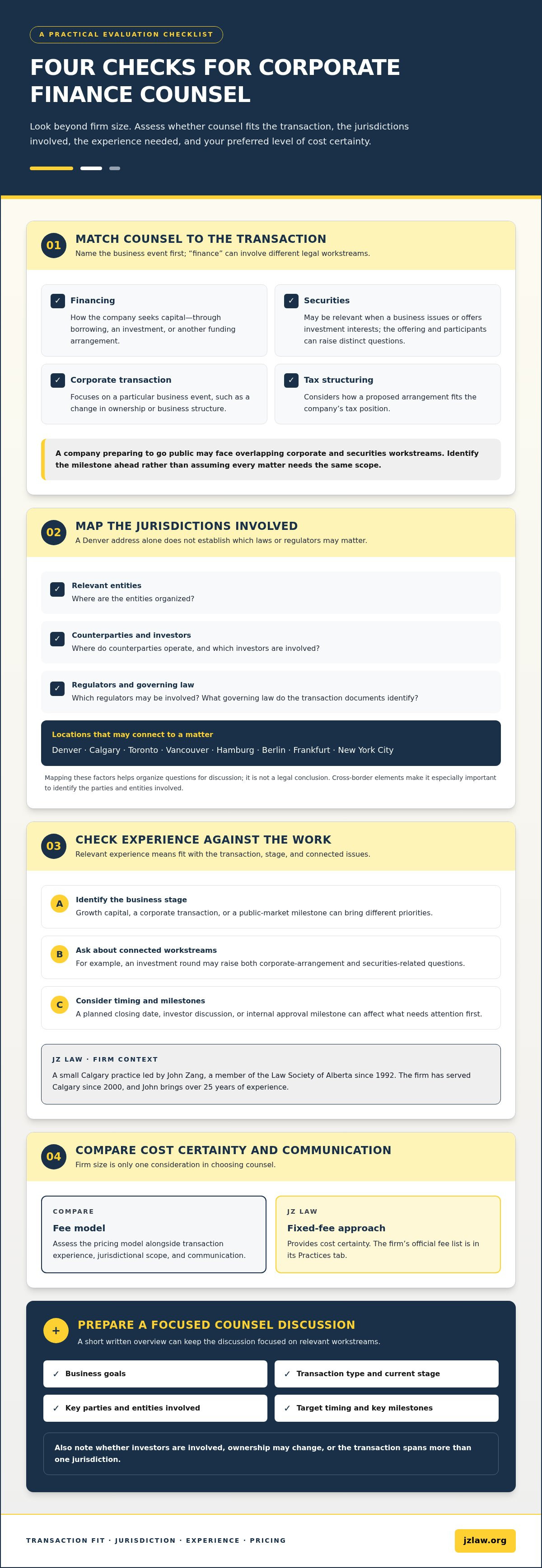
These needs are connected, but they aren’t interchangeable. Financing concerns how a company seeks capital, through borrowing, an investment, or another funding arrangement. Securities work may become relevant when a business issues or offers investment interests. Corporate transactions can involve changes in ownership or business structure, while tax structuring considers how a proposed arrangement fits the company’s tax position. A company preparing to go public may face overlapping corporate and securities workstreams. The broader concept of corporate finance provides useful context, but it doesn’t determine which legal services a particular deal requires.
Which corporate finance matters may require legal counsel?
Legal support may be relevant when a company is negotiating a transaction, planning an offering, considering taking the company public, or evaluating a structure with tax implications. Rather than assume every matter needs the same scope of support, identify the central business event and note connected questions, such as whether investors are involved, ownership may change, or the transaction spans more than one jurisdiction.
Business stage helps sharpen that picture. A company exploring growth capital may have different priorities from one negotiating a corporate transaction or preparing for a public-market milestone. The decision timeline matters, too: a planned closing date, investor discussion, or internal approval milestone can affect what needs attention first. A short written summary of the goal, current stage, transaction type, and target timing can help keep a discussion with counsel focused on relevant workstreams.
Why Denver location does not answer every jurisdiction question
A company’s Denver location is important context, but it doesn’t, by itself, establish which laws or regulators may be relevant to a transaction. The governing documents, locations of the entities and counterparties, investors, and markets involved may point to additional jurisdictions. Cross-border elements make it especially important to identify the parties and entities involved rather than assume the company’s location resolves every legal question.
Before comparing counsel, map the jurisdictions potentially connected to the matter: where the relevant entities are organized, where counterparties operate, which regulators may be involved, and what governing law the transaction documents identify. This framework helps organize the issues for discussion, but it isn’t a legal conclusion. For businesses with connections to Calgary, Toronto, Vancouver, Hamburg, Berlin, Frankfurt, New York City, or Denver, the same jurisdictional questions can arise across locations. JZ Law is based in Calgary, and professional counsel can assess how the facts and jurisdictions relate to a specific transaction.
Corporate Finance Legal Services: Match Counsel to the Transaction
Corporate finance legal work helps businesses address the corporate, securities, transaction, and tax-structuring issues connected to raising capital, changing ownership, or pursuing growth. The right combination depends on the milestone ahead, not simply on whether a matter is described as “finance.”
Corporate and securities work as a company grows
At an early stage, a business may be deciding how to organize its company and establish a structure that supports its plans. Incorporation is one milestone to identify, while corporate transactions may become relevant as the business changes or grows. These concepts are related but describe different work: corporate matters concern the company and its structure, while a transaction concerns a particular business event.
As a company considers raising capital, securities regulation may enter the picture. The way a company raises funds, the interests it offers, and the participants involved can raise questions distinct from its general corporate structure. If the company’s long-term objective is to go public, that is a separate milestone: taking a company public involves different considerations from an early financing or private corporate transaction. These workstreams can intersect, but identifying them separately helps define the matter more precisely.
For example, a company planning an investment round may need to consider both its corporate arrangements and securities-related questions. A business preparing for a public-company path may need to assess how its corporate decisions and securities matters relate to that objective. These are general illustrations, not conclusions about what a particular business must do. Requirements depend on the facts and jurisdictions involved.
Transactions and tax structuring as distinct workstreams
A corporate transaction focuses on a specific event or change involving a business. Tax structuring, by contrast, considers the tax dimension of a proposed arrangement. Both may relate to the same business objective, but they aren’t interchangeable: the transaction’s commercial purpose helps identify what is changing, while tax structuring examines the arrangement from a different perspective.
Consider a company evaluating a strategic acquisition. The transaction workstream may focus on the proposed corporate change, while tax structuring may be relevant to how the contemplated arrangement is organized. A company seeking investment without a change in ownership may have different priorities, with securities regulation potentially more central. These examples frame a conversation, not prescribe a legal structure or outcome.
Sector-specific illustration: A cannabis business considering a public-company path may need to distinguish its cannabis licensing considerations from its securities regulation and taking-companies-public workstreams. The industry context doesn’t make those services one issue; the company’s objectives and transaction stage shape what questions arise.
Businesses assessing how a transaction fits a broader growth strategy can also consult this strategic corporate transactions guide. For counsel on corporate transactions, securities regulation, or tax structuring, review JZ Law’s corporate and finance-related services.
How to Compare Denver Corporate Finance Counsel Without Choosing by Firm Size
A prominent name or a large team can appear reassuring, but firm size alone doesn’t establish whether counsel’s experience, jurisdictional scope, and fee model fit a particular matter. A more useful comparison starts with the work the business needs done, then considers how the lawyer’s experience and approach align with the transaction and the company’s priorities.
Use the framework below to compare a corporate finance law firm Denver businesses are considering. Focus on specific, relevant details rather than broad claims of capability.
Assess experience, transaction fit, and jurisdiction
Experience is most useful when it relates to the matter at hand. A business considering a securities issue, for example, should distinguish relevant securities experience from a general statement that a firm handles business law. John Zang’s Law Society of Alberta membership since 1992 and over 25 years of experience are specific credentials; JZ Law’s service in Calgary since 2000 is a separate firm history. When a transaction involves more than one jurisdiction, identify that connection and raise it in a discussion with counsel.
Compare fee structure and client alignment
Fixed-fee pricing can make the fee structure clearer for the work covered. To compare fairly, understand the defined scope and refer to JZ Law’s Practices tab for its official fee list. JZ Law does not act for banks, insurance companies, or large companies. Its stated position, “WE ARE HERE FOR THE LITTLE GUY,” reflects a focus on fighting the big guy on behalf of clients. For a closer look at the firm’s corporate and securities work, explore JZ Law’s legal services.
Prepare for a Corporate Finance Law Firm Discussion in Denver
A focused first discussion is easier when the business context is organized in advance. For a Denver business speaking with a corporate finance law firm found through a search, the goal isn’t to arrive with legal conclusions. It’s to explain what the company is trying to accomplish, where the transaction stands, who is involved, and which questions need attention first.
Use this preparation sequence to make the conversation more productive:
Summarize the business goal. Describe the intended outcome in a few sentences, such as raising capital, completing a corporate transaction, considering a public-company path, or addressing tax structuring. Distinguish the immediate objective from the company’s longer-term plans.
Describe the company and its structure. Note the business name, relevant entities, where each is organized, and how they relate to the proposed matter. If ownership or control is relevant, outline the people or entities involved without trying to resolve legal questions yourself.
State the transaction stage and timing. Explain whether the idea is under discussion, being evaluated, or already reflected in draft documents. Record known decision dates, planned meetings, or commercial milestones, and distinguish firm dates from tentative targets.
Identify the principal parties. List the people or organizations involved, such as owners, potential investors, counterparties, or other advisers. Note each party’s role and location where known. This can help frame possible cross-border connections without assuming which jurisdiction’s law applies.
Map known jurisdictional and regulatory touchpoints. Record where the entities and counterparties are based, which markets the transaction may involve, and any regulator or filing already mentioned in correspondence. Treat these as facts to discuss, not conclusions about legal requirements or applicable law.
Gather relevant background and set priorities. Make an inventory of agreements, draft documents, and correspondence connected to the proposed matter. Identify the key questions you want to discuss about scope, communication, fee structure, and the next decision. Don’t send confidential documents through an unsecured channel; arrange an appropriate method for sharing them.
Separate immediate decisions from long-term objectives
A company may have a long-range plan to expand, attract investment, or pursue a public-company future, while facing a nearer decision about a proposed transaction. Bring both into the discussion, but label them clearly. That distinction helps keep the first conversation focused on the current business need while preserving context about the company’s direction.
Before the discussion, select the three questions whose answers would most help the business decide what to do next. For instance, you may want to clarify which legal workstreams appear relevant, how the matter’s scope would be defined, and how fee expectations are presented. Avoid assuming that a closing date, regulatory outcome, or legal requirement can be predicted without assessing the facts.
Once your summary and priorities are ready, Explore JZ Law’s corporate legal services to see how its corporate transactions, securities regulation, and tax structuring work relates to your business needs.
JZ Law’s Fixed-Fee Approach and the Next Step for Denver Businesses
After comparing matter fit, jurisdiction, experience, and communication, consider how a firm’s size and pricing model align with your business. A corporate finance law firm Denver businesses are evaluating should be considered in light of the transaction, rather than selected by scale alone. JZ Law is a small Calgary practice focused on corporate, securities, and tax-structuring work, with services that include corporate transactions, securities regulation, tax structuring, and taking companies public.
A small-firm model built around cost certainty
JZ Law’s small-firm structure has lower overhead than larger firms, and the practice uses fixed-fee pricing. A fixed fee gives cost certainty for the work covered, but it isn’t a promise of a particular legal outcome or a universal total for every matter. The appropriate scope depends on the services involved. For official fee details, consult the Practices tab.
Firm size is one consideration, not a measure of suitability on its own. A smaller practice may appeal to a business seeking a focused relationship and a defined pricing format, while the central question remains whether the matter aligns with the firm’s stated work and relevant experience. John Zang has over 25 years of experience, and JZ Law has served the Calgary area since 2000.
Client alignment also matters. JZ Law does not act for banks, insurance companies, or large companies. Its stated commitment, WE ARE HERE FOR THE LITTLE GUY, reflects the firm’s focus on fighting the big guy on behalf of clients. For a business assessing counsel, that positioning offers context for the firm’s approach, alongside practical questions about transaction fit, jurisdiction, and scope.
Discuss your corporate finance matter with JZ Law
For a Denver business, a useful next step is to explain the transaction objective, its current stage, the parties involved, and any known jurisdictional connections. This gives the discussion a concrete starting point without assuming which laws apply or what outcome is possible. JZ Law is based in Calgary.
Whether your matter concerns a corporate transaction, securities regulation, tax structuring, or taking a company public, bring your priorities and timing questions to the conversation. The Practices tab provides the official fixed-fee list so you can review the firm’s pricing format.
Call or text 403 680 9264 and ask for John Zang to discuss your corporate finance matter.Contact JZ Law.
Move From Comparison to a Confident Next Step
Turn your comparison into a clear account of what the business needs now. Before making a decision, identify the transaction’s immediate objective, the jurisdictions that may be involved, and the questions that still need professional assessment. This gives a discussion a practical focus without assuming which legal rules apply or predicting an outcome.
For a Denver business considering a corporate finance law firm Denver search, clarity about the matter can be more useful than a long list of services or a firm’s size. Bring forward the decision the company faces, the timing that matters, and what you need to understand about scope and fees. Then assess whether counsel’s approach aligns with those priorities.
JZ Law’s small-firm practice, fixed-fee format, and stated commitment to fighting the big guy offer a distinct perspective for businesses weighing counsel. A direct discussion can help you explore how its corporate and finance-related services relate to your matter.
Call or text 403 680 9264 and ask for John Zang to discuss your corporate finance matter. A focused conversation can help your business move forward with greater clarity.
Frequently Asked Questions
Is corporate finance law the same as corporate law?
No. The terms overlap, but they aren’t interchangeable in every matter. Corporate law may address company formation and governance, while corporate finance work may concern a transaction, securities issue, or financing-related corporate decision. For example, revising governance arrangements differs from evaluating a securities offering, even if both affect the same company. The exact scope depends on the facts and applicable law. This is general information, not legal advice. Contact JZ Law for professional counsel about your situation.
Can a corporate finance lawyer replace an investment banker?
No. Legal counsel and investment bankers generally have different roles in a transaction. A lawyer addresses legal matters within the engagement, while an investment banker may provide financial or transaction services. For instance, a company considering a capital raise may need to distinguish legal questions about the transaction from financial analysis or transaction support. Their responsibilities aren’t interchangeable, and the appropriate mix depends on the company’s objectives and circumstances. Contact JZ Law for legal counsel about a specific matter.
Does corporate finance counsel only work with public companies?
No. Corporate finance-related legal questions can arise for private businesses as well as public companies. A privately held company considering an ownership change, securities matter, or tax-structuring question may have legal issues to assess without being publicly traded. Public-company work, including going-public matters, represents another possible context, not the sole one. The relevant services depend on the transaction and jurisdiction. This overview isn’t legal advice; contact JZ Law for professional counsel tailored to a particular business situation.
When should a founder consider speaking with corporate finance counsel?
A founder may consider speaking with counsel while planning a significant corporate transaction, securities issue, or company-growth decision. For example, before discussing a proposed investment with potential participants, a founder may want to understand which legal questions the plan raises. Raising those questions early can help clarify what needs professional assessment before important business choices are made. Timing and requirements vary by matter and jurisdiction. This is informational only; contact JZ Law for advice about a specific situation.
Can a corporate finance lawyer work with a company’s accountant?
Yes. A company may need both legal and accounting input because the professionals address different aspects of a business matter. For example, a proposed transaction may raise legal questions alongside accounting considerations. Their work isn’t a substitute for one another, and each professional’s role depends on the engagement. Don’t assume one has reviewed the other’s analysis. For legal guidance tailored to a corporate matter, contact JZ Law. This answer provides general information, not legal advice.
What is the difference between a corporate finance lawyer and a securities lawyer?
Corporate finance describes a broader business context that may involve transactions, company structure, or financing decisions. Securities law focuses on legal issues involving securities and related regulation. The areas may intersect, such as when a business transaction involves investment interests, but the terms don’t describe identical work in every case. A business comparing a corporate finance law firm Denver companies may consider should identify the specific issue and relevant jurisdiction. Contact JZ Law for advice about a particular matter.



Comments