


Private Placements in Alberta: A Practical Guide for Issuers
Could a private placement be a practical way to raise capital without making compliance an afterthought? For issuers searching “private placement alberta,” the answer depends on the prospectus exemption, the investors involved, and the disclosure and filing obligations that may follow.
A private financing may seem more straightforward than a prospectus offering, but the exemption an issuer relies on shapes who may invest and what the issuer must prepare. Assessing eligibility, disclosure, and reporting requirements early helps clarify the work involved.
This guide explains the basic Alberta framework, outlines the information issuers commonly organize before a distribution, and compares private placements with other financing routes. It is general information, not legal advice tailored to an issuer’s circumstances.
JZ Law is a small Calgary-based practice providing securities and corporate law services, with lower overhead. John Zang has been a member of the Law Society of Alberta since 1992, and the firm has served Calgary since 2000. WE ARE HERE FOR THE LITTLE GUY, and we fight the big guy on behalf of our clients.
Table of Contents
Alberta Private Placements: Definition and Use Cases
A private placement is a way for an issuer to sell securities without using the prospectus process generally associated with a public offering. Instead of offering securities broadly to the public under a prospectus, the issuer relies on an available prospectus exemption and must meet its conditions. For a company considering a private placement alberta, the exemption is a starting point for planning, not a blanket release from securities-law responsibilities.
The distinction matters because “private” describes how securities are distributed, not an absence of regulation. An issuer may still need to consider investor eligibility, disclosure, distribution procedures, filings, and resale restrictions. Which requirements apply depends on the facts and the current rules.
What does prospectus-exempt financing mean?
Prospectus-exempt financing is a securities distribution that relies on a specific legal exemption from the requirement to prepare and file a prospectus, subject to the exemption’s conditions and any other applicable obligations. A prospectus provides prescribed information to prospective investors in a public offering. An exemption offers a conditional alternative. It does not, by itself, make a financing simple, unrestricted, or appropriate for every issuer or investor.
Exemptions differ in their criteria and requirements. The issuer’s circumstances and proposed distribution therefore matter. Selecting an exemption involves more than choosing a label for the transaction. The general overview of Private placement provides broader context, while Alberta issuers need to assess their circumstances against applicable Canadian securities rules.
Why might an Alberta company consider a private placement?
Issuers may explore private financing to support business growth, fund operations or development, or advance a corporate transaction. For example, a company might be considering capital to expand its activities or complete a strategic acquisition. These are general business objectives, not indications that a particular exemption or financing route will suit the company.
To frame the decision, an issuer can consider:
What business purpose would the financing serve, and how does it fit the company’s plans?
What type of security is being considered, and how could it affect the company’s ownership or existing arrangements?
Who are the prospective investors, and where are they located?
What information will investors need to assess the proposed investment?
These questions help frame the analysis, but they do not determine eligibility or settle which rules apply. The issuer’s corporate structure, security terms, investor characteristics, and distribution circumstances may all be relevant. If prospective investors are outside Alberta, the requirements of other jurisdictions may also need consideration.
A practical starting point is to define the business objective and outline the proposed distribution before settling on a route. Securities-law counsel can assess the relevant facts against current rules and identify issues for further consideration. This section is general information, not legal advice; an issuer’s specific circumstances require professional counsel.
How Alberta’s Private-Placement Exemption Framework Fits Together
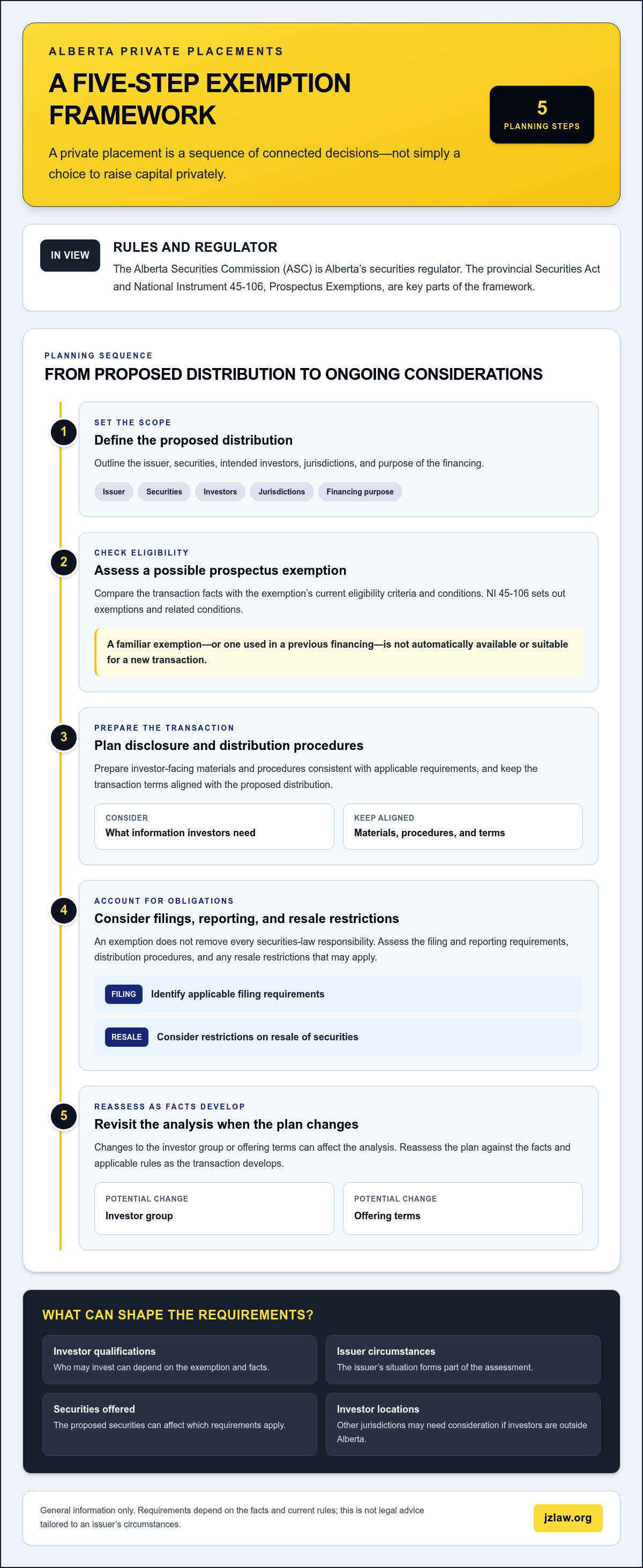
A private placement alberta issuer is considering involves a sequence of connected decisions, not just selecting an exemption. The issuer identifies a potentially available prospectus exemption, then assesses its conditions against the proposed securities, investors, and distribution. Next, it considers disclosure and distribution procedures, reporting requirements, and any resale restrictions. Changes to the investor group or offering terms can affect the analysis, so the plan may need to be revisited as the transaction develops.
Which rules and regulators should issuers recognize?
The Alberta Securities Commission (ASC) is Alberta’s securities regulator. The provincial Securities Act and National Instrument 45-106, Prospectus Exemptions, are key parts of the framework for prospectus-exempt distributions. NI 45-106 sets out exemptions and related conditions, but an exemption used in one transaction may not fit another.
Investor qualifications, the issuer’s circumstances, and the securities being offered can all matter. The relevant legislation, rules, and guidance should be assessed against the particular facts. A route used in a previous financing is not automatically suitable for a new one. Securities-law counsel can assess the possible exemption and related obligations before an offer is made.
How do the main steps connect?
A practical planning sequence can help keep legal and business considerations aligned:
Define the proposed distribution. Identify the issuer, securities, intended investors, jurisdictions, and purpose of the financing.
Assess a possible exemption. Compare the facts with the exemption’s current eligibility criteria and conditions. A familiar exemption is not automatically available.
Plan disclosure and distribution. Prepare investor-facing materials and procedures consistent with applicable requirements, and keep the transaction terms aligned with what is presented.
Address reporting and resale. Determine whether an exempt-distribution report is required, which form and filing system apply, and what resale restrictions may affect the securities.
Prospectus relief removes only the prospectus requirement available under a qualifying exemption; it does not automatically remove other securities-law obligations or transaction-specific conditions. Exemption, disclosure, distribution, reporting, and resale are connected parts of the financing and should be considered together.
What reporting and resale issues can arise?
Where applicable, an issuer may need to report an exempt distribution using Form 45-106F1, Report of Exempt Distribution. Whether a report is required, what information it must contain, and the filing process depend on the transaction and exemption. Current form requirements and deadlines are set out in official materials. Filing responsibilities belong in the financing plan, rather than being treated as administrative details only after closing.
Resale restrictions also matter. Securities acquired under an exemption may not be freely resold immediately. The rules can depend on whether the issuer is a reporting issuer and on other circumstances. These restrictions may affect investor expectations and are relevant to the issuer’s planning and disclosure.
Because the applicable rules turn on specific facts and can change, professional securities-law review can help identify issues before commitments are made. JZ Law provides securities and corporate law counsel for issuers assessing these requirements.
Private Placement or Public Offering? Compare the Financing Routes Before Deciding
Choosing between a prospectus offering and an exempt distribution involves more than comparing paperwork. An issuer should consider its intended investor group, the information investors need, the transaction’s timing, and any obligations that may continue after distribution. A private placement alberta issuer considers is not automatically faster, less costly, or more suitable than a public offering. The comparison depends on the issuer’s objectives and the transaction’s facts.
What should an issuer compare across financing routes?
The table is a planning guide, not a statement that every offering follows one fixed pattern. Public-offering requirements and prospectus exemptions can vary. Securities-law details should be assessed against current official sources before a financing proceeds.
Neither column establishes the time or effort required in a particular case. Preparation, review, investor communications, and regulatory steps vary. “Private” does not mean unregulated: an exemption addresses prospectus requirements, not every securities-law obligation or investor protection. Use the comparison to identify questions for professional review, then assess the relevant requirements against current Alberta and Canadian sources.
How can cross-border fundraising change the analysis?
A distribution to investors outside Alberta can raise questions beyond the Alberta framework. The laws of a purchaser’s jurisdiction may also apply, so the intended investor locations can affect planning, disclosure, and compliance analysis. This can be relevant whether prospective investors are in Toronto or Vancouver, or in Hamburg, Berlin, Frankfurt, New York City, or Denver. MLT Aikins’ discussion of Alberta businesses raising capital in the United States is an example of this added complexity, not a rule that applies to every Alberta financing.
Cross-border offerings may require jurisdiction-specific securities-law analysis. Identifying where offers and sales may occur is part of assessing which requirements could apply. JZ Law provides securities and corporate law services to issuers considering these matters.
Professional review can help assess a financing route against an issuer’s goals and the applicable rules. JZ Law provides securities and corporate law services for issuers working through these considerations.
What Should an Alberta Issuer Prepare Before Exploring a Private Placement?
Before discussing a potential private placement, alberta issuers can make the process more focused by organizing the commercial rationale and basic facts of the proposed transaction. This preparation is not a substitute for legal advice or a complete due diligence list. It gives the issuer and counsel a clearer starting point for discussing possible structures, investor communications, and relevant requirements.
Start with the business plan. Consider the financing in the context of the company’s wider priorities, such as planned growth, operations, or a proposed corporate transaction. If capital raising forms part of a reorganization, acquisition, or other strategic initiative, the strategic corporate transactions guide can help frame the wider planning context.
Which business and transaction details should be organized?
Prepare a concise summary of the funding purpose, the issuer’s corporate structure, the proposed amount, intended investor categories, and anticipated timing. Note the type of security the company is considering, if known, and whether potential investors are located outside Alberta. These details help describe the transaction being explored; they do not establish that a particular exemption is available.
Gather relevant records for review, such as incorporation and governance documents, capitalization information, existing financing or shareholder agreements, and material contracts that could affect the proposed transaction. The records needed depend on the issuer and its circumstances, so this is a starting point rather than a universal checklist.
Summarize the business purpose and how the financing fits the company’s plans.
Describe the issuer’s structure, current ownership, and any relevant securities already issued.
Outline prospective investor categories and the jurisdictions in which they may be located.
Collect applicable corporate records, agreements, and prior financing documents.
Organize draft term sheets, presentations, forecasts, or other materials prepared for potential investors.
Why review offering communications before distribution?
Investor-facing statements can have legal significance. A presentation, term sheet, forecast, email, or verbal description may influence how a prospective investor understands the issuer, the security, and the proposed terms. Materials prepared for business planning may not be suitable for distribution without review, particularly if statements differ across documents or imply outcomes the issuer cannot support.
Have proposed communications and distribution plans reviewed by securities-law counsel before approaching investors. Counsel can assess the materials in light of the proposed transaction and applicable requirements. The analysis depends on the facts, and this general information is not legal advice.
For transaction-specific guidance, discuss securities and corporate law matters with JZ Law before distribution begins.
How JZ Law Supports Alberta Securities and Corporate Matters
A private placement involves both securities-law questions and corporate decisions. JZ Law provides securities and corporate law services to issuers assessing a proposed financing, including how the transaction relates to the company’s structure, objectives, and broader business plans. Counsel can help identify relevant issues and requirements based on the facts, without promising that a financing will proceed or produce a particular result.
JZ Law is a small Calgary-based practice led by John Zang. John has been a member of the Law Society of Alberta since 1992, and JZ Law has served the Calgary area since 2000. The firm brings over 25 years of experience to its work with individuals and businesses.
What can clients expect from JZ Law’s approach?
As a small firm with lower overhead, JZ Law offers a focused option for clients seeking professional securities and corporate counsel. The firm’s approach centers on understanding each client’s circumstances and considering legal matters alongside business objectives. For an issuer, that means looking at a proposed financing in context, including its relationship to the company’s corporate arrangements.
JZ Law uses fixed-fee pricing for all services, providing cost certainty as clients consider legal work. Official fee details are available on the Practices tab.
WE ARE HERE FOR THE LITTLE GUY. JZ Law fights the big guy on behalf of clients. That commitment informs the firm’s focus on individuals and businesses seeking knowledgeable representation and a practical understanding of the challenges they face.
How can readers take a practical next step?
Before speaking with counsel, an issuer may find it useful to prepare a short summary of its financing purpose, proposed investor profile, relevant corporate records, and any draft offering materials. These details can help focus an initial discussion, but do not replace legal review of the transaction, its terms, or the current rules that apply.
For professional guidance, call or text 403 680 9264 and ask for John Zang, or email jzanglaw@gmail.com. An issuer can outline its plans and discuss transaction-specific questions with counsel.
Contact JZ Law about securities law to discuss the legal considerations relevant to a proposed financing.
Plan Your Next Financing Step with Confidence
A potential private placement alberta issuers are considering deserves early, transaction-specific legal review. The business rationale and proposed terms can help frame a discussion with securities-law counsel before investors are approached. Addressing questions early helps clarify what needs further analysis as the financing develops.
JZ Law provides securities and corporate law services on a fixed-fee basis, supporting cost certainty as businesses assess their options. John Zang has been a member of the Law Society of Alberta since 1992, and JZ Law has served Calgary since 2000. The firm is committed to fighting the big guy on behalf of clients. Official fixed-fee details are available on the Practices tab.
For professional counsel on a proposed financing, contact JZ Law about securities law to discuss your circumstances and possible next steps.
Frequently Asked Questions
Is a private placement legal in Alberta?
Private placements may be conducted in Alberta when an issuer can rely on an available prospectus exemption and meets its conditions and other applicable securities-law requirements. The exemption is not automatic, and whether it applies depends on the offering. A company’s proposed investor group and security terms, for example, may affect the assessment. This is general information, not legal advice; transaction-specific questions call for professional securities counsel and current official materials.
Can an Alberta company raise money without filing a prospectus?
In some circumstances, an Alberta company may raise capital under an exemption from prospectus requirements. Whether a particular route is available depends on details such as the issuer, purchasers, offering structure, and current rules. Prospectus relief does not necessarily remove reporting, disclosure, resale, or other obligations. An issuer considering a financing should obtain professional advice on its proposed transaction rather than rely on a general description of an exemption.
Who can invest in an Alberta private placement?
Who may invest depends on the exemption used and the facts of the offering. Some exemptions include purchaser-related conditions; others have different eligibility criteria or requirements. An issuer should not assume that a prospective investor qualifies simply because they have invested in a private company before. For a private placement alberta company is planning, counsel can assess the proposed purchaser group and related materials against the exemption being considered.
Does an Alberta private placement require a report of exempt distribution?
Some exempt distributions may require a report, but the applicable form and deadline depend on the rules and transaction circumstances. An issuer planning a closing should identify who is responsible for assessing any filing and keeping the information needed to prepare it. The Alberta Securities Commission publishes materials on exempt-distribution reporting. Current official requirements should be assessed for the specific distribution rather than relying on a deadline quoted in an older article or general guide.
Can an Alberta company sell a private placement to U.S. investors?
An Alberta company may consider a cross-border offering, but selling to U.S. investors can involve securities requirements in Alberta and in the jurisdictions where purchasers are located. The analysis depends on the offering and the laws that apply in each place. A discussion of an Alberta issuer fundraising in the United States is an example, not a universal rule. Companies considering cross-border capital should obtain qualified counsel familiar with the relevant jurisdictions.
Are securities from a private placement freely resalable?
Not necessarily. Resale restrictions may apply, and their effect can depend on the security, exemption, issuer, and applicable rules. An investor considering a later transfer should not assume that completing the original purchase makes the securities freely tradable. Issuers and investors should review current official requirements and seek transaction-specific legal advice before making plans based on a future resale or promising that securities can be transferred freely.



Comments