


How to Handle a Securities Investigation in NYC: A Clear, Informational Guide
A request for records from a securities regulator can feel like the start of a criminal case. It is not, by itself, proof of wrongdoing or a sign that charges will follow. Understanding how to handle a securities investigation in NYC begins with identifying who is making the request and whether it is informal, compulsory, or part of a formal proceeding.
It is reasonable to feel uncertain when a notice comes from an unfamiliar authority or uses difficult language. This guide explains the roles of federal and New York regulators, outlines common stages of an investigation, and clarifies why an inquiry, subpoena, and enforcement action are not interchangeable. It also explains when general information may not answer the questions raised by a specific matter.
You will learn what the SEC, FINRA, and New York Attorney General may do, what can happen as an inquiry develops, and why the scope of a request matters. A securities matter involving New York City may raise jurisdictional questions for people and businesses in NYC, Calgary, Toronto, Vancouver, Denver, Hamburg, Berlin, and Frankfurt. This guide is informational, not legal advice.
Table of Contents
How to Handle a Securities Investigation in NYC: Start by Identifying the Inquiry
How a Securities Investigation Typically Develops: From Inquiry to Possible Action
SEC, FINRA, New York, or Federal Case: Understand the Process Before Comparing It
What to Understand About Notices, Requests, and Possible Consequences
How to Handle a Securities Investigation in NYC: Start by Identifying the Inquiry
A regulator’s letter, call, or request can leave a person or business unsure what is happening. A useful starting point is to identify the authority involved, the subject of the inquiry, and whether the communication is an initial request or part of a formal process. The label alone does not determine the outcome.
A securities investigation examines possible securities-law or regulatory issues. It may involve transactions, communications, disclosures, or business records, but it is not a finding that anyone violated the law. An investigation alone does not establish a violation. An enforcement action is a proceeding an agency brings to seek a legal or regulatory remedy. A criminal case, by contrast, is brought by prosecutors and involves potential criminal charges. These processes are distinct, although more than one authority may take an interest in related facts.
SEC investigations are generally conducted privately, so an inquiry may not initially appear in public records. If the SEC later brings an administrative proceeding or files a case in federal court, that action may become public. An investigation does not automatically become a public proceeding, and its existence does not predict the outcome.
What can trigger a securities investigation in New York City?
Regulators may examine trading patterns, company disclosures, fundraising practices, or investor complaints. For example, a regulator might compare information provided to investors with company records, or review trading activity that raises questions. These are general illustrations, not conclusions about any particular person or organization.
Some inquiries begin with information gathered by an agency; others may follow a complaint, referral, or publicly available material. A request for information does not necessarily mean the recipient is accused of misconduct. The authority may be seeking records, testimony, or context about conduct involving other parties.
Which authorities may be involved in a securities inquiry?
The Securities and Exchange Commission (SEC) is the federal agency responsible for enforcing federal securities laws. Its enforcement staff investigates potential violations and may recommend an enforcement action. Depending on the matter, the SEC may pursue a case in federal court or through an administrative proceeding.
FINRA is a self-regulatory organization that oversees brokerage firms and registered representatives subject to its membership and rules. Its examinations and investigations may address compliance by member firms or associated persons. Its disciplinary process is separate from an SEC enforcement case, and its relevance depends on the parties and conduct involved.
New York’s Attorney General may pursue securities matters under state law, including matters with a sufficient New York connection. Federal prosecutors, including the Department of Justice, may investigate suspected federal crimes. That is a criminal process, distinct from civil or administrative securities enforcement. More than one authority may examine related conduct, but their roles and procedures are not interchangeable. Identifying the sender is an important first step in understanding the kind of inquiry underway.
How a Securities Investigation Typically Develops: From Inquiry to Possible Action
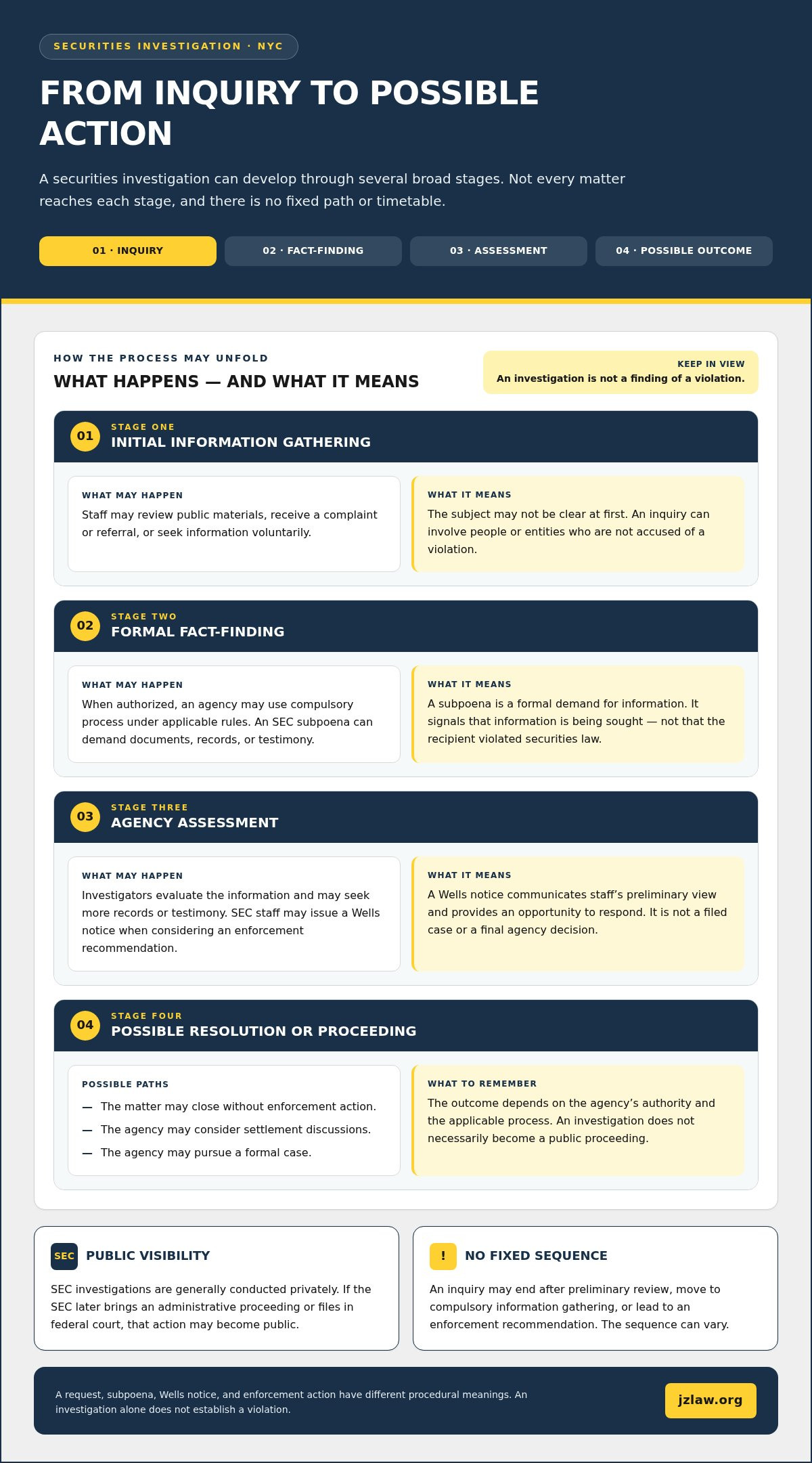
A securities investigation may pass through several broad stages, but there is no fixed path or timetable. An inquiry can end after preliminary review, proceed to compulsory information gathering, or lead to an enforcement recommendation. Not every matter reaches each stage, and an investigation does not necessarily become a public proceeding.
The SEC’s SEC Investigation Process overview describes how staff gather and assess information and the range of possible outcomes. In general, a process may include:
Initial information gathering. Staff may review public materials, receive a complaint or referral, or seek information voluntarily. The subject may not be clear at first, and an inquiry can involve people or entities who are not accused of a violation.
Formal fact-finding. If an agency has the required authority, it may use compulsory process under applicable rules. An SEC subpoena is a formal demand for documents, records, or testimony. It signals that information is being sought, not that the recipient has violated securities law.
Agency assessment. Investigators evaluate the information and may seek further records or testimony. SEC staff may issue a Wells notice when considering whether to recommend that the Commission bring an enforcement action. The notice communicates the staff’s preliminary view and provides an opportunity to respond. It is not a filed case or a final agency decision.
Possible resolution or proceeding. The matter may close without enforcement action. The agency may also consider settlement discussions or pursue a formal case, depending on its authority and the applicable process.
What is the difference between an informal inquiry and a formal investigation?
An informal inquiry generally refers to preliminary contact or requests made before an agency uses formal compulsory authority. A formal investigation may be authorized in a way that permits tools such as subpoenas, subject to the agency’s rules. The distinction is about process and authority, not the strength of a conclusion. Informal contact is not automatically inconsequential, and formal process does not prove wrongdoing.
The communication’s form and wording can offer clues, but agencies do not always use terms consistently. A voluntary request and a subpoena may seek similar records while having different legal characteristics. The issuer, stated authority, scope, and procedural context all matter when understanding the stage of a matter.
What can happen after an agency investigation?
An investigation may close without public action. In other cases, the SEC may seek a negotiated resolution or bring a civil enforcement case in federal court or through an administrative proceeding. An agency investigation is not a court judgment. A court case has its own process, and agency allegations are not findings made after adjudication.
Criminal proceedings are separate. Federal prosecutors may consider a criminal case where they believe the evidence and applicable law support one. An SEC civil investigation does not itself establish that criminal charges will follow. For information about JZ Law’s securities law and commission proceedings work, visit the firm’s website. This overview is general information, not legal advice.
SEC, FINRA, New York, or Federal Case: Understand the Process Before Comparing It
In an NYC securities matter, the authority involved can help explain the process, but it does not establish what happened or what will follow. The SEC, FINRA, New York authorities, and federal prosecutors have different roles and powers. Their involvement depends on the conduct, the people or firms involved, and the jurisdictional basis for the matter. More than one authority may become relevant, but parallel proceedings are not automatic.
What distinguishes an SEC matter from a FINRA inquiry?
The SEC is a federal government agency. Its securities-enforcement work can concern issuers, investment advisers, broker-dealers, and other parties, depending on the facts and applicable law. FINRA is a self-regulatory organization, not a government agency, and its regulatory authority is tied to its member firms and associated persons. Its processes do not apply in the same way to every company, investor, or securities transaction.
For example, an inquiry involving a brokerage firm or registered representative may raise FINRA issues, while a separate SEC investigation may examine potential federal securities-law concerns. Their subject matter can overlap, but their processes are not identical. FINRA’s FINRA Investigation Process overview explains its investigative and disciplinary framework.
How can a New York or federal process fit into the picture?
New York authorities may examine conduct that falls within state law and their jurisdiction. The New York Attorney General’s securities enforcement can involve the Martin Act, a state statute. Federal prosecutors, including those in the U.S. Attorney’s Office for the Southern District of New York, may investigate suspected federal crimes when jurisdictional requirements are met. The SDNY covers Manhattan and several other counties; its location alone does not determine where a case belongs or whether one will be brought.
A civil regulator’s inquiry and a prosecutor’s criminal investigation are distinct, even if they concern related facts. Each authority makes its own decisions under the laws and procedures that govern it. This overview of securities regulation basics also explains why different rules may apply to different participants. For anyone considering how to handle a securities investigation in NYC, identifying the authority and its stated role is a useful starting point. The specific process depends on the matter.
What to Understand About Notices, Requests, and Possible Consequences
Regulatory communications may use terms that sound similar but have different procedural meanings. A request may seek information voluntarily, while a subpoena is compulsory process issued under an authority’s legal powers and applicable rules. A testimony request concerns a person’s account of events, often in an interview or sworn setting. The issuer, wording, and stated authority help define the communication’s significance. The communication alone does not establish liability or determine what happens next.
What does a subpoena or document request generally signal?
A document request identifies materials an agency wants to review, which may include business records, correspondence, or transaction documents. A voluntary request seeks cooperation but does not itself carry the same compulsory force as a subpoena. A subpoena is a formal demand for records or testimony, though its scope and effect depend on the issuing authority and governing procedure.
For example, a regulator examining a fundraising transaction might seek offering materials and communications about it. The request does not, on its own, mean the recipient is accused of misconduct. The recipient could be a witness or another source of relevant information. Nor does the request decide whether the materials support an allegation. Rights, deadlines, and obligations depend on the specific notice and circumstances. This section provides general information, not instructions about how to respond to, withhold, alter, or produce materials.
What is a Wells notice, and what does it not mean?
A Wells notice is a communication from SEC staff indicating that they may recommend that the Commission bring an enforcement action against a person or entity. It gives notice of a potential recommendation, not a final Commission decision. The process may include an opportunity to present a response, but the notice is not a filed court case, court judgment, or criminal charge.
A Wells notice is specific to the SEC process. It does not establish that an enforcement action will be authorized, that a court will find a violation, or that another authority will pursue a separate matter. Any response process, deadlines, and rights depend on the notice and applicable procedures, not on a general description that applies to every investigation.
Possible outcomes also differ by forum. A civil regulatory proceeding may seek remedies such as an injunction, monetary penalties, or other relief allowed by law. A criminal case is brought by prosecutors and can involve criminal penalties if a person is convicted. These are separate proceedings. An investigation or civil allegation alone does not establish criminal liability. Any outcome depends on the evidence, applicable law, and decisions made through the relevant process.
Company records may be central to understanding a notice, particularly when a financing, disclosure, or other corporate transaction is involved. The business context can affect which documents or activities are relevant, as discussed in this guide to strategic corporate transactions. For professional counsel about securities matters and commission proceedings, contact JZ Law about securities-law matters. JZ Law provides securities-law services, and specific rights and obligations depend on the facts and jurisdiction.
How JZ Law Supports Securities Matters and What to Do Next
Understanding the authority and process can bring structure to an unsettling situation, but general information cannot resolve questions about a particular notice, deadline, or jurisdiction. JZ Law provides Securities Law services, including securities commission proceedings within its Corporate Law practice. Its work addresses securities and regulatory matters in the context of the applicable legal framework.
What is JZ Law’s approach to securities-law matters?
John Zang has been a member of the Law Society of Alberta since 1992, and JZ Law has served Calgary since 2000. The firm has over 25 years of experience and operates as a small practice with lower overhead. Its approach focuses on professional, practical support for clients facing complex business and regulatory issues.
JZ Law’s stated principle is “WE ARE HERE FOR THE LITTLE GUY.” The firm fights the big guy on behalf of its clients. It uses fixed-fee pricing to provide cost certainty. Official fee amounts are listed on the firm’s Practices tab.
A New York or other U.S. securities matter can raise questions about the relevant law, forum, and authority. The rules and procedures depend on the jurisdiction and the particular proceeding. JZ Law provides Securities Law services; general information about how to handle a securities investigation in NYC cannot determine how a specific matter will proceed.
How can a reader take a measured next step?
A general guide can explain terminology and possible pathways, but it cannot assess a specific notice or determine an individual’s rights and obligations. For professional counsel based on the facts, deadlines, and jurisdiction involved, contact JZ Law about its securities-law services.
Readers can explore JZ Law’s securities-law services and review the Practices tab for official fixed-fee information. Call or text 403 680 9264, email jzanglaw@gmail.com, or visit 1150, 707 7th Avenue SW, Calgary, AB T2P 3H6.
Disclaimer: This article provides general information only and is not legal advice. It does not create a lawyer-client relationship, assess a specific investigation, or predict an outcome. Contact JZ Law for professional counsel about the legal issues raised by your circumstances and jurisdiction.
Take a Clear-Eyed Next Step
Once the regulator’s identity and the nature of its communication are clearer, the matter can be considered in its legal and business context. Relevant questions may include where the conduct occurred, which rules apply, and whether the matter crosses national borders. General guidance can frame those questions, but it cannot determine how they apply to a specific person or company.
If you are considering how to handle a securities investigation in NYC, contact JZ Law for professional counsel on the securities-law issues involved. An assessment based on the actual facts and jurisdiction can distinguish what is known from what remains uncertain, without treating an inquiry as a predetermined outcome.
JZ Law provides securities-law services, including securities commission proceedings. Explore JZ Law’s securities-law services to learn more about the firm’s work and approach. This article is general information, not legal advice, and does not create a lawyer-client relationship. Contact JZ Law to discuss your circumstances and next steps.
Frequently Asked Questions
Is every securities investigation in NYC a criminal case?
No. A regulator may examine potential securities-law issues through a civil or administrative process without criminal charges being filed. For example, an SEC review of a company disclosure is distinct from a prosecutor’s criminal investigation, even if related facts later interest both. The authority, allegations, and possible outcomes depend on the matter. This general explanation cannot assess an individual situation. Contact JZ Law for professional counsel about a specific securities matter.
What happens after the SEC contacts a person or company?
The next stage depends on the type of communication, the SEC’s authority, and the information it seeks. A contact might concern a transaction, a company filing, or another party’s conduct, and the recipient’s role may be unclear at first. When considering how to handle a securities investigation in NYC, distinguish what the communication says from assumptions about its implications. Contact alone does not establish wrongdoing. JZ Law provides securities-law services for case-specific counsel.
Can a securities investigation involve both the SEC and criminal authorities?
Yes. Related facts can draw attention from civil regulators and prosecutors, but parallel involvement is not automatic. An SEC matter about a securities transaction may proceed without a criminal case, while prosecutors may separately assess suspected federal crimes. Other regulators may also have distinct responsibilities, depending on the parties and conduct. Whether processes overlap depends on jurisdiction and evidence. Contact JZ Law for counsel about the circumstances of a particular matter.
How long does a securities investigation in New York City take?
There is no single timeline that reliably predicts how long an investigation will last. A matter involving a limited set of records and parties may differ substantially from one involving complex transactions, extensive data, or related proceedings. Some inquiries end without a public case; others continue into administrative litigation or court proceedings. The pace depends on the facts and procedural path, so a generic estimate is not a forecast for an individual matter.
What is a Wells notice in an SEC investigation?
A Wells notice generally tells a recipient that SEC staff may recommend an enforcement action and provides an opportunity to respond under applicable procedures. It is not a court judgment, criminal charge, or final decision by the Commission. Its significance depends on its contents and the stage of the matter. Contact JZ Law for professional counsel about a specific notice.
Does receiving a subpoena mean someone has been found liable?
No. A subpoena is a legal instrument used in an applicable process to seek testimony or materials. It does not decide whether a person or company is liable, or establish that wrongdoing occurred. For example, a business employee may be asked to provide information relevant to a transaction without being the subject of an allegation. The issuing authority, proceeding, and subpoena terms determine its significance. Contact JZ Law for counsel about a specific subpoena.
Does JZ LAW use fixed fees for securities-law services?
Yes. JZ LAW uses a fixed-fee format for its services, and the official fee amounts are listed on the firm’s Practices tab. The fee information should be read in the context of the relevant practice and work involved. For counsel about a particular securities-law matter, contact JZ Law.



Comments