


Corporate Restructuring Lawyer Calgary: Strategic Legal Guidance 2026
- jzanglaw
- Jun 15
- 13 min read
A successful corporate reorganization in 2026 is far more than an insolvency safeguard; it's a calculated strategic evolution designed to capture market share in an increasingly volatile economy. You've likely felt the mounting pressure of Alberta's evolving regulatory landscape, where navigating AER requirements or Securities Commission mandates can feel like a minefield for shareholder value. Engaging a seasoned corporate restructuring lawyer calgary ensures that these complex shifts become opportunities for growth rather than liabilities. We understand that the fear of losing control or eroding equity during a transition is a significant concern for any executive team.
This guide provides the clarity you need to protect your assets and establish a tax-optimized corporate structure that leverages Alberta's competitive 8% general corporate tax rate. We'll explore how to successfully navigate the nuances of the Companies’ Creditors Arrangement Act (CCAA) and the Canada Business Corporations Act (CBCA) while maintaining strict compliance with new ISC reporting standards. You'll gain a comprehensive understanding of how modern legal counsel transforms regulatory hurdles into a clear path for long-term viability and operational excellence.
Key Takeaways
Discover how strategic restructuring serves as a catalyst for growth in Calgary’s energy and tech sectors, transforming market volatility into long-term operational resilience.
Understand the critical distinctions between the CCAA, BIA, and CBCA to determine the most effective legal framework for your organization’s specific debt profile and solvency status.
Partnering with a corporate restructuring lawyer calgary allows executives to navigate the intricate intersection of tax structuring and securities regulation while protecting shareholder value.
Learn a structured roadmap for reorganization that prioritizes early stakeholder engagement and rigorous objective setting to ensure a seamless transition for all parties involved.
Gain specialized insights into managing regulatory hurdles within emerging industries, including cryptocurrency and cannabis licensing, during complex corporate shifts and mergers.
Table of Contents
Understanding Corporate Restructuring in the Calgary Business Landscape
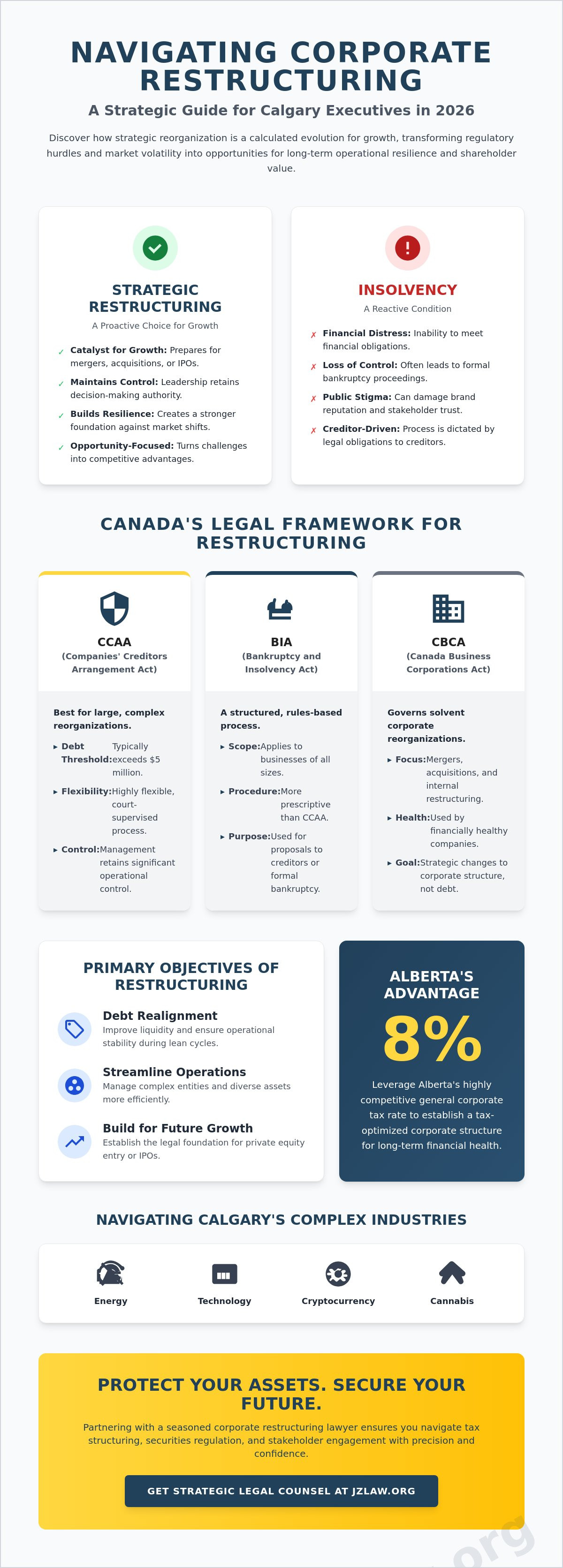
Corporate restructuring is the fundamental process of significantly altering a company’s capital structure or operational framework to better align with shifting economic realities. Within the specific context of the Calgary business environment, these reorganizations frequently emerge as a response to energy market volatility or the introduction of stringent new regulations in the emerging technology sector. While often associated with financial distress, modern restructuring also serves as a vital preparatory phase for entities pursuing mergers, acquisitions, or initial public offerings. Corporate restructuring serves as a sophisticated strategic tool that enables businesses to build long-term resilience against the unpredictable fluctuations of the 2026 global market. Engaging a qualified corporate restructuring lawyer calgary allows leadership teams to approach these transitions with precision, ensuring that the legal architecture of the business supports its long-term commercial vision.
The Difference Between Restructuring and Insolvency
It's vital to distinguish between a company’s financial state and its strategic response. Insolvency describes a specific condition where an entity can no longer meet its financial obligations as they come due. In contrast, restructuring is the deliberate legal and operational methodology used to address such challenges or to prevent them entirely. By initiating a proactive reorganization, Calgary executives can often avoid the public stigma and the significant loss of management control that typically accompanies formal bankruptcy proceedings. Common triggers in Alberta include sudden shifts in commodity pricing, the need to integrate a major acquisition, or the requirement to comply with the Companies' Creditors Arrangement Act (CCAA) when debt loads become unsustainable.
Key Objectives for Calgary Executives
The primary goal of any reorganization is to establish a sustainable path forward. For many local firms, this starts with debt realignment to improve immediate liquidity and ensure operational stability during lean cycles. Beyond simple survival, restructuring allows for the streamlining of complex corporate entities, which is particularly beneficial for managing diverse oil and gas law assets more efficiently. This process also builds the necessary legal foundation for future growth, whether that involves preparing for complex securities filings or positioning the company for a successful private equity entry. A dedicated corporate restructuring lawyer calgary provides the technical expertise required to ensure these objectives are met without compromising the integrity of the existing business model. Through methodical planning, organizations can protect their core value while shedding the inefficiencies that hinder progress in a competitive 2026 economy.
The Legal Framework: CCAA, BIA, and CBCA in Alberta
Navigating Calgary's high-stakes business environment requires a precise understanding of the statutory tools available for organizational change. The choice of a legal framework isn't merely a procedural detail; it's a strategic decision that dictates the survival or evolution of your enterprise. In Canada, three primary statutes govern this space: the Companies’ Creditors Arrangement Act (CCAA), the Bankruptcy and Insolvency Act (BIA), and the Canada Business Corporations Act (CBCA). Each serves a distinct purpose based on the organization's debt profile, solvency status, and ultimate commercial objectives. Identifying the correct path early in the process is vital for protecting assets and maintaining stakeholder confidence.
For corporations carrying significant debt, generally exceeding $5 million, the CCAA provides a flexible environment for complex reorganizations. You can review the Full text of the Companies' Creditors Arrangement Act to understand the breadth of court discretion involved in these proceedings. Conversely, the BIA offers a more structured, rules-based process that's often better suited for smaller entities or scenarios where a quick liquidation is the most pragmatic path. A seasoned corporate restructuring lawyer calgary will assess your balance sheet to determine which path offers the greatest protection for your specific operational needs.
CCAA vs. BIA: Navigating Distressed Scenarios
Under CCAA proceedings, the court appoints a "Monitor," an independent licensed insolvency trustee who oversees operations and reports to the court. While management remains in place, the Monitor's presence provides creditors with the transparency needed to maintain trust during the shift. Both acts provide a crucial "stay of proceedings," which serves as a legal shield by halting lawsuits and collection efforts. This breathing room is essential for drafting a "Plan of Arrangement," a comprehensive proposal that requires a double majority of creditor approval to redefine debt terms and secure the company’s future. Success here depends on balancing the legal requirements with the practical realities of the 2026 market.
Solvent Restructuring Under the CBCA
Not every reorganization is born of financial distress. Many Calgary firms utilize the CBCA to facilitate strategic shifts while remaining completely solvent. This statute allows for sophisticated corporate transactions such as amalgamations, continuances, or share exchanges without the negative connotations of insolvency. The court's primary role in a CBCA plan of arrangement is to ensure the plan is "fair and reasonable," balancing the interests of all stakeholders involved. Choosing this route often signals strength to the market, indicating that the company is proactively optimizing its structure for future growth or an eventual exit.
Selecting the appropriate statute requires a deep dive into your company's financial health and long-term goals. Whether you're facing immediate creditor pressure or planning a complex merger, the right legal architecture is paramount. If you're currently evaluating these options, consulting with a corporate restructuring lawyer calgary can provide the clarity needed to make a confident decision. Our team at John Zang Services can help you assess which framework best serves your strategic interests.
Strategic Tax and Securities Structuring: Beyond Insolvency
While many view reorganization through the lens of distressed debt, the most successful Calgary enterprises utilize these legal mechanisms to drive tax efficiency and market agility. This proactive approach is particularly relevant for businesses engaged in multi-layered corporate transactions where the primary goal is the preservation of shareholder value rather than debt mitigation. By aligning operational shifts with sophisticated tax planning, companies can unlock capital and streamline their balance sheets for a more competitive 2026 posture. It's about building a foundation that supports expansion rather than merely preventing contraction.
Implementing "Butterfly Transactions" or other tax-deferred rollovers allows for the divisive reorganization of a corporation, enabling shareholders to separate assets without triggering immediate tax liabilities. These maneuvers require surgical precision to remain compliant with the General Anti-Avoidance Rule (GAAR). While the Bankruptcy and Insolvency Act (BIA) provides a roadmap for distressed scenarios, solvent tax structuring focuses on the proactive movement of assets to maximize future growth. A corporate restructuring lawyer calgary acts as a strategic architect in these scenarios, ensuring every move satisfies the Canada Revenue Agency's (CRA) rigorous standards and protects the long-term interests of the firm.
Tax-Efficient Corporate Reorganizations
Strategic asset movement often hinges on the effective use of Section 85 rollovers, which facilitate the transfer of property to a corporation in exchange for shares while deferring capital gains. This is especially critical when managing tax losses and carry-forwards during a change of control, as improper execution can lead to the permanent loss of these valuable tax attributes. We meticulously structure "Step Transactions" to ensure each individual component of a reorganization serves a distinct commercial purpose. This methodical approach maintains CRA compliance and avoids the pitfalls of recharacterization, providing executives with the security they need to move forward with confidence.
Securities Considerations for Public Entities
For public companies, a significant reorganization triggers a cascade of reporting obligations that must be managed with absolute transparency. Navigating the intersection of securities regulation and corporate law is essential, particularly for firms currently in the process of taking companies public or those already listed on the TSX. Calgary executives must remain vigilant regarding insider trading rules and disclosure requirements during sensitive negotiations to prevent market manipulation or regulatory sanctions. Compliance with FINTRAC and the Alberta Securities Commission (ASC) isn't optional; it's the bedrock of a successful 2026 restructuring strategy. Partnering with a corporate restructuring lawyer calgary ensures that your public image remains as robust as your new corporate structure, safeguarding the trust of your investors and the integrity of the market.
Navigating the Restructuring Process: A Roadmap for Executives
A successful corporate reorganization isn't a reaction to a crisis; it's a planned sequence of strategic milestones designed to reposition a company for future success. While the legal technicalities are complex, the process generally follows a chronological roadmap that ensures all stakeholders are aligned and assets are protected. Engaging a corporate restructuring lawyer calgary provides the oversight necessary to manage these phases without disrupting core operations. The process typically unfolds across four distinct stages:
Phase 1: Diagnosis and Objective Setting. We begin by identifying the "why" behind the move, whether it's driven by tax optimization, a response to energy market volatility, or preparation for a future exit.
Phase 2: Stakeholder Mapping. This involves identifying the interests of lenders, shareholders, and regulators early to prevent friction during the formal transition.
Phase 3: Legal Drafting and Court Filings. Our team focuses on creating precise documents that can withstand intense judicial scrutiny and satisfy provincial requirements.
Phase 4: Implementation and Compliance. The final stage ensures that the new corporate structure is operational and that all post-restructuring reporting mandates are met.
Early Stage Preparation and Due Diligence
Rigorous due diligence is the bedrock of any successful transition. Executives must start with a comprehensive internal audit of all material contracts, commercial leases, and contingent liabilities to identify potential roadblocks. In Calgary’s interconnected industrial landscape, identifying "critical suppliers" is a top priority. These are vendors whose goods or services are so vital that their non-payment would jeopardize the entire reorganization. Securing their cooperation early is a strategic necessity. Throughout this phase, independent legal counsel is essential for protecting director liability and ensuring that the board’s decisions remain beyond reproach.
Negotiating with Creditors and Shareholders
Developing a "VOTABLE" plan is as much about strategic diplomacy as it is about legal drafting. To gain the necessary approvals, a reorganization proposal must be commercially viable and demonstrably better for creditors than the alternative of liquidation. Under Alberta law, executives must also manage the "Dissent Rights" of minority shareholders. These rights allow shareholders to challenge the plan if they feel their interests are being unfairly prejudiced. Maintaining absolute transparency throughout these negotiations is the most effective way to ensure business continuity and preserve the company’s reputation in the 2026 market.
If your leadership team is preparing for a significant organizational shift, the experts at John Zang Services can provide the strategic roadmap and legal precision required to protect your company's future.
Strategic Legal Counsel for Calgary’s Complex Industries
Calgary’s economic landscape is defined by high-stakes industries that require more than generalist legal advice. When an organization in a specialized sector undergoes a significant shift, the legal counsel must possess deep domain expertise to prevent regulatory friction. A dedicated corporate restructuring lawyer calgary provides the nuanced perspective necessary to handle the specific burdens of the energy and tech sectors. Unlike large-scale firms that often apply a standardized template to every file, a boutique approach allows for the strategic agility required to navigate the unique hurdles of 2026. We prioritize a partnership model where legal strategy is inseparable from your commercial objectives.
In the rapidly evolving field of cryptocurrency law, restructuring often involves the complex management of digital assets and decentralized liabilities. We ensure that these innovative ventures remain compliant with securities mandates while protecting their core technology during a reorganization. Similarly, cannabis licensing presents distinct challenges during a merger or corporate shift. A change in corporate structure can trigger mandatory reviews by Health Canada or provincial boards. Mismanaging these timelines can lead to a suspension of operations, which is why we integrate license preservation into the earliest stages of the restructuring plan.
The energy sector remains a pillar of the Alberta economy, yet it faces significant pressure regarding Asset Retirement Obligations (ARO). During a reorganization, managing these environmental liabilities is paramount to securing court approval and maintaining the trust of the Alberta Energy Regulator (AER). We provide the strategic oversight needed to address these obligations without compromising the company’s liquidity or future viability. This methodical approach ensures that even the most distressed energy assets are handled with the precision the 2026 regulatory environment demands.
Tailored Solutions for Emerging Tech and Energy
JZ Law integrates deep regulatory knowledge directly into the restructuring process. We understand that for tech-driven firms, intellectual property and digital assets are often the company’s most valuable resources. Our strategy focuses on ring-fencing these assets during debt negotiations to ensure they remain under the control of the reorganized entity. For energy clients, we maintain a proactive dialogue with the AER. This ensures that every step of the process aligns with current environmental and operational standards, mitigating the risk of administrative penalties or delays.
The JZ Law Advantage: Professionalism and Precision
John Zang’s approach to strategic corporate transactions is built on a foundation of professional dignity and meticulous attention to detail. We don't just act as legal executors; we function as strategic partners who understand the broader market implications of every decision. Our commitment to high-stakes representation ensures that your business transition is handled with the composure and sophistication it deserves. If your organization requires a corporate restructuring lawyer calgary to guide you through a complex evolution, the next step is a confidential consultation. We invite you to contact us to discuss how we can protect your interests and secure your company’s 2026 trajectory.
Securing Your Corporate Future in a Volatile Economy
A successful reorganization in 2026 requires a shift in perspective, moving from a survival mindset to a strategy of long-term operational resilience. By leveraging the appropriate legal frameworks and maintaining a tax-optimized structure, Calgary businesses can navigate the complexities of the CCAA or CBCA while safeguarding shareholder value. The integration of regulatory compliance with proactive asset protection ensures that your enterprise remains agile enough to capture new market opportunities. Partnering with a dedicated corporate restructuring lawyer calgary provides the technical precision necessary to manage these transitions with absolute confidence.
JZ Law offers a specialized, boutique approach that prioritizes your unique business objectives over standardized legal templates. With decades of experience in Calgary’s Oil and Gas sector and a modern expertise in the regulatory nuances of Cryptocurrency and Cannabis law, we provide the strategic depth required for high-stakes corporate transactions. We focus on tax structuring and risk mitigation to ensure your company’s evolution is both seamless and legally sound. Your organization's stability is our primary objective. Consult with JZ Law for Strategic Corporate Restructuring to begin defining your path forward with professional dignity and strategic clarity.
Frequently Asked Questions
What is the primary difference between CCAA and BIA for Calgary businesses?
The primary distinction lies in the scale of the debt and the level of court-supervised flexibility. The CCAA is reserved for larger corporations with debts exceeding $5 million, offering a broad judicial discretion to tailor the reorganization. In contrast, the BIA provides a more structured, rules-based process that is often more efficient for smaller entities or straightforward liquidations. A corporate restructuring lawyer calgary will evaluate your specific debt load to determine which statute offers the most robust protection for your assets.
Can a company restructure without going through a formal court process?
Yes, many organizations achieve their goals through private "out-of-court" workouts by negotiating directly with their primary lenders and creditors. This method preserves confidentiality and can be significantly more cost-effective than formal litigation. However, it requires the unanimous cooperation of all major stakeholders, as it lacks the legal "stay of proceedings" that a court order provides to halt hostile collection actions or lawsuits during the negotiation phase.
How does corporate restructuring affect my personal liability as a director?
Restructuring can provide a shield for directors, but it does not automatically erase all personal risks. Directors remain personally liable for certain statutory debts, such as unremitted GST, provincial sales taxes, and unpaid employee wages. During formal CCAA or BIA proceedings, we often seek court-ordered director charges that provide an indemnity for liabilities incurred while the company is under court protection, ensuring that leadership can focus on the reorganization without fear of personal financial ruin.
What are the tax implications of transferring assets during a reorganization?
Moving assets between entities can trigger immediate capital gains taxes unless you utilize specific deferral mechanisms under the Income Tax Act. By employing Section 85 rollovers, a corporate restructuring lawyer calgary can facilitate the transfer of property in exchange for shares while deferring the tax impact. These maneuvers require precise execution to ensure they aren't recharacterized by the CRA as taxable events, which would undermine the financial benefits of the entire reorganization process.
How long does a typical corporate restructuring process take in Alberta?
The duration of a reorganization is highly dependent on the complexity of the corporate group and the legal framework selected. A solvent plan of arrangement under the CBCA might be completed within three to six months if stakeholder support is high. More complex CCAA proceedings involving multiple classes of creditors and contested court hearings can easily extend beyond a year. We prioritize a methodical approach to ensure that the timeline remains predictable and aligned with your operational needs.
Is corporate restructuring only for companies in financial trouble?
Reorganization is a sophisticated strategic tool used by many solvent companies to enhance tax efficiency or prepare for a major transaction. It's common for Calgary firms to restructure their legal architecture before taking companies public or following a significant acquisition to eliminate redundant entities. This proactive approach ensures the corporate structure is optimized for future growth, rather than merely serving as a defensive response to insolvency or market downturns.
What role does a securities lawyer play in a corporate reorganization?
For public companies, a securities expert ensures that the reorganization complies with all Alberta Securities Commission (ASC) and stock exchange reporting requirements. They manage the timing of material change disclosures and oversee the communication strategy to prevent insider trading risks during sensitive negotiations. Their involvement is vital for maintaining market integrity and ensuring that the restructuring doesn't inadvertently trigger regulatory sanctions or a loss of investor confidence.
How can I protect my oil and gas leases during a restructuring?
Protecting energy assets requires a proactive strategy that addresses the Alberta Energy Regulator (AER) requirements regarding Asset Retirement Obligations (ARO). During a restructuring, we focus on ensuring that the proposed plan provides adequate security for environmental liabilities to prevent the regulator from blocking the transfer of licenses. Maintaining a transparent dialogue with the AER and ensuring operational compliance throughout the transition is the most effective way to safeguard your leases and mineral rights.


Comments