


DeFi Legal Issues 2026: Navigating Regulatory Frameworks in Calgary, New York, and Berlin
The long-standing belief that "code is law" has been definitively rejected by global enforcement agencies as of January 2026, leaving many founders exposed to personal liability they didn't anticipate. You likely understand that the borderless nature of decentralized finance doesn't grant immunity from the specific, often conflicting demands of authorities in Calgary, New York, and Berlin. Navigating defi legal issues today requires more than just technical proficiency; it demands a preventive strategic approach to bridge the gap between innovative protocols and rigid legislative frameworks that no longer view decentralization as a legal shield.
This article provides a comprehensive legal analysis of the current landscape, offering you the strategic frameworks needed to manage securities, AML, and liability risks across these diverse jurisdictions. You'll learn how to implement corporate structures that mitigate personal exposure while maintaining the functional integrity of non-custodial platforms. We'll examine the specific requirements for operating in the Canadian market alongside international peers, providing a clear map to help you scale cross-border without the constant shadow of litigation.
Key Takeaways
Understand the 2026 transition from unpredictable "regulation by enforcement" to structured statutory frameworks, enabling founders to build with greater legal certainty.
Navigate the critical distinctions between the US Howey Test and Alberta’s "Contractual Right" theory to ensure token classifications comply with Canadian provincial regulations.
Implement robust compliance strategies for defi legal issues relating to FINTRAC requirements and FATF’s unhosted wallet guidelines to mitigate cross-border regulatory risks.
Identify the "General Partnership" traps within DAO structures and evaluate how smart contract audits function as a preventive shield against personal liability for protocol losses.
Learn how to integrate cross-border tax structuring with protocol architecture to create a globally efficient and legally defensible operation through strategic counsel.
Table of Contents The Evolution of DeFi Legal Issues in 2026: A Global Perspective Securities Law and Token Classification: Calgary vs. New York vs. Berlin AML, KYC, and Sanctions: The "Unhosted Wallet" Challenge The Liability Gap: DAOs, Smart Contracts, and Personal Risk Strategic Legal Counsel for DeFi: How JZ Law Navigates Complexity
The Evolution of DeFi Legal Issues in 2026: A Global Perspective
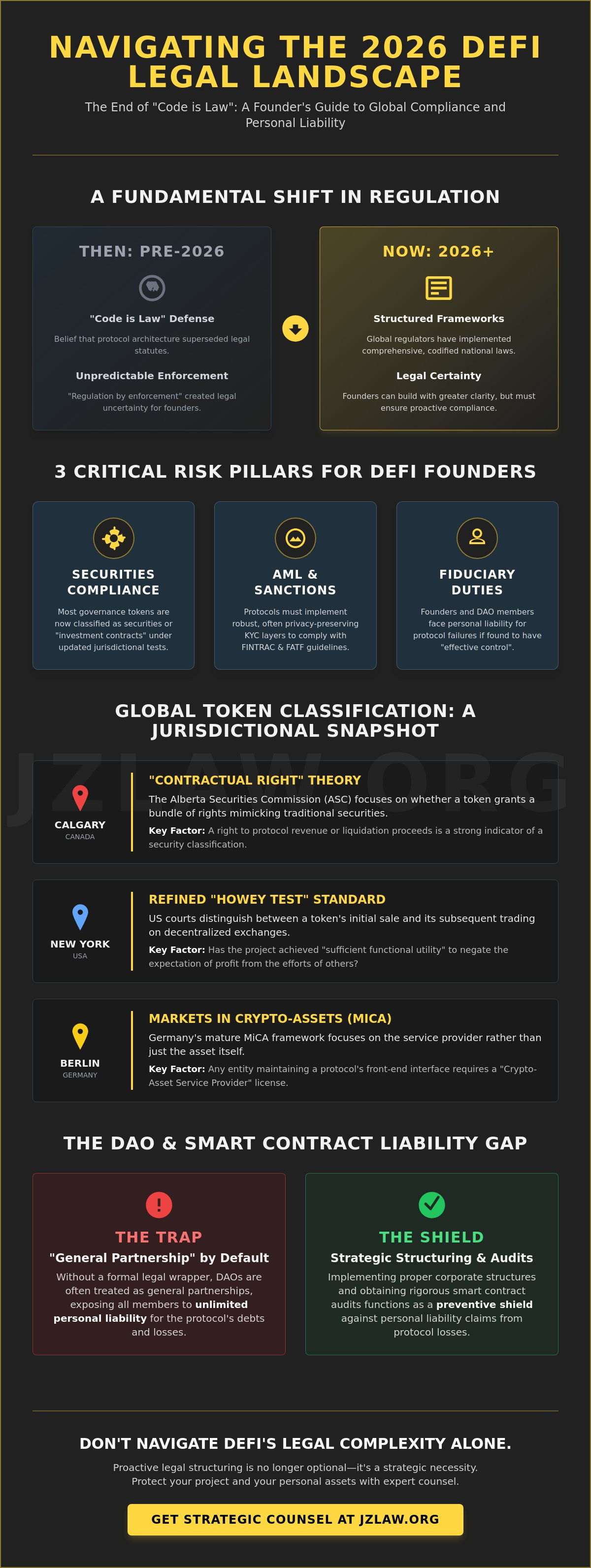
By 2026, decentralized finance has transitioned from a fringe experimental sector to a structured component of the global financial system. Regulators have moved beyond the "regulation by enforcement" phase that defined the early 2020s. They've replaced it with comprehensive statutory frameworks that demand transparency and accountability. Understanding
is now a prerequisite for any developer or investor. The primary
defi legal issues
in this era center on how automated protocols reconcile with codified national laws. The "Code is Law" defense, once a pillar of the crypto-anarchist movement, has effectively failed in modern courtrooms. Following a landmark 2025 ruling in the Federal Court of Canada, judges have consistently held that software architecture doesn't supersede consumer protection statutes. If a protocol functions like a bank or an exchange, it's treated as one, regardless of its underlying smart contracts. The current risk landscape for DeFi operators involves three critical pillars:
Securities Compliance: Most governance tokens are now classified as investment contracts under updated "Howey-style" tests.
Anti-Money Laundering (AML): Protocols must implement privacy-preserving KYC (Know Your Customer) layers to operate legally in major markets.
Fiduciary Duties: Founders and DAO (Decentralized Autonomous Organization) members often face personal liability for protocol failures if they're found to have "effective control."
The 2026 Regulatory Landscape in Major Hubs
In Calgary and Toronto, the Canadian Securities Administrators (CSA) implemented the "DeFi Compliance Framework" in late 2025. This requires protocols serving Canadian residents to register if they provide liquidity or leverage. In Berlin and Frankfurt, the Markets in Crypto-Assets (MiCA) regulation has fully matured. German authorities now require "Crypto-Asset Service Provider" licenses for any entity maintaining a protocol's front-end interface. Meanwhile, New York remains a point of friction; the SEC's 2026 "Protocol Rule" frequently clashes with more permissive state-level laws in places like Denver and Wyoming.
Why Founders Can No Longer Ignore Jurisdictional Arbitrage
The myth that being "offshore" provides total immunity has been dismantled. Regulators in Vancouver and New York now use "effective control" metrics to target decentralized teams based on where their core developers reside. If a team operates from a Calgary office, the CSA claims jurisdiction even if the entity is registered in the Marshall Islands. Proactive legal structuring before a protocol launch is no longer optional; it's a strategic necessity to mitigate defi legal issues. Strategic partners now focus on preventive measures, ensuring that decentralization is a functional reality rather than a legal facade. Waiting for an inquiry from a regulator often means it's already too late to protect the project's assets.
Securities Law and Token Classification: Calgary vs. New York vs. Berlin
By 2026, the landscape for defi legal issues has shifted from speculative enforcement to rigorous, jurisdiction-specific frameworks. In New York, US courts have moved beyond the broad strokes of the 1946 Howey Test. They now apply a "refined investment contract" standard that distinguishes between the initial sale of a token and its subsequent trading on decentralized exchanges. This distinction, solidified in 2025 appellate rulings, offers a narrow window for protocols to argue that secondary market transactions don't constitute securities offerings if the underlying project has achieved sufficient functional utility.
In Calgary, the Alberta Securities Commission (ASC) adheres to a "Contractual Right" theory. This approach posits that most DeFi tokens represent a bundle of rights that mimic traditional securities, regardless of their technical label. If a token provides a right to protocol revenue or liquidation proceeds, it's classified as a security under the Alberta Securities Act. Integrating academic insights on regulatory responses to DeFi reveals that this Canadian stance is among the most conservative globally, requiring developers to seek exempt market dealer status or rely on specific prospectus exemptions to avoid penalties that can exceed C$1,000,000 for non-compliance.
Berlin presents a starkly different environment. Germany’s Electronic Securities Act (WpIG) and the full implementation of the Markets in Crypto-Assets (MiCA) regulation provide a clear taxonomy. Utility tokens aren't treated as financial instruments if they only grant access to a service. This regulatory certainty has turned Berlin into a hub for European DeFi issuance, as founders can "passport" their compliance across the EU, avoiding the fragmented defi legal issues that plague North American projects.
Is Your Governance Token a Security?
The legal status of governance tokens often hinges on the "efforts of others" prong. If a core team maintains the protocol's code or controls the treasury, courts in 2026 likely view the token as a security. Secondary market liquidity on platforms like Uniswap adds risk, as it suggests an expectation of profit from market appreciation. The 2026 Decentralization Threshold requires that no single entity or coordinated group controls more than 15% of voting power or protocol upgrades for a token to qualify for a securities exemption.
Cross-Border Compliance Strategies for Token Issuance
Issuers targeting both Calgary and New York must navigate a dual-track approach. This involves structuring private placements under Regulation D in the US while simultaneously utilizing the "accredited investor" exemption in Alberta. For those scaling toward institutional maturity, taking your company public provides a roadmap for the high-level transparency regulators now demand. German projects benefit from MiCA’s unified rules, allowing a single filing in Berlin to cover the entire European market. Successful founders often adopt a preventative legal strategy to ensure their liquidity provider (LP) tokens don't inadvertently trigger collective investment scheme regulations.
AML, KYC, and Sanctions: The "Unhosted Wallet" Challenge
The 2026 FATF (Financial Action Task Force) guidelines have fundamentally altered the compliance landscape for decentralized finance. These standards demand that Virtual Asset Service Providers (VASPs) collect and verify information on "unhosted wallets" when transaction values exceed certain thresholds. In Canada, FINTRAC has mirrored these requirements, compelling DeFi protocols operating in Calgary and Toronto to integrate robust monitoring tools. The evolution of defi legal issues centers on the friction between decentralization and the state's need for financial surveillance. Compliance isn't optional; it's a prerequisite for institutional scale.
Protocol developers in Canada now face a landscape where code neutrality isn't a guaranteed legal defense. Following the precedent set by the 2022 Tornado Cash sanctions, legal authorities in 2026 hold developers and DAO participants liable if they don't implement reasonable measures to block sanctioned entities. This shift forces a difficult balance between privacy-preserving technology and global anti-money laundering (AML) mandates. Developers must consider whether their smart contracts facilitate "blind" transactions for entities on the OSFI or OFAC lists, as the cost of negligence often includes criminal prosecution or heavy administrative penalties.
KYC at the Protocol Level: Necessary Evil or Legal Shield?
Institutional participants in Frankfurt and NYC have pioneered "Permissioned DeFi," where users must pass KYC checks before accessing liquidity pools. This approach acts as a legal shield, protecting the protocol from defi legal issues related to illicit fund flows. To maintain user privacy, many projects now utilize zero-knowledge proofs (ZKP). These cryptographic tools allow users to prove they aren't on a sanctions list without revealing their entire identity or transaction history to the public ledger. It's a sophisticated middle ground that satisfies regulators in Berlin and New York while respecting the ethos of blockchain technology.
Stablecoins and DeFi: A Regulatory Intersection
Stablecoins act as the primary bridge for DeFi, but their integration triggers immediate Money Services Business (MSB) and banking regulations. The New York Department of Financial Services (NYDFS) has established a global benchmark for reserve transparency that Canadian firms must often follow to maintain cross-border liquidity. If your protocol utilizes these assets, you must consult our Stablecoin Regulation 2026 guide to understand the specific licensing requirements. In Calgary, failing to register as an MSB when handling stablecoin-to-fiat conversions can lead to immediate cease-and-desist orders from provincial regulators.
The Liability Gap: DAOs, Smart Contracts, and Personal Risk
The legal landscape for decentralized autonomous organizations (DAOs) has shifted from theoretical risk to concrete litigation. By mid-2026, regulators in both Calgary and New York have consistently applied the "General Partnership" doctrine to unincorporated DAOs. This means that if you hold governance tokens and participate in votes, you could be held personally liable for the entirety of a protocol's debt or losses. If a smart contract exploit results in a C$15 million loss, every active member's personal assets are potentially at risk under Alberta's Partnership Act or similar New York statutes. These defi legal issues highlight the danger of operating without a recognized legal personality.
Smart contract audits, while technically essential, don't provide an automatic legal safe harbor in 2026. Courts now view audits as a minimum standard of care rather than a complete liability defense. Developers and major token holders must also recognize their evolving fiduciary duties. Recent 2025 enforcement actions against unincorporated entities demonstrate that "decentralization" isn't a shield against claims of negligence or breach of duty when a small group of holders controls the majority of the vote. Addressing these defi legal issues requires a preventive, structured approach to protect individual stakeholders from catastrophic financial exposure.
Corporate Wrappers for DAOs: Strategic Structuring
Liability insulation requires moving beyond pure code. Many Alberta-based projects now utilize Wyoming or Marshall Islands LLCs to create a "corporate wrapper" that limits personal exposure. Conversely, the Berlin "Foundation" (Stiftung) model is increasingly favored for protocol governance because it separates the assets of the protocol from the individuals who manage it. For Canadian developers, a professional corporation can provide a layer of protection, though it must be carefully integrated with the DAO's smart contract logic to ensure the corporate veil isn't pierced by regulators looking for a centralized point of failure.
Drafting Enforceable Terms of Use for Decentralized Platforms
The front-end interface is often the only place where a legal contract can be formed with users. A simple "Connect Wallet" button is insufficient. In 2026, platforms must implement robust click-wrap agreements that require active consent to terms before any transaction occurs. These documents should include mandatory arbitration clauses, specifying Calgary or New York as the seat of dispute resolution to avoid unpredictable jurisdictional jumps. It's vital to include specific disclaimers for oracle failures and smart contract exploits, as these are no longer considered unforeseeable events by courts. This level of precision is essential for long-term risk mitigation.
Strategic legal planning is the foundation of protocol viability and developer safety. Contact Jaszovszky Ügyvédi Iroda to secure your decentralized project against personal liability and regulatory scrutiny.
Strategic Legal Counsel for DeFi: How JZ Law Navigates Complexity
Success in the decentralized finance sector requires more than just innovative code; it demands a robust legal foundation. JZ Law employs a specialized methodology that synchronizes cross-border cryptocurrency law with aggressive regulatory defense. We don't just interpret rules. We anticipate shifts in enforcement priorities across Calgary, New York, and Berlin. By integrating tax structuring directly into protocol architecture, we ensure your project achieves global efficiency without triggering unintended tax liabilities in multiple jurisdictions. This dual-layer approach protects both the developers and the long-term viability of the protocol itself.
The most critical step for any founder is the Preventative Legal Audit. Completing this review before mainnet deployment is the difference between a sustainable launch and a catastrophic regulatory shutdown. We analyze your smart contracts for defi legal issues that might attract scrutiny from the Alberta Securities Commission or the SEC. This proactive approach identifies potential classification risks early, allowing for architectural adjustments that preserve decentralization while maintaining compliance. Investing in a C$20,000 audit today often prevents a C$500,000 enforcement action tomorrow.
John Zang provides the strategic corporate oversight necessary for the Web3 era. Whether you're structuring a DAO or a centralized development entity, his counsel ensures your corporate transactions remain airtight. We focus on long-term viability, helping you build a legacy that can withstand the scrutiny of institutional auditors and global regulators alike. Our firm acts as a strategic partner, translating complex legal requirements into actionable business logic.
From Startup to Public: The JZ Law Advantage
Scaling a protocol requires a clear path from initial deployment to potential public exit or institutional acquisition. JZ Law guides entities through the labyrinth of securities regulation, ensuring your tokenomics don't inadvertently create unregistered securities. Our expertise spans the unique requirements of Calgary's tech sector, Berlin's MiCA-compliant markets, and NYC's financial hubs. For a deeper look at the evolving landscape, explore our analysis of Cryptocurrency Law 2026. We provide the bridge between agile startup culture and the rigorous standards required for global market entry.
Secure Your Protocol’s Future
Institutional trust is the most valuable currency in 2026. Securing venture capital now requires a demonstrated commitment to compliance that goes beyond a simple legal opinion. Strategic legal counsel is essential for passing the due diligence phases of top-tier investment firms. By addressing defi legal issues before they become liabilities, we position your project as a low-risk, high-reward opportunity for institutional partners. Don't leave your protocol's survival to chance. Schedule a consultation with JZ Law today to begin your comprehensive compliance review.
Securing Your DeFi Venture in a Fragmented Global Regulatory Landscape
The regulatory landscape of 2026 proves that the divergence between jurisdictions like Calgary, New York, and Berlin has created a complex environment where standard compliance models often fail. Projects must now reconcile the Alberta Securities Commission's specific mandates with the rigorous enforcement standards of the NYDFS. Effectively navigating defi legal issues requires a transition toward a preventive legal framework that addresses liability gaps within DAOs and smart contracts before they result in regulatory friction. Success in this sector depends on your project's ability to integrate robust AML protocols for unhosted wallets while maintaining the operational efficiency of decentralized protocols.
JZ Law provides the specialized cryptocurrency law practice needed to bridge these international divides. Our firm offers deep expertise in securities regulation across Canada and the US, delivering strategic counsel for complex corporate transactions that demand both precision and a modern business perspective. We don't just react to legal shifts; we help you anticipate them to ensure your project remains resilient and compliant. Navigate your DeFi legal strategy with JZ Law to build your venture on a foundation of professional dignity and long-term security.
Frequently Asked Questions
Are DeFi protocols legal in Canada and the US in 2026?
DeFi protocols are legal provided they adhere to the stringent registration requirements established by the Canadian Securities Administrators (CSA) and the SEC. In Canada, Staff Notice 21-332 mandates that platforms facilitating crypto asset trading must provide functional decentralization proofs to avoid being classified as restricted dealers. You'll find that compliance isn't optional; it's the foundation of your platform's longevity in the 2026 regulatory environment.
Can a DAO be sued if it has no central office or CEO?
Yes, a DAO can be sued as an unincorporated association under precedents set by the 2023 Ooki DAO case and subsequent Canadian rulings. Courts now look past the lack of a physical headquarters to identify "control persons" or token holders who participate in governance. This legal reality means that individual members can face joint and several liability for the entity's debts or regulatory infractions.
What are the biggest legal risks for DeFi developers personally?
Personal liability for unlicensed money transmission and securities violations represents the most significant risk for developers. Under the updated 2025 Anti-Money Laundering Act, developers who maintain administrative keys or "backdoor" access can face personal fines exceeding C$500,000. It's vital to recognize that writing code is protected speech, but deploying and maintaining a profit-seeking protocol is a regulated financial activity.
How does the MiCA regulation in Germany affect DeFi platforms?
The Markets in Crypto-Assets (MiCA) regulation requires any platform with centralized components to obtain a BaFin license by the 2026 implementation deadline. If your Calgary-based platform serves users in Berlin, you must demonstrate "full decentralization" to qualify for the MiCA exemption. Failure to meet these technical and legal standards results in a total ban from the European Economic Area's digital asset market.
Do I need to implement KYC/AML on my decentralized exchange (DEX)?
You must implement KYC/AML protocols if your DEX facilitates trades for Canadian residents, as FINTRAC now classifies these platforms as Money Services Businesses (MSBs). The 2026 guidelines require "travel rule" compliance for all transactions over C$1,000. Ignoring these requirements doesn't just invite fines; it triggers aggressive enforcement actions from the Alberta Securities Commission and federal authorities.
Is a smart contract audit enough to prevent legal liability?
A smart contract audit is a technical necessity but doesn't serve as a shield against defi legal issues or regulatory scrutiny. While audits demonstrate a commitment to security, they don't address compliance with the Securities Act or consumer protection laws. Our preventive approach emphasizes that legal "bug bounties" and regulatory mapping are just as critical as checking your Solidity code for reentrancy vulnerabilities.
How can a Calgary-based lawyer help with New York securities law?
A Calgary firm provides strategic representation by utilizing the US-Canada Multijurisdictional Disclosure System (MJDS) to coordinate cross-border compliance. We manage the complex interplay between Alberta’s provincial regulations and the SEC’s 2026 "Exchanges" definitions. This ensures your protocol doesn't inadvertently trigger a New York Taylor Act violation while you're focused on domestic growth in the Canadian market.
What is the "Investment Contract" status of governance tokens in 2026?
Most governance tokens are classified as investment contracts under the Howey Test and Canada's Pacific Coin precedent if they're sold to fund development. If the token's value relies on the "managerial efforts" of a core team, it's a security. We analyze the 2026 decentralization metrics to determine if your token has sufficiently evolved into a non-security utility asset or remains a regulated financial instrument.



Comments