


JOHN ZANG's VIEWS: How to Get a Cannabis Cultivation Licence in Alberta: A Strategic Legal Guide
- jzanglaw
- Apr 5
- 13 min read
Updated: Apr 6
Many people come to John Zang and ask what if the most significant obstacle to your commercial grow operation isn't the quality of your product, but the rigid sequence of Health Canada's "site-first" mandate? You likely understand that securing a facility before even submitting an application represents a C$150,000+ capital risk that keeps many entrepreneurs awake at night. It's frustrating to face a regulatory landscape where Calgary's land-use bylaws clash with Edmonton's specific requirements; this often leaves your business caught in a jurisdictional gap. Learning how to get a cannabis cultivation license in alberta requires more than just persistence. It demands a strategic legal partner who anticipates roadblocks before they occur.
This guide provides the strategic legal clarity you need to secure your commercial cultivation licence with professional precision while ensuring your corporate structure is robust enough for a future IPO or scaling. We'll examine the critical path from initial site acquisition to final federal approval, focusing on the preventive legal measures that protect your investment from the start. You'll gain a clear roadmap to federal compliance that aligns perfectly with Alberta's specific land-use bylaws, allowing you to focus on your business growth rather than regulatory hurdles.
Key Takeaways
Navigate the complex interplay between federal Health Canada regulations and Alberta municipal bylaws to establish a solid legal foundation for your facility.
Determine the most cost-effective licensing category for your business by analyzing the specific security and production differences between Micro and Standard cultivation.
Follow a structured, professional methodology on how to get a cannabis cultivation license in alberta, focusing on municipal land-use compliance and security clearances.
Avoid the "insufficient evidence" trap by ensuring your Site Evidence Package and Good Production Practices (GPP) documentation meet rigorous federal standards.
Position your venture for future capital markets or an IPO through strategic corporate structuring that prioritizes long-term scalability and regulatory integrity.
Table of Contents
Understanding the Cannabis Licensing Framework in Alberta
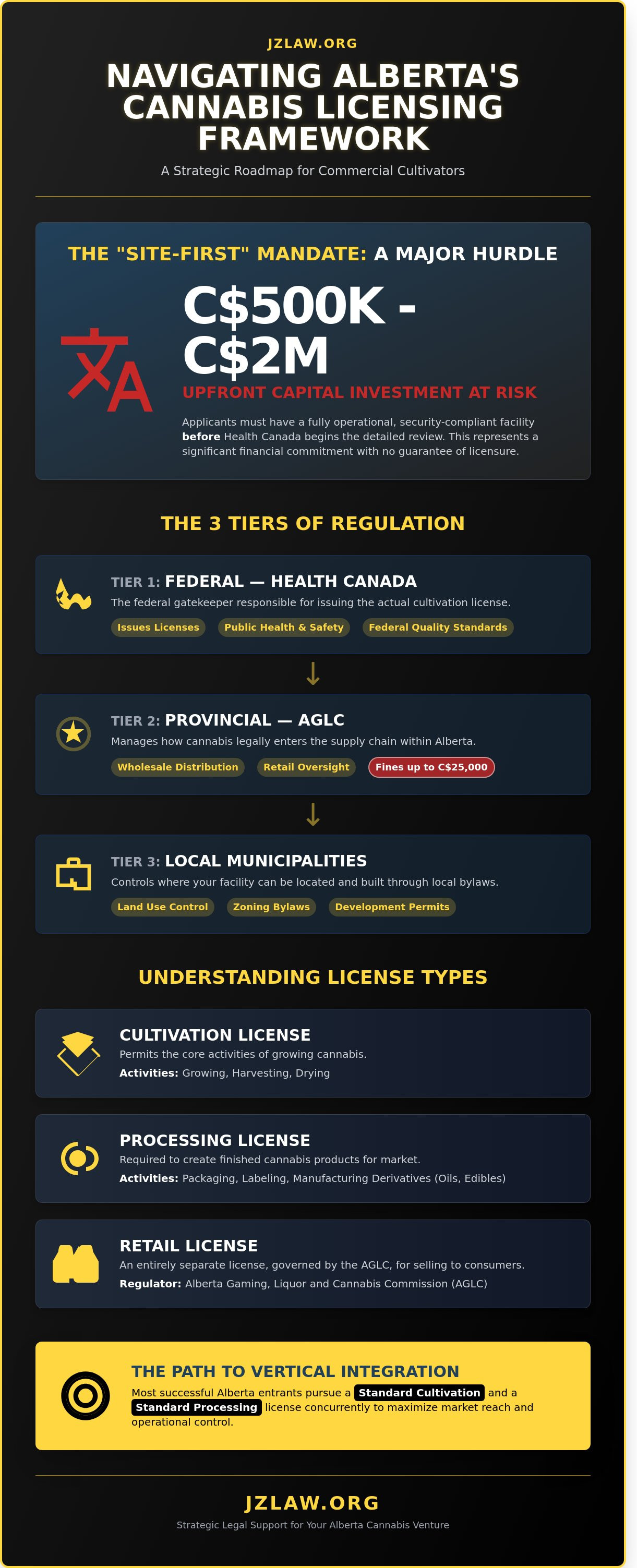
Establishing a commercial cannabis venture requires a rigorous understanding of the multi-tiered regulatory environment. As of 2024, Alberta hosts over 130 licensed producers, making it one of Canada's most concentrated markets for both standard and micro-cultivation. The legal framework rests upon the Cannabis Act and the Cannabis Regulations, which underwent significant refinements in early 2026 to streamline security requirements for micro-class applicants. Regulatory authority is divided across three distinct levels, and failing to synchronize with any of them can result in a permanent halt to your operations.
Health Canada serves as the federal gatekeeper, issuing the actual cultivation license. The Alberta Gaming, Liquor and Cannabis Commission (AGLC) manages the wholesale distribution and retail oversight. Local municipalities control land use through development permits and zoning bylaws. Understanding how to get a cannabis cultivation license in alberta necessitates a strategy that addresses all three levels simultaneously to ensure the facility meets both federal security standards and local land-use requirements.
We must distinguish between license types to avoid costly application errors. Cultivation permits allow the growing, harvesting, and drying of plants. Processing licenses are required for packaging, labeling, and manufacturing derivatives like oils or edibles. Retail licenses, governed by the AGLC, are entirely separate. Most successful Alberta entrants pursue a "Standard Cultivation" and "Standard Processing" license concurrently to maximize vertical integration and market reach.
Federal vs. Provincial Jurisdictions
Health Canada's mandate focuses on public health and safety, ensuring that every gram produced meets federal quality standards. Conversely, Alberta's provincial framework, detailed in the Cannabis in Alberta overview, dictates how that product enters the legal supply chain. You can't sell directly to consumers from your farm; you must sell through the AGLC or to other federally licensed processors. This dual-jurisdiction model requires a preventive legal strategy to avoid compliance gaps that can lead to C$25,000 fines or license suspension.
The 'Site-First' Application Requirement
Implementing the process of how to get a cannabis cultivation license in alberta involves a significant "build-then-apply" mandate. Applicants must have a fully operational, security-compliant facility before Health Canada begins the detailed review. This means committing C$500,000 to C$2,000,000 in capital before receiving any guarantee of licensure. To mitigate this risk, we recommend a phased construction approach and a "shelf-ready" evidence package that includes a 100 percent complete site video and comprehensive Standard Operating Procedures (SOPs) to ensure the first submission is the only submission.
Standard vs. Micro-Cultivation: Which Licence Fits Your Business?
Determining the appropriate regulatory path is the first hurdle in understanding how to get a cannabis cultivation license in alberta. The Cannabis Regulations establish distinct categories based on the scale of production and intended market reach. While the fundamental goal of compliance remains constant, the financial and operational burdens vary significantly between standard and micro-cultivation models. Your choice will dictate your facility's design, your security budget, and your long-term scalability within the Canadian market.
Standard Cultivation Licences
Standard cultivation licences are designed for industrial-scale operations. There's no upper limit on canopy size, which allows for massive production volumes that can satisfy provincial supply agreements or international export demands. However, this freedom comes with rigorous security requirements. You must implement 24/7 visual monitoring and intrusion detection for all areas where cannabis is present. For companies aiming to go public or attract institutional investment, the standard licence provides the necessary scalability. When you analyze how to get a cannabis cultivation license in alberta, the choice of a standard licence usually implies a capital-intensive strategy focused on high-volume output and broad market penetration.
Micro-Cultivation Licences
Micro-cultivation licences target the "craft" market. These facilities are restricted to a maximum canopy of 800 square metres. This limitation is offset by reduced regulatory hurdles and lower initial capital requirements. For instance, micro-cultivators can often utilize visual monitoring without the same level of high-tech intrusion detection sensors required for larger sites. This makes it an attractive entry point for entrepreneurs with limited initial capital who want to focus on high-quality, niche brands. You can review the specific criteria through the Health Canada Cannabis Licensing Application portal to see which tier aligns with your site's physical footprint and financial capacity.
The corporate implications of these choices are profound. While a micro-licence is easier to obtain, it limits your revenue ceiling. If your business grows, you'll need to apply for a licence amendment or a new class of licence to expand beyond the 200 square metre limit. This transition requires a preventative approach to facility design to ensure your site can meet stricter security standards later. Securing a strategic legal consultation early in the planning phase prevents costly misalignments between your facility design and your chosen licence class.
Nursery licences represent a third, specialized opportunity. These are restricted to producing seeds and seedlings, serving as the genetic backbone for the wider industry. A nursery licence allows for a maximum canopy of 50 square metres for flowering plants, but there's no limit on the space used for vegetative growth. This niche is ideal for breeders focused on genetics rather than the consumer flower market. Each path requires a different set of "Key Personnel" who must pass Health Canada's security screening, a process that can take several months to complete.
JOHN ZANG's ADVICE: The 5-Step Path to Licensure for Alberta Producers
Securing a federal permit requires a methodical adherence to both federal and local frameworks. The process of understanding how to get a cannabis cultivation license in alberta involves five distinct phases that transform a business concept into a compliant operational facility. Since the 2019 regulatory shift, Health Canada requires applicants to have a fully built site before submission, making the sequence of these steps critical for capital management.
Step 1: Corporate Structuring and Security Clearance Preparation. You must establish a legal entity and identify all key personnel. This stage involves preparing the personal history and financial disclosure documents required for the Health Canada cultivation licence application.
Step 2: Site Selection and Municipal Land-Use Compliance. You'll need to secure a property that meets both federal security requirements and local zoning bylaws. A formal "Letter of Non-Objection" or a valid Development Permit from the municipality is mandatory.
Step 3: Facility Construction and Site Evidence Package Creation. Once the facility is built to the specifications of the Cannabis Regulations, you'll create a Site Evidence Package. This includes high-definition video walkthroughs and photographic proof of perimeter security and access controls.
Step 4: Submission via the Cannabis Tracking and Licensing System (CTLS). All data, including the site evidence and corporate records, are uploaded to the federal portal. At this stage, the C$3,277 to C$23,000 application fee is typically due, depending on the licence class.
Step 5: Health Canada Review and Pre-Licence Inspection. Regulators review the digital evidence. While micro-cultivators may receive a licence based on the evidence package, standard cultivators often undergo a physical pre-licence inspection to verify security measures.
Municipal Zoning in Calgary and Edmonton
Calgary’s Land Use Bylaw 1P2007 defines specific industrial districts where cultivation is permitted, yet it imposes a 150-metre separation from schools and emergency shelters. In Edmonton, Zoning Bylaw 12800 is equally stringent, requiring a 200-metre separation distance from sensitive sites. You must obtain a Development Permit from the city to prove local compliance. Without this document, Health Canada won't proceed with your file, as municipal alignment is a prerequisite for federal approval.
Security Clearances and Key Personnel
The security clearance process is the most frequent cause of delays. Directors, officers, and any individual holding more than 25% of a private corporation must undergo screening by the RCMP and CSIS. These agencies look for links to organized crime or a history of drug-related convictions. Red flags that derail applications include unexplained wealth, associations with sanctioned individuals, or significant financial instability. It's vital to vet your partners before submission to ensure their backgrounds don't jeopardize the corporate application.
Mitigating Legal Risks and Common Application Pitfalls
Securing a federal permit is a rigorous process where technical precision outweighs entrepreneurial enthusiasm. Understanding how to get a cannabis cultivation license in alberta requires a granular focus on documentation. Health Canada reported in their 2023-2024 performance data that nearly 35% of delays in the licensing queue result from incomplete Site Evidence Packages. These packages must provide visual and narrative proof that the facility is fully built and compliant with the Cannabis Act. A common error involves submitting low-resolution video tours or photographs that fail to show the exact placement of physical barriers and visual monitoring points. If the evidence is deemed insufficient, the application is pushed back into a multi-month review cycle; this creates a liquidity drain that many startups cannot survive.
Alberta's regulatory environment introduces unique operational hurdles. Cultivators must secure water licenses from Alberta Environment and Protected Areas before operations begin. Failing to account for the peak utility loads required by high-intensity discharge lighting can lead to costly retrofits. In 2023, two Edmonton-based applicants faced six-month delays because their initial electrical plans did not meet the specific grid requirements of EPCOR. Strategic legal oversight ensures these provincial nuances are integrated into the federal application from day one.
GPP and Quality Assurance
Your Quality Assurance Person (QAP) is the most critical hire in your corporate structure. This individual doesn't just oversee plant health; they act as the primary liaison for federal audits. Standard Operating Procedures (SOPs) must be exhaustive. They should cover everything from sanitation cycles to the calibration of scales with 0.01-gram accuracy. Effective SOPs aren't static documents. They're living frameworks that withstand the scrutiny of unannounced inspections. We recommend a preventive legal strategy where internal audits are conducted quarterly to ensure the facility remains in a state of perpetual compliance. This proactive stance prevents the suspension of licenses which can cost a producer upwards of C$50,000 per day in lost revenue. This state of perpetual compliance extends to the physical facility itself, which requires diligent upkeep and professional maintenance. For business owners planning these operational needs, it can be helpful to visit JBM Custom Contracting to see the scope of professional property services available.
Part of this proactive stance involves robust integrated pest management (IPM) to protect your crop from devastating infestations. Ensuring your facility is secure from insects and rodents is as critical as any other security measure. For those developing their SOPs, it can be helpful to see what professional services are available; you can discover Jones Bros Pest Control, Inc. for insights into comprehensive pest management solutions.
Tax Structuring and Financial Compliance
Effective financial management is a pillar of long-term viability. Producers in Alberta must navigate the federal excise tax framework; this currently demands C$1.00 per gram or 10% of the ad valorem value, whichever is higher. Strategic tax structuring involves more than just bookkeeping. It requires the intelligent categorization of assets to maximize depreciation under the Income Tax Act. While Canada doesn't have a direct equivalent to the American 280E tax code, producers still face "280E-style" traps where certain promotional and overhead expenses are non-deductible or heavily restricted. Proper corporate structuring can shield your assets and improve your bottom line by as much as 12% annually. For specialized assistance in protecting your investment, you should consult with a strategic legal partner to review your financial architecture.
Strategic Legal Support for Your Alberta Cannabis Venture
Securing a license is the foundation, but building a scalable enterprise requires a preventive legal framework. Understanding how to get a cannabis cultivation license in Alberta is merely the first step in a multi-year capital strategy. JZ Law bridges the gap between strict Health Canada compliance and aggressive corporate growth. We don't just help you follow the rules; we ensure your corporate structure can withstand the scrutiny of institutional investors and public markets.
A preventive legal approach is vital in an industry where a single regulatory oversight can result in administrative monetary penalties exceeding C$25,000 or the total suspension of operations. We treat legal counsel as a strategic asset rather than a reactive cost. By identifying potential bottlenecks in your governance or supply chain contracts early, we protect the valuation of your Alberta cannabis startup before you even break ground on a facility.
Corporate Transactions and Securities
Transitioning from a private, founder-led cultivation site to a public entity requires meticulous preparation. We guide clients through the complexities of Taking Your Cannabis Company Public, ensuring every disclosure and financial statement meets the rigorous standards of Canadian securities regulators. Our team manages the delicate balance of shareholder agreements and complex corporate financing, often involving C$5 million to C$50 million in private placements or venture debt.
Structuring your business for future investment means more than just filing paperwork. It involves creating a robust intellectual property strategy and clean cap tables that don't scare away Tier 1 lenders. Whether you're preparing for an Initial Public Offering (IPO) or positioning your facility for acquisition by a larger Licensed Producer (LP), we ensure your legal architecture supports your exit or expansion goals.
Why Choose John Zang for Your Cannabis Licensing
John Zang provides direct, professional counsel for founders and executive teams who require more than a generalist's perspective. Our practice is built on deep expertise in both the Alberta and California regulatory landscapes, offering a unique cross-border vantage point on market trends and compliance evolution. We focus exclusively on high-stakes corporate law, intentionally excluding criminal and family matters to maintain a sharp edge in business litigation and transactional strategy.
When you're determining how to get a cannabis cultivation license in Alberta, you need a partner who understands the nuances of the Cannabis Act alongside the pressures of the boardroom. We offer a sophisticated, business-first approach that prioritizes your company's long-term viability. Our clients benefit from a lawyer who acts as a strategic partner, translating complex legal requirements into actionable business advantages.
John Zang: Secure Your Future in the Alberta Cannabis Market
Securing a foothold in Alberta's cannabis sector requires more than just meeting basic regulatory requirements; it demands a rigorous adherence to Health Canada's security and quality control standards. It's not just about the paperwork. Whether you're pursuing a micro-cultivation license or a large-scale standard operation, the difference between a successful application and a costly delay often lies in the precision of your site evidence package and corporate structure. Understanding how to get a cannabis cultivation license in Alberta is merely the first step in a broader commercial journey involving complex securities law and capital strategy.
JZ Law provides the specialized legal architecture necessary to navigate these hurdles, leveraging our strategic presence in Calgary and San Francisco to bridge the gap between local operations and international capital markets. We don't just handle licenses; we specialize in the sophisticated process of taking cannabis companies public. Our preventive approach identifies potential pitfalls before they impact your C$100,000+ initial investments. Schedule a Strategic Consultation with JZ Law to ensure your venture is built on a foundation of legal excellence. Your path to becoming a licensed producer in Canada's most dynamic market is ready for its next phase.
Frequently Asked Questions
How much does a cannabis cultivation licence cost in Alberta?
A standard cultivation licence application costs C$3,277, while a micro-cultivation licence application fee is C$1,654 as of 2024. These figures represent the initial Health Canada screening fees and exclude the annual regulatory fees which are calculated as a percentage of your total cannabis revenue. You must also budget for security clearances at C$1,654 per person and local municipal permits which often exceed C$5,000 in major Alberta hubs like Calgary or Edmonton.
Can I grow cannabis in my home for commercial sale in Alberta?
You can't grow cannabis in a private dwelling for commercial sale under current federal regulations. Health Canada mandates that your production site must be a dedicated facility separate from any residential living space to ensure strict compliance with security and quality control standards. Establishing a professional facility is a prerequisite for anyone learning how to get a cannabis cultivation license in alberta, as inspectors require clear boundaries between personal and commercial operations.
How long does it take for Health Canada to approve a cultivation licence?
The approval process generally spans 180 to 365 days depending on the completeness of your facility and the complexity of your application. Health Canada moved to a site-first model in May 2019, meaning your facility must be fully built and ready for inspection before you submit your final application. Delays often occur during the security clearance phase for key personnel, which can take several months to finalize.
Do I need a separate licence for processing and selling medical cannabis?
You need a separate processing licence to transform raw cannabis into products like oils or edibles; a sales for medical purposes licence is required to sell directly to patients. While you can apply for multiple classes of licences simultaneously, each carries distinct regulatory requirements and security protocols. Combining these authorizations allows for a vertically integrated business model, but it increases the complexity of your initial strategic compliance framework.
What are the security requirements for a micro-cultivation site?
Micro-cultivation sites require physical barriers and visual monitoring of all areas where cannabis is present, though they don't need the 24/7 active video surveillance required for standard sites. You must maintain a detailed log of everyone entering the facility and ensure that the perimeter is secured against unauthorized access. These preventative measures protect your assets and ensure you meet the baseline safety standards dictated by the Cannabis Act and its regulations.
Can an American citizen own a cannabis cultivation business in Alberta?
American citizens can own shares in an Alberta cannabis business, but all directors and officers must obtain a Canadian federal security clearance. This process involves a thorough background check by the RCMP and CSIS to ensure no links to organized crime or security threats. Non-residents often face longer processing times for these clearances, so we recommend appointing at least one Canadian resident director to streamline administrative interactions with Health Canada.
What happens if my Alberta municipal permit is denied after I apply to Health Canada?
A denial of your municipal development permit effectively halts your ability to operate, as Health Canada requires evidence that you've notified local authorities of your intent. If your local permit is rejected, you must either appeal the decision through the municipal Subdivision and Development Appeal Board or find a new location that meets local zoning bylaws. Securing your land use rights is a critical first step in the process of how to get a cannabis cultivation license in Alberta.
How do I change my licence from Micro to Standard as my business expands?
You must submit a formal licence amendment application through the Cannabis Tracking and Licensing System (CTLS) to transition from a micro to a standard licence. This change is necessary if your canopy grows beyond the 200 square meter limit allowed for micro-cultivators. The transition requires you to upgrade your security infrastructure to meet the more stringent standard level requirements; this includes enhanced perimeter monitoring and continuous video recording of all production areas.


Comments