


How to Legally Launch a Token in Canada: The 2026 Regulatory Roadmap
- jzanglaw
- 6 days ago
- 12 min read
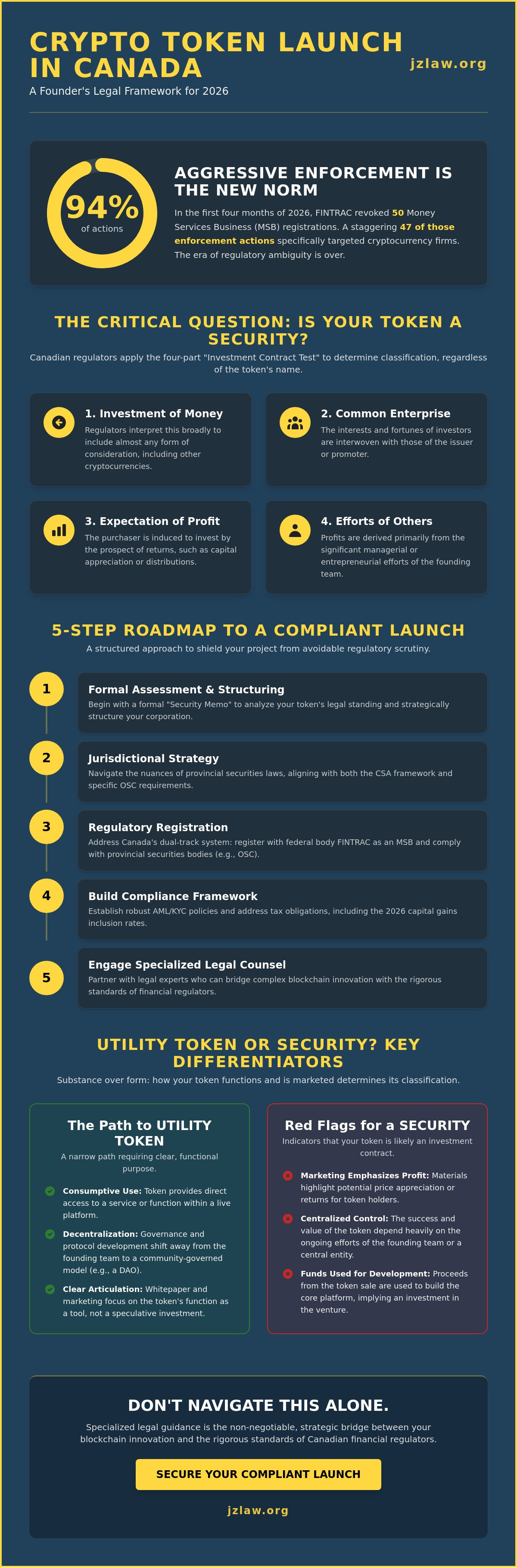
In the first four months of 2026, FINTRAC revoked 50 Money Services Business registrations, and 47 of those enforcement actions specifically targeted cryptocurrency firms. This aggressive shift in oversight signals that the period of regulatory ambiguity has closed. You're likely concerned about the potential for OSC enforcement or the complex classification of your digital asset. Understanding how to legally launch a token in canada is no longer an optional exercise in due diligence; it's the fundamental prerequisite for establishing a project that institutional partners and cautious investors will actually support.
We recognize that the fear of a misstep often stifles innovation, yet a structured approach to compliance provides the security your venture requires. This guide delivers a comprehensive legal framework for founders to navigate CSA requirements and the latest "Project Tokenization" initiatives. We'll break down the 2026 Stablecoin Act, clarify FINTRAC's reporting thresholds, and provide a precise checklist for a compliant launch. You'll gain the strategic insight necessary to manage risk while positioning your token for success in Canada's sophisticated financial ecosystem.
Key Takeaways
Discover the precise criteria for determining whether your digital asset is classified as an investment contract, which is the first critical step in understanding how to legally launch a token in canada without triggering enforcement actions.
Navigate the jurisdictional nuances of the CSA and OSC to ensure your offering aligns with provincial securities laws while maintaining the flexibility required for technological growth.
Implement a structured five-step roadmap that begins with a formal "Security Memo" and strategic corporate structuring to shield your project from avoidable regulatory scrutiny.
Establish a robust compliance framework that addresses FINTRAC registration and the 2026 capital gains inclusion rates to protect both your corporate entity and your investors.
Learn how specialized legal guidance serves as a strategic bridge between complex blockchain innovation and the rigorous standards of Canadian financial regulators.
Table of Contents
Defining Your Asset: Is Your Token a Security Under Canadian Law?
Navigating the Canadian Regulatory Landscape: CSA, OSC, and FINTRAC
The Legal Roadmap: 5 Essential Steps to Launching a Token in Canada
Mitigating Risk: AML, KYC, and Tax Obligations for Token Issuers
Strategic Legal Counsel: Why Professional Guidance is Non-Negotiable
Defining Your Asset: Is Your Token a Security Under Canadian Law?
The classification of a digital asset is the most critical decision a founder makes. The Canadian Securities Administrators (CSA) consistently emphasize substance over form; it doesn't matter if your technical documentation labels an asset a "utility token" if the economic reality suggests otherwise. Determining how to legally launch a token in canada begins with a rigorous analysis of whether your Cryptocurrency or tokenized asset constitutes an "investment contract." This legal concept is the primary vehicle through which provincial regulators, such as the OSC, assert their jurisdiction over the blockchain sector.
Canadian courts and regulators rely on the "Pacific Coin" test to determine if a security exists. This principles-based approach focuses on the intent of the issuer and the reasonable expectations of the purchaser. In 2026, the CSA's "Project Tokenization" initiative has further refined these boundaries, specifically examining how distributed ledger technology interacts with traditional investor protection mandates. If your marketing materials emphasize potential price appreciation or the expertise of your management team in "driving value," you're likely crossing the threshold into securities territory. The intent you project during the pre-launch phase creates a legal reality that is difficult to reverse once the token is live on secondary markets.
The Four Pillars of the Investment Contract Test
To qualify as an investment contract, an arrangement must meet specific criteria that have remained largely consistent, even as technology evolves. First, there must be an investment of money, which regulators interpret broadly to include almost any form of consideration. Second, this investment must be in a common enterprise where the interests of the investors are interwoven with those of the issuer. Third, there must be an expectation of profit. Finally, those profits must be derived primarily from the significant managerial efforts of others. In 2026, the CSA scrutinizes these "efforts of others" by looking at who controls the protocol's development and whether the success of the token depends on a centralized team rather than a truly autonomous network.
Utility Tokens: The Narrow Path to Non-Security Status
Establishing that a token is a pure utility requires demonstrating "consumptive use." This means the token's primary purpose is to provide access to a specific service or function within a platform rather than serving as a speculative vehicle. Your whitepaper must clearly articulate how the token functions as a tool. Decentralization plays a pivotal role here; as a project moves away from a central founding team toward a community-governed model, the argument for security classification weakens. Recent 2026 precedents regarding Decentralized Autonomous Organizations (DAOs) suggest that the more power is distributed among token holders, the less likely the asset is to be viewed as an investment contract. Understanding these nuances is essential when planning how to legally launch a token in canada while avoiding the high costs of regulatory missteps.
Navigating the Canadian Regulatory Landscape: CSA, OSC, and FINTRAC
Successfully bringing a digital asset to market requires managing two distinct regulatory layers simultaneously. While securities regulation falls under provincial authority, anti-money laundering (AML) oversight is a federal mandate. This dual-track requirement is central to understanding how to legally launch a token in canada. The Canadian Securities Administrators (CSA) works to harmonize provincial rules, yet the Ontario Securities Commission (OSC) frequently acts as the lead regulator for high-profile projects. Because Ontario represents a significant portion of the Canadian capital market, its standards often dictate the compliance baseline for the entire country.
The interaction between these bodies is complex. A project might satisfy provincial securities requirements only to face federal enforcement for failing to register as a Money Services Business (MSB). This intersection demands a cohesive strategy that addresses both investor protection and financial transparency. A detailed review of Blockchain & Cryptocurrency Laws & Regulations reveals that these jurisdictional overlaps are often where compliance strategies fail if they aren't structured with precision from the outset.
Provincial vs. Federal Jurisdiction
You must comply with the laws of every province where your investors reside. The "Passport System" allows an issuer to deal primarily with one principal regulator, such as the OSC, while gaining access to other participating jurisdictions through a streamlined filing process. However, if your token is deemed a security, you'll likely need to register as an Exempt Market Dealer (EMD) or rely on specific prospectus exemptions to avoid the high cost of a full public filing. Navigating these provincial nuances requires a strategic partner who understands the specific expectations of each regulator. Engaging with specialized cryptocurrency law services ensures that your project remains on the right side of both provincial and federal authorities.
FINTRAC and the PCMLTFA
Federal compliance is governed by the Financial Transactions and Reports Analysis Centre of Canada (FINTRAC) under the Proceeds of Crime (Money Laundering) and Terrorist Financing Act (PCMLTFA). If your project facilitates virtual currency exchange or transfer, you're classified as a Virtual Asset Service Provider (VASP). As of 2026, the enforcement climate has intensified significantly. FINTRAC revoked 50 MSB registrations in the first four months of 2026, 47 of which were crypto-related firms. Reporting thresholds are strict; you must file a Large Virtual Currency Transaction Report (LVTR) for any transaction of CAD $10,000 or more within five business days. Additionally, the Travel Rule requires identifying information for transfers exceeding CAD $1,000. Non-compliance results in Administrative Monetary Penalties (AMPs) that, in 2026, have reached as high as CAD $176.96 million for major industry players.
The Legal Roadmap: 5 Essential Steps to Launching a Token in Canada
Launching a digital asset in the current environment requires a methodical sequence of legal checkpoints. This structured progression ensures that your project remains insulated from the enforcement trends discussed earlier. If you're determining how to legally launch a token in canada, your strategy must move from abstract concepts to formal legal documentation. A misstep in the sequence can lead to irreversible jurisdictional conflicts or the accidental issuance of unregistered securities.
The following five steps constitute the baseline for a compliant launch:
Step 1: The Security Memo. You must commission a formal legal opinion that analyzes your token under the Pacific Coin test. This document serves as your primary defense if regulators inquire about your classification.
Step 2: Corporate Structuring. You'll need to select a corporate vehicle that balances tax efficiency with regulatory clarity. This often involves choosing between a Canadian federal corporation or a specialized offshore entity.
Step 3: Compliant Disclosure. Your whitepaper and Offering Memorandum must meet provincial standards. These documents are legal representations of your project's risk and utility.
Step 4: Participant Onboarding. Every participant must undergo rigorous KYC and AML screening. In 2026, this process is largely automated but must still meet FINTRAC's strict identity verification standards.
Step 5: Regulatory Filings. Once the structure is set, you must file the necessary exemptions or registrations with the OSC or your principal provincial regulator.
Phase 1: Pre-Launch Structuring
Your whitepaper is a legal document, not just a marketing tool. Regulators now scrutinize these documents for "investment-like" language that could categorize a utility token as a security. During this phase, selecting the right corporate vehicle in hubs like Calgary or Toronto is vital for establishing a legitimate nexus. If you're raising capital before the token is functional, you'll likely use a Simple Agreement for Future Tokens (SAFT). These agreements must be structured as securities offerings, even if the eventual token is intended for utility. This distinction is a frequent point of confusion for founders but is essential for maintaining a compliant trajectory.
Phase 2: Execution and Compliance
Execution in 2026 relies on the "Accredited Investor" exemption to raise funds safely without a full prospectus. This requires verifying that your backers meet specific financial thresholds. Automation is no longer optional for KYC/AML protocols; your systems must be capable of flagging transactions that meet the CAD $10,000 reporting threshold in real time. After the Token Generation Event (TGE), the OSC expects ongoing transparency. This includes reporting any significant changes to the project's governance or financial health. Managing these post-launch obligations is as critical as the launch itself for ensuring long term viability in the Canadian market.
Mitigating Risk: AML, KYC, and Tax Obligations for Token Issuers
Beyond the classification of the asset itself, operational compliance requires a rigorous adherence to federal financial crime standards and fiscal protocols. Establishing how to legally launch a token in canada involves more than just a securities filing; it requires a proactive defense against money laundering and a precise understanding of the Canada Revenue Agency's (CRA) expectations. In 2026, the intersection of technology and oversight is more visible than ever. Failure to implement these controls invites scrutiny from both FINTRAC and the CRA, potentially jeopardizing the project's long term viability before it gains market traction.
Data privacy is another pillar of this risk mitigation strategy. Handling investor identity documents under the Personal Information Protection and Electronic Documents Act (PIPEDA) requires an encrypted infrastructure to prevent breaches. These disparate obligations must work in harmony to ensure that your project remains a viable commercial entity rather than a regulatory liability.
KYC/AML Best Practices
A robust Anti-Money Laundering (AML) policy is a mandatory requirement for any entity classified as a Money Services Business (MSB). In 2026, FINTRAC's oversight has intensified, making the appointment of a dedicated Compliance Officer a non-negotiable step for token issuers. This individual is responsible for overseeing sanction screening to ensure that no transactions involve prohibited jurisdictions or individuals. Automated transaction monitoring must also be deployed to identify "red flag" patterns on the blockchain that suggest suspicious activity. Under the Crypto-Asset Reporting Framework (CARF) implemented in 2026, Canadian issuers must now report customer transaction information to the CRA automatically. This leaves no room for manual reporting errors or delayed disclosures.
Tax Structuring for Token Issuers
The CRA treats digital assets as commodities, meaning their disposition generally triggers either business income or capital gains. For capital gains realized on or after January 1, 2026, the inclusion rate for individuals with net capital gains over CAD $250,000 has increased to 66.67%. Token issuers must also navigate the complexities of GST/HST. While many digital currency transactions are exempt, certain service-based token models or "consumptive use" utilities may still trigger sales tax obligations depending on the nature of the utility provided. Staking rewards and airdrops are viewed as taxable events, often categorized as business income if the activity is frequent and organized. For deeper insights into managing these requirements across different jurisdictions, review our guide on cryptocurrency law 2026.
Strategic planning ensures these tax and AML obligations don't create unnecessary operational friction. If you require assistance in aligning your project with these rigorous standards, our team provides specialized tax structuring and cryptocurrency law services to secure your venture's future in the Canadian market.
Strategic Legal Counsel: Why Professional Guidance is Non-Negotiable
Innovation in the blockchain sector often moves faster than the legislative process. This creates a dangerous gap for founders who rely on generic, international legal templates that don't account for the specific nuances of Canadian provincial law. Understanding how to legally launch a token in canada requires more than a standard checklist; it demands a strategic partnership that balances business agility with a rigorous compliance posture. JZ Law serves as this bridge, ensuring that your project's technical architecture doesn't conflict with the evolving expectations of the CSA or provincial securities commissions.
John Zang brings specialized expertise in securities regulation and tech law to every engagement. Unlike broad-market firms that may lack the granular technical understanding of distributed ledger technology, our approach is rooted in the practical realities of the crypto space. We prioritize proactive regulatory engagement because preventing an enforcement action is significantly more cost-effective than defending against one. This foresight is what separates sustainable projects from those that vanish under the weight of litigation. Relying on "off-the-shelf" legal documents in Canada's principles-based environment is a high-risk strategy that often fails to satisfy the "substance over form" scrutiny applied by the OSC.
Tailored Legal Solutions for High-Stakes Tech
Blockchain startups based in Calgary and Toronto face unique jurisdictional challenges that generic solutions simply cannot address. We provide bespoke guidance on strategic corporate transactions, ensuring your entity is structured for long term growth from the outset. Our services aren't limited to the initial launch phase. We guide the entire lifecycle of a project, including the complex process of taking companies public once they've reached maturity. This comprehensive support ensures that every corporate milestone, from the first private sale to a potential public listing, is achieved within a secure and predictable legal framework.
Your Next Steps for a Compliant Launch
Determining your project's regulatory perimeter is the first step toward a successful Token Generation Event. An initial consultation allows us to identify potential risks before they become systemic issues, saving your team both time and capital. When preparing for a meeting with a securities lawyer, you should have your technical whitepaper, proposed governance structure, and any marketing drafts ready for review. This preparation allows for a more efficient and focused analysis of your specific compliance needs. Secure your project's future with JZ Law's cryptocurrency legal services to ensure your roadmap is both innovative and legally sound. Navigating how to legally launch a token in canada is a complex undertaking, but with the right strategic partner, compliance becomes a foundation for trust rather than a barrier to entry.
Securing Your Competitive Advantage Through Regulatory Precision
The transition from a speculative environment to a mature, regulated financial sector is now complete. Success in the 2026 landscape demands absolute clarity on asset classification and a disciplined approach to FINTRAC and CRA obligations. Mastering how to legally launch a token in canada is no longer just about avoiding penalties; it's about building the institutional trust required for long term scalability. By prioritizing a formal Security Memo and robust corporate structuring, you transform complex requirements into a strategic asset that protects both your project and your investors.
JZ Law provides the sophisticated representation necessary to navigate this high-stakes environment. With deep expertise in Securities Regulation and a specialized Cryptocurrency Law practice, we guide founders through every phase of the digital asset lifecycle, including the complex journey of taking companies public. Don't leave your project's viability to chance in an era of heightened enforcement. Schedule a Consultation with John Zang for Your Token Launch to ensure your venture is built on a foundation of professional excellence and strategic foresight. Your vision deserves a legal framework that matches its ambition.
Frequently Asked Questions
Is a utility token considered a security in Canada in 2026?
Classification depends entirely on the "Pacific Coin" test rather than the label you assign to the asset. If purchasers have a reasonable expectation of profit derived from your managerial efforts, the CSA will likely classify it as a security. This remains the most significant hurdle when determining how to legally launch a token in canada without triggering an enforcement action.
Do I need to register with FINTRAC before launching a token?
Registration is mandatory if your project functions as a Virtual Asset Service Provider or a Money Services Business. This requirement applies to any entity facilitating the exchange or transfer of virtual currencies. Given that FINTRAC revoked 50 MSB registrations in early 2026, ensuring your compliance program is fully operational before launch is a critical priority.
What is the 'Accredited Investor' exemption and how does it apply to crypto?
This exemption allows you to sell tokens to high net worth individuals and institutional entities without filing a full prospectus. It's the primary mechanism used for private sales and SAFT agreements. You must verify that every participant meets the specific financial thresholds mandated by provincial securities laws to utilize this exemption safely.
Can a Canadian business launch a token through an offshore entity?
A Canadian business can utilize an offshore entity, but this does not exempt the project from Canadian law if it targets Canadian residents. Provincial regulators maintain jurisdiction over any offering that involves a person residing in Canada. You must still comply with OSC or CSA requirements for the portion of the offering accessible to the domestic market.
What are the penalties for launching an unregistered security in Ontario?
The OSC can impose administrative penalties of up to CAD $1 million per violation and permanent market participation bans. Additionally, regulators often seek disgorgement of all capital raised during the non-compliant offering. These financial and reputational costs typically far exceed the initial expense of establishing a proper legal framework.
How does the CRA tax the proceeds from a Token Generation Event (TGE)?
The CRA generally treats TGE proceeds as business income if the issuance is conducted as a commercial enterprise. If the tokens are categorized as capital property, the 2026 inclusion rate of 66.67% applies to capital gains exceeding CAD $250,000. It's essential to structure your treasury management to account for these specific tax liabilities from the first day of operations.
Do I need a formal legal opinion before my token goes live?
A formal "Security Memo" is a standard requirement for any professional token issuance. This document provides a reasoned legal basis for your asset's classification and serves as your primary due diligence defense during a regulatory inquiry. It's a foundational component for anyone seeking how to legally launch a token in canada while maintaining institutional grade credibility.


Comments