


How to Start a Dispensary in California: A 2026 Legal Checklist
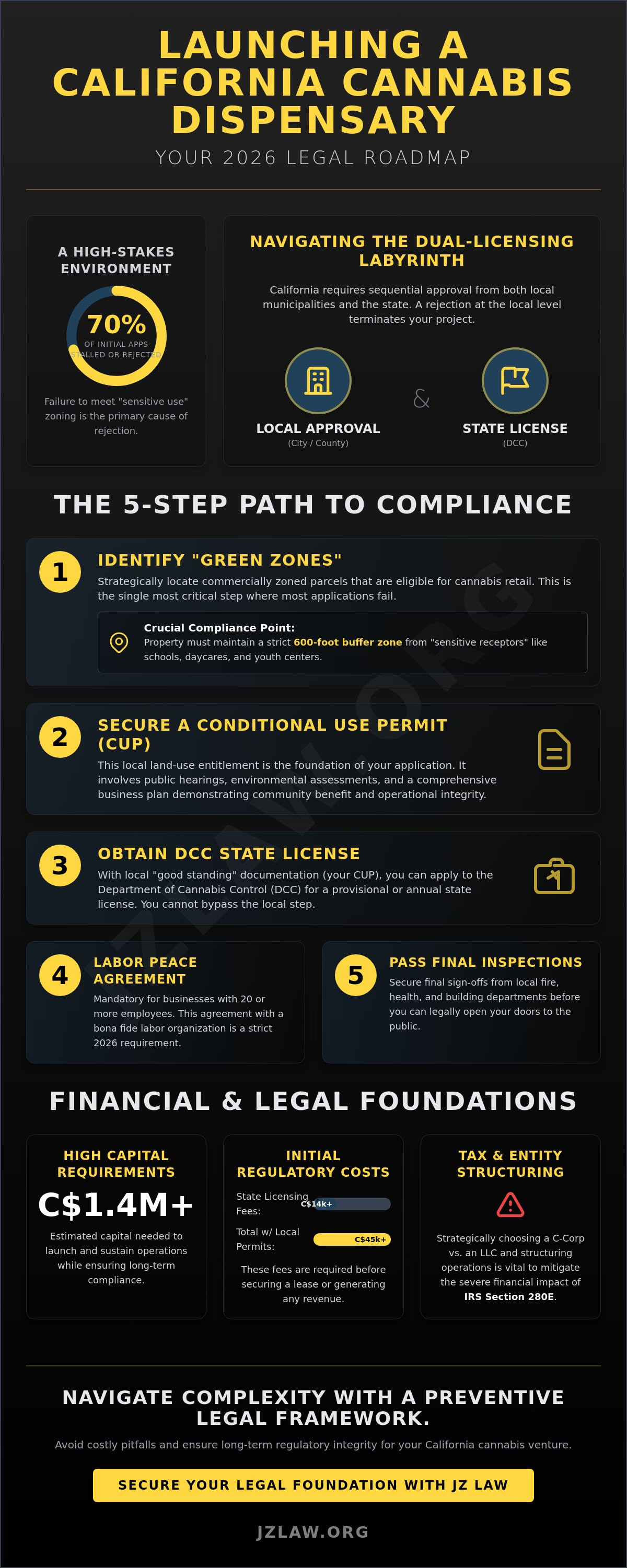
Did you know that nearly 70% of initial cannabis retail applications in California are currently stalled or rejected due to a failure to meet local "sensitive use" zoning requirements? You likely understand that starting a dispensary california involves far more than securing a storefront; it's a high-stakes legal maneuver within a dual-licensing system that demands absolute precision. Managing these complex requirements requires a strategic partner who prioritizes a preventive approach to avoid the costly pitfalls of regulatory non-compliance.
This guide serves as your comprehensive legal roadmap for 2026, offering a clear sequence of actions to launch a successful and legally protected retail business. We'll examine the complexities of municipal permits, state licensure, and the persistent tax challenges of Section 280E. By the end of this analysis, you'll have a structured plan to manage high capital requirements, which often reach upwards of C$1,400,000, while ensuring your business remains resilient in a shifting economic landscape.
Key Takeaways
Adopt a preventive legal framework to navigate the 2026 Department of Cannabis Control (DCC) requirements and ensure long-term regulatory integrity.
Master the dual-licensing labyrinth by strategically identifying municipal "Green Zones" and securing the essential local Conditional Use Permits.
Mitigate the financial impact of IRS Section 280E through sophisticated tax structuring and modern merchant service solutions tailored for the cannabis sector.
Streamline your path to market by mastering the specific legal requirements for starting a dispensary california, from zoning buffer compliance to METRC integration.
Execute a rigorous pre-launch compliance audit to ensure all packaging, labeling, and staff training protocols meet the latest 2026 standards.
Table of Contents Establishing a Robust Legal Foundation for Your California Cannabis Venture Navigating the Dual-Licensing Labyrinth: Local and State Approval Strategic Real Estate and Zoning: Securing a Compliant Location Financial Integrity and Tax Structuring: Navigating Section 280E The 2026 Pre-Launch Checklist: Final Steps to Opening
Establishing a Robust Legal Foundation for Your California Cannabis Venture
The Department of Cannabis Control (DCC) serves as the central regulatory authority in 2026, enforcing a unified licensing system that demands absolute transparency. Success in this sector isn't just about retail strategy; it's about a preventive legal mindset. High-stakes industries don't forgive procedural errors. Entrepreneurs must anticipate regulatory shifts before they manifest as compliance violations. Understanding the History of Cannabis in California is vital for any entrepreneur, as it explains the shift from a gray market to the current high-compliance environment that dictates every operational move today.
California's market structure differs significantly from hubs like Denver or Calgary. While Calgary operates under a centralized provincial model with predictable AGLC oversight, California relies on a "dual-licensing" system. You need both local authorization and a state license. This creates a fragmented landscape where municipal ordinances often conflict with state mandates. Professional legal counsel is the only way to avoid common "dispensary traps," such as predatory management services agreements or signing leases for properties that don't meet the strict 600-foot buffer zones from sensitive receptors. Starting a dispensary california requires a strategic partner who views law as a tool for business stability, not just a series of hurdles.
Choosing the Optimal Business Entity
Selecting between a C-Corp and an LLC is a decision with long-term fiscal consequences. Most investors prefer the C-Corp structure because it simplifies the issuance of equity and prepares the venture for future public offerings or acquisitions. However, an LLC offers "pass-through" taxation that might benefit smaller, independent groups. You must have a rigorous operating agreement. For multi-partner ventures, this document must clearly define "deadlock" resolutions and buyout triggers to prevent internal litigation from paralyzing the business. In 2026, state regulators scrutinize these agreements to ensure "financial interest holders" are fully disclosed during the starting a dispensary california process.
Drafting a Regulatory-Ready Business Plan
A California cannabis business plan is a technical manual, not just a pitch deck. To secure local authorization, your plan must include five core components: a detailed security and surveillance protocol, a track-and-trace integration strategy (Metrc), a waste management plan, a labor peace agreement, and a comprehensive odor mitigation brief. Local jurisdictions prioritize social equity goals, so your mission must include specific, measurable commitments to community reinvestment or hiring from disproportionately impacted areas. Financial projections must be realistic. State licensing fees can exceed C$14,000, and when combined with local permits, your initial regulatory costs often surpass C$45,000 before you even secure a lease. Clear, data-backed projections demonstrate to local officials that your business is capitalized well enough to maintain compliance over the long term.
Navigating the Dual-Licensing Labyrinth: Local and State Approval
Establishing a retail presence requires a sequential, high-stakes coordination between municipal authorities and state regulators. The process of starting a dispensary california involves a rigid, two-tiered approval system where local authorization serves as the foundation for state licensure. You can't bypass the city to reach the state; a rejection at the municipal level effectively terminates your project before the Department of Cannabis Control (DCC) even reviews your file. To succeed, you must follow a precise five-step sequence:
Identify "Green Zones": Locate parcels specifically zoned for cannabis retail, ensuring they meet sensitive use buffers (e.g., 600 feet from schools or youth centres).
Secure a Conditional Use Permit (CUP): Obtain this local land-use entitlement through public hearings and environmental assessments.
Obtain the DCC License: Apply for a provisional or annual state license once you have local "good standing" documentation.
Execute a Labor Peace Agreement: If you plan to hire more than 20 employees, this agreement with a bona fide labor organization is a mandatory 2026 requirement.
Pass Final Inspections: You'll need signed approvals from fire, health, and building departments before the DCC issues a final permit to operate.
Securing Local Authorization in Competitive Jurisdictions
Local municipalities act as the definitive gatekeeper of the market. As of January 2026, approximately 60% of California jurisdictions still prohibit retail cannabis, making "Green Zone" real estate incredibly scarce. In competitive hubs like Los Angeles or West Hollywood, you'll face merit-based scoring systems. Success depends on proactive community outreach; you must win over neighborhood councils and local business associations before your public hearing. For a broader perspective on how these local hurdles compare to other international regulatory frameworks, see our Cannabis Licensing Guide 2026.
State License Application: The DCC Requirements
The DCC requirements for starting a dispensary california include exhaustive background checks for every "owner" and any "financial interest holder" with a stake of 10% or more. Whether you're pursuing a storefront retail license or a non-storefront delivery permit, the documentation must be flawless. By 2026 standards, your security plans must include 4K resolution surveillance and biometric access controls for inventory storage. You can find the full technical specifications in the California Dispensary License Application Guide. Precision here is vital; even minor discrepancies in your floor plans can delay your opening by several months.
Canadian investors should account for the fact that local application fees and initial security deposits often exceed C$75,000 before a single gram of product is sold. While the Canadian federal framework is more centralized, California's fragmented system demands a localized, site-specific strategy. Before committing significant capital to a lease, consult with a strategic legal partner to verify that your chosen municipality isn't planning a moratorium on new retail licenses.
Strategic Real Estate and Zoning: Securing a Compliant Location
By 2026, the scarcity of "Green Zone" real estate has become the primary barrier for entrepreneurs starting a dispensary california. Most municipalities have exhausted their ideal commercial zones, leaving a limited inventory of compliant parcels. Securing a location is no longer a simple real estate transaction; it's a complex legal maneuver that dictates your business's long-term viability. Without a strategic approach to zoning, your initial investment remains at constant risk of regulatory revocation. Real estate law acts as the pillar of your dispensary’s stability, protecting you from shifts in local sentiment.
Landlords often exploit this scarcity by demanding "landlord premiums." It's common to see monthly rents for cannabis-compliant spaces priced at C$12,000 to C$18,000 above standard retail market rates. These inflated costs reflect the perceived risk and the intensive vetting processes required by local boards. Before signing any letter of intent, consult the official state business checklist to ensure your entity structure aligns with your property holding strategy and state registration requirements.
Understanding Buffer Zones and Sensitive Use Restrictions
California state law mandates a 600-foot buffer between cannabis retailers and "sensitive uses," which include schools, daycares, and youth centers. However, local ordinances frequently expand these restrictions. Many jurisdictions now include public parks, libraries, and even certain residential zones within these exclusion perimeters. A professional parcel search is mandatory to verify that no "hidden" sensitive uses, such as a small private tutoring center or a licensed home-based daycare, exist within the restricted radius.
Grandfathering clauses offer some protection if zoning laws change after you've secured your permit. However, these protections are often narrow and fragile. If your dispensary closes for a specific period, usually 90 days, you might lose your non-conforming use status. This makes continuous operation a legal necessity rather than just a business goal.
Negotiating Cannabis-Specific Commercial Leases
Standard commercial leases are insufficient for the cannabis industry. You must include specific "license contingencies" that allow you to terminate the lease without penalty if the state or local government denies your application. Another critical element is protecting against asset seizure. Your lease should explicitly state that the landlord has no claim to your cannabis inventory, which remains subject to strict state tracking and disposal laws. This prevents landlords from inadvertently violating federal law by taking possession of a controlled substance.
A "Right to Cure" provision is equally vital. This gives you a set window to fix regulatory violations before the landlord can initiate eviction. Because these contracts involve high stakes and unique liabilities, our Commercial Real Estate Law experts focus on insulating tenants from predatory clauses that could jeopardize their license. A well-structured lease acts as a shield, ensuring that your physical location remains a stable foundation for your enterprise while you focus on starting a dispensary california successfully.
Financial Integrity and Tax Structuring: Navigating Section 280E
Section 280E of the Internal Revenue Code remains the most formidable barrier to profitability when starting a dispensary california. Even in 2026, federal law prohibits businesses trafficking in Schedule I or II substances from deducting standard operating expenses. This means you can't deduct rent, payroll, or marketing costs from your federal taxes. The result is an effective tax rate that often exceeds 70 percent, a reality that catches many new entrepreneurs off guard. Financial integrity isn't just about following rules; it's about survival in a landscape where traditional business logic doesn't apply.
The 2026 banking landscape offers more options than previous years, but merchant services remain selective. Most tier-one banks still require exhaustive documentation before opening an account. You'll need to demonstrate a clear path of funds and show that your capital isn't coming from prohibited sources. Maintaining "clean books" is a prerequisite for any future exit strategy. If you plan to sell your license or bring on institutional partners by 2028, your 2026 records must be audit-ready today. Incomplete ledgers are the fastest way to devalue a cannabis asset during due diligence.
Strategic Tax Structuring for Maximizing Deductions
Profitability hinges on Cost of Goods Sold (COGS) optimization. Under Treasury Regulation 1.471-11, retailers can include certain indirect production costs in their inventory valuation. This is a narrow path that requires surgical precision. Many sophisticated operators in 2026 utilize a dual-entity structure. One "plant-touching" entity handles direct sales, while a separate management company manages non-cannabis functions. This separation helps isolate expenses, but it carries high audit risks. The IRS increased cannabis-related audits by 15 percent between 2023 and 2025. Aggressive tax positions without a rigorous legal basis often lead to catastrophic penalties that can bankrupt a new dispensary within its first two years.
Banking Solutions and AML Compliance
Accessing merchant services requires strict adherence to Anti-Money Laundering (AML) and Know Your Customer (KYC) protocols. Financial institutions in the cannabis space perform deep-dive reviews of every beneficial owner. You must maintain transparent financial records that sync perfectly with California's track-and-trace system. State regulators now perform automated reconciliations between METRC data and bank statements to flag discrepancies. Working with a Cannabis Business Lawyer is the most effective way to vet financial partners and ensure your internal controls meet the 2026 standard. Secure Cannabis Industry Financing by proving your operation is low-risk and fully compliant.
Prepare your financial infrastructure by consulting our team for
.
The 2026 Pre-Launch Checklist: Final Steps to Opening
Starting a dispensary in California culminates in a rigorous pre-launch phase where legal theory meets operational reality. By 2026, the Department of Cannabis Control (DCC) has tightened enforcement on physical and digital infrastructure. You can't afford a single oversight during the final 30 days before your doors open to the public. Every lock, camera, and software integration must function perfectly to avoid immediate regulatory scrutiny.
Physical security remains a primary focus for state investigators during final inspections. Your facility must feature a commercial-grade alarm system and 24-hour video surveillance with a minimum resolution of 1280x720 pixels. All footage must be stored for at least 90 days on a secure server. Beyond hardware, you'll need robust insurance to shield your investment. General liability and product liability policies are essential to protect your assets from claims involving consumer illness or premises accidents. Without these protections, a single legal challenge could jeopardize your entire venture before it gains momentum.
Operational Compliance and METRC Integration
The Track-and-Trace system, METRC, is the regulatory heartbeat of your business. Discrepancies between your physical inventory and digital records can result in immediate administrative holds or fines exceeding $5,000 per violation. You must establish Standard Operating Procedures (SOPs) that dictate how staff record every transaction, transfer, and waste event. Comprehensive training ensures that your team understands the weight of these digital logs; they aren't just retail records but legal affidavits of your compliance.
For entrepreneurs focusing on delivery-only "non-storefront" models in 2026, compliance includes GPS tracking for all vehicles and strict daily inventory limits. These retailers must ensure that every delivery request originates from a verified customer profile before the vehicle leaves the premises. Training your team on these specific DCC standards prevents the clerical errors that often lead to license suspension. Verifying that all packaging and labeling meets the latest child-resistant and tamper-evident requirements is the final hurdle before your first legal sale.
Strategic Scaling: From Single Dispensary to Public Offering
While the immediate goal is opening your doors, savvy owners view compliance as a long-term asset. Maintaining meticulous records and clean audits creates the transparency required for institutional investment or future expansion. If your vision extends beyond a single location, you should consider the path of Taking Your Cannabis Company Public. This transition requires a level of corporate governance that begins on day one of your operations.
An Initial Public Offering (IPO) requires years of verifiable financial and regulatory history. By treating your pre-launch checklist as the first step in a multi-year audit trail, you position your brand for significant capital raises or acquisition. Early-stage compliance isn't just a hurdle; it's the foundation of your exit strategy. Success in starting a dispensary in California demands a partner who understands the intersection of regulatory law and business growth. Contact JZ Law for a strategic consultation on your California dispensary venture.
Positioning Your California Cannabis Venture for 2026 Success
Success in the competitive landscape of the Golden State requires more than a retail vision; it demands a rigorous adherence to the dual-licensing framework and a proactive stance toward Section 280E tax compliance. Securing a compliant location remains a primary hurdle, as local zoning ordinances often fluctuate. By establishing a robust legal foundation early, you protect your investment and ensure your venture remains resilient against shifting regulatory tides. When you're starting a dispensary california, the margin for error is non-existent, making precise corporate structuring essential for long-term viability.
Our firm serves as a strategic partner, leveraging decades of regulatory experience from principal lawyer John Zang to navigate corporate transactions and complex licensing across North America. We emphasize a preventive approach, identifying potential bottlenecks in the 2026 pre-launch checklist before they become costly liabilities. Whether you're managing cross-border interests or local operations, our expertise in tax structuring provides the security your business needs to thrive. Secure Strategic Legal Counsel for Your California Dispensary today to ensure your path to licensure is handled with professional dignity and modern business precision. Your ambition deserves a legal strategy that's as dynamic as the industry itself.
Frequently Asked Questions
How much capital do I need to start a dispensary in California in 2026?
You'll typically need between C$1,100,000 and C$2,750,000 when starting a dispensary california in 2026. This estimate covers initial application fees, real estate procurement, security infrastructure, and six months of operational liquidity. Licensing fees alone can exceed C$13,500 depending on your projected gross revenue. We recommend securing at least 20% more than your initial budget to account for unforeseen regulatory delays or local compliance adjustments.
Can a non-California resident own a dispensary in the state?
Yes, non-residents can legally own and operate a cannabis dispensary in California. State law doesn't impose a residency requirement for license applicants, which allows international and out-of-state investors to enter the market. However, every owner with a 20% or greater stake must pass a background check and provide detailed financial disclosures to the Department of Cannabis Control (DCC). Local jurisdictions might still have specific preferences or social equity requirements that favor local applicants.
What is the difference between a storefront and non-storefront retail license?
A storefront license permits you to operate a physical retail location where customers can browse and purchase products in person. In contrast, a non-storefront license restricts your operations to delivery only, requiring a closed-to-the-public premises for inventory storage. While storefronts often see higher brand visibility, non-storefront operations involve lower overhead costs and simpler security requirements. Choosing the right model depends on your target demographic and the specific zoning laws of your chosen municipality.
How long does the California cannabis licensing process typically take?
The timeline for starting a dispensary california typically spans 6 to 18 months from the initial local application to the final state approval. You must first secure a local permit from your city or county, which often takes 4 to 12 months depending on the competitive nature of the area. Once you've secured local authorization, the Department of Cannabis Control usually processes the state-level application within 60 to 90 days. Professional legal guidance can prevent common filing errors that extend these timelines.
Is a Labor Peace Agreement mandatory for all California dispensaries?
An LPA is mandatory for any California cannabis business that employs 20 or more people. This requirement, codified under the Medicinal and Adult-Use Cannabis Regulation and Safety Act, ensures that your business won't interfere with union organizing efforts. You must provide a signed statement to the DCC confirming that you've entered into such an agreement or will do so. Failing to maintain a valid LPA can lead to the immediate suspension of your operating license.
What are the most common reasons for a DCC license denial?
The Department of Cannabis Control frequently denies licenses due to incomplete financial disclosures or failure to meet local zoning requirements. Specifically, 15% of applications face delays or denials because the proposed site is too close to sensitive uses like schools or youth centers. Other common issues include undisclosed owners or significant discrepancies in the security plan. Ensuring your application is meticulously prepared and matches local ordinances is vital for a successful outcome.
How does Section 280E affect my ability to deduct business expenses?
IRS Section 280E prohibits cannabis businesses from deducting standard operating expenses, such as rent, marketing, or payroll, from their federal taxes. Because cannabis remains a Schedule I substance, you're only permitted to deduct the Cost of Goods Sold (COGS). This often results in effective tax rates as high as 70% for some retailers. We help clients implement strategic accounting structures to maximize COGS allocations and protect their bottom line under these restrictive federal rules.
Can JZ Law help with both local and state-level licensing?
JZ Law provides comprehensive legal support for both local municipal permits and state-level DCC licensing. Our team manages the entire administrative burden, from drafting your initial business plan to representing your interests during public hearings. We focus on a preventive approach, identifying potential compliance hurdles before they become costly delays. By acting as your strategic partner, we ensure your dispensary meets all regulatory standards for a smooth launch in the California market.


Comments