


Investor-Ready Legal Documents in Calgary: A 2026 Founder’s Strategic Guide
- jzanglaw
- 11 minutes ago
- 13 min read
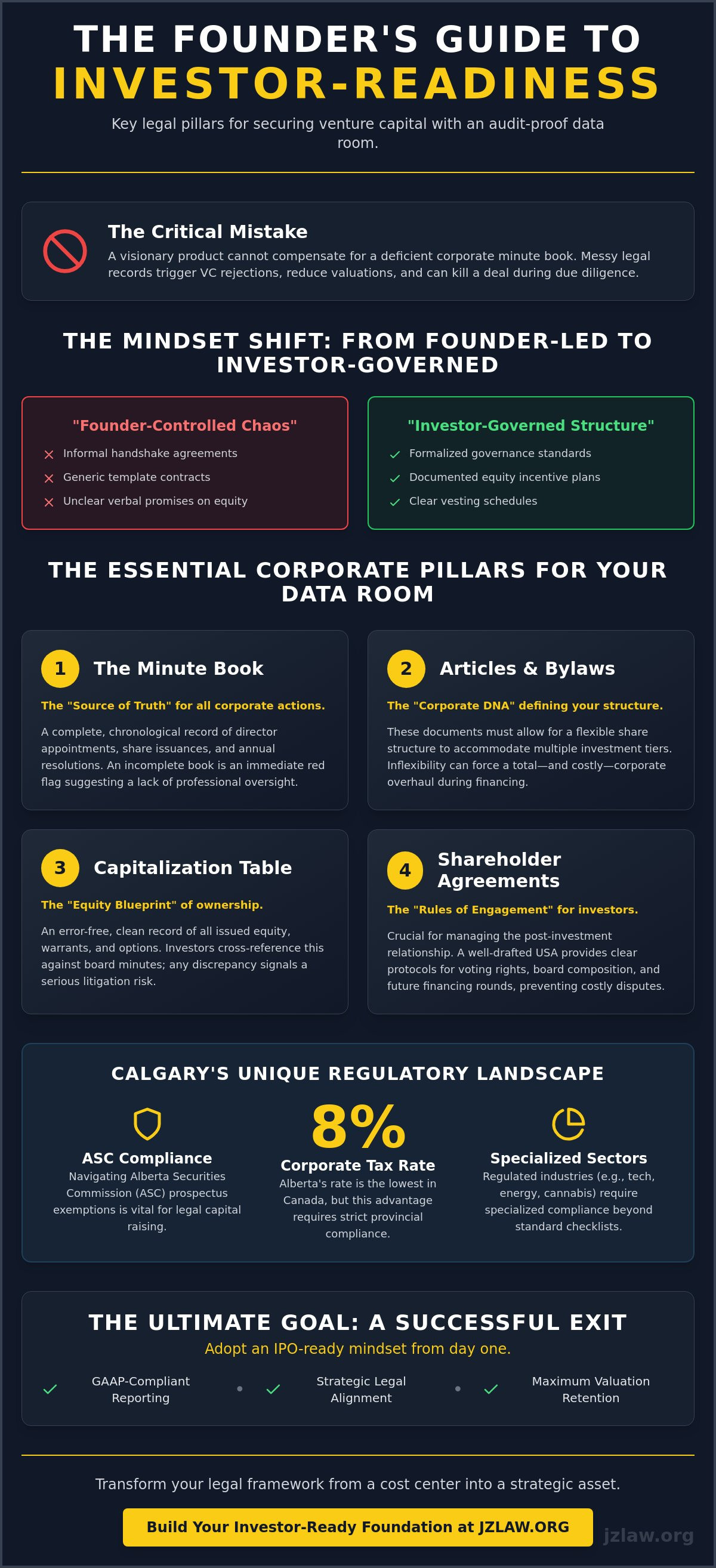
A visionary product cannot compensate for a deficient corporate minute book when sophisticated capital is on the line. In Calgary's 2026 investment climate, securing the investor-ready legal documents calgary founders require is no longer a clerical task; it's a strategic imperative that defines your company's maturity. You've likely felt the pressure of entering due diligence with the fear that "messy" records might trigger a VC rejection, or perhaps you're struggling to reconcile Alberta's competitive 8% corporate tax benefits with federal regulatory demands. It's a common frustration to realize that fixing legal errors during active negotiations isn't just stressful, it's prohibitively expensive.
This guide is designed to help you master the complex legal framework required to secure venture capital and angel investment in Calgary's evolving corporate landscape. We'll examine the specific requirements for a clean, professional data room and how to align your corporate structure with long-term growth goals. By the end of this article, you'll have a clear roadmap for navigating ASC prospectus exemptions and maintaining the rigorous standards that modern investors demand. We'll provide the clarity needed to transform your legal department from a cost center into a strategic asset.
Table of Contents
Defining Investor-Readiness in Calgary’s 2026 Corporate Climate
Investor-readiness isn't a vague aspiration. It's a measurable state where every legal, financial, and operational record is audit-proof. In Calgary’s competitive 2026 market, the presence of clean books serves as the primary driver of deal speed and valuation retention. When a founder can present a comprehensive set of investor-ready legal documents calgary venture firms expect, it signals a level of maturity that mitigates perceived risk. This preparation transforms the due diligence process from a defensive scramble into a strategic demonstration of corporate health. It's the difference between a deal that closes in weeks and one that languishes for months because of preventable clerical errors.
Institutional investors don't just buy a product; they buy a corporate vehicle capable of scaling without legal friction. If your cap table is cluttered or your intellectual property assignments are missing, you risk valuation leakage where the investor discounts your company's price to account for future remedial costs. Professional Venture capital financing requires a seamless transition from operating mode to investable mode. This shift requires a rigorous internal legal audit long before the first term sheet arrives. Clean records ensure that you retain control over your narrative during negotiations rather than being forced to explain away historical inconsistencies.
The Mindset Shift: From Founder-Controlled to Investor-Governed
Early-stage startups often rely on informal handshake agreements or template contracts that lack professional rigor. Transitioning to investor-governed standards means formalizing every relationship within the company. You've got to replace verbal promises to early employees with documented equity incentive plans and clear vesting schedules. Moving away from total founder control requires a structure that respects the rights of outside capital, ensuring you possess the investor-ready legal documents calgary VCs demand to see. Professional governance standards established early prevent the high costs of fixing structural errors during active due diligence.
Calgary’s Unique Regulatory Landscape
The 2026 corporate climate in Calgary is defined by a sophisticated blend of traditional energy, emerging tech, and highly regulated sectors. The Alberta Securities Commission (ASC) maintains specific oversight that dictates how early-stage capital can be raised legally, including the use of various exemptions. Alberta’s 8% general corporate tax rate remains the lowest in Canada, making the province an attractive hub for growth, but this advantage requires strict compliance with provincial filing requirements. Local expertise in Alberta-specific regulations is vital. It ensures your provincial foundation doesn't create hurdles for national scaling. Founders who anticipate these regulatory shifts in tech and energy remain the most attractive targets for sophisticated capital.
The Essential Corporate Pillars: Core Documents for Your Data Room
Compiling a data room filled with the investor-ready legal documents calgary investors demand requires more than just gathering files. It involves curate a narrative of compliance and foresight. The Minute Book is the foundational legal record for any Calgary corporation. This document serves as the "source of truth" for every corporate action taken since inception, including director appointments, share issuances, and annual resolutions. If this record is incomplete, it suggests a lack of professional oversight that can immediately cool investor interest. Beyond the Minute Book, your Articles of Incorporation and Bylaws must be reviewed to ensure your share structure is flexible enough to accommodate multiple investment tiers without requiring a total overhaul of your corporate DNA.
A capitalization table, or cap table, is another non-negotiable pillar. It must be a clean, error-free record of all equity, warrants, and options. Investors will cross-reference this against your share certificates and board minutes; any discrepancy creates a "red flag" that signals potential litigation risk. Similarly, you'll need to disclose all material contracts. This includes commercial leases, supplier agreements, and customer contracts that represent a significant portion of your revenue or operational capacity. Maintaining these investor-ready legal documents calgary requires diligence but pays dividends in deal speed. Ensuring these pillars are solid is a prerequisite for successful corporate transactions that move at the speed of modern business.
Structuring Shares for Future Rounds
Founders often start with a simple structure of common shares, but sophisticated capital usually requires the creation of preferred share classes. These classes often carry specific liquidation preferences, anti-dilution protections, and veto rights. Many Calgary founders look to industry-embraced model documents as a benchmark for what Series A investors expect. A "messy" cap table, cluttered with small, unaccredited investors or undocumented promises, can be a deal-breaker. You've got to clean these up early. Additionally, a well-structured stock option pool is essential for attracting the top-tier talent needed to scale post-investment.
Employment and Contractor Agreements
Investors must be certain that the company owns its intellectual property. Every employee and contractor should have signed an agreement containing robust IP assignment clauses. Without these, your core technology might technically belong to a former developer rather than the corporation. Clear termination clauses are equally vital; they prevent future litigation liabilities that could drain your newly acquired capital. Finally, expect investors to insist on "founder vesting." This mechanism ensures that the leadership team remains committed to the long-term vision of the company rather than exiting shortly after the check clears.
Specialized Industry Compliance: Beyond the Standard Checklist
While standard corporate pillars provide a necessary foundation, they are often insufficient for companies operating in Calgary’s high-growth, regulated sectors. Investors in 2026 aren't just looking for a clean minute book; they're looking for proof that your business can navigate specific regulatory minefields without triggering catastrophic fines or license revocations. Failing to provide specialized investor-ready legal documents calgary firms in these sectors require can stall a deal indefinitely. For instance, in the cannabis sector, your corporate governance must be inextricably linked to cannabis licensing requirements, ensuring that every director and significant shareholder meets the stringent "fit and proper" tests mandated by regulators.
Similarly, founders in the energy sector must demonstrate a mastery of oil and gas law, particularly when drafting joint venture agreements that involve complex royalty structures and liability indemnifications. In the emerging tech space, navigating cryptocurrency law requires more than just a whitepaper. You've got to show documented FINTRAC registration and robust anti-money laundering (AML) protocols. Sophisticated investors often look toward SEC capital raising guidance as a benchmark for transparency, even when raising capital within Canadian borders, to ensure the venture remains attractive for future cross-border expansion. This proactive alignment with international standards reduces friction during subsequent funding rounds.
Regulatory Licensing and Permits
A "compliance calendar" is a vital component of your digital data room. This document tracks renewal dates, reporting deadlines, and audit requirements for all specialized industry licenses. In the cannabis and crypto sectors, clear risk disclosure regarding regulatory shifts is essential for maintaining investor confidence. For energy companies, demonstrating commitment to environmental and social governance (ESG) is no longer optional; it's a core requirement for investment readiness. Investors want to see that your operational permits are not just current but are protected by a proactive legal strategy that anticipates future legislative changes.
Intellectual Property (IP) as a Strategic Asset
Your core technology is often your most valuable asset, yet many Calgary startups fail to document the ownership chain-of-title correctly. An "IP Audit" proves that your company, and not an individual founder or contractor, owns every patent, trademark, and trade secret. This is particularly critical if you plan on scaling your Calgary-born innovation to the US or EU markets. International IP protection requires a strategic filing approach that mirrors the complexity of your growth goals. Proving you have a defensible IP moat is the best way to protect your valuation during a high-stakes capital raise.
Governance and Shareholder Agreements: Managing the Investor Relationship
A Unanimous Shareholder Agreement (USA) functions as the definitive rulebook for how decisions are made and disputes resolved within a private corporation. It's one of the most scrutinized investor-ready legal documents calgary investors will evaluate before committing capital. Unlike standard bylaws, which provide a general framework for operations, the USA addresses the specific tension points between founders and venture capital firms. It defines the boundaries of authority, ensuring that both the vision of the founders and the financial interests of the investors are legally protected. A poorly drafted agreement can lead to governance paralysis, whereas a precise one facilitates decisive action.
Control remains the central issue in any high-stakes negotiation. You've got to clearly define voting rights and board composition to determine who actually directs the company post-investment. This involves more than just counting shares; it involves designating specific seats for founder representatives, investor nominees, and independent directors who can provide neutral tie-breaking votes. A well-drafted agreement prevents the friction that often occurs when governance structures aren't scaled alongside the company's valuation. It's about creating a framework where strategic alignment is codified into the company's DNA.
Liquidity events require foresight to protect all parties involved. Drag-along rights allow a majority of shareholders to force a sale of the company, preventing a small minority from blocking a lucrative exit. Conversely, tag-along rights protect minority shareholders by allowing them to join a sale initiated by the majority on the same terms. These clauses ensure that the path to an exit is clear of legal hurdles that could otherwise derail a deal at the last minute. They provide the certainty that institutional investors require before they'll consider a significant equity stake.
Protecting your equity from future dilution is equally critical for long-term value retention. Pre-emptive rights give existing shareholders the opportunity to purchase additional shares in future rounds to maintain their ownership percentage. Similarly, a Right of First Refusal (ROFR) ensures that if a shareholder wants to sell their stake, the company or other shareholders have the first opportunity to buy those shares. These mechanisms help maintain a stable cap table as the business matures. Maintaining these investor-ready legal documents calgary requires a proactive approach to corporate governance.
The Unanimous Shareholder Agreement (USA)
A USA is the gold standard for private corporations in Alberta because it can restrict the powers of directors and transfer them directly to shareholders. This flexibility allows you to embed protective provisions that shield founders from hostile takeovers by early-stage investors who might otherwise seek to pivot the company's direction prematurely. Customizing the USA is a vital step when preparing for long-term corporate transactions. It ensures your governance model is robust enough for international expansion while protecting your core interests.
Board of Directors: Structure and Liability
Board composition often shifts significantly after a Series A round. You'll need to balance founder seats with those held by investors, often adding independent directors to satisfy governance requirements. This shift increases the importance of D&O (Directors and Officers) insurance and indemnity agreements to protect individuals from personal liability. Directors must understand their fiduciary duties, which require them to act in the best interests of the corporation as a whole, rather than just the specific group that appointed them. If you need assistance drafting these complex governance frameworks, the experts at John Zang Services can help you align your corporate structure with your growth goals.
The Path to Exit: Preparing for IPOs and Major Acquisitions
The transition from a privately held entity to a public issuer represents the ultimate stress test for your corporate records. Investor-readiness is not a static milestone; it is a continuous evolution that culminates in the rigorous scrutiny of public market underwriters. The foundation for taking companies public is laid during your earliest funding rounds. If your initial investor-ready legal documents calgary were drafted with an "IPO-ready" mindset, the path to a liquidity event becomes a matter of refinement rather than reconstruction. This foresight ensures that when a major acquisition offer or a listing opportunity arises, your legal structure facilitates the deal instead of obstructing it.
Financial transparency is the cornerstone of this transition. You've got to move beyond internal spreadsheets and embrace GAAP-compliant reporting. Audited financial statements provide the verified data that institutional investors and public exchanges, such as the TSX or NASDAQ, demand. This level of disclosure requires a shift in corporate culture where transparency is prioritized over founder autonomy. Strategic tax structuring also plays a vital role in this phase. With Alberta’s competitive 8% general corporate tax rate, founders and investors must align their exit strategies to maximize value retention during a liquidity event. Proper planning ensures that the wealth created through years of growth isn't unnecessarily eroded by structural inefficiencies.
Steps to Transition from Private to Public
A successful transition begins with a comprehensive pre-IPO legal audit. This process identifies structural weaknesses, such as incomplete minute books or unresolved IP claims, before they are exposed to the public eye. You'll need to upgrade your corporate governance to meet the exacting standards of public exchanges, which often include requirements for independent audit committees and diverse board representation. Engaging specialized securities counsel is essential to manage the prospectus process and ensure compliance with the Alberta Securities Commission. This proactive approach allows you to address regulatory hurdles while market conditions are favorable, rather than being forced to wait for remedial work to conclude.
Securing Strategic Counsel in Calgary
While "Big Law" firms offer scale, they often lack the strategic agility and personalized attention that a high-growth startup requires. A boutique firm like JZ Law provides the nimble, expert-led guidance necessary to navigate the complexities of 2026’s regulatory environment. John Zang’s specialized expertise in cryptocurrency, cannabis, and energy law allows for a nuanced approach that larger, more generalized firms may overlook. We don't just act as legal technicians; we serve as strategic partners who understand the market dynamics driving your industry. To ensure your company is truly prepared for its next phase of growth, Schedule a strategic consultation with JZ Law to audit your investor-readiness and secure your corporate future.
Mastering the Strategic Foundation of Your Capital Raise
Achieving a state of investor-readiness is a transformative process that shifts your organization from a founder-led startup to a sophisticated corporate vehicle. By formalizing your minute book, refining your cap table, and implementing a robust Unanimous Shareholder Agreement, you create the transparency that institutional capital demands. Mastering the investor-ready legal documents calgary founders need ensures that your valuation is protected and your deal speed remains high during critical negotiations. This preparation is the most effective way to mitigate risk and demonstrate professional maturity to prospective partners.
Navigating the specialized regulatory landscapes of cannabis, cryptocurrency, and energy requires a proactive legal strategy that anticipates shifts before they impact your bottom line. JZ Law, led by John Zang, provides the strategic agility of a boutique firm combined with deep expertise in complex regulatory sectors and high-stakes securities law. Secure your startup’s future with investor-ready counsel from JZ Law and benefit from a partner who understands the intricate nuances of corporate transactions. Your vision deserves a legal foundation built on professional dignity and strategic precision. We're ready to help you navigate the path to your next successful liquidity event.
Frequently Asked Questions
What are the most common legal mistakes Calgary startups make before pitching investors?
Calgary startups frequently neglect formalizing early handshake deals with co-founders and employees. This lack of documentation creates ownership disputes that stall due diligence. Another error is failing to maintain a current Minute Book, which serves as the legal foundation for all corporate history. Fixing these issues during active negotiations is often significantly more expensive than proactive maintenance, as it can lead to valuation discounts or deal termination.
Do I need a Unanimous Shareholder Agreement (USA) if I only have one investor?
You should implement a Unanimous Shareholder Agreement even with a single outside investor. A USA provides a clear rulebook for decision-making and dispute resolution that standard bylaws don't cover. It protects both parties by codifying board composition and exit rights. Ensuring these investor-ready legal documents calgary are robust from the start prepares your company for the complexity of future growth rounds where multiple stakeholders are involved.
How does Alberta securities law differ from other Canadian provinces for early-stage raises?
Alberta is unique because corporate filings are processed through authorized private registry agents rather than directly with the government. While the Alberta Securities Commission participates in the Canadian Securities Administrators' harmonized system, local exemptions and filing fees can differ slightly. Alberta’s 8% general corporate tax rate, the lowest in Canada, also influences how investment income and tax structuring are handled compared to higher-tax jurisdictions like Ontario or British Columbia.
What is a "clean" cap table, and why is it essential for VCs?
A "clean" capitalization table is an error-free, fully documented record of all equity, warrants, and options. It's essential for VCs because it proves exactly who owns what percentage of the company and identifies potential dilution. Messy cap tables often contain "ghost" equity or undocumented verbal promises. These represent significant litigation risks that institutional investors won't accept, as they need absolute certainty regarding their ownership position post-investment.
How long does it typically take to get a company "investor-ready" from a legal standpoint?
The timeline typically ranges from four to eight weeks, depending on the current state of your corporate records. A comprehensive legal audit involves reviewing every resolution, share issuance, and IP assignment since the company's inception. Starting this process early prevents the "deal fatigue" that occurs when founders scramble to fix structural errors during the final stages of a capital raise. A proactive approach ensures you're ready when the term sheet arrives.
What specific documents are required for a cannabis company seeking investment in 2026?
Cannabis companies must provide specific documentation regarding the "fit and proper" status of directors and major shareholders to satisfy regulatory requirements. In 2026, this includes detailed compliance calendars for Health Canada and AGLC reporting. You'll also need to show that your corporate governance structure is strategically aligned with your specific cannabis licensing tier. Investors will scrutinize these records to ensure the company's operational authority is not at risk.
Is it possible to take my Calgary-based company public on a US exchange like the NASDAQ?
It's entirely possible to list a Calgary-based company on the NASDAQ by utilizing cross-border securities regulation. This path requires your early-stage investor-ready legal documents calgary to meet stringent SEC disclosure standards from the outset. You'll need to transition to GAAP-compliant reporting and establish a board structure that satisfies international exchange requirements. Success depends on building a legal foundation that is compatible with both Canadian and American regulatory frameworks.
How do I protect my intellectual property if I am using overseas contractors?
Protecting intellectual property with overseas contractors requires robust, written assignment clauses that clearly transfer ownership to your Calgary corporation. These agreements should include "work-for-hire" language and specify Alberta as the governing jurisdiction for any disputes. Without these protections, you risk a break in the chain of title. This can devastate your company's valuation during due diligence, as investors must be certain the corporation owns its core technology.


Comments