


Nasdaq Listing Requirements 2026: Legal Guide for Issuers
Did you know that the number of non-compliant issuers on Nasdaq dropped to just 91 in 2025, yet the exchange has simultaneously been granted broader discretionary authority to deny applications? This paradox highlights a deliberate shift toward quality over quantity. For many executives, the path to an IPO feels like a maze of shifting goalposts, especially when trying to decipher the specific nasdaq listing requirements for 2026. You likely feel that the distinction between the Global Select and Capital Market tiers is unnecessarily opaque, or that the recent $25 million gross proceeds mandate for China-based issuers adds a layer of complexity you didn't anticipate.
We understand that navigating these stringent liquidity and corporate governance standards requires more than just meeting a checklist; it demands a proactive legal strategy. This guide will help you master the financial benchmarks and governance protocols necessary to qualify for and maintain your listing. We'll provide a clear breakdown of quantitative requirements, help you determine which tier aligns with your current valuation, and outline a methodical roadmap for the legal application process. By the end, you'll have the clarity needed to approach your public debut with absolute confidence.
Table of Contents
The Three Tiers of the Nasdaq Stock Market
The Nasdaq tier system is a hierarchical framework based on market capitalization and liquidity. It functions as a structured ecosystem designed to categorize companies by their financial maturity and market reach. Understanding these divisions is the first step in mastering the Nasdaq Stock Market Tiers and the associated legal obligations. Each tier carries its own set of nasdaq listing requirements, meaning an issuer's choice of market affects everything from investor perception to the intensity of ongoing regulatory oversight.
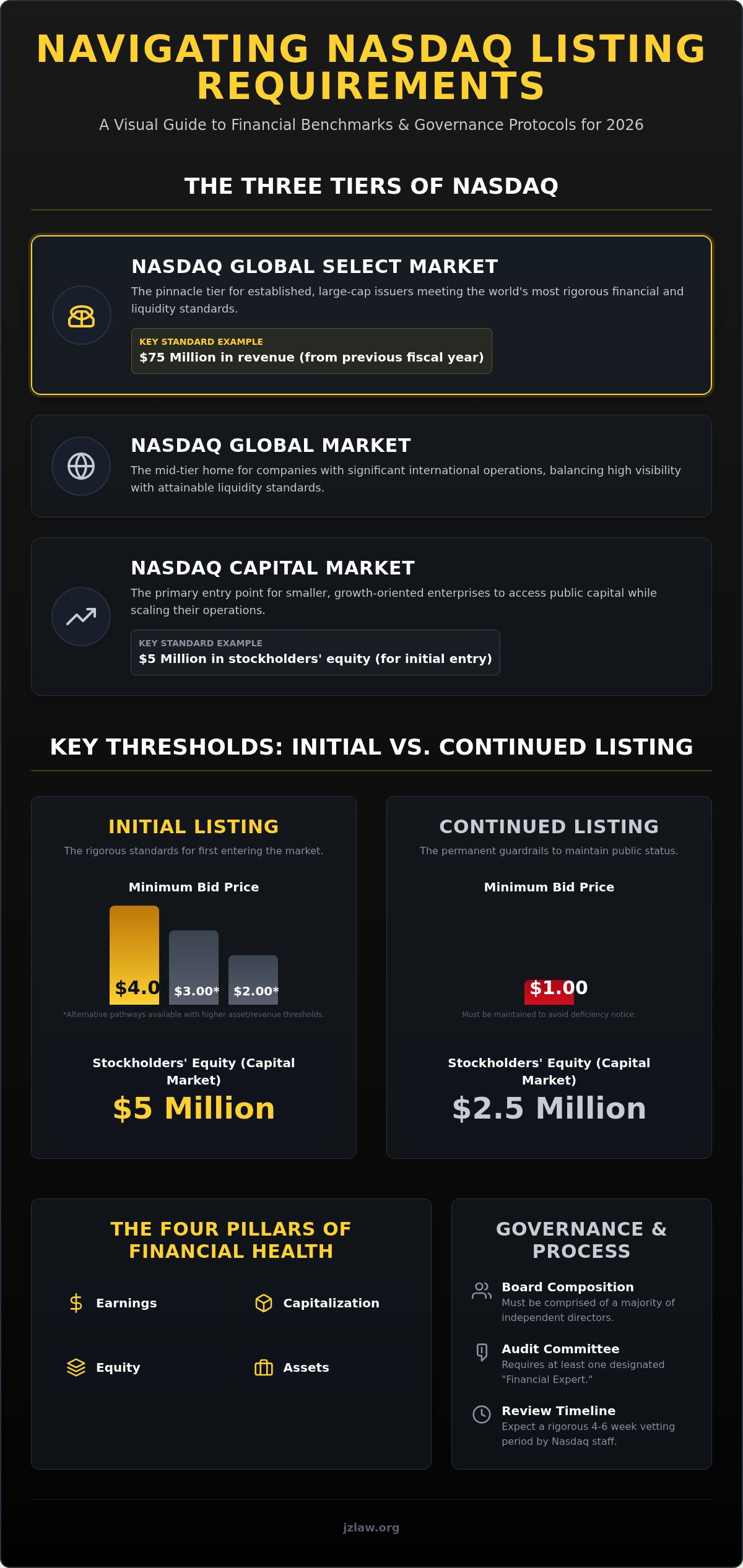
The Nasdaq Global Select Market represents the pinnacle of the exchange. It hosts large-cap issuers that meet the most rigorous financial and liquidity benchmarks in the world. For these companies, the nasdaq listing requirements include meeting one of four distinct standards, such as the "Capitalization with Revenue" standard, which demands at least $75 million in revenue from the previous fiscal year. This tier is designed for established leaders with high trading volumes and significant public interest.
The Nasdaq Global Market serves as the mid-tier home for companies with significant international operations. It provides a balance between high visibility and attainable liquidity standards. Conversely, the Nasdaq Capital Market acts as the primary entry point for smaller, growth-oriented enterprises. While the standards here are less demanding than the Global Select tier, they still require a minimum of $5 million in stockholders' equity for initial entry. This tier allows emerging firms to access public capital while they scale toward the higher markets.
Choosing the Right Tier for Your Growth Strategy
Strategic positioning is as vital as financial compliance. Prestige matters. Institutional investors often have internal mandates that restrict them to Global Select or Global Market stocks because of the perceived stability those tiers offer. While the Capital Market offers lower listing fees, the trade-off in market visibility and analyst coverage can be significant. It's a strategic calculation. Companies have the flexibility to move between tiers as their valuation scales, but this transition requires a fresh, comprehensive review of all quantitative standards to ensure the move doesn't trigger a compliance deficiency later.
Entry Requirements vs. Continued Listing Standards
Initial entry is just the beginning of the legal journey. Continued listing standards are the permanent legal guardrails for your public status. For instance, regardless of the tier, a company must maintain a minimum bid price of $1.00. If the price stays below this threshold for 30 consecutive business days, the exchange issues a deficiency notice. Maintaining at least $2.5 million in stockholders' equity is another non-negotiable for continued listing on the Capital Market. Falling below these thresholds can lead to delisting, which often triggers catastrophic clauses in corporate debt agreements and erodes shareholder trust. Proactive legal monitoring of these benchmarks is essential for long-term survival.
Quantitative Financial and Liquidity Requirements
Qualifying for a listing is a rigorous exercise in financial transparency. When evaluating a potential listing, the exchange examines the "Four Pillars" of financial health: Earnings, Capitalization, Equity, and Assets. These benchmarks ensure that only companies with a sustainable financial foundation can access the public markets. The Market Value of Publicly Held Shares (MVPHS) requirement serves as a critical filter by measuring the total market value of all unrestricted shares held by non-affiliates. This metric ensures there's enough "float" to prevent extreme price volatility and market manipulation.
Price stability begins with the minimum bid price rule. Most nasdaq listing requirements mandate a $4.00 minimum bid price for initial entry. However, the exchange provides alternative pathways for companies with lower share prices. An issuer might qualify with a $2.00 or $3.00 closing price if they meet higher net tangible asset or revenue thresholds. These alternatives offer flexibility for growth-stage companies that possess strong fundamentals but trade at lower nominal prices. Consulting the Nasdaq Initial Listing Guide can provide additional clarity on these specific pricing exceptions.
Financial Standards for the Capital Market Tier
The Capital Market tier offers three distinct pathways for qualification, allowing companies to lead with their strongest financial attribute. The Equity Standard requires a minimum of $5 million in stockholders’ equity, providing a safety net for investors. Alternatively, the Market Value Standard focuses on the company's scale, requiring a $50 million market value of listed securities. For profitable enterprises, the Net Income Standard demands $750,000 from continuing operations in the latest fiscal year or in two of the last three fiscal years. Precision in these filings is non-negotiable; even minor accounting discrepancies can stall an application for months.
Liquidity and Shareholder Distribution Rules
Liquidity is the lifeblood of a public exchange. To ensure a healthy trading environment, Nasdaq requires a minimum of 1,000,000 unrestricted publicly held shares. Furthermore, the company must have at least 300 round lot holders, which are investors holding 100 shares or more. This distribution prevents a small group of insiders from controlling the market price. Market makers also play a vital role, as the exchange requires at least three active market makers to maintain a fair and orderly market for the security.
For companies in emerging sectors, the choice between a reverse merger vs ipo often hinges on these liquidity requirements. A reverse merger might offer a faster path to the "public shell," but it doesn't bypass the need to meet the 1,000,000 share float or the round lot holder count. Strategic legal preparation is essential to ensure your cap table is clean and compliant before the formal review begins. If you're navigating these complexities, partnering with a firm experienced in securities regulation can help mitigate the risks of a rejected application.
Corporate Governance: The Qualitative Legal Standards
Financial strength alone doesn't guarantee a seat on the exchange. The qualitative nasdaq listing requirements focus on the integrity of corporate leadership and the protection of shareholder interests. These standards are designed to foster transparency and accountability, ensuring that the company's internal oversight is as robust as its balance sheet. For issuers in complex sectors like cryptocurrency or cannabis, these governance hurdles often require more intensive preparation than the financial benchmarks themselves.
A majority of the board of directors must be independent, meaning they have no material relationship that would interfere with their exercise of independent judgment. This structural mandate is supplemented by the requirement for a fully independent Audit Committee. This committee isn't merely a formality; at least one member must qualify as a "Financial Expert" with a documented background in accounting or sophisticated financial oversight. Additionally, issuers must establish Compensation and Nominating Committees, typically composed of independent directors, to manage executive pay and board appointments with objective rigor. Adopting a formal Code of Conduct and Ethics is equally mandatory, providing a public-facing commitment to legal and ethical compliance for all officers and employees.
Board Composition and Independence
Defining "Independence" under Nasdaq Rule 5605 is a nuanced legal task. It goes beyond simple employment history to include family ties and significant consulting relationships. To maintain the integrity of this independence, these directors must hold regular executive sessions, meeting at least twice a year without management present. In the 2026 regulatory climate, board diversity disclosure requirements have become a central focus. Issuers must provide a standardized matrix of board diversity or explain why they haven't met specific diversity objectives. Detailed templates for these disclosures are available in Nasdaq's official listing guide, which serves as the primary reference for governance compliance.
Shareholder Approval and Voting Rights
The exchange ensures that shareholders retain a meaningful voice in transformative corporate actions. Shareholder approval is generally required for equity compensation plans and significant acquisitions that result in the issuance of 20% or more of the company's outstanding stock. Beyond these specific events, the exchange strictly prohibits any corporate action that would disparately reduce the voting rights of existing shareholders. This rule prevents the creation of multi-class structures that disenfranchise the public float. Integrating these governance protocols into strategic corporate transactions is a prerequisite for a successful listing, as it ensures that rapid expansion doesn't inadvertently trigger a delisting event.
Navigating the Application and SEC Review Process
The application process is a collaborative yet rigorous vetting period that typically spans four to six weeks. During this window, the Nasdaq Listing Qualifications Staff conducts a granular review of the issuer's background, financial history, and governance structure. This staff acts as the primary gatekeeper, ensuring every detail aligns with the nasdaq listing requirements established for the chosen tier. It's vital to remember that meeting the quantitative benchmarks doesn't guarantee entry. Nasdaq retains broad "Public Interest" authority, which allows the exchange to deny a listing if they believe the issuer’s presence would undermine the integrity of the market or investor confidence. This discretionary power is often exercised when an issuer's past conduct or business model poses a perceived risk to the exchange's reputation.
Success requires synchronized timing between the exchange application and federal filings. Issuers must coordinate their Nasdaq submission with the SEC review of Form S-1 for IPOs or Form 10 for registration of a class of securities. Any discrepancies between these documents can trigger a cascade of SEC comment letters, delaying the listing and increasing legal costs. Ensuring consistency across all regulatory submissions is a hallmark of sophisticated securities regulation counsel. A fragmented approach to these filings often leads to structural deficiencies that are difficult to correct mid-cycle.
The Symbol Reservation and Listing Agreement
Before final approval, issuers must secure their market identity by reserving a trading symbol of one to four characters. This process is managed through the Nasdaq Listing Center and should be initiated early to avoid conflicts with existing tickers. Once the staff completes their preliminary review, the company executes the formal Listing Agreement and the Listing Summary Term Sheet. These documents codify the issuer's commitment to ongoing compliance and transparency. The process also requires the payment of a non-refundable application fee and an initial listing fee, the latter of which is generally paid upon the successful commencement of trading on the exchange.
Regulatory Hurdles for Complex Industries
Companies operating in emerging or high-risk sectors face additional layers of scrutiny. For those involved in cannabis licensing, the exchange requires exhaustive proof of compliance with state laws and a clear strategy for navigating federal legality issues. Similarly, issuers in the digital asset space must provide detailed disclosures regarding cryptocurrency law, focusing on custody solutions and valuation methodologies. Effectively managing SEC comment letters regarding these structural deficiencies is critical. A proactive approach that anticipates regulatory pushback can shave weeks off the approval timeline and prevent a public rejection that could damage the company's brand.
Strategic Legal Preparation for a Successful Listing
A successful listing represents the culmination of months, often years, of deliberate legal positioning. It’s a transformation of the corporate identity. Meeting the nasdaq listing requirements isn't merely about hitting a numerical target; it's about proving to the global market that your organization possesses the maturity to handle public scrutiny. Specialized securities counsel plays a pivotal role here, conducting exhaustive pre-listing audits that mirror the exchange's own vetting process. This proactive approach identifies and resolves potential red flags before they reach the Nasdaq Listing Qualifications Staff.
One of the most critical tasks in this preparation phase is the purification of the "Cap Table." Counsel must verify the clear title of every share issued since the company's inception, ensuring that no historical disputes or poorly documented equity grants cloud the ownership structure. Simultaneously, strategic tax structuring serves as more than a fiscal optimization; it ensures the issuer’s financial profile reflects the stability demanded by institutional investors. For global issuers, maintaining a local presence in financial hubs like New York or Toronto provides a distinct advantage. These locations offer direct access to the specialized legal networks and capital markets that are central to the Nasdaq ecosystem, facilitating smoother communication with regulators.
The Pre-IPO Legal Audit
The pre-IPO audit is a comprehensive scrub of the company's legal history. This includes a rigorous review of all material contracts and intellectual property rights to ensure the company’s core assets are fully protected and transferable. For companies with significant physical footprints, such as those in the energy or manufacturing sectors, compliance with real estate law is paramount. Clear property titles and compliant lease agreements are essential to prevent encumbrances that could trigger a deficiency during the vetting process. Historical corporate governance lapses, such as missing board minutes or undocumented executive sessions, must be corrected before the initial filing to demonstrate a culture of compliance.
Ongoing Compliance and Post-Listing Support
Listing is not the end of the journey; it marks the beginning of a permanent reporting cycle. Once public, companies must establish and maintain rigorous Internal Controls for Financial Reporting (ICFR) to satisfy the Sarbanes-Oxley Act requirements. Managing quarterly (10-Q) and annual (10-K) reporting obligations becomes a non-negotiable part of the corporate calendar. Failure to meet these deadlines can lead to immediate deficiency notices and potential delisting. Leveraging John Zang’s expertise for strategic corporate transactions post-listing allows companies to pursue acquisitions or secondary offerings with the same legal precision that secured their initial listing. This long-term partnership ensures that as the company scales, its governance and compliance frameworks remain as robust as the day it first hit the trading floor.
Securing Your Position in the 2026 Public Market
Achieving a listing on the Nasdaq is a transformative milestone that demands more than just financial strength; it requires a commitment to the highest standards of corporate integrity. Success in 2026 hinges on identifying the optimal market tier for your growth and rigorously auditing your internal governance before the formal review begins. Mastery of the nasdaq listing requirements involves balancing complex liquidity benchmarks with the qualitative expectations of the Listing Qualifications Staff. A well-prepared cap table and a transparent board structure aren't just checkboxes; they are the foundation of investor trust.
Whether you're navigating the nuances of the Global Select Market or entering through the Capital Market, your legal strategy must be proactive. At JZ Law, we provide the strategic counsel necessary for complex regulatory sectors, leveraging our deep experience in the New York, Toronto, and Calgary financial markets. We act as your strategic partner in high-stakes corporate transactions to ensure your public status is both achieved and maintained. Contact JZ Law for expert securities counsel and listing strategy to begin your transition to the public stage. With the right preparation, your company can navigate this regulatory landscape with precision and emerge as a leader in the global market.
Frequently Asked Questions
What is the minimum bid price for a Nasdaq listing in 2026?
The minimum bid price for an initial nasdaq listing requirements submission is generally $4.00 per share. However, the exchange provides alternative pathways for companies with closing prices of $2.00 or $3.00 if they meet higher revenue or asset thresholds. For issuers in growth hubs like Vancouver or Hamburg, these pricing rules ensure that listed securities possess a baseline of market stability before trading commences on the public exchange.
How many independent directors are required for a Nasdaq-listed company?
Nasdaq requires that a majority of the board of directors be independent as defined under Rule 5605. Additionally, the Audit Committee must be composed entirely of independent directors, with at least one member designated as a "Financial Expert." These governance standards are designed to provide objective oversight and protect shareholder interests across all three market tiers, ensuring that corporate leadership remains accountable to the public float.
Can a cannabis company list on the Nasdaq?
A cannabis company can list on the Nasdaq provided its operations comply strictly with federal laws in the jurisdictions where it operates. For issuers in hubs like Toronto or Denver, this often requires exhaustive legal opinions regarding the legality of their revenue streams. The exchange conducts a rigorous review of cannabis licensing and business models to ensure that the listing doesn't violate the "Public Interest" authority or federal statutes.
What are the differences between the Nasdaq Global Select and Capital Markets?
The primary differences lie in the stringency of financial and liquidity benchmarks. The Global Select Market is the highest tier, requiring higher revenue, market capitalization, and a greater number of round lot holders. In contrast, the Capital Market serves as an entry point for smaller growth companies, with lower thresholds for stockholders' equity and market value. Both tiers share identical corporate governance standards, but the Global Select tier offers higher visibility.
How long does the Nasdaq listing application process take?
The Nasdaq listing application process typically takes four to six weeks from the initial submission to the final approval. This timeline includes a comprehensive review by the Listing Qualifications Staff, who vet the issuer’s financial history and governance protocols. For companies coordinating filings from Calgary or New York City, synchronized legal preparation is essential for maintaining the projected IPO schedule and addressing any SEC structural deficiencies that may arise during the review.
What happens if a company fails to meet continued listing requirements?
If a company fails to meet continued nasdaq listing requirements, such as maintaining a $1.00 minimum bid price or $2.5 million in equity, the exchange issues a deficiency notice. The company usually receives a 180-day grace period to regain compliance. Failure to rectify the deficiency within the allotted timeframe can lead to delisting, which often triggers negative consequences for corporate credit facilities and overall market reputation.
Are there special requirements for foreign private issuers (FPIs)?
Foreign private issuers (FPIs) may follow their home country’s corporate governance practices instead of certain Nasdaq rules, provided they disclose these deviations in their annual reports. However, FPIs must still comply with the exchange’s rules regarding the Audit Committee and the notification of non-compliance. Companies from major hubs like Frankfurt or Berlin often leverage these exemptions while ensuring their financial disclosures meet U.S. GAAP or IFRS standards.
What is the "Public Interest" rule in Nasdaq listings?
The "Public Interest" rule grants Nasdaq the broad discretionary authority to deny an initial listing or delist a security even if the company meets all quantitative benchmarks. This power is used to protect the integrity of the market and investor confidence. The exchange may exercise this authority if an issuer’s past conduct, business model, or regulatory history in jurisdictions like Calgary or New York City poses a perceived risk to the exchange's reputation.


Comments