


Navigating Landowner Disputes in Alberta: A 2026 Strategic Legal Guide
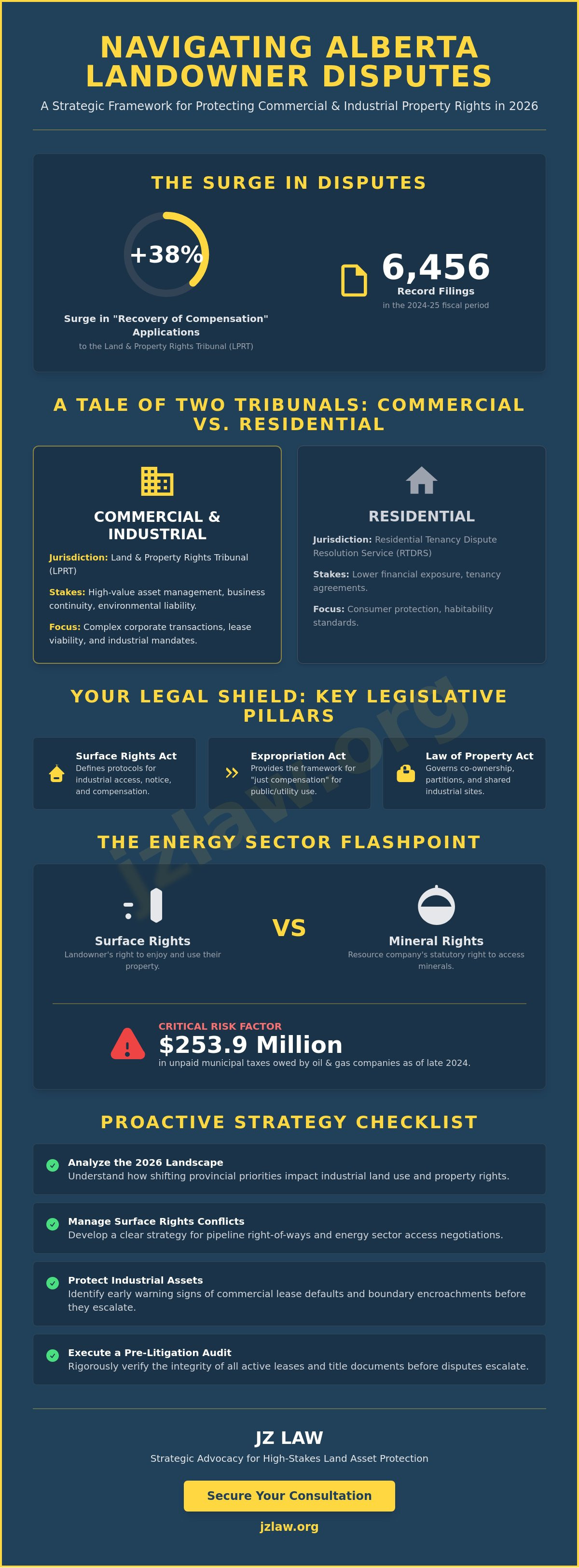
With "Recovery of Compensation" applications to the Land and Property Rights Tribunal surging by 38 percent to a record 6,456 filings, the friction between private property and industrial mandates has reached a critical boiling point. For many, navigating landowner disputes alberta requires moving beyond simple negotiation; it's a high-stakes strategic exercise against regulatory inertia and shifting provincial priorities. You likely feel the weight of this complexity, especially when facing the Alberta Energy Regulator or the daunting new tiered fee structures of the RTDRS.
It's frustrating to watch your asset's value erode while waiting for a 120-day project approval or dealing with the financial fallout of unauthorized surface access. This guide provides a sophisticated legal framework to help you reclaim control over your property rights and secure the dignity of your holdings. We'll examine the 2026 updates to Land Titles fees, the nuances of the new Condominium Dispute Resolution Tribunal, and precise methods for securing favorable lease terms in an era of industrial encroachment.
Key Takeaways
Analyze how 2026 provincial priorities have shifted the legal landscape for industrial land use and property rights.
Develop a clear strategy for managing surface rights conflicts, specifically regarding pipeline right-of-ways and energy sector access.
Protect industrial assets by identifying early warning signs of commercial lease defaults and boundary encroachments before they escalate to forfeiture.
Execute a rigorous pre-litigation audit when navigating landowner disputes alberta to verify the integrity of all active leases and title documents.
Learn how high-level oil and gas law expertise and strategic corporate transactions can serve as a proactive shield for your commercial property interests.
Table of Contents
Understanding the 2026 Landscape of Alberta Landowner Disputes
Landowner disputes in a commercial or industrial context differ fundamentally from residential disagreements. In 2026, these conflicts often involve the intersection of high-value asset management and evolving provincial energy mandates. While residential tenants might look toward the Residential Tenancy Dispute Resolution Service (RTDRS), which implemented a tiered fee structure on April 1, 2026, commercial stakeholders operate within a much more rigorous regulatory environment. Successfully navigating landowner disputes alberta requires a deep understanding of the Land & Property Rights Tribunal (LPRT), an entity that saw applications for compensation recovery surge by 38 percent to a record 6,456 filings in the 2024-25 fiscal period. This volume underscores a province in transition, where the government's push for 120-day project approval timelines creates friction between rapid development and established property rights.
Commercial vs. Residential: Why the Distinction Matters
The distinction between these two spheres is not merely semantic; it is jurisdictional. Residential frameworks prioritize consumer protection, whereas commercial land litigation involves complex corporate transactions and significant financial exposure. The stakes often include business continuity, environmental liability, and long-term lease viability. While the Court of King's Bench remains the venue for high-value contract breaches, specialized tribunals like the LPRT handle the technical nuances of surface access and compensation. Understanding Land ownership in Canada is essential here, as the separation of surface and mineral rights in Alberta creates unique legal obligations that do not exist in standard residential law. The financial implications of a commercial dispute are also heightened by the February 2026 update to Land Titles fees, which saw resubmission costs and registration ranges increase significantly.
Key Legislative Frameworks for Landowners
The Surface Rights Act remains the primary pillar for industrial access, but 2026 amendments have tightened the protocols for notice and compensation. For landowners facing industrial encroachment, the Expropriation Act provides the necessary, albeit rigid, framework for "just compensation" when private land is taken for public or utility purposes. Additionally, the Law of Property Act continues to govern co-ownership and partition, which is vital for businesses managing shared industrial sites or joint ventures. These statutes, combined with the December 15, 2022, abolition of adverse possession (squatter's rights) against private owners, define the current boundaries of property protection. When navigating landowner disputes alberta, stakeholders must also account for the Education Property Tax rates for 2026-27, which set non-residential rates at $4.17 per $1,000 of assessed value, adding another layer of financial strategy to any land use conflict.
Surface Rights and Energy Sector Conflicts
In Alberta, the legal separation of surface ownership from mineral rights creates an inherent friction that defines much of the province's industrial landscape. Successfully navigating landowner disputes alberta involves managing the tension between a proprietor’s right to enjoy their land and a resource company's statutory right to access minerals. These conflicts often manifest during the negotiation of pipeline right-of-ways or wellsite access. When a company proposes a project, the Alberta Energy Regulator (AER) provides a dispute resolution process, but this framework often favors streamlined approvals over individual property concerns. To balance the scales, landowners should consult the Farmers' Advocate Office for guidance on mediation and water rights before formalizing any agreement.
Negotiating a surface lease isn't just about the initial entry; it's about long-term asset protection. With oil and gas companies owing a cumulative $253.9 million in unpaid municipal taxes as of late 2024, the financial stability of an operator is a critical risk factor. A well-structured lease should account for potential insolvency and include specific clauses for annual compensation reviews. If you're facing complex regulatory hurdles, engaging a partner focused on high-stakes land asset protection can help ensure your property isn't compromised by industrial encroachment.
Oil and Gas Access Rights
An energy company can legally enter your land if they hold a negotiated surface lease or a Right of Entry order from the Land and Property Rights Tribunal. It's a common misconception that landowners can simply refuse access; instead, the focus must be on the strategic negotiation of entry fees and annual compensation. These payments are intended to cover the loss of use and the adverse effect on your remaining land. For a deeper understanding of the regulatory environment governing these interactions, reviewing the latest developments in oil and gas law is essential for any commercial or industrial stakeholder.
Environmental Liabilities and Reclamation Disputes
Reclamation is a major point of contention in 2026. There are approximately 170,000 unreclaimed oil and gas sites across the province, leaving many landowners with "orphan" wells that hinder future development. While the operator is legally responsible for restoring the land to its original state, the process is often fraught with delays. Navigating landowner disputes alberta in this context requires aggressive legal remedies when an operator fails to obtain a reclamation certificate or neglects site maintenance. You shouldn't bear the burden of environmental contamination. Precise legal notices and tribunal applications are necessary to hold companies accountable for their restoration obligations.
Commercial Lease and Real Estate Disputes
The transition from rural surface rights to urban industrial corridors introduces a different set of legal complexities. For commercial property owners, the focus shifts toward contractual integrity and boundary precision. Successfully navigating landowner disputes alberta in a commercial context often hinges on the rigorous application of real estate law to resolve title defects or restrictive covenant violations. These covenants, which may limit land use or development, require strategic litigation to either enforce or discharge, depending on the long-term objectives of the enterprise. When disputes arise regarding land use or compensation, Alberta's Land and Property Rights Tribunal provides the necessary oversight to ensure that industrial developments align with provincial standards while respecting private ownership. The February 2026 update to Land Titles fees, which introduced new resubmission charges, makes title clarity even more critical for maintaining asset liquidity.
Commercial Tenant Defaults and Remedies
In the current economic climate, high-stakes commercial lease defaults demand immediate and precise action. Landlords often utilize "distress for rent," a remedy allowing the seizure of a tenant's commercial assets to recover arrears. This process is fraught with procedural risks and requires a disciplined approach to avoid liability. If a landlord terminates a lease, the tenant may apply for "relief from forfeiture," a court-ordered remedy that can reinstate the lease and halt an eviction. A 2025 Alberta Court of King's Bench decision clarified that the duty of good faith allows parties to exit unfavorable contracts for economic reasons, provided the opportunity wasn't created dishonestly. This ruling gives landlords and tenants more clarity when negotiating the strategic termination of high-value leases without the fear of immediate judicial reversal.
Title and Boundary Litigation
Industrial zones frequently face boundary disputes and easement encroachments that can stall multi-million dollar expansions. The Property Rights Statutes Amendment Act, which came into effect on December 15, 2022, simplified these matters by abolishing adverse possession claims against private landowners. You no longer have to fear "squatter's rights" eroding your property lines over time. Instead, modern disputes often center on utility easements and access rights for neighboring parcels. By 2026, digital land surveying has become the gold standard for boundary evidence, offering a level of precision that traditional markers cannot match. This technology is particularly vital in industrial corridors where even a few centimeters of encroachment can violate municipal bylaws or safety setbacks. Resolving these issues early prevents permanent legal liabilities and ensures your land remains a marketable asset.
Strategic Steps for Navigating Landowner Disputes
Informal discussions often fail when multi-million dollar industrial assets are at stake. Successfully navigating landowner disputes alberta requires a transition from reactive communication to a structured, evidence-based legal strategy. The process begins with a comprehensive pre-litigation audit. You must verify the integrity of every active lease, easement, and title document, ensuring no clerical errors or expired terms weaken your position. Once your standing is confirmed, formalizing the dispute involves serving precise legal notices that comply with the Surface Rights Act or the Law of Property Act. These notices aren't just administrative requirements; they're the foundation of your case if the matter proceeds to a formal hearing.
While Alternative Dispute Resolution (ADR) remains a viable path for early settlement, many high-value conflicts inevitably move toward the Land & Property Rights Tribunal (LPRT). Filing an application with the LPRT is a technical process that demands a clear articulation of the compensation or access issues at hand. This stage requires a strategic partner who understands how to leverage expert legal representation for land disputes to protect your commercial interests from the outset. Navigating landowner disputes alberta effectively means being prepared for the transition from negotiation to adjudication at any moment.
Evidence Gathering and Expert Witnesses
The success of a compensation claim often rests on the quality of your expert testimony. A specialized real estate appraiser is critical for determining the "highest and best use" of your land, which often contradicts the lower valuations provided by industrial operators. For surface damage claims, environmental engineers provide the technical data necessary to prove soil compaction, contamination, or drainage issues. You must structure this evidence to meet the specific standards of the LPRT and the Alberta Energy Regulator (AER). Raw data is rarely enough; it must be presented within a framework that highlights the long-term economic impact on your property's value.
The LPRT Hearing Process
By 2026, LPRT hearings are conducted through a mix of virtual and in-person formats, offering more flexibility but requiring rigorous digital preparation. One of the most vital aspects of the hearing is the cross-examination of corporate land agents. These individuals often rely on standardized industry data that may not reflect the unique characteristics of your specific parcel. Challenging their assumptions is essential for a favorable outcome. After the hearing, the tribunal typically issues a written decision within several weeks. If the result is unsatisfactory, you have a limited window to seek leave to appeal to the Alberta Court of Appeal on questions of law or jurisdiction. Understanding these timelines is vital for maintaining the momentum of your dispute resolution strategy.
JZ Law: Strategic Advocacy for Alberta Landowners
JZ Law approaches property rights with a precision that balances traditional legal dignity and modern economic agility. John Zang's methodology for navigating landowner disputes alberta focuses on the intersection of technical regulatory knowledge and high-level commercial strategy. By integrating corporate transactions with land asset protection, the firm ensures that every lease or access agreement serves as a robust component of the client's broader business portfolio. This boutique approach provides a level of responsiveness that larger, more rigid organizations often struggle to match, particularly when dealing with the fast-moving 120-day project approval timelines set by the provincial government in 2026.
John Zang's services are built on the belief that a lawyer should be a strategic partner who understands market cycles and industrial pressures. In an energy sector where the volume of "Recovery of Compensation" applications has reached record highs, having a specialized advocate allows you to bypass the gridlock of standard administrative processes. The firm's expertise in both oil and gas law and real estate law creates a comprehensive shield for your holdings, whether they're rural surface parcels or urban industrial zones. It's not just about resolving a single conflict; it's about the long-term preservation of your property's value.
Proactive Risk Mitigation
Effective land management begins long before a tribunal application is filed. JZ Law prioritizes the drafting of bulletproof surface leases that anticipate the financial risks discussed earlier, such as operator insolvency or the $253.9 million in unpaid municipal taxes currently burdening the sector. By auditing corporate land holdings for latent legal liabilities, the firm identifies weaknesses in title or environmental indemnities before they become active disputes. This proactivity allows landowners to position themselves strategically for future development or inevitable expropriation, ensuring that compensation isn't just a reaction but a planned outcome.
High-Stakes Representation
When conflicts escalate, you need a partner who can navigate the specific rigors of the Alberta Energy Regulator (AER) and the Land & Property Rights Tribunal (LPRT). JZ Law provides sophisticated representation across all Alberta courts, offering customized legal frameworks for unique industrial land challenges. Whether the issue involves the complexities of oil and gas law or high-value real estate law, the firm's commitment to protecting the commercial interests of Alberta businesses remains the priority. If your enterprise is currently navigating landowner disputes alberta, securing a strategic consultation with JZ Law is the first step toward reclaiming the security of your property assets.
Securing the Future of Your Alberta Land Assets
Success in the 2026 regulatory environment requires a transition from reactive defense to proactive strategic management. The record surge in tribunal applications and the evolving provincial priorities prove that surface rights and commercial lease integrity are no longer guaranteed by default. Effective resolution depends on the precise application of expert evidence and a disciplined understanding of the jurisdictional boundaries between Alberta courts and specialized tribunals. Navigating landowner disputes alberta effectively means looking beyond the immediate conflict to the long-term viability of your industrial portfolio.
JZ Law offers the specialized focus necessary for these high-stakes challenges. Our firm provides expertise in Alberta Energy Regulator (AER) compliance and a strategic approach to the Land & Property Rights Tribunal, ensuring that your commercial interests are prioritized during every stage of negotiation or adjudication. We bridge the gap between complex corporate transactions and industrial land protection to maintain the dignity of your holdings. Your property deserves a defense that is as sophisticated as the industries surrounding it. Consult with JZ Law for Strategic Landowner Representation and secure the professional advocacy your assets require.
Frequently Asked Questions
What is the Land & Property Rights Tribunal (LPRT) in Alberta?
The LPRT is an independent quasi-judicial body responsible for adjudicating disputes related to surface rights, land compensation, and municipal assessments. It provides an alternative to the court system for technical land matters. While navigating landowner disputes alberta, stakeholders often engage the LPRT to resolve compensation disagreements that cannot be settled through private mediation. The tribunal's decisions are binding and carry the same weight as a court order.
Can I refuse a company access to my land for oil and gas activity?
You cannot legally prevent a company from accessing your land if they hold a valid Right of Entry order from the LPRT. While you have the right to negotiate the terms of entry and the amount of compensation, the mineral rights holder has a statutory priority to access resources. If negotiations fail, the operator will apply for a tribunal order to gain access despite your objections.
How is compensation calculated for surface rights disputes?
Compensation is calculated by evaluating the market value of the land taken, the loss of use, and the adverse effect on the remaining property. The tribunal also considers nuisance factors such as noise and dust. In 2026, accurate appraisals from specialized experts are essential to ensure the final award reflects the highest and best use of the industrial or commercial site.
What is the difference between an easement and a right-of-way in Alberta?
An easement is a legal interest that grants one party the right to use another's land for a specific, limited purpose. A right-of-way is a specific category of easement that provides a path for transit, such as a pipeline corridor or a road. Both are registered on the land title and remain in effect even if the property is sold to a new owner.
How long does a landowner dispute take to resolve in Alberta courts?
Resolution timelines vary significantly depending on the complexity of the case and the chosen venue. While the Alberta government targets a 120-day approval timeline for major projects, high-value litigation in the Court of King's Bench can take 18 to 24 months. Tribunal hearings are generally more efficient, but the preparation of expert evidence often extends the process by several months.
Can I claim legal fees as part of a surface rights settlement?
Landowners are often entitled to recover reasonable legal and expert costs under the Surface Rights Act. This provision is designed to level the playing field between individual proprietors and well-funded industrial corporations. When navigating landowner disputes alberta, it's vital to keep detailed records of all professional expenses to ensure they're included in the final settlement or tribunal award.
What happens if an energy company goes bankrupt while on my land?
If an operator becomes insolvent, the responsibility for reclamation typically falls to the Orphan Well Association. Landowners can also apply to the LPRT to recover unpaid annual rentals from the provincial government, which manages a specific fund for this purpose. With unpaid municipal taxes from oil and gas companies reaching $253.9 million, verifying an operator's financial health is a critical pre-lease step.
Does a commercial lease automatically terminate if the tenant defaults?
Termination isn't automatic; it requires the landlord to exercise their right of reentry or serve a formal notice of forfeiture. The lease agreement's specific terms dictate the required notice period and the types of defaults that trigger termination rights. Tenants have the right to seek relief from forfeiture in court, which can reinstate the lease if the default is cured promptly.


Comments