


Oil and Gas Joint Venture Agreement: Strategic Legal Frameworks for 2026
Could a single vague liability clause in your 2026 project draft jeopardize a C$50 million upstream investment before the first drill bit even touches the ground? Most energy executives understand that the traditional handshake deal is a relic of the past. You likely recognize that as Canadian regulatory bodies like the CER (Canada Energy Regulator) tighten ESG requirements, the margin for error in partnership structures has vanished. An oil and gas joint venture agreement must now serve as a dynamic shield against operational deadlock rather than just a static stack of papers.
It's clear that the complexity of cross-border regulations and the threat of litigation over vague terms keep even the most seasoned project managers awake at night. We'll show you exactly how to master these energy partnerships by providing expert legal insights into structuring, risk mitigation, and cross-border compliance. This article breaks down the essential components of a robust legal framework, defines clear operational control, and ensures your next venture aligns perfectly with local energy regulators' expectations for the 2026 landscape.
Key Takeaways
Evaluate the strategic advantages of incorporated versus unincorporated structures to optimize liability protection and tax efficiency within the Canadian energy sector.
Master the essential components of an oil and gas joint venture agreement, including operator duties, cash call mechanisms, and robust ESG compliance frameworks.
Navigate the complexities of regional regulations by understanding how Alberta’s AER requirements differ from international standards to ensure seamless cross-border operations.
Implement preventive legal strategies to mitigate high-stakes risks and protect your capital commitments against funding defaults or interest dilution.
Discover how a boutique, strategic legal approach can bridge regulatory gaps and facilitate stable, long-term partnerships in the evolving global energy market.
Table of Contents What is an Oil and Gas Joint Venture Agreement? Choosing the Right Structure: Incorporated vs. Unincorporated JVs Critical Clauses for Risk Management and ESG Compliance Navigating Local Regulations: Calgary, Denver, and Germany The JZ Law Approach to Strategic Energy Partnerships
What is an Oil and Gas Joint Venture Agreement?
An oil and gas joint venture agreement serves as the foundational pillar for collaborative energy projects across Canada's resource-rich provinces. It's a precise contractual arrangement where two or more parties combine their financial resources, technical expertise, and operational capacities to execute specific upstream exploration or midstream infrastructure projects. Unlike a corporate merger, which involves the total integration of entities, a joint venture focuses on a defined asset or a specific geographic area. For those seeking a broader conceptual foundation, understanding What is a Joint Venture? provides the necessary background on how these partnerships function as distinct legal and economic units.
The primary objective of these agreements involves pooling capital to mitigate the immense financial exposure inherent in the sector. In Western Canada, where unconventional resource plays can require initial capital outlays exceeding C$100 million, sharing risk isn't just a preference; it's a structural necessity. These frameworks ensure that liabilities, production outputs, and operational costs are distributed according to each participant's working interest. By 2026, the landscape has shifted toward high-tech, low-carbon extraction, making the oil and gas joint venture agreement a tool for sharing the burden of expensive decarbonization technologies and sophisticated seismic data processing.
Core Components of an Energy JV
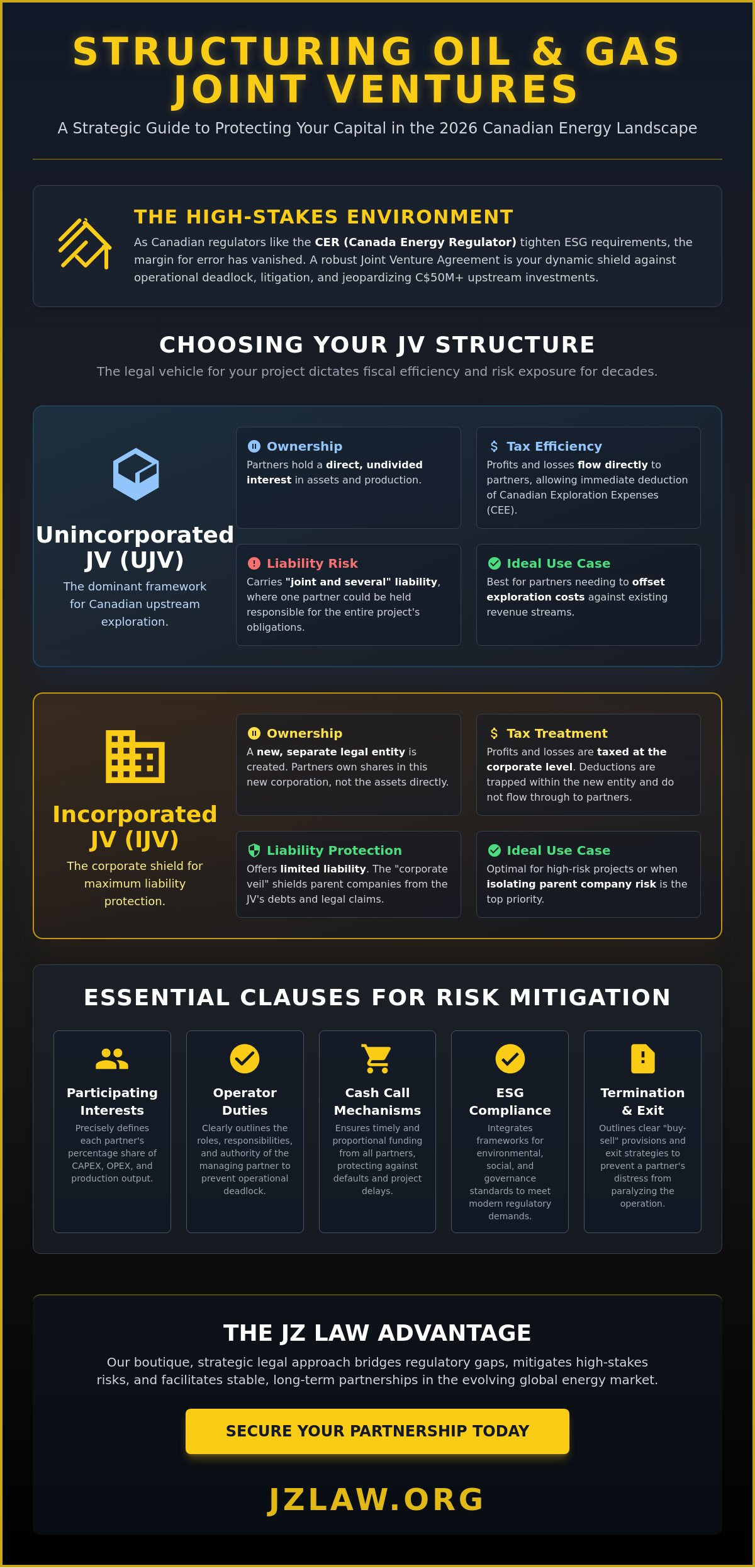
Identifying participating interests is the first step in any robust agreement. Each partner's percentage determines their share of capital expenditures (CAPEX) and operating expenses (OPEX). The scope of operations must be defined with surgical precision, stating whether the partnership covers exploration, development, or long-term infrastructure management. Term and termination clauses are equally critical. They protect the project's viability by outlining clear exit strategies and "buy-sell" provisions that prevent a single partner's financial distress from paralyzing the entire operation.
The Evolution of Model Agreements
The Petroleum Joint Venture Association (PJVA) in Canada and the Association of International Energy Negotiators (AIEN) have recently updated their standards to reflect a shift toward integrated energy management. We've moved beyond a "drill-only" focus. Modern 2026 agreements now frequently include provisions for carbon capture storage and hydrogen co-production. Standard templates often fail to address specific Canadian corporate tax structures, particularly regarding flow-through shares or complex royalty regimes. Customizing these frameworks is essential to ensure they align with the strategic interests of all stakeholders while maintaining compliance with the latest environmental regulations.
Choosing the Right Structure: Incorporated vs. Unincorporated JVs
The selection of a legal vehicle for an oil and gas joint venture agreement dictates the project's fiscal efficiency and risk exposure for decades. In the Canadian energy sector, specifically within the Western Canadian Sedimentary Basin, the choice hinges on whether participants prioritize tax transparency or the isolation of liability. Each model presents distinct advantages regarding capital recovery and operational control. Decisions made in the drafting phase determine how C$50 million or C$500 million in capital is shielded from unforeseen market shifts.
Unincorporated Joint Ventures (UJV)
The UJV remains the dominant framework for upstream exploration in the Canadian oil sands and Western shale plays. Under this model, participants hold a direct, undivided interest in the assets and production. This structure ensures tax transparency; profits and losses flow directly to the venturers, allowing for the immediate deduction of Canadian Exploration Expenses (CEE) against other income. This is particularly beneficial for junior partners who need to offset exploration costs against existing revenue streams. However, this direct ownership necessitates a robust oil and gas joint venture agreement to manage "joint and several" liability risks. While participants are typically liable only for their proportionate share of costs, third-party claims can sometimes bypass these contractual limitations. To mitigate these complexities, operators often rely on the AIEN Model Joint Operating Agreement to standardize accounting and liability protocols. This model facilitates faster decision-making because it lacks the bureaucratic layers of a corporate board; instead, it relies on an Operating Committee where votes are weighted by working interest.
Incorporated Joint Ventures (IJV)
When projects involve high-capital midstream infrastructure or international cross-border pipelines, an IJV is often superior. By creating a Special Purpose Vehicle (SPV), partners ring-fence project risks, ensuring that liabilities don't migrate to the parent companies' balance sheets. Governance is exercised through a formal shareholder agreement and a dedicated board of directors. While this adds a layer of corporate tax, it simplifies the financing process. Lenders often find it easier to secure debt against a distinct legal entity with its own assets. For investors seeking a passive role with capped downside, the IJV provides a protective shield that the UJV cannot match. It's the preferred choice for complex projects where the participants' risk tolerances vary significantly.
JZ Law recognizes that no two projects carry the same risk profile. Our firm analyzes the specific geological and financial variables of your play to recommend a structure that aligns with your long-term exit strategy. Whether you're managing a shale development or a multi-billion dollar infrastructure build, we provide the strategic legal oversight necessary to protect your capital. We ensure that your governance clauses prevent deadlock while maintaining the protective barriers essential for 2026's volatile energy market. Our approach prioritizes precision, ensuring your venture is built on a foundation of legal certainty.
Critical Clauses for Risk Management and ESG Compliance
The Operator serves as the primary executor of the project, wielding significant power over daily activities and procurement. A robust oil and gas joint venture agreement must clearly delineate the Operator’s duties, limiting their authority to "Authorized Expenditures" (AFEs) that don't exceed the approved budget by more than 10%. Removal mechanisms shouldn't be restricted to gross negligence; they must include provisions for insolvency or a change in corporate control. Protecting the venture requires rigorous indemnity frameworks. In Canada, liability for environmental remediation can reach hundreds of millions of Canadian Dollars, making it vital to establish that the Operator is only indemnified when acting within the scope of the operating committee's directives.
Funding stability depends on the precision of cash call provisions. When a partner defaults on a C$10,000,000 capital contribution, the agreement must trigger immediate dilution or "withering" clauses. These clauses often penalize the defaulting party by reducing their working interest at a rate of 200% of the unpaid amount, ensuring the non-defaulting partners are compensated for the increased financial risk. This preventative structure maintains the project's momentum during high-cost exploration phases in the Montney or Duvernay formations.
Operational Control and Deadlock Resolution
Voting thresholds for AFEs determine the speed of field development. Most Canadian ventures utilize a "pass mark" of 65% to 75% for major capital projects to prevent a single minority partner from stalling progress. When disputes arise, arbitration in Calgary or Vancouver is preferred over litigation to maintain confidentiality and leverage industry-specific expertise. A deadlock occurs when voting parties reach an impasse on a critical operational decision, which is frequently resolved via a "buy-sell" mechanism where one party offers to purchase the other’s interest or sell their own at a specified price.
ESG and Regulatory Alignment
By 2026, compliance with the Canadian federal methane regulations (SOR/2018-196) is a non-negotiable contractual requirement. Modern agreements must include clauses for real-time carbon intensity monitoring and mandatory reporting to meet the 75% methane reduction target from 2012 levels. These ESG obligations are now central to corporate transactions involving asset transfers, as buyers demand proof of regulatory alignment. Every oil and gas joint venture agreement should specify which party bears the cost of installing carbon capture technologies or upgrading leak detection systems to ensure the asset remains viable under 2026's stringent environmental benchmarks.
Navigating Local Regulations: Calgary, Denver, and Germany
Drafting a robust oil and gas joint venture agreement requires more than a standard template; it demands a precise alignment with the specific regulatory hurdles of each operating basin. Local oversight dictates the operational reality for every partner involved. Whether you're targeting the Western Canadian Sedimentary Basin or the Denver-Julesburg Basin, the legal architecture must account for regional shifts in liability and environmental compliance. By 2026, the intersection of traditional extraction and carbon-neutral mandates will define how these contracts are structured and enforced.
The Alberta and Calgary Energy Landscape
The Alberta Energy Regulator (AER) has fundamentally shifted its oversight through Directive 088, moving toward a holistic assessment of a licensee's life cycle. JV partners in Calgary must now conduct rigorous due diligence on their co-venturer's financial health to avoid being saddled with orphan well liabilities. The Petroleum Joint Venture Association (PJVA) is preparing model updates for 2026 that specifically address decommissioning triggers and carbon sequestration rights within standard operating procedures. This evolution makes it vital to secure an oil and gas lawyer Calgary who understands these local nuances to ensure your 2026 execution remains compliant.
US and European Market Considerations
Operations in Denver and New York City face a different set of challenges. In Colorado, the Energy and Carbon Management Commission (ECMC) enforces some of the strictest setback and emission rules in North America, which can significantly alter the "Area of Mutual Interest" clauses in your oil and gas joint venture agreement. Financing these ventures often involves complex securities regulations, particularly when raising capital through private placements in New York financial hubs.
European ventures, particularly those centered in Berlin or Frankfurt, operate under the shadow of the EU's Foreign Subsidies Regulation (Regulation 2022/2560). This regulation, fully effective as of July 2023, requires partners to disclose financial contributions from non-EU states if they exceed specific thresholds, potentially delaying or blocking strategic energy transactions. German-based JVs are also leading the way in "Hydrogen-Ready" gas infrastructure, requiring legal frameworks that allow for a seamless transition from natural gas to green hydrogen production within the same contractual lifespan.
Cross-border tax structuring: US and Canadian partners often utilize "Check-the-Box" elections to prevent double taxation on JV distributions.
Mineral rights: Unlike the US, where private ownership is common, Canadian mineral rights are largely held by the Crown, necessitating specific lease-holding strategies.
Regulatory Reporting: The AER's Integrated Compliance Assurance Framework (ICAF) requires real-time data sharing between JV operators and non-operators.
Strategic legal planning prevents the friction that often arises from these overlapping jurisdictions. If your venture involves complex cross-border assets, you should consult with a strategic legal partner to build a preventive framework that protects your capital and ensures long-term regulatory compliance.
The JZ Law Approach to Strategic Energy Partnerships
High-stakes energy projects in 2026 require more than template-based legal work; they demand surgical precision. A boutique firm like JZ Law provides the specialized attention necessary for niche energy transactions that larger, volume-driven firms often overlook. We prioritize the strategic nuances of your oil and gas joint venture agreement, ensuring that every clause aligns with your long-term commercial objectives rather than just filling a standard form.
John Zang specializes in bridging the complex regulatory gaps between Canada, the United States, and Europe. This international perspective is vital for Canadian operators seeking foreign capital or European investors entering the Western Canadian Sedimentary Basin. By aligning domestic requirements with international standards, we facilitate smoother capital flow and operational compliance across borders. This cross-jurisdictional fluency allows our clients to move faster than competitors who are bogged down by administrative friction.
Comprehensive Counsel for Complex Sectors
Our firm provides a holistic approach by integrating oil and gas law with sophisticated securities and tax strategies. This integration is essential for companies taking the next step toward going public on the TSX or TSX Venture Exchange. John Zang brings more than 10 years of experience in regulatory compliance to every file he manages. We ensure your corporate structure supports future equity raises while maintaining a tax-efficient profile for current stakeholders.
Preventative legal strategy sits at the core of our practice. We don't just react to crises; we solve disputes before they reach the courtroom. By drafting clear, data-driven "deadlock" and "buy-sell" provisions, we eliminate the ambiguity that typically leads to litigation. In the Canadian energy sector, where a single day of stalled production can cost upwards of C$50,000 in lost revenue for mid-sized operations, avoiding the courtroom isn't just a legal preference; it's a financial necessity.
Structuring your 2026 energy joint venture requires foresight regarding carbon accounting, evolving indigenous consultation requirements, and volatile commodity pricing. We invite you to begin this process with a strategic consultation. Our team will review your proposed partnership structure to identify hidden liabilities and optimize your operational framework. Don't leave your oil and gas joint venture agreement to chance. Contact JZ Law to secure a legal foundation that is as resilient as the assets you manage.
Fortifying Your Energy Partnerships for the 2026 Regulatory Landscape
Navigating the complexities of an oil and gas joint venture agreement requires more than standard templates; it demands a preventive legal strategy that anticipates the shifting regulatory landscape of 2026. Whether you're structuring an unincorporated venture to optimize tax flow-through or opting for an incorporated entity to shield assets, the precision of your contract dictates your long-term operational stability. ESG mandates and local regulations in hubs like Calgary are no longer optional additions. It's clear they're foundational requirements for any partnership aiming for sustainable growth in the Canadian market.
With a decade of experience managing complex corporate transactions, John Zang provides the sophisticated counsel needed to bridge technical operations and legal protection. He's specialized in taking energy companies public and maintains deep expertise in the Calgary, Denver, and Berlin energy markets. This specialized background ensures your venture is built on a resilient framework that protects capital while fostering innovation. Consult with John Zang on your Oil and Gas Joint Venture Agreement to ensure your next partnership is legally sound and strategically positioned for the future. We look forward to helping your business thrive in this evolving sector.
Frequently Asked Questions
What is the difference between a Joint Operating Agreement (JOA) and a JV?
A Joint Venture (JV) represents the broad commercial arrangement between parties to share risks and rewards, while a Joint Operating Agreement (JOA) is the specific contract governing day to day operations. In the Canadian energy sector, the JV defines the overarching partnership structure. The JOA, often utilizing the 2015 CAPL Operating Procedure, dictates exactly how the operator manages the assets on behalf of non-operators to ensure technical compliance.
How is liability shared in an unincorporated oil and gas joint venture?
Liability in an unincorporated oil and gas joint venture is typically "several" rather than "joint and several," meaning each party is responsible only for its proportionate percentage of costs and risks. This distinction is vital under Canadian common law to prevent one partner from being held liable for the entire debt of the project. However, third party creditors may still pursue all partners if the agreement lacks specific protective language or indemnity clauses.
Can a joint venture agreement include clauses for carbon credit ownership?
Yes, modern oil and gas joint venture agreements now include specific clauses to allocate ownership of carbon offsets and emission reduction credits. Under the Canadian Net-Zero Emissions Accountability Act, these assets carry significant value for compliance and voluntary markets. Partners must define whether credits belong to the operator or are distributed based on working interest percentages to avoid disputes as the 2030 emissions reduction milestones approach.
What happens if a partner fails to meet a "cash call" in an energy project?
If a partner fails to meet a cash call, they face immediate default penalties outlined in the JOA, which can include the loss of voting rights or the forfeiture of production revenue. In Alberta, the non-defaulting parties may cover the shortfall to maintain operations, often applying a 200 percent to 500 percent penalty on the defaulting party's share of future profits. This mechanism ensures the project remains solvent despite individual liquidity issues.
Are oil and gas joint venture agreements enforceable across international borders?
Oil and gas joint venture agreements are enforceable internationally through the New York Convention, which Canada ratified in 1986, allowing for the recognition of foreign arbitral awards. Most cross-border energy contracts include an arbitration clause naming a neutral forum like the London Court of International Arbitration. This provides a structured mechanism to resolve disputes without navigating the local court systems of every participating jurisdiction.
How does the Alberta Energy Regulator (AER) view joint venture partnerships?
The Alberta Energy Regulator (AER) views joint venture partnerships through the lens of Directive 067, which focuses on the eligibility of parties to hold licenses and their financial fitness. While the regulator recognizes the private nature of an oil and gas joint venture agreement, it holds all licensees accountable for environmental liabilities. Since the 2019 Redwater decision, the regulator scrutinizes these partnerships to ensure that decommissioning costs aren't abandoned.



Comments