


Preparing a Business for Sale Checklist: The 2026 Legal & Strategic Guide
- jzanglaw
- 12 minutes ago
- 11 min read
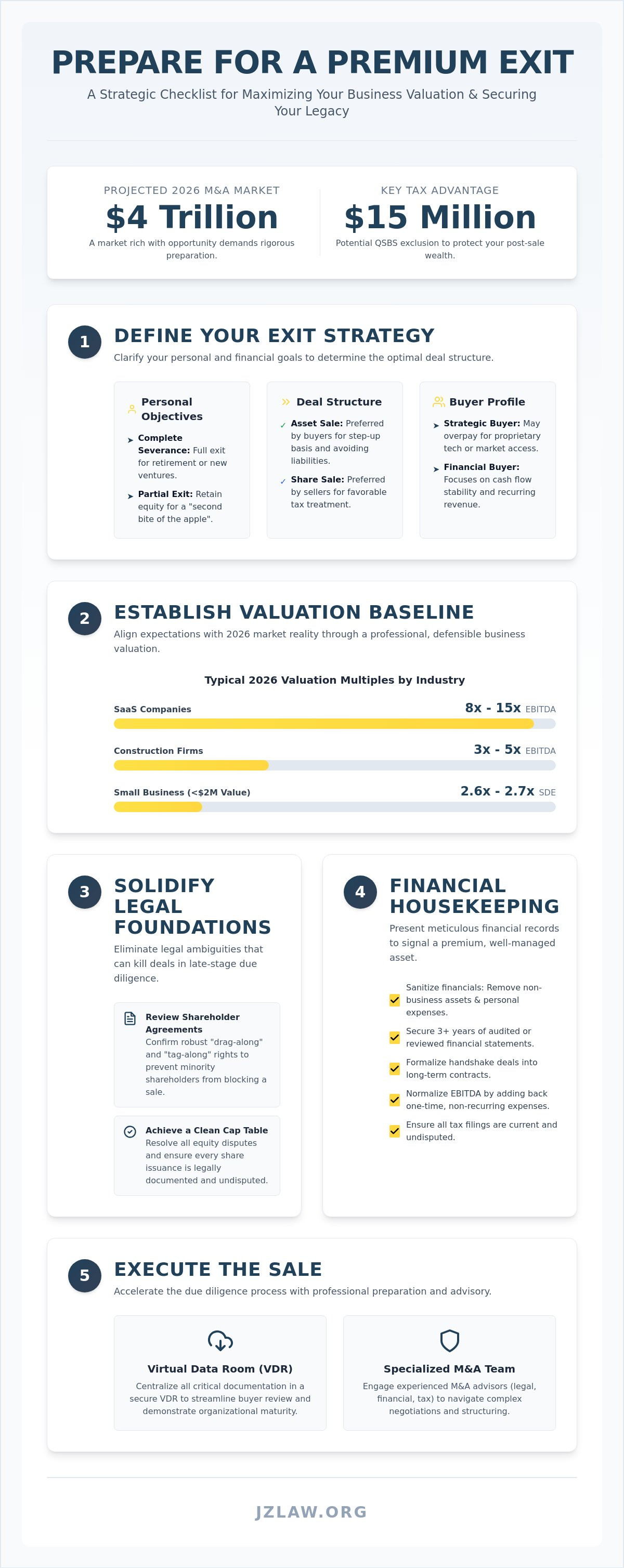
What if the most expensive mistake of your career isn't a failed product launch, but a single overlooked clause in your corporate structure that devalues your life's work? With global M&A deal value projected to reach $4 trillion in 2026, the market is rich with opportunity, but buyers are applying more rigorous scrutiny than ever before. You've likely spent years scaling your operations, yet the prospect of opening your books for a high-stakes audit feels daunting. It's natural to fear leaving money on the table or feeling overwhelmed by the volume of documentation required for modern due diligence.
We believe that a successful exit requires more than just a healthy EBITDA; it demands a foundation of absolute legal and strategic clarity. This preparing a business for sale checklist is designed to help you secure a premium valuation by identifying hidden value-killers and optimizing your legal structure before you engage potential buyers. You'll learn how to navigate 2026 regulatory standards, leverage the $15 million QSBS exclusion, and structure your transaction to minimize friction. This guide provides a clear roadmap to a clean, high-value exit that protects your legacy and your post-sale tax position.
Table of Contents
Defining Your Exit Strategy and Valuation Goals
Every successful exit begins with a decision that's as much emotional as it is financial. You must define whether you're seeking a complete severance to pursue retirement or a partial exit where you retain equity to benefit from a "second bite of the apple." These objectives dictate the entire preparation process. Choosing between an asset sale and a share sale is a pivotal moment in any preparing a business for sale checklist. While buyers often prefer asset sales to secure a step-up in basis and avoid historical liabilities, sellers usually favor share sales to access favorable tax treatments. Identifying your ideal buyer early allows you to groom the company specifically for their needs. A strategic buyer might overpay for your proprietary technology, whereas a financial buyer will focus strictly on cash flow stability and recurring revenue.
A credible Business valuation serves as your baseline, ensuring your expectations align with the reality of the 2026 market. Without this objective data, you risk entering negotiations with a figure that's either too low, leaving capital on the table, or too high, which can alienate serious prospects. Professional valuations provide the defensible evidence that lenders and sophisticated buyers require to move forward with a Letter of Intent (LOI).
The Role of Shareholder Alignment
Internal cohesion is a prerequisite for a smooth transaction. You should review existing shareholder agreements to confirm they contain robust "drag-along" or "tag-along" rights. These clauses prevent minority shareholders from blocking a beneficial sale. It's vital to resolve any lingering disputes or equity disputes before marketing the business. Buyers look for clean cap tables where every share issuance is legally documented and undisputed. Ambiguity in ownership is a primary reason deals collapse during the final stages of due diligence.
Setting the 2026 Valuation Baseline
Valuation multiples in 2026 vary significantly by industry and operational maturity. For example, SaaS companies often trade between 8x and 15x EBITDA, while construction firms might see multiples in the 3x to 5x range. Smaller businesses under $2M in value typically sell for approximately 2.6x to 2.7x of their Seller’s Discretionary Earnings (SDE). You can boost these numbers by highlighting "value-add" features like proprietary IP or long-term regulatory licenses in sectors like energy or cannabis. The Valuation Gap is the discrepancy between a seller's perceived worth and a buyer's calculated offer, which can only be bridged through rigorous legal preparation and documented operational efficiency.
Financial and Operational Housekeeping for Maximum Transparency
Financial transparency serves as the primary filter through which sophisticated buyers view your legacy. A disorganized balance sheet suggests operational chaos, whereas a meticulous one signals a premium asset. As you work through your preparing a business for sale checklist, the first priority is removing non-business assets and personal expenses from the corporate ledger. Buyers expect to see exactly how the business performs as a standalone entity, without the distortion of the founder’s personal lifestyle costs. Securing at least three years of audited or reviewed financial statements provides the empirical evidence needed to justify your asking price. Handshake deals with suppliers represent a significant risk; therefore, you must formalize long-term contracts to stabilize future revenue and reassure nervous investors. This level of preparation mirrors the rigorous standards found in Fulton Bank's Business Sale Checklist, which remains a benchmark for financial readiness.
Normalizing Financial Statements
Normalizing your earnings involves identifying one-time expenses, such as a major rebranding or a specific legal settlement, that should be added back to your EBITDA. This process reveals the true earning potential of the enterprise. It's equally critical to ensure that all tax filings in major hubs like New York, Toronto, and Calgary are current and undisputed. Clean financials aren't merely a preference; they're the first hurdle in due diligence that determines whether a buyer moves to a binding agreement or terminates the deal.
Reducing Operational Dependency
The most valuable businesses are those that function independently of their owners. Assessing key person risk is vital. If your daily presence is required for the company to survive, your valuation will suffer. You must develop a comprehensive transition plan for management and critical staff to ensure continuity. Reviewing employment contracts for change of control clauses and non-compete agreements protects the buyer’s investment. As part of a thorough preparing a business for sale checklist, these operational details often represent the difference between a successful exit and a failed negotiation. For those managing complex corporate transactions, these structural safeguards are indispensable for maintaining deal momentum.
Mitigating Regulatory and Legal Value-Killers
Unaddressed legal liabilities act as silent value-killers, capable of derailing even the most lucrative M&A transactions during the final hours of due diligence. While financial health attracts buyers, legal hygiene is what allows them to close. A proactive preparing a business for sale checklist must prioritize a comprehensive audit of all material contracts to identify assignability and consent requirements. If your most profitable customer contracts contain "change of control" clauses that allow for termination upon a sale, your valuation is effectively at risk until those consents are secured. Similarly, any outstanding or threatened litigation must be addressed immediately; buyers rarely have the appetite to inherit a lawsuit, and unresolved claims often lead to aggressive holdbacks or price reductions that strip away your hard-earned equity.
Intellectual Property and Proprietary Assets
Ownership of intangible assets is frequently the cornerstone of a premium exit, yet it's often the most vulnerable area during an audit. You must confirm that all employee and contractor IP assignments are signed, filed, and legally enforceable to prevent any future claims on your technology or brand. Reviewing trademark and patent filings for international coverage in key markets like Germany, Canada, and the USA ensures your competitive advantage is protected globally. For firms with significant physical footprints, aligning these proprietary assets with a robust Real Estate Law 2026 strategy ensures that leasehold improvements and land use rights are properly valued and transferable.
Industry-Specific Regulatory Compliance
The 2026 regulatory environment demands a level of precision that generic checklists often overlook. For cannabis enterprises, this involves verifying license standing and local zoning compliance in jurisdictions like Calgary or Berlin, where shifting municipal standards can impact operational permits. Cryptocurrency firms face even stricter scrutiny, requiring a full audit of AML/KYC protocols against 2026 global standards to satisfy institutional buyers. Even as enforcement of the Corporate Transparency Act (CTA) remains paused for many domestic companies in 2026, maintaining high standards of beneficial ownership documentation remains a best practice. Navigating these complexities is central to Strategic Corporate Transactions 2026, where regulatory alignment is treated as a strategic asset rather than a mere hurdle. By addressing these industry-specific risks early, you eliminate the friction that causes buyers to seek price adjustments during the sensitive due diligence phase.
Strategic Tax Structuring and Deal Architecture
Tax structuring shouldn't be viewed as a reactive administrative step, but as a proactive driver of your final net proceeds. A sophisticated preparing a business for sale checklist must weigh the starkly different tax consequences of a share sale versus an asset sale. In the 2026 market, approximately 70% of private lower-middle-market transactions are structured as asset sales because buyers seek a step-up in asset basis for tax purposes. However, as a seller, an asset sale can trigger ordinary income tax rates as high as 37% on depreciation recapture. Conversely, a share sale generally qualifies for long-term capital gains treatment, capped at a 20% federal rate plus the 3.8% Net Investment Income Tax (NIIT). Navigating these nuances requires a strategic partner who understands how to balance buyer demands with your need for after-tax wealth preservation.
For founders with eligible stock acquired after July 4, 2025, the Section 1202 Qualified Small Business Stock (QSBS) exclusion has increased to $15 million, offering a transformative opportunity to shield gains from federal tax. In the Canadian context, utilizing the Lifetime Capital Gains Exemption (LCGE) remains a cornerstone of domestic exit planning. When deals involve cross-border elements between NYC, Berlin, or Toronto, international tax treaties must be scrutinized to prevent double taxation on roll-over equity or deferred payments. Sophisticated deal architecture often involves earn-outs or escrow holdbacks to bridge valuation gaps, but these must be legally structured to ensure they don't inadvertently trigger immediate tax liabilities on phantom income.
Optimizing the Purchase Price Allocation
Negotiating the allocation of the purchase price is a critical tug-of-war between buyer and seller. You'll want to allocate more value to goodwill, which is taxed at favorable capital gains rates, while buyers often push for higher allocations to equipment or inventory to accelerate their own depreciation. Tax Efficiency in 2026 M&A is the strategic synchronization of deal structure and statutory exemptions to maximize the seller's after-tax liquidity while minimizing recapture exposure. Understanding how "goodwill" valuation impacts your final bill is essential before signing any binding Letter of Intent.
Managing Post-Closing Liabilities
Protecting your exit proceeds doesn't end at the closing table. Establishing escrow accounts or specific holdbacks allows you to manage potential indemnity claims without jeopardizing the entire transaction. Earn-out provisions must be drafted with extreme precision to ensure they're enforceable and fair, particularly when the buyer takes operational control. To secure your financial future and ensure your transaction is optimized for the current regulatory climate, engaging specialists in Tax Structuring is a vital step in your preparation. Coordinating with tax counsel across all relevant jurisdictions ensures that your global business interests are transitioned with minimal friction and maximum fiscal integrity.
Executing the Sale: Due Diligence and Professional Advisory
The transition from strategic planning to active execution is the most volatile phase of any transaction. It's the moment where the theoretical value you've built is tested against the cold reality of a buyer's investigation. To survive this scrutiny, you must assemble a specialized advisory team consisting of an M&A lawyer, a tax accountant, and a business broker. Relying on a generalist is a common mistake that leads to deal fatigue or catastrophic oversights. For instance, a legal team accustomed to local real estate in Calgary may not possess the international terminological depth required for a cross-border tech acquisition involving NYC or Berlin. Integrating a "mock" due diligence into your preparing a business for sale checklist allows you to identify and remediate remaining gaps before a potential buyer ever sees them. This proactive approach ensures that when the Letter of Intent (LOI) arrives, you're negotiating from a position of undisputed strength, protected by strict confidentiality agreements.
Preparing the Virtual Data Room (VDR)
A secure Virtual Data Room serves as the digital foundation for your transparency. You should organize all documentation into logical categories: Corporate, Financial, Legal, HR, and Regulatory. Every file must be clearly labeled and fully searchable to accelerate the buyer's review process. Disorganized data rooms signal a lack of operational discipline and can lead to a buyer lowering their offer. Maintaining strict version control for sensitive legal agreements is essential to ensure that all parties are working from the most recent, negotiated terms. In a market where megadeals valued over $5 billion accounted for 48% of global deal value in the first half of 2026, the efficiency of your data room can be a significant competitive advantage.
The Importance of Specialized Legal Counsel
Generalist lawyers often lack the specialized knowledge required to identify niche regulatory risks in volatile sectors like energy, cannabis, or fintech. Your lead counsel plays a pivotal role in negotiating the definitive purchase agreement, ensuring that indemnity clauses and post-closing liabilities are tightly controlled. They act as your strategic partner, translating complex legal requirements into business-centric decisions that protect your legacy. In 2026, where global M&A value exceeded $1.2 trillion in Q1 alone, the stakes for precision are immense. To ensure your exit is handled with the precision and professional dignity it deserves, you should Consult JZ Law for strategic exit preparation and M&A counsel. Our approach combines conservative reliability with a dynamic understanding of the modern economic landscape, ensuring your interests are represented at the highest level throughout the entire sale process.
Securing Your Premium Exit in the 2026 Market
The path to a successful sale is defined by meticulous preparation and strategic foresight. By adhering to this preparing a business for sale checklist, you've moved beyond mere operational success to create a transparent, de-risked asset that commands a premium valuation. We've explored how legal hygiene, sophisticated tax structuring, and rigorous due diligence readiness act as the primary catalysts for a smooth transition. Your legacy deserves a partner who understands the complexities of modern regulatory environments and the nuances of global business hubs.
Our firm offers deep expertise in high-stakes sectors such as Cannabis, Crypto, and Energy; we provide the specialized representation necessary to navigate today's competitive M&A landscape. Whether your interests reside in Calgary, Toronto, New York, or Berlin, we focus on de-risking your transaction and optimizing your post-sale wealth through precise deal architecture. Secure your legacy with JZ Law’s strategic M&A and corporate counsel. We look forward to guiding you toward a clean, premium-value exit that reflects the true worth of your life's work.
Frequently Asked Questions
How long does it typically take to prepare a business for sale?
Preparation typically requires a timeline of six to twenty-four months to achieve optimal results. This period allows you to implement a comprehensive preparing a business for sale checklist, addressing financial audits and legal de-risking before engaging the market. Rushing this phase often leads to lower valuations or deal fatigue during the investigative stage.
What are the most common dealbreakers found during due diligence?
The most frequent dealbreakers include unresolved litigation, ambiguous intellectual property ownership, and "change of control" clauses in material contracts. Buyers also terminate negotiations if they discover a significant discrepancy between reported earnings and normalized EBITDA. Addressing these gaps early ensures that the due diligence process remains a formality rather than a series of obstacles.
Should I tell my employees I am preparing to sell the business?
Maintaining strict confidentiality is usually the most prudent course of action until a Letter of Intent is finalized. Prematurely disclosing a sale can trigger talent flight or destabilize customer relationships, both of which devalue the asset. You should only involve a small circle of essential management personnel who are bound by non-disclosure agreements.
What is the difference between an asset sale and a share sale?
An asset sale involves the transfer of specific business components, while a share sale transfers the entire corporate entity to the buyer. In 2026, buyers favor asset sales for the step-up in tax basis; yet sellers often prefer share sales to access the 20% federal capital gains rate. This choice profoundly impacts your final net proceeds and post-closing liability profile.
How much does it cost to prepare a business for sale in 2026?
Preparation costs are contingent upon the complexity of your corporate structure and the depth of the required financial audits. While these expenses represent an upfront investment, they're designed to prevent the "Valuation Gap" that occurs when buyers find unmitigated risks. A well-prepared business often secures a higher multiple, effectively offsetting the cost of professional advisory services.
Can I sell my business if I have ongoing litigation?
Ongoing litigation doesn't preclude a sale, but it necessitates sophisticated deal structuring to protect the buyer. You can expect the purchaser to demand specific indemnity clauses or escrow holdbacks to cover potential judgments. Resolving or settling these disputes before going to market is always the preferred strategy to maintain maximum leverage.
When is the best time to hire an M&A lawyer for the exit process?
You should engage an M&A lawyer at the inception of your exit strategy, long before a buyer is identified. Early involvement allows your counsel to structure the preparing a business for sale checklist to your advantage and review non-disclosure agreements before sensitive data is shared. Waiting until the Letter of Intent stage often leaves you reacting to buyer-friendly terms rather than setting the agenda.


Comments