


Private Placement Exemptions in Canada: 2026 Issuer Guide
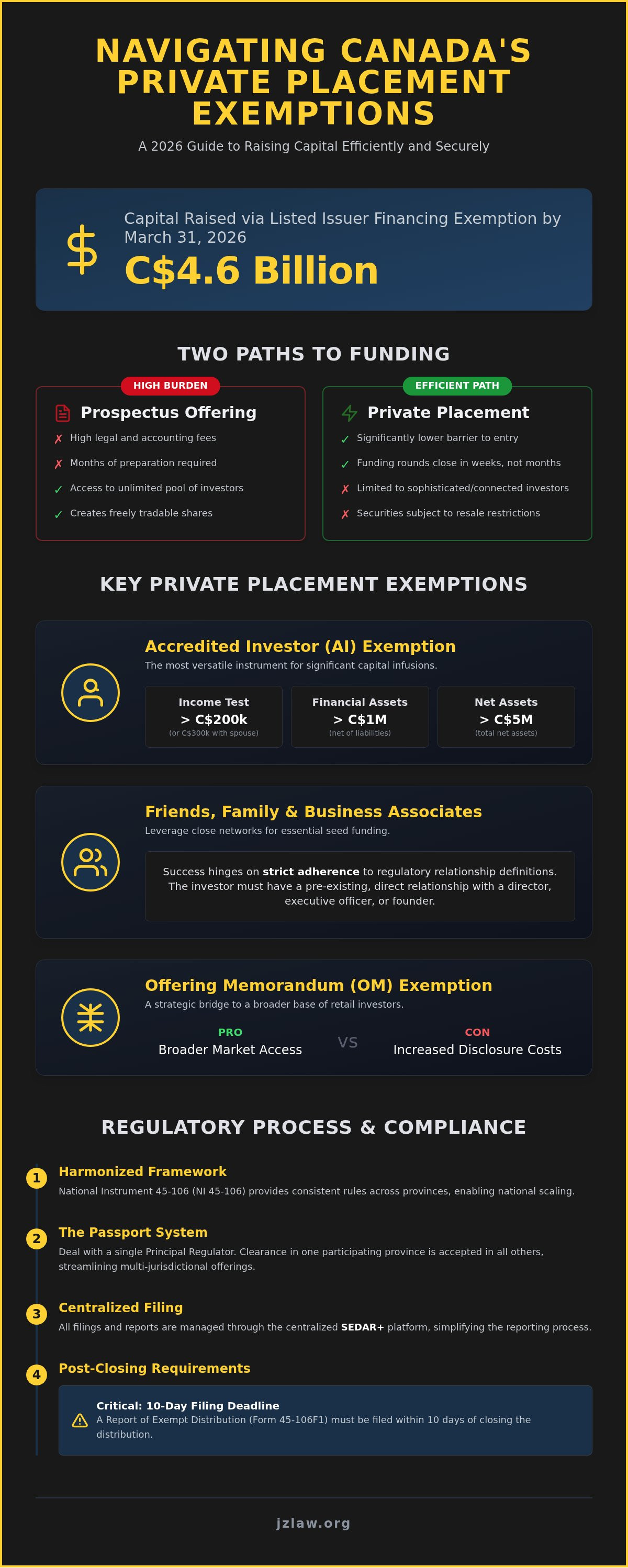
By March 31, 2026, approximately 523 issuers in Canada had successfully raised C$4.6 billion through the Listed Issuer Financing Exemption alone, demonstrating that a full prospectus is no longer the sole gateway to substantial capital. You likely understand that the traditional path to funding is often obstructed by the high costs of prospectus preparation and the fragmented nature of provincial regulations. It's a complex environment where the fear of non-compliance with the Canadian Securities Administrators can stall even the most promising growth strategies. This guide will help you master the landscape of private placement exemptions canada to raise capital efficiently and securely.
We provide a rigorous analysis of the 2026 regulatory framework, including the permanent C$50 million capital-raising limits for listed issuers and the newly implemented self-certified investor exemptions. By the end of this article, you'll be equipped to identify the most cost-effective exemptions for your specific corporate trajectory. Our objective is to ensure every transaction is backed by logical precision and strategic foresight, allowing you to secure necessary funding while maintaining the highest standards of regulatory integrity.
Table of Contents
The Prospectus Requirement and the Private Placement Alternative
In Canada, the fundamental rule of the capital markets is that every distribution of securities must be accompanied by a prospectus. This document serves as a comprehensive disclosure tool designed to protect the public by providing detailed financial and operational data. However, the sheer scale and complexity of the prospectus requirement often renders it impractical for emerging enterprises or specific corporate transactions. This is where a private placement becomes an essential strategic alternative. By utilizing private placement exemptions canada, issuers can raise capital from sophisticated or connected investors without the exhaustive time and financial commitment of a public filing.
Because securities regulation is a matter of provincial jurisdiction, each province and territory maintains its own regulatory body to oversee capital markets within its borders. To prevent a fragmented and inefficient regulatory environment, the Canadian Securities Administrators (CSA) implemented National Instrument 45-106 (NI 45-106). This instrument provides a harmonized framework, ensuring that the rules for raising capital remain relatively consistent whether an issuer is based in Calgary, Toronto, or Vancouver. It's the primary tool that allows businesses to scale across provincial lines without facing thirteen entirely different sets of rules.
Prospectus vs. Private Placement
The choice between a prospectus and a private placement is a cost-benefit analysis centered on market reach and regulatory burden. A prospectus offering allows for an unlimited pool of investors and creates freely tradable shares, but it demands months of preparation and significant legal and accounting fees. Conversely, private placements offer a rapid time to market. They allow companies to close funding rounds in weeks rather than months, which is critical for maintaining momentum in fast-moving sectors. While the resulting securities are typically subject to resale restrictions, the trade-off is a significantly lower barrier to entry for early-stage capital.
The Passport System in 2026
The Passport System remains the cornerstone of multi-jurisdictional offerings in 2026. This model allows an issuer to deal with a single Principal Regulator, usually located in their head office province. Once the Principal Regulator clears the filing, it's effectively accepted in all other participating provinces. All filings and reports are now managed through the centralized SEDAR+ platform, which has streamlined the reporting process for 2026. It's essential to recognize that while the Ontario Securities Commission (OSC) participates in the system through a dual filing interface, they maintain distinct fee structures and specific local requirements that must be accounted for during the planning phase to avoid accidental non-compliance.
The Accredited Investor Exemption: The Gold Standard for Capital
The Accredited Investor (AI) exemption remains the most versatile instrument among private placement exemptions canada, particularly for ventures requiring significant capital infusions. It allows issuers to raise unlimited funds from an unlimited number of investors, provided those participants meet specific financial or professional thresholds. In 2026, an individual qualifies as an AI if they earned a net income before taxes exceeding C$200,000 in each of the two most recent calendar years, or C$300,000 when combined with a spouse. Alternatively, an individual may qualify by holding at least C$1 million in financial assets, net of liabilities, or C$5 million in total net assets. These thresholds ensure that participants possess the financial resilience to withstand the inherent risks of private securities.
For innovators operating within cryptocurrency law frameworks, the AI exemption is often the primary vehicle for growth. High-volatility sectors benefit from the sophisticated nature of accredited investors who understand complex digital asset structures. Once the distribution is complete, the issuer must file a report of exempt distribution via Form 45-106F1 through SEDAR+. This filing is mandatory and must be completed within 10 days of the closing to maintain the legality of the exemption.
Verification and Compliance
Issuers cannot simply take an investor's word regarding their status; they have a proactive duty to verify these claims. Best practices in 2026 involve collecting signed subscription agreements alongside the Form 45-106F9 Risk Acknowledgement for individual investors. This form is a critical defensive tool that confirms the investor understands they could lose their entire investment. Many issuers stumble by failing to ensure the form is correctly dated or by neglecting to identify which specific AI category the investor claims. An issuer maintains strict liability for any misrepresentation of investor status; such errors can trigger the total rescission of the offering and severe regulatory penalties. If you're unsure about your verification process, consulting with a securities specialist can help mitigate these risks early.
Institutional vs. Individual Accredited Investors
While high-net-worth individuals are valuable, targeting institutional accredited investors like venture capital firms or private equity funds often provides more than just capital. These entities typically invest through managed accounts where a registered portfolio manager makes the investment decisions. This structure is particularly prevalent in Calgary-based oil and gas law raises, where institutional players provide the technical oversight necessary for large-scale energy projects. Strategic issuers balance their cap table by mixing individual AIs, who may offer niche industry connections, with institutional AIs who provide long-term stability and follow-on funding potential.
Friends, Family, and Business Associates Exemption
For early-stage ventures, the initial capital infusion often originates from a circle of trust rather than institutional markets. The Friends, Family, and Business Associates exemption, found within NI 45-106, allows issuers to raise seed capital without the wealth-based restrictions of the Accredited Investor model. This provision recognizes that individuals with a direct, substantive relationship with the company's leadership possess a unique vantage point to assess risk. It's a foundational tool for private placement exemptions canada, yet it's frequently misunderstood by founders who mistake casual acquaintances for legal "friends" or "associates."
The integrity of this exemption relies entirely on the pre-existing relationship between the investor and a director, executive officer, founder, or control person of the issuer. Provincial variations add a layer of complexity; for instance, Ontario maintains stricter limitations on the types of family members who qualify and generally prohibits investment funds from utilizing this specific exemption. Conversely, Saskatchewan has historically provided broader latitude to support local entrepreneurial growth. If an issuer accepts capital from "the stranger"-someone who doesn't meet the strict definitions of closeness-the entire distribution may be deemed non-compliant, potentially triggering a right of rescission for all investors in the round.
The Relationship Test
Regulators apply a rigorous "closeness" test that goes far beyond a simple introduction. To survive a regulatory audit, you must demonstrate a relationship characterized by frequent contact and a history of personal or professional interaction. Social media connections, such as LinkedIn "friends" or followers, do not meet the legal threshold for Canadian securities law. We recommend that issuers maintain a "relationship log" or detailed internal memos that document the duration and nature of the connection before any subscription documents are signed. This proactive documentation serves as your primary defense against claims that the exemption was used to circumvent public disclosure requirements.
Comparison: AI vs. Friends & Family
While the Accredited Investor (AI) exemption focuses on financial resilience, the Friends and Family exemption prioritizes personal knowledge. Transitioning between these two requires a shift in your compliance strategy as your capital needs expand. Consider these distinctions:
Investor Limits: The AI exemption has no cap on the number of investors, whereas some provinces may scrutinize high-volume "Friends and Family" rounds more closely.
Filing Requirements: Both typically require a Form 45-106F1 filing and applicable fees via SEDAR+ within 10 days of closing.
Disclosure: Neither requires a prospectus, but the AI exemption often involves more sophisticated subscription agreements tailored to institutional expectations.
A 'close business associate' is an individual who has had sufficient prior business dealings with a director, executive officer, founder, or control person of the issuer to be in a position to assess their capabilities and trustworthiness.
The Offering Memorandum (OM) and Crowdfunding Exemptions
The Offering Memorandum (OM) exemption serves as a strategic bridge for issuers seeking to access capital from the general public without the prohibitive costs of a full prospectus. While previous private placement exemptions canada focused on the investor's wealth or personal connections, the OM exemption focuses on disclosure. It allows a company to raise capital from "retail" investors, provided they receive a comprehensive disclosure document. However, this access comes with a financial trade-off. Issuers must typically provide audited financial statements, which increases the upfront cost compared to simpler exemptions. Entities navigating cannabis licensing often utilize the OM to secure community-based funding, effectively turning their local customer base into a loyal stakeholder group.
For smaller raises, the Start-up Crowdfunding Exemption provides an online alternative. By 2026, many early-stage ventures use registered funding portals to raise up to C$1.5 million annually. This method democratizes investment but requires strict adherence to portal rules and individual investment limits, which are often capped at C$2,500 per person unless a registered dealer confirms suitability.
The Listed Issuer Financing Exemption
The 2026 regulatory environment has seen the Listed Issuer Financing Exemption (LIFE) become a dominant force for reporting issuers. As of March 2026, over 500 issuers have used this path to raise more than C$4.6 billion. This exemption allows companies listed on the TSX-V or CSE to raise capital based on their continuous disclosure records rather than a new offering document. Eligible issuers can raise the greater of C$25 million or 20% of their market value, up to a maximum of C$50 million in a 12-month period. It's a game-changer for mid-cap companies because it provides the speed of a private placement with the benefit of issuing freely tradable shares.
Disclosure and Liability under the OM
Accuracy in an OM is not merely a best practice; it's a legal necessity. The document grants investors a statutory right of action for rescission or damages if it contains a misrepresentation. This means if the OM includes a material false statement, the issuer and its directors can be held personally liable. Managing "Forward-Looking Information" (FLI) is particularly delicate in 2026. Issuers must have a reasonable basis for any projections and must clearly identify the material factors that could cause actual results to differ. This is especially relevant in real estate law syndications, where projected returns are a primary driver for investor interest. To ensure your disclosure documents meet these rigorous standards, consult with our securities regulation team before finalizing your offering.
Strategic Execution: Navigating the Private Placement Process
The successful deployment of private placement exemptions canada requires more than a mere understanding of the law; it demands a tactical alignment with your company's long-term objectives. At JZ Law, we treat every raise as a precursor to your eventual IPO path, ensuring that the cap table remains clean and the regulatory history is beyond reproach. Once the subscription funds are received, the clock begins to tick on the mandatory 10-day post-closing filing deadline for the report of exempt distribution. Failing to meet this window can result in late fees and, in some jurisdictions, a suspension of the ability to use certain exemptions in the future. It's essential to account for the varying fee structures in 2026, where filings in British Columbia and Ontario may carry different administrative costs.
Beyond the filings, issuers must manage the physical and digital representation of the securities. Share certificates or Direct Registration System (DRS) statements must carry specific 'legends' that outline the resale restrictions under National Instrument 45-102. Typically, these securities are subject to a four-month hold period. This detail must be clearly communicated to investors to manage liquidity expectations and ensure secondary market compliance. Contacting John Zang early in the process ensures these administrative requirements don't become obstacles to your funding goals.
Common Pitfalls in Private Placements
Regulatory scrutiny often intensifies after the capital is raised, making the post-closing phase high-risk. One frequent error is the accidental 'General Solicitation.' If an issuer uses social media or public advertisements to find investors for an exemption that requires a pre-existing relationship, they risk invalidating the entire round. We also observe inconsistencies where a marketing deck makes aggressive claims that aren't supported by the more conservative legal filings. This discrepancy creates a liability gap that regulators are quick to exploit. Precision in every document is the only way to safeguard the transaction.
Securing Professional Legal Counsel
In high-growth, high-regulation sectors like cryptocurrency and cannabis, a generalist firm often lacks the nuance required to handle modern private placement exemptions canada. Boutique expertise allows for a proactive, preventive approach that focuses on risk mitigation before a document is ever signed. We assist in structuring your board and corporate governance today so that you're ready for the rigours of a public listing tomorrow. Contact JZ Law today for a strategic consultation on your next raise and let us handle the complex regulatory side of your growth.
Strategic Capital Raising for the 2026 Regulatory Environment
Effective utilization of private placement exemptions canada in 2026 requires a disciplined alignment between your funding needs and the current regulatory framework. Success depends on meticulous adherence to NI 45-106 and timely SEDAR+ filings, whether you're leveraging the C$50 million limits of the Listed Issuer Financing Exemption or tapping into high-net-worth networks. Precision is mandatory. A proactive approach to provincial variations is the only way to ensure your raise remains compliant while protecting your corporate trajectory.
At JZ Law, we combine specialized knowledge in Cannabis and Crypto regulation with a strategic focus on taking private companies public. Our expertise ensures that your governance and disclosure are structured to support future growth and public listings from the very first round. Secure your capital raise with JZ Law's expert securities counsel and navigate the complexities of the Canadian market with confidence. We look forward to partnering with you as you reach your next financial milestone.
Frequently Asked Questions
What is a report of exempt distribution in Canada?
A report of exempt distribution is a mandatory regulatory filing, typically submitted via Form 45-106F1 through the SEDAR+ system. Issuers must file this report within 10 days of a distribution to inform provincial regulators about the capital raised and the specific private placement exemptions canada utilized. It includes details on the proceeds collected in each jurisdiction and the applicable filing fees. Precision in this document is vital to maintain your compliance standing.
Can a US investor participate in a Canadian private placement?
Yes, US investors can participate, provided the issuer complies with both Canadian provincial rules and US federal and state securities laws. Typically, this involves ensuring the participant is an "accredited investor" under US SEC Regulation D. Issuers in hubs like Toronto, Vancouver, or New York City must manage these cross-border complexities carefully. Professional counsel is essential to harmonize these disparate regulatory requirements and avoid accidental breaches of international law.
How much does it cost to file a private placement exemption in Alberta?
Filing fees in Alberta are generally calculated as a percentage of the gross proceeds raised from investors within the province. The Alberta Securities Commission (ASC) sets a minimum fee threshold, and issuers must also account for the mandatory SEDAR+ system charges. These costs are distinct from those in Ontario or British Columbia. For a precise calculation based on your 2026 raise in Calgary, you should review the latest ASC fee schedule before closing.
Do I need audited financial statements for an Offering Memorandum in 2026?
Audited financial statements are a standard requirement for the Offering Memorandum (OM) exemption under NI 45-106. Issuers must provide audited annual statements and often reviewed interim statements to their "retail" investors. This level of disclosure provides a higher degree of transparency but increases the upfront cost for cannabis or crypto startups. However, reporting issuers utilizing the Listed Issuer Financing Exemption may avoid this specific burden by relying on their existing continuous disclosure records.
What are the resale restrictions on securities issued under an exemption?
Securities issued under a prospectus exemption are generally subject to a "restricted period" or a "hold period" before they can be resold to the public. In most cases, this period lasts four months and one day from the date of distribution. The issuer must ensure that share certificates or digital statements carry the appropriate restrictive legend. These rules prevent the immediate creation of a public market without the comprehensive disclosure provided by a full prospectus.
Can I use multiple exemptions for the same financing round?
Issuers frequently combine different private placement exemptions canada within a single financing round to maximize their reach. You might secure high-value capital from accredited investors in Toronto while simultaneously using the Friends, Family, and Business Associates exemption for seed investors in Calgary. Each individual investor must be accurately mapped to a specific, valid exemption. Maintaining a detailed compliance log is the best way to manage these multi-faceted capital raises securely.
What is the 'Accredited Investor' threshold for individuals in Canada?
In 2026, an individual qualifies as an accredited investor if they earned a net income before taxes exceeding C$200,000 in each of the two most recent years. This threshold increases to C$300,000 if combined with a spouse. Alternatively, an individual may qualify by holding C$1 million in financial assets, net of liabilities, or C$5 million in total net assets. These financial benchmarks ensure that participants have the necessary resilience to withstand private market volatility.
How do I verify if an investor is truly a 'close personal friend'?
Verification requires documenting a substantive relationship that existed before the investment was discussed. You must be able to demonstrate frequent contact and a history of personal interaction that goes beyond professional networking. Regulators in provinces like Ontario and British Columbia explicitly state that social media connections don't meet this threshold. We recommend keeping internal records that describe the nature and duration of the relationship to defend the exemption during a potential regulatory audit.


Comments