


Reverse Merger vs IPO: Strategic Paths to Going Public in 2026 (Calgary, NYC, & Berlin)
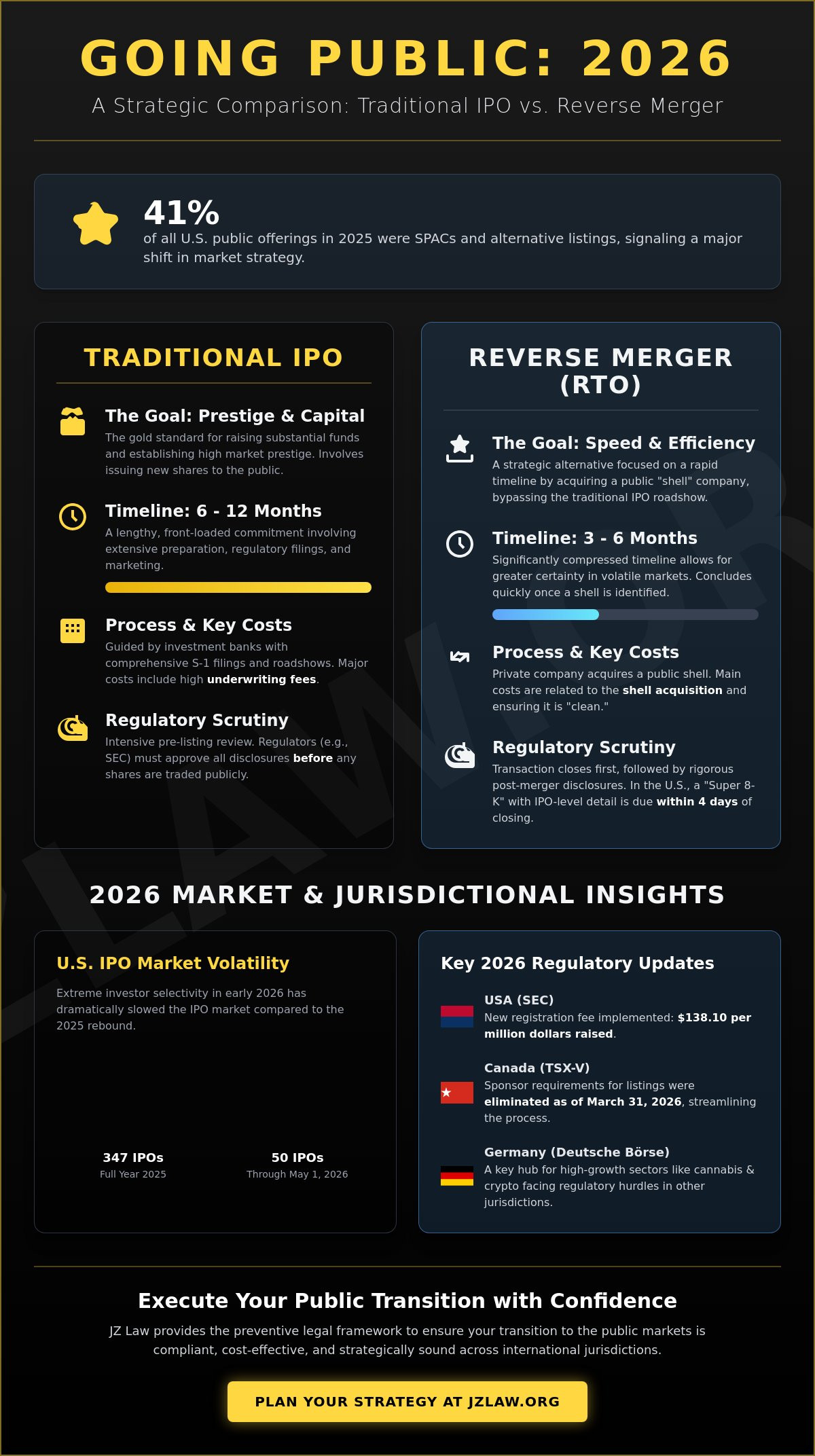
Special Purpose Acquisition Companies and alternative listings accounted for 41% of all U.S. public offerings in 2025, proving that the traditional road to Wall Street is no longer the only viable option for ambitious leadership teams. You're likely weighing the prestige of a traditional listing against the speed of alternative routes as you watch 2026 market volatility impact pricing for the 50 IPOs that have already reached the U.S. market this year. Deciding on a reverse merger vs ipo requires more than a simple cost analysis; it demands a sophisticated understanding of how jurisdictions like the SEC in New York, the TSX in Calgary, and the Deutsche Börse in Berlin have evolved their regulatory frameworks.
This article provides the definitive strategic comparison you need to navigate these high-growth financial hubs with confidence. We'll examine the latest 2026 updates, such as the TSX Venture Exchange eliminating sponsor requirements as of March 31 and the new SEC registration fee of $138.10 per million dollars. By the end of this analysis, you'll have a clear decision-making framework to minimize underwriting fees and ensure your firm’s transition to the public markets is both compliant and cost-effective.
Key Takeaways
Identify the strategic trade-off between the immediate capital access of a traditional listing and the accelerated execution timeline offered by alternative routes.
Understand the critical differences in timeline commitments, contrasting the 12-month IPO cycle with the streamlined 3–6 month window of a reverse takeover.
Evaluate the financial implications of a reverse merger vs ipo by comparing shell acquisition costs against traditional underwriting fees and primary capital dynamics.
Navigate jurisdiction-specific opportunities in 2026, including Canada’s CPC program and the regulatory updates within the German Stock Exchange Act.
Learn how a structured, preventive legal framework ensures seamless compliance with international regulators like the SEC and BaFin during your transition.
Table of Contents Navigating the 2026 Public Market Landscape: IPOs and Reverse Mergers The Mechanics of Going Public: Traditional IPOs vs. Reverse Takeovers Strategic Comparison: Evaluating Cost, Speed, and Capital Access Regional and Sector Nuances: From Calgary’s TSX-V to NYC’s NASDAQ Executing Your Public Transition with JZ Law
Navigating the 2026 Public Market Landscape: IPOs and Reverse Mergers
The traditional Initial Public Offering (IPO) remains the gold standard for firms seeking to raise substantial capital while establishing a high level of market prestige. It's a rigorous process where private companies issue new shares to the public, typically guided by investment banks and underwriters. However, the first half of 2026 has shown that market volatility in financial hubs like New York and Toronto can abruptly close the IPO window, leaving high-growth firms in a precarious position. Only 50 IPOs priced in the U.S. market through May 1, 2026, reflecting a climate of extreme investor selectivity. By contrast, a Reverse takeover (RTO) offers a strategic alternative focused on speed and operational efficiency. In this scenario, a private company acquires a controlling interest in an existing public shell, effectively bypassing the lengthy roadshow and underwriting phase. When evaluating a reverse merger vs ipo, the primary goal for many executives is no longer just the immediate cash infusion; it's the creation of a liquid public currency that enables future acquisitions and enhances shareholder value.
The 2026 Shift in Public Listing Preferences
Current interest rates and shifting investor appetites in Calgary and Berlin have forced a recalibration of listing strategies. While the U.S. market saw a rebound with 347 IPOs in 2025, the selective nature of early 2026 investors means only the most established firms successfully price their offerings. This environment has led to a resurgence in hybrid paths. Special Purpose Acquisition Companies (SPACs) accounted for 41% of all U.S. IPOs in 2025, serving as a middle ground for those seeking the speed of a merger with the capital of an IPO. A public shell is a reporting company with no active business operations or significant assets, serving as the legal vehicle that facilitates a reverse merger.
Why Niche Sectors are Choosing Alternative Paths
High-growth firms in the cannabis and crypto sectors frequently encounter institutional barriers that make a traditional IPO nearly impossible. Regulatory scrutiny in the U.S. and Germany often leads these companies toward RTOs, where they can achieve a listing on the TSX Venture Exchange or the Berlin Stock Exchange with greater certainty. Success in these markets requires a proactive approach to compliance. As outlined in our Strategic Corporate Transactions 2026 guide, legal foresight is the only way to manage the complex reporting requirements of jurisdictions like Denver and Berlin. Leaders must weigh the reverse merger vs ipo trade-off by analyzing whether their sector's current regulatory climate favors the transparency of an IPO or the structural flexibility of an RTO. Strategic partners don't just react to market shifts; they anticipate them to protect client interests during the transition to public status.
The Mechanics of Going Public: Traditional IPOs vs. Reverse Takeovers
Executing a transition to the public markets requires a disciplined adherence to specific procedural timelines and regulatory milestones. The traditional IPO represents a front-loaded commitment of 6 to 12 months, characterized by the filing of a comprehensive S-1 registration statement and a series of intensive roadshows designed to secure institutional backing. Conversely, the timeline for a reverse takeover (RTO) is significantly compressed, typically concluding within 3 to 6 months once a suitable shell is identified. The fundamental difference in a reverse merger vs ipo lies in the sequencing of regulatory scrutiny. While an IPO requires the SEC or local regulators to approve disclosures before a single share is traded, an RTO allows the transaction to close first. This speed is balanced by the "Super 8-K" requirement in the United States, which demands a filing containing IPO-level financial detail within four business days of closing. Similar rigorous reporting standards apply in the German and Canadian markets to ensure transparency remains the priority for new issuers.
The IPO Process: A Long-Term Commitment
A successful IPO in NYC or Toronto depends on the coordination of investment banks and specialized auditors who ensure compliance with PCAOB standards. These audits are exhaustive, often tracing financial history back several years to satisfy institutional appetite for risk mitigation. During this period, companies must observe a "quiet period," a regulatory phase where corporate communication is strictly limited to prevent the artificial inflation of share prices. The cornerstone of this path is the prospectus; it's a legal document that must clearly articulate the company's value proposition, risk factors, and intended use of proceeds. This transparency is what builds the long-term trust necessary to sustain a high market valuation after the initial listing.
The Reverse Merger Process: Speed and Strategy
In a reverse merger, the private entity gains control through a calculated exchange ratio, where private shares are swapped for a majority stake in the public shell. The legal definition of a reverse merger emphasizes this structural inversion, allowing the private company to inherit the shell's public status. Success in Calgary or Vancouver hinges on the identification of a "clean shell," meaning a vehicle free of undisclosed liabilities or pending litigation. Legal due diligence is non-negotiable here; any oversight during the shell acquisition can lead to catastrophic post-merger compliance failures. If your leadership team is evaluating whether to pursue a reverse merger vs ipo, securing a strategic partner to oversee the due diligence is the most effective way to prevent hidden legal risks from surfacing after the deal is finalized. Once the merger is complete, the new entity must immediately pivot to meet the ongoing reporting obligations of a public corporation, including quarterly filings and material change reports.
Strategic Comparison: Evaluating Cost, Speed, and Capital Access
The financial architecture of a public listing is defined by a fundamental trade-off between immediate capital infusion and the speed of execution. In a traditional IPO, the primary objective is often the simultaneous raising of capital and the establishment of a public market for shares. This path, however, carries substantial upfront costs, primarily in the form of underwriting fees that typically range from 6% to 8% of gross proceeds. Conversely, the reverse merger vs ipo decision for many firms in 2026 is driven by the fact that transaction costs for a reverse merger are often 60% to 70% lower than those of a traditional offering. While a reverse merger doesn't inherently raise capital, it provides a faster route to a public currency, with shell acquisition costs generally falling between $500,000 and $2 million depending on the cleanliness of the vehicle's history.
Valuation certainty also differs dramatically between these two paths. IPO pricing is subject to the whims of institutional investors during the roadshow, where market volatility can lead to significant "down-rounds" or even the total withdrawal of the offering. In a reverse merger, the valuation is a negotiated figure between the private company and the shell’s board, providing founders with a clearer picture of their post-transaction equity stake. This negotiated approach often results in a different dilution profile; while founders avoid the steep "underwriter's discount," they must account for the equity retained by the existing shell shareholders, which can range from 5% to 15% of the post-merger entity.
Cost Efficiency and the "PIPE" Alternative
To address the lack of immediate capital in a reverse takeover, many firms utilize a Private Investment in Public Equity (PIPE) transaction. This allows the company to secure capital from private investors simultaneously with the merger, effectively mimicking the capital-raising function of an IPO. When evaluating the total cost of ownership over the first 24 months, firms must consider the new 2026 SEC registration fee of $138.10 per million dollars and the NASDAQ Global Select entry fee of $325,000. In hubs like Calgary or Denver, preventive legal costs are a critical component of the budget. Thoroughly vetting a shell to ensure it's free of legacy liabilities is an investment that prevents the catastrophic expense of post-closing litigation. As noted in the SEC Investor Bulletin on Reverse Mergers, the regulatory scrutiny is not avoided but rather deferred, making upfront legal diligence a prerequisite for long-term stability.
Speed to Market: When Timing is Everything
For technology and energy firms operating in volatile sectors, missing a three-month market window can be the difference between a successful launch and a failed fiscal year. The 50 IPOs priced in the U.S. market through May 1, 2026, demonstrate that while the window is open, it's highly selective. Market Risk is the primary disadvantage of the traditional IPO path, as a sudden shift in economic sentiment during the six-month SEC review period can force a company to abandon its listing plans. A reverse merger bypasses this vulnerability by allowing a firm to go public in as little as 90 days, ensuring they can capitalize on favorable sector trends before the macro-environment shifts.
Regional and Sector Nuances: From Calgary’s TSX-V to NYC’s NASDAQ
The strategic decision between a reverse merger vs ipo isn't made in a vacuum; it's dictated by the regulatory "soil" of the jurisdiction where a firm chooses to plant its roots. Canada remains a global leader in the alternative listing space through the TSX Venture Exchange (TSX-V) and its unique Capital Pool Company (CPC) program. As of March 31, 2026, the TSX-V has eliminated the mandatory sponsorship requirement for new listings, a move designed to reduce both the time and expense for private firms entering the public sphere. This makes the CPC model, essentially a regulated shell vehicle, an exceptionally attractive path for high-growth firms in Calgary and Vancouver. These companies can establish a public currency and then leverage it for a "Qualifying Transaction," providing a structured environment that balances speed with investor protection.
The Canadian Advantage: CPCs and RTOs
Calgary and Vancouver have solidified their positions as preeminent hubs for the CPC and reverse takeover (RTO) models. The Alberta Securities Commission (ASC) plays a pivotal role in facilitating cross-border transactions, ensuring that firms moving between the TSX and U.S. markets maintain rigorous compliance. For energy entities, this transition requires more than just financial auditing. Success depends on adhering to the Oil and Gas Law strategic legal frameworks, which dictate how reserves and resources must be disclosed to satisfy both Canadian and American regulators. This sector-specific oversight ensures that the technical data supporting a company’s valuation remains beyond reproach during the transition to public status.
Regulatory Hurdles in Berlin and Frankfurt
In Germany, the regulatory landscape underwent a significant transformation on February 10, 2026, with the implementation of the Location Promotion Act. This legislation amended the Stock Exchange Act to waive introductory notices and fees for new introductions, positioning the Berlin Stock Exchange as a highly cost-effective entry point for European tech firms. However, firms must still choose between the Prime Standard, which requires quarterly reporting and international transparency, and the General Standard, which offers a more relaxed compliance burden. "Passporting" a listing between the EU and North American exchanges remains a complex legal maneuver. It requires a precise alignment of IFRS and GAAP accounting standards to prevent regulatory friction. Fintech and blockchain leadership teams should review our Cryptocurrency Law 2026 guide to understand how European MiCA regulations interact with the SEC’s evolving stance on digital assets.
Sector-specific barriers often make the reverse merger vs ipo debate a matter of necessity rather than preference. Cannabis firms, for instance, still face significant institutional barriers to traditional IPOs in New York due to federal restrictions, making a reverse takeover on the TSX-V or a listing in Berlin a more predictable path to liquidity. If your firm operates in a complex or heavily regulated sector, you should consult with our cross-border securities team to determine which jurisdiction offers the most efficient path to your public debut while minimizing your long-term compliance risks.
Executing Your Public Transition with JZ Law
JZ Law functions as the essential bridge between the entrepreneurial drive of private firms and the rigorous demands of public market compliance. Our expertise in Securities and Corporate Finance is particularly relevant for companies operating in the complex regulatory environments of New York, Calgary, and Berlin. We adopt a preventive legal approach that prioritizes the early identification of potential liabilities. While the reverse merger vs ipo decision involves various financial trade-offs, the legal integrity of the chosen path is what determines long-term success. We meticulously vet potential shell companies to uncover hidden litigation, tax arrears, or regulatory encumbrances before they jeopardize a transaction. Our firm doesn't just interpret statutes; we safeguard your business interests by ensuring every structural component is resilient enough to withstand the scrutiny of global regulators.
The initial phase of our engagement involves a systematic feasibility study. This assessment weighs your firm’s specific financial profile against the 3 to 6 month RTO timeline and the 12-month IPO commitment. We don't just look at the calendar; we examine your internal reporting capabilities. If a firm chooses a reverse merger, they must be prepared for the "Super 8-K" requirements, which demand IPO-level financial transparency within four business days of closing. Our role is to ensure your team is prepared for this sudden shift in disclosure standards, preventing the regulatory friction that often stalls less prepared entities.
Tailored Legal Solutions for High-Stakes Industries
John Zang Services provide a hands-on, strategic partnership that extends beyond traditional legal counsel. Founders in high-growth sectors require a partner who can manage the intricate details of cross-border transactions across multiple time zones and legal systems. Whether you're coordinating a listing between NYC and Toronto or seeking entry into the German markets via Berlin, our team ensures your corporate structure is optimized for international scrutiny. For leadership teams in the burgeoning cannabis sector, our specialized insights in Taking Your Cannabis Company Public offer a roadmap for overcoming institutional barriers and achieving a successful listing. We understand that in high-stakes industries, a single missed detail in a shell's history can become a deal-breaker.
Start Your Public Journey Today
Your transition begins with a comprehensive consultation and jurisdictional selection. We analyze your firm’s growth objectives to determine whether the reverse merger vs ipo route aligns with your 2026 goals. This assessment includes an evaluation of your current real estate holdings and tax structuring to ensure the resulting public entity is built on a stable, tax-efficient foundation. Our process is methodical and designed to eliminate surprises during the SEC or BaFin review phases. We invite you to consult with JZ Law to determine your optimal path to the public markets and secure the strategic representation your firm deserves.
Securing Your Firm’s Future in the Global Public Markets
Navigating the transition to public status in 2026 requires a precise alignment of corporate goals with the regulatory realities of your chosen financial hub. Whether you're leveraging the streamlined CPC model on the TSX Venture Exchange or targeting the premium liquidity of the NASDAQ; success depends on a proactive approach to compliance. The strategic decision of a reverse merger vs ipo hinges on whether your leadership prioritizes the immediate capital of a traditional offering or the 90-day execution window of a reverse takeover. With the February 2026 implementation of the Location Promotion Act in Germany and the removal of sponsorship requirements on the TSX-V; the barriers to entry have shifted, making expert jurisdictional selection a critical first step for any high-growth entity.
JZ Law provides the strategic oversight necessary to mitigate the risks inherent in acquiring public shells or navigating complex S-1 filings. Our firm offers specialized counsel for high-growth firms in the cannabis, crypto, and energy sectors; ensuring that technical disclosures meet the rigorous standards of the SEC, ASC, and BaFin. By employing a preventive legal strategy, we identify potential liabilities before they jeopardize your transaction. We invite you to secure Strategic Counsel for Your IPO or Reverse Merger to ensure your firm’s public debut is both efficient and legally resilient. Your path to global liquidity starts with a structured, professional partnership.
Frequently Asked Questions
Is a reverse merger legal in Canada?
Yes, reverse mergers are a standard and legally recognized method for going public in Canada, where they are formally known as a Reverse Takeover (RTO). The TSX Venture Exchange (TSX-V) specifically facilitates these transactions through its Capital Pool Company (CPC) program. To further streamline this path, the TSX-V eliminated the requirement for a sponsor for new listings effective March 31, 2026, reducing both the procedural complexity and the associated costs for private firms.
How long does a reverse merger take compared to an IPO in 2026?
A reverse merger typically concludes within a 3 to 6 month window, whereas a traditional IPO requires a commitment of 6 to 12 months. The primary distinction in a reverse merger vs ipo timeline is the sequencing of regulatory review. An RTO allows a company to complete the transaction and begin trading before filing the exhaustive "Super 8-K" or equivalent disclosure, while an IPO requires the SEC or local regulators to clear all registration statements before any shares are sold.
What are the primary risks of merging with a public shell company?
The most significant risks involve inherited liabilities, undisclosed litigation, or historical tax issues associated with the shell entity. Because the private company inherits the shell’s entire legal and financial history, any oversight during the due diligence phase can lead to catastrophic costs after the deal is finalized. It's essential to identify a "clean shell" through rigorous forensic auditing to ensure the vehicle is free of legacy encumbrances that could jeopardize the new entity’s standing.
Can a cannabis company list on a major US exchange via a reverse merger?
Cannabis companies with "plant-touching" operations in the United States remain ineligible for listing on major U.S. exchanges like the NASDAQ or NYSE due to federal restrictions. This remains true regardless of whether the firm pursues an RTO or an IPO. However, these firms frequently utilize reverse mergers to list on the TSX-V or the CSE in Canada. Firms providing ancillary services or those with purely international operations may be eligible for U.S. listings, provided they satisfy specific SEC transparency standards.
What is the difference between an RTO and a SPAC?
A Special Purpose Acquisition Company (SPAC) is a blank-check entity that raises capital through its own IPO specifically to acquire a private target later. In a traditional RTO, the private company merges with an existing public shell that usually lacks significant cash reserves. While SPACs accounted for 41% of U.S. IPOs in 2025, they are generally more complex and expensive to execute than a standard reverse merger, which is favored by firms prioritizing speed over an immediate cash infusion.
Do reverse mergers require a PCAOB audit for US listings?
Yes, any private entity seeking a U.S. listing through a reverse merger must provide financial statements audited by an accounting firm registered with the PCAOB. This requirement is a critical component of the "Super 8-K" filing, which must be submitted to the SEC within four business days of the transaction's completion. These audits ensure that the private company’s financial history meets the same rigorous transparency standards expected of a traditional IPO issuer.
What are the ongoing costs of being a public company in Toronto vs. New York?
Ongoing costs vary significantly by exchange and market tier. As of February 2026, NASDAQ annual listing fees range from $56,000 for the Capital Market to $199,000 for the Global Select Market. In Toronto, the TSX-V offers a more accessible fee structure for smaller issuers, though firms must still budget for quarterly reporting, independent audits, and specialized legal counsel. Berlin remains a unique option for cost-conscious firms, as it currently maintains a policy of no ongoing annual fees for certain listing segments.
How does JZ Law assist with cross-border securities regulation?
JZ Law acts as a strategic partner by navigating the complex interplay between the SEC, ASC, and BaFin. We provide the preventive legal oversight necessary to identify shell company risks before they become deal-breakers. Our team manages the alignment of cross-border filings, ensuring that financial disclosures meet both IFRS and GAAP standards. By coordinating the legal requirements of New York, Calgary, and Berlin, we allow leadership teams to focus on growth while we manage the intricacies of jurisdictional compliance.


Comments