


Securities Regulation 2026: A Guide for Founders in Calgary, New York, and Berlin
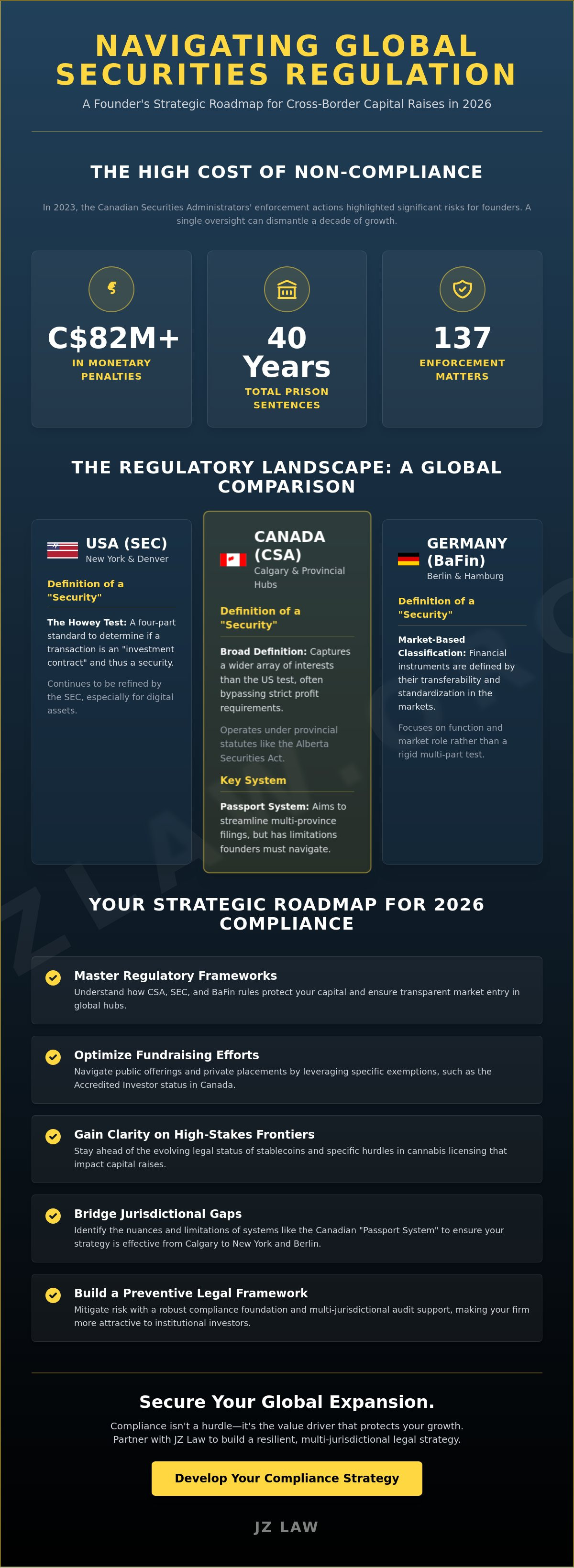
In 2023, the Canadian Securities Administrators concluded 137 enforcement matters, resulting in over C$82 million in monetary penalties and 40 years of total prison sentences. For a founder scaling a firm from Calgary to New York or Berlin, these figures represent more than just legal data; they're a stark reminder that a single oversight in securities regulation can dismantle a decade of corporate growth. You likely recognize that capital is the lifeblood of your international expansion, yet the friction between Alberta’s provincial requirements and the federal mandates of the SEC or Germany’s BaFin often feels like a moving target. It's frustrating to realize that the same filing that satisfies one jurisdiction might trigger a formal investigation in another.
This guide provides a strategic roadmap to master these cross border complexities, ensuring your next capital raise remains protected from the high costs of non-compliance. We'll examine the specific regulatory shifts expected by 2026, the nuances of Canadian provincial versus federal rules, and the precise steps required to mitigate leadership risk during an IPO.
Key Takeaways
Understand how 2026 securities regulation frameworks across the CSA, SEC, and BaFin function to protect your capital while ensuring transparent market entry in global hubs.
Navigate the complexities of public offerings and private placements by leveraging specific exemptions, such as the Accredited Investor status in Canada, to optimize your fundraising efforts.
Gain strategic clarity on the evolving legal status of stablecoins and the specific cannabis licensing hurdles that impact capital raises in 2026.
Identify the nuances of the Canadian "Passport System" and its limitations to ensure your compliance strategy effectively bridges the gap between Calgary, New York, and Berlin.
Discover how a preventive legal framework and multi-jurisdictional audit support can mitigate risk and provide a robust foundation for long-term corporate growth.
Table of Contents What is Securities Regulation and Why Does it Matter in 2026? The Regulatory Landscape: SEC, CSA, and BaFin Compared Core Compliance Pillars: From Private Placements to IPOs High-Stakes Frontiers: Crypto, Cannabis, and ESG in 2026 Strategic Representation: Why JZ Law is Your Compliance Partner
What is Securities Regulation and Why Does it Matter in 2026?
Securities regulation is the codified system of statutes and rules that dictate how financial instruments are issued, marketed, and traded within a specific jurisdiction. Its core mission remains constant: protecting the integrity of capital markets by ensuring investors receive full, true, and plain disclosure of all material facts. By 2026, the regulatory environment has moved past simple periodic disclosure. It now demands real-time digital transparency and rigorous safeguards for retail investors who access markets through decentralized or fractional platforms. This shift reflects a global effort to maintain stability as traditional finance merges with high-frequency, algorithm-driven trading environments.
Founders must recognize that the consequences of non-compliance in this new era are severe. Administrative penalties often reach C$1 million per violation in Canadian jurisdictions, and regulatory bodies have become more aggressive in pursuing permanent market bans for directors. Beyond financial levies, criminal liability remains a tangible threat for those who intentionally bypass registration requirements or provide misleading information to the public. Effective securities regulation ensures that the market remains a level playing field, where the quality of the underlying business, rather than the opacity of its financial structure, determines its success.
The Definition of a "Security" Across Jurisdictions
Founders in New York and Denver still contend with the Howey Test, a four-part judicial standard used to determine if a transaction qualifies as an investment contract. While the SEC continues to refine this test for digital assets, Calgary-based founders operate under the Alberta Securities Act, which employs a broader definition. In Canada, the term "security" captures a wider array of interests, often bypassing the strict "profit solely from the efforts of others" requirement found in US case law. Meanwhile, in Berlin and Hamburg, the German Federal Financial Supervisory Authority (BaFin) classifies financial instruments based on their transferability and standardization in the markets. Understanding financial regulation from this multi-jurisdictional perspective is essential for any startup seeking cross-border capital in 2026.
Why Founders Cannot Ignore Regulatory Frameworks
Adopting a preventative legal strategy is no longer optional; it's a prerequisite for institutional readiness. Compliance isn't just a hurdle, it's a value driver that significantly enhances a firm's attractiveness during the process of taking companies public. Investors in 2026 prioritize "clean" cap tables and documented regulatory adherence over raw growth metrics. Proactive engagement with securities regulation prevents future litigation and avoids the funding freezes that occur when a lead investor's due diligence uncovers an unregistered offering from an earlier seed round. Regulatory risk is the primary threat to startup liquidity in 2026. By addressing these frameworks during the early stages of growth, founders protect their ability to exit or scale when market conditions are most favorable.
The Regulatory Landscape: SEC, CSA, and BaFin Compared
Founders operating across Calgary, New York, and Berlin face a fragmented yet increasingly interconnected regulatory environment. In 2026, primary oversight is managed by the Securities and Exchange Commission (SEC) in the United States, the Canadian Securities Administrators (CSA) in Canada, and the Bundesanstalt für Finanzdienstleistungsaufsicht (BaFin) in Germany. While these bodies share the core goal of market integrity, their enforcement methods and jurisdictional reach vary significantly. By 2026, global coordination has reached a peak through the IOSCO Enhanced Multilateral Memorandum, allowing these agencies to share digital ledger data within minutes to prevent cross-border fraud and market manipulation.
Navigating the US Securities Framework (NYC & Denver)
The foundation of American compliance remains the U.S. securities laws, specifically the Securities Act of 1933 and the Exchange Act of 1934. In 2026, the SEC has pivoted its focus toward tech-heavy listings, implementing stricter disclosure rules for firms utilizing generative AI and proprietary algorithms. While New York remains the primary financial heart, firms headquartered in Denver must satisfy specific Colorado state "blue sky" laws that often differ from the aggressive enforcement seen under New York's Martin Act. FINRA continues to oversee broker-dealers in NYC, ensuring that secondary market trading follows strict liquidity protocols that became mandatory after the 2025 volatility spikes.
The Provincial System in Canada (Calgary, Toronto, Vancouver)
Canada lacks a federal regulator, which requires the CSA to coordinate 13 provincial and territorial bodies. The "Passport System" allows an issuer to deal with one principal regulator to gain access to other markets, though Ontario remains a "non-passport" jurisdiction. This means firms often need separate filings for Toronto-based capital. We've seen how the provincial barriers effect on cannabis industry growth serves as a cautionary tale for securities regulation fragmentation. For founders in Calgary, the Alberta Securities Commission (ASC) is the primary contact, particularly as energy firms transition into renewables and carbon-credit trading, where the ASC has introduced specialized reporting exemptions to encourage local innovation.
Germany and the EU Market (Berlin & Hamburg)
In Germany, BaFin oversees the Securities Trading Act (WpHG), but its reach is now heavily influenced by EU-wide mandates. The 2026 landscape is defined by the full implementation of the Markets in Crypto-Assets (MiCA) regulation, which has transformed Berlin into a regulated fintech powerhouse. While Berlin attracts digital startups, Hamburg maintains its status as a hub for maritime and trade-related securities through the Hamburg Stock Exchange. Founders must balance BaFin’s rigid reporting with the Frankfurt Stock Exchange’s specific transparency standards. Success in these markets depends on a preventive legal strategy that anticipates how securities regulation evolves across these three distinct economic zones.
Core Compliance Pillars: From Private Placements to IPOs
The 2026 landscape for securities regulation demands a shift from reactive legal fixes to a proactive, strategic framework. Founders in Calgary and New York often view compliance as a barrier to speed, yet data from 2025 suggests that companies with robust early-stage legal structures secured Series A funding 18% faster than those with "messy" cap tables. Compliance isn't merely a set of rules; it's a signal of institutional readiness that sophisticated investors demand before committing capital.
Prospectus Requirements and Exemptions
The default legal requirement for any company offering securities is the filing of a comprehensive prospectus. This document ensures transparency by providing potential investors with all material facts. You can review our detailed guide on prospectus requirements to understand the granular filing obligations in different jurisdictions. However, most early-stage raises bypass this expensive process through "private placement" exemptions. In Canada, the Accredited Investor exemption under NI 45-106 remains the primary vehicle for Calgary startups. South of the border, founders rely on U.S. Securities Laws, specifically Regulation D, to raise capital without SEC registration. By 2026, documenting a "Qualified Institutional Buyer" (QIB) requires more than a simple representation letter. Founders must now maintain digitized verification of the QIB’s asset threshold, which typically involves confirming managed assets exceeding C$140 million to ensure the exemption holds under audit.
Continuous Disclosure and Insider Trading Rules
Once a company transitions to public status or reaches a specific shareholder count, continuous disclosure obligations take effect. This involves regular reporting through documents equivalent to the 10-K or 10-Q in the US, or Annual Information Forms in Canada. These reports are no longer just financial snapshots; 2026 standards require real-time updates on material changes. Insider trading rules have also tightened significantly. Modern securities regulation now utilizes AI-driven surveillance to monitor executive stock sales for patterns that precede market-moving news. A robust internal compliance policy acts as a preventative shield here. It establishes "blackout periods" and pre-clearance procedures that protect the C-suite from unintended regulatory scrutiny. Preventing a violation is always more cost-effective than defending one during a formal investigation.
Founders frequently argue that high-level regulation is too expensive for a seed-stage venture. It's a common misconception. While a full IPO prospectus can cost hundreds of thousands, a properly structured private placement typically costs between C$7,500 and C$15,000 in legal fees. Compare this to the alternative: a single regulatory fine or a "right of rescission" where investors can force the company to return their capital. In 2025, the average administrative penalty for non-compliant private raises in Alberta exceeded C$45,000. Investing in early compliance is a strategic move to avoid these catastrophic capital drains later.
Accredited Investor Exemption: Reduces filing costs by up to 85% compared to a full prospectus.
Digital Compliance Vaults: 2026 startups use these to automate the collection of investor certificates.
Strategic Partnering: Legal counsel should function as a partner that anticipates shifts in CSA and SEC enforcement priorities.
High-Stakes Frontiers: Crypto, Cannabis, and ESG in 2026
Founders operating at the intersection of emerging technology and traditional finance face a regulatory environment that demands surgical precision. By January 2026, the divide between innovation and compliance has narrowed, forcing startups to integrate legal safeguards directly into their business models from the first seed round. This shift is most visible in the digital asset and sustainability sectors, where securities regulation has evolved from a reactive framework into a proactive gatekeeper of global capital.
Cryptocurrency and Digital Asset Regulation
The SEC stance in New York has solidified around the functional reality of decentralized finance (DeFi). By 2026, the commission treats any protocol that facilitates automated liquidity or governance-based profit sharing as an exchange, regardless of its decentralized claims. In contrast, Berlin utilizes a sophisticated "Token Taxonomy" to provide founders with a clearer roadmap. This system differentiates utility tokens, which grant access to digital services, from security tokens, which represent an equity-like interest in the venture's success. To mitigate risk, smart contracts are now being audited for regulatory compliance by specialized legal-tech firms to ensure that automated distributions don't violate cross-border offering rules.
The Cannabis Capital Market Challenge
Raising capital for cannabis ventures remains a complex exercise in jurisdictional friction. While New York and Denver offer robust state-level frameworks, the persistent conflict with US federal law creates significant banking bottlenecks that don't exist in the Canadian market. Canadian cannabis firms remain the global standard-bearers for securities regulation compliance, having operated under a unified federal system since 2018. This stability allows them to access institutional capital more efficiently than their US peers. Success in this sector often hinges on the strategic importance of tax structuring in corporate transactions for cannabis M&A, where missteps can lead to crippling liabilities. Navigating the specific cannabis licensing hurdles in global hubs requires a preventive legal strategy that anticipates shifting enforcement priorities.
ESG and Green Securities in Calgary
ESG (Environmental, Social, and Governance) disclosures are no longer a voluntary marketing tool; they're a mandatory component of the listing process in both the EU and North America. In Calgary, the energy sector is adapting to a new era of "Green Securities" regulation. The Alberta Securities Commission now requires detailed transition plans for any firm raising more than C$5 million. These disclosures must include:
Verified carbon intensity metrics for all Scope 1 and Scope 2 emissions.
Specific capital allocation strategies for renewable energy integration.
Governance structures that link executive compensation to sustainability targets.
This rigorous reporting ensures that Calgary-based firms can continue to attract international institutional investors who are increasingly bound by strict green mandates. Founders who fail to provide these data points find themselves excluded from 85% of major institutional debt and equity pools. It's no longer enough to have a viable business; you must have a compliant one. To ensure your venture meets these evolving standards, consult with a strategic legal partner to audit your compliance framework before your next funding round.
Strategic Representation: Why JZ Law is Your Compliance Partner
JZ Law functions as a boutique powerhouse, bridging the sophisticated financial markets of New York City, the energy-driven economy of Calgary, and the burgeoning tech scene in Berlin. We don't just react to regulatory shifts; we anticipate them. Our "John Zang Services" model provides a centralized point of command for founders facing multi-jurisdictional audits. This approach ensures that a filing in Germany doesn't inadvertently trigger a compliance red flag in Alberta or New York. We believe in a preventative philosophy. We identify and fix legal leaks before they evolve into floods that drain your capital. By 2026, the complexity of securities regulation will demand this level of integrated, global oversight.
Cross-Border Expertise for Global Founders
Bridging the gap between German civil law and North American common law requires more than just translation; it requires deep structural understanding. JZ Law specializes in translating complex European regulatory requirements into actionable strategies for the Canadian and American markets. For founders in Alberta, we provide essential guidance on oil and gas law finance, ensuring capital raises for energy projects meet stringent provincial standards. Our expertise extends to high-volatility sectors like crypto-assets and cannabis, where regulatory goalposts move frequently. Whether you're navigating the CSA’s latest staff notices or the SEC's evolving stance on digital assets, our firm provides the technical precision needed to maintain compliance across three continents. We've seen firms lose upwards of C$500,000 in legal fees simply because their early-stage documentation didn't account for cross-border tax and securities regulation alignment.
Securing Your Corporate Future
Early legal intervention is the single most effective way to protect your IPO lifecycle. Founders who wait until the "letter of intent" stage to address governance gaps often face delays that can cost millions in C$ valuation. We help you build a "compliance-first" culture from the seed stage onward. Use this brief checklist to evaluate your current exposure:
Are your cross-border intercompany agreements documented to withstand a 2026 audit?
Does your cap table reflect the specific disclosure requirements of both the ASC and SEC?
Have you isolated intellectual property assets to prevent jurisdictional leakage?
Is your internal reporting ready for the 2026 ESG disclosure mandates?
Don't leave your 2026 capital planning to chance. Contact JZ Law for strategic securities counsel to ensure your firm is positioned for growth, not bogged down by litigation. Strategic preparation today prevents the regulatory crises of tomorrow.
Securing Your Global Expansion in 2026
The regulatory environment for 2026 demands more than just basic adherence; it requires a proactive, strategic alignment with evolving CSA and international standards. Founders must navigate a landscape where crypto-asset frameworks and mandatory ESG reporting are no longer optional. Successfully managing securities regulation across Calgary, New York, and Berlin ensures your venture maintains its competitive edge while mitigating the risks of cross-border non-compliance. It's about building a resilient structure that supports growth through every private placement and eventual IPO.
JZ Law serves as a strategic partner for firms entering these high-stakes frontiers. Led by principal lawyer John Zang, our team brings specialized expertise to 8 global financial hubs, with a dedicated focus on the unique legal pressures of the Crypto and Cannabis sectors. We prioritize a preventive approach, ensuring your compliance strategy is robust enough to handle the complexities of the mid-decade market. Consult with JZ Law on your 2026 securities compliance strategy to safeguard your firm's trajectory. We're ready to help you turn regulatory challenges into a sustainable business advantage.
Frequently Asked Questions
What is the primary difference between US and Canadian securities regulation in 2026?
The primary distinction between the two jurisdictions remains the regulatory structure, where the United States operates under the federal Securities and Exchange Commission, while Canada maintains a provincial model coordinated through the Canadian Securities Administrators. By 2026, Canada's SEDAR+ system has fully integrated multi-jurisdictional filings across all 13 provinces and territories. This contrasts with the US approach, which emphasizes federal pre-emption for most large-scale offerings. Founders should recognize that Canadian securities regulation often provides more flexible exemptions for start-ups, such as the harmonized crowdfunding exemption.
Do I need a prospectus for a private seed round in Berlin or New York?
You don't typically need a full prospectus for a private seed round in Berlin or New York, provided you qualify for specific exemptions. In New York, most founders utilize Rule 506(b) of Regulation D, which permits raising unlimited capital from accredited investors without a formal prospectus. Similarly, Germany's Securities Prospectus Act allows for exemptions on offerings under €8 million, provided they target fewer than 150 non-qualified investors. These exemptions significantly reduce the initial administrative burden for early-stage ventures.
How does BaFin regulate cryptocurrency tokens differently than the SEC?
BaFin regulates cryptocurrency tokens under the European MiCA framework, which categorizes assets into specific tiers like asset-referenced tokens or e-money tokens. This provides a clearer statutory roadmap than the SEC's approach, which primarily relies on the 1946 Howey Test to determine if a token is an investment contract. While the SEC often pursues enforcement actions to define boundaries, BaFin requires a standardized white paper for most public offerings. This legislative clarity in Germany helps founders predict compliance costs more accurately.
What are the penalties for failing to file a continuous disclosure report in Calgary?
The Alberta Securities Commission (ASC) imposes strict financial penalties for disclosure failures, with fines reaching up to C$5 million per violation under Section 194 of the Securities Act. Beyond monetary sanctions, the ASC can issue cease trade orders that effectively freeze a company's ability to raise capital. In severe cases of intentional misrepresentation, directors may face prison sentences of up to five years less a day. It's vital to maintain a rigorous compliance calendar to avoid these disruptive legal outcomes.
Can a cannabis company list on the New York Stock Exchange (NYSE) in 2026?
A cannabis company can't list on the New York Stock Exchange if it conducts touch-the-plant operations within the United States, as marijuana remains a Schedule I substance under federal law. However, Canadian companies that operate exclusively in legal jurisdictions often maintain their listings. As of 2026, the NYSE continues to enforce strict compliance with US federal statutes, regardless of state-level legalization. Most multi-state operators still prefer the Canadian Securities Exchange for its more permissive listing requirements regarding US-based assets.
What is the "Howey Test" and does it apply to my tech startup?
The Howey Test applies to any tech startup that issues digital assets or unique investment contracts to raise capital. It's a four-part legal standard used by the SEC to determine if a transaction qualifies as a security. If your startup's token involves an investment of money in a common enterprise with a reasonable expectation of profits derived from your team's efforts, it's a security. Failing this test means your offering must comply with federal securities regulation, or face potential rescission claims from investors.
How much does a securities regulation audit typically cost for a mid-market firm?
A comprehensive audit for a mid-market firm typically ranges from C$45,000 to C$120,000, depending on the complexity of the firm's jurisdictional footprint. These figures, reflected in recent 2025 industry compliance reports, cover legal reviews, internal control assessments, and filing verifications. Costs often escalate if the firm operates in multiple provinces or requires cross-border reconciliation between Canadian and US standards. Investing in these audits prevents much larger expenses related to regulatory investigations or class-action litigation.
Why is Calgary considered a unique hub for energy-related securities law?
Calgary's status as a unique hub stems from the concentration of energy companies and the specific application of National Instrument 51-101. This regulation dictates how oil and gas companies must disclose reserves and resources, requiring specialized legal and geological expertise. Since over 70% of Canada's oil and gas producers are headquartered in Alberta, the local legal community has developed a sophisticated framework for energy-specific capital raises. This expertise makes Calgary a global center for resource-based financial transactions.



Comments