


Security Token Offering Lawyer Canada: 2026 Regulatory Compliance Guide
- jzanglaw
- Jul 30
- 12 min read
With 25% of Canadians now holding crypto assets as of early 2026, the digital finance sector has officially moved from the fringes to the mainstream of the national economy. This rapid adoption brings a heightened level of scrutiny from provincial regulators who view every blockchain-based investment through the lens of traditional securities law. If you're planning a launch, you likely understand that the biggest threat to your capital raise isn't market volatility, but regulatory friction. Securing an experienced security token offering lawyer canada is no longer just a legal formality; it's a strategic necessity to ensure your project survives the rigorous standards of the OSC and ASC.
It's understandable to feel overwhelmed by the complexity of multi-jurisdictional compliance and the high costs associated with traditional public offerings. This 2026 regulatory guide is designed to strip away the uncertainty and provide a clear, compliant path to market. You'll gain a comprehensive understanding of the latest Canada Stablecoin Act provisions, updated LIFE exemption thresholds, and the specific FINTRAC reporting requirements that dictate modern token issuance. This guide provides the professional roadmap needed to bridge the gap between innovative blockchain technology and institutional-grade legal security.
Table of Contents
Understanding Security Token Offerings (STOs) in the Canadian Market
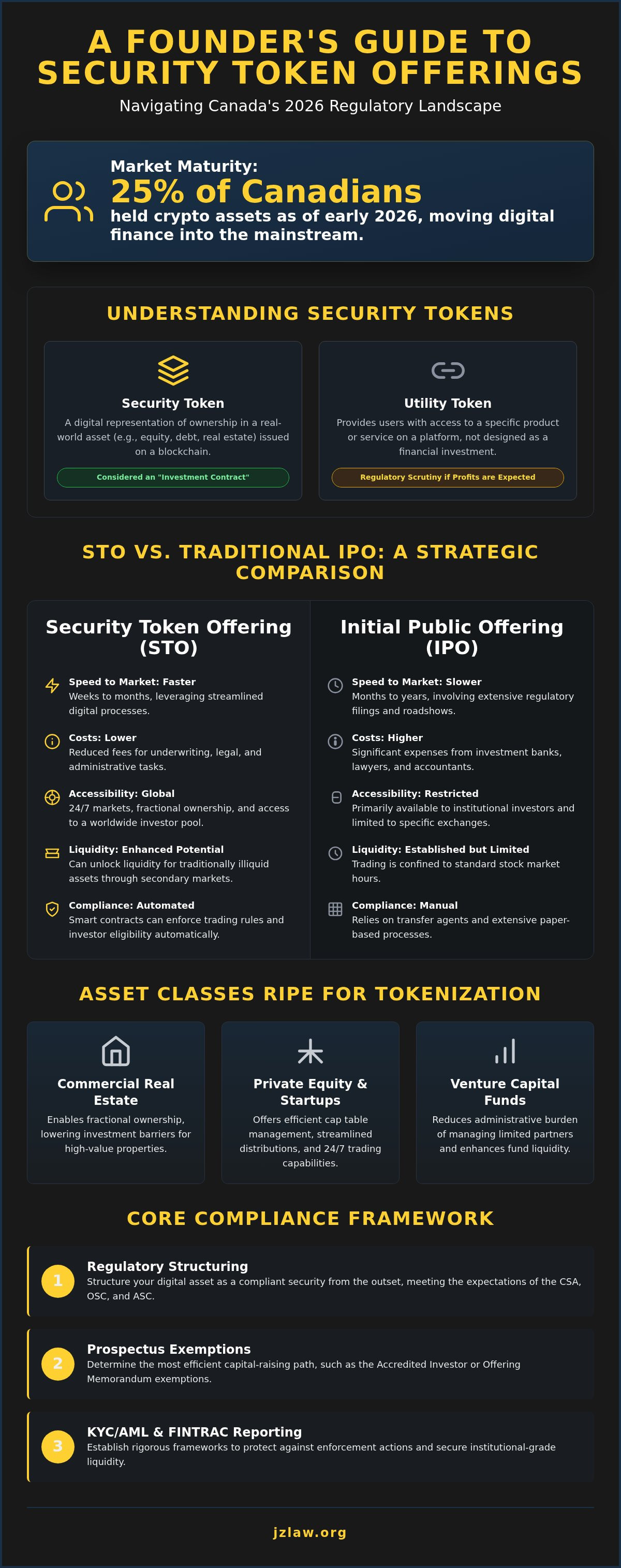
A Security Token Offering (STO) represents a fundamental shift in how capital is raised and distributed within the Canadian financial ecosystem. Unlike the speculative nature of early digital assets, an STO is a digital representation of ownership in a tangible asset, such as equity, debt, or real estate, that's issued and traded on a blockchain. By 2026, the Canadian market has matured significantly, moving away from the regulatory ambiguity of early Initial Coin Offerings (ICOs). Founders now recognize that long-term viability requires a foundation built on strict compliance rather than regulatory avoidance. This shift is driven by a desire for institutional-grade liquidity and the protection that comes with legal oversight.
The distinction between utility tokens and security tokens remains the most critical legal hurdle for issuers. While utility tokens are designed to provide access to a specific service or platform, the Canadian Securities Administrators (CSA) maintain a technology-neutral stance. If a token carries an expectation of profit through the efforts of others, it's classified as a security regardless of the underlying technology. Partnering with a security token offering lawyer canada allows firms to navigate these definitions with precision, ensuring that the offering doesn't inadvertently trigger enforcement actions from provincial commissions like the OSC or ASC.
The Evolution of Digital Asset Fundraising
The transition from the unregulated "Wild West" of 2017 to the structured environment of 2026 marks a new era for corporate finance. Regulators still rely on the "Investment Contract" test as the gold standard for determination. This evolution has benefited issuers by providing access to institutional liquidity that was previously unavailable to unregulated projects. STOs offer automated compliance through smart contracts, ensuring that secondary trading only occurs between verified, eligible investors. This technological layer provides a more stable foundation for long-term corporate growth compared to the volatile fundraising methods of the past.
Asset Classes Ripe for Tokenization
Tokenization unlocks value in traditionally illiquid markets by enabling fractional ownership and lowering entry barriers. Commercial real estate is a primary candidate, where fractionalized interests allow a broader range of investors to participate in high-value developments. Similarly, private corporations and high-growth tech startups use STOs to manage cap tables more efficiently. By tokenizing equity, these companies can offer 24/7 trading capabilities and streamlined dividend distributions, often proving more agile than taking companies public through traditional, paper-heavy IPO routes. Private equity participation has also seen a surge, as blockchain technology reduces the administrative burden of managing diverse groups of limited partners.
The Canadian Regulatory Framework: CSA, OSC, and ASC Compliance
The regulatory landscape for digital assets in Canada is governed by a decentralized yet coordinated group of provincial authorities. While the Canadian Securities Administrators (CSA) provide national policy direction, the actual enforcement and registration processes occur at the provincial level. For any founder, the primary challenge lies in interpreting CSA Staff Notice 46-308, which clarifies how traditional securities laws apply to token offerings. This notice reinforces that most tokens issued to raise capital are considered investment contracts. Canadian courts apply a test derived from the Pacific Coast Coin Exchange case, which mirrors the American Howey Test but maintains its own judicial precedents. This test examines whether there is an investment of money in a common enterprise with a reasonable expectation of profit to be derived from the significant efforts of others.
Navigating these requirements requires more than just a passing familiarity with the tech. It demands the precision of a security token offering lawyer canada who can bridge the gap between code and compliance. The Ontario Securities Commission (OSC) takes a lead role in Toronto-based offerings, often focusing on investor protection and market integrity for institutional-grade projects. Conversely, the Alberta Securities Commission (ASC) has developed a reputation for supporting innovation within Calgary's burgeoning tech and energy sectors. Each commission has specific filing nuances that can delay a launch if not handled with meticulous detail. If your project involves complex cross-border considerations, consulting with a security token offering lawyer canada is the most reliable way to mitigate enforcement risks.
The CSA Regulatory Sandbox
Innovative blockchain projects that don't fit neatly into existing categories can apply for the CSA Regulatory Sandbox. This initiative allows businesses to test products or services in the Canadian market on a time-limited basis with exemptive relief from certain securities law requirements. It's a controlled environment where firms can demonstrate their compliance capabilities before transitioning to a full-scale market offering. Sandbox participation isn't a free pass. It requires rigorous reporting and a clear path toward permanent compliance. For many, this serves as a vital proof-of-concept phase that builds trust with regulators and future investors alike.
Provincial Nuances: Toronto vs. Calgary
Strategic differences between the OSC and ASC often dictate the structure of an STO. While the OSC may emphasize disclosure for retail investors, the ASC often facilitates capital raises through private placement exemptions favored by the energy sector. Coordinating these multi-jurisdictional filings is a complex task that requires a unified legal strategy. Understanding the local nuances of cryptocurrency law across different provinces ensures that a project remains compliant from coast to coast. Working with a strategic partner like JZ Law can help streamline these provincial interactions, allowing founders to focus on growth rather than administrative hurdles.
STOs vs. Traditional IPOs: A Strategic Comparison for Founders
Founders often view the Initial Public Offering (IPO) as the ultimate milestone, yet the path to a traditional listing is frequently paved with prohibitive costs and administrative delays. A security token offering provides a sophisticated alternative that streamlines capital formation without sacrificing regulatory integrity. While a traditional IPO requires extensive underwriting from investment banks and significant listing fees, an STO leverages blockchain technology to reduce middleman intervention. This doesn't eliminate the need for rigorous oversight. Engaging a security token offering lawyer canada remains essential to ensure the issuance meets the same high standards as a conventional prospectus-based offering. Legal and accounting fees for an STO are often more manageable for mid-market firms compared to the multi-million dollar budgets required for a TSX listing.
The speed-to-market is perhaps the most compelling advantage for growth-stage firms. The process of taking companies public through traditional exchanges can span twelve to eighteen months, whereas an STO can often be executed in a fraction of that time. This agility allows founders to capitalize on market opportunities while maintaining a global investor reach that traditional, exchange-bound listings struggle to match. Unlike an IPO, where trading is limited to specific exchange hours and jurisdictions, tokenized securities offer 24/7 accessibility to a borderless pool of accredited and institutional investors. This digital approach doesn't just change how you raise money; it changes who can participate in your success.
Liquidity and Secondary Markets
Secondary market liquidity has historically been a challenge for private companies, but the emergence of Canadian Alternative Trading Systems (ATS) has changed the equation. These platforms provide a regulated environment for the trading of security tokens, offering a bridge between private placement and public listing. Smart contracts facilitate automated dividend distributions and enforce compliance rules directly on the chain. For example, lock-up periods, which are standard in venture capital, are no longer dependent on manual oversight. They're hard-coded into the token's architecture, preventing unauthorized transfers until the legal requirements are met. This automation reduces the administrative burden on the issuer while providing clear rules for the investor.
Regulatory Friction and Investor Trust
Institutional investors are increasingly drawn to STOs because they offer the legal certainty of a regulated security combined with the efficiency of modern technology. To overcome the lingering "crypto stigma," founders must prioritize transparency and rigorous legal documentation. Building a strategic corporate transactions framework is vital for establishing this trust. By working with a security token offering lawyer canada, issuers can demonstrate that their project isn't just a technological experiment, but a legitimate, institutional-grade investment vehicle that adheres to the highest standards of Canadian securities law. This level of professionalism is what ultimately bridges the gap between retail speculation and institutional liquidity.
Practical Legal Steps: Exemptions, Prospectuses, and KYC/AML
Launching a compliant digital asset requires moving beyond technical architecture into the rigid domain of securities exemptions. Most issuers avoid the time and expense of a full prospectus by utilizing specific exemptions under National Instrument 45-106. The Accredited Investor exemption remains the most common route, allowing firms to raise unlimited capital from high-net-worth individuals and institutional entities without the burden of a traditional prospectus. For those seeking a broader reach, the Offering Memorandum (OM) exemption provides a middle ground. It requires a detailed disclosure document but stops short of the exhaustive requirements of a public listing. Navigating these choices without triggering an enforcement action requires the guidance of a security token offering lawyer canada who understands how to align your token's functionality with these legal safe harbors.
Regulatory compliance in 2026 also demands a robust Anti-Money Laundering (AML) and Know-Your-Client (KYC) framework. Under the Proceeds of Crime (Money Laundering) and Terrorist Financing Act, reporting entities must report virtual currency transactions equivalent to $10,000 CAD or more to FINTRAC within five working days. Additionally, the Travel Rule necessitates that virtual asset service providers exchange sender and receiver information for transfers of $1,000 CAD or more. The stakes for non-compliance are exceptionally high. As of 2026, a "very serious" violation can result in administrative monetary penalties of up to $20 million CAD. This financial risk makes professional legal oversight an essential component of your risk management strategy.
National Instrument 45-106 Compliance
Every STO founder must be intimately familiar with the filing requirements of NI 45-106. This includes the mandatory filing of a Report of Exempt Distribution (Form 45-106F1) with provincial regulators like the OSC or ASC within 10 days of the token sale. Managing the resale restrictions is equally vital; most tokens issued under these exemptions are subject to a restricted period, often four months or longer, during which they cannot be traded to the public. Failing to hard-code these restrictions into the token's smart contract can lead to inadvertent illegal distributions.
Smart Contract Audits and Legal Enforceability
A smart contract audit is a legal necessity, not just a technical one. The code must perfectly reflect the underlying legal rights established in your shareholder agreements and subscription documents. If the smart contract allows for a transfer that violates the 12-month hold period or an investor's rights under provincial law, the issuer remains liable. A security token offering lawyer canada works alongside developers to verify that token transfer restrictions, dividend rights, and voting mechanisms are legally enforceable and immune to technical exploits.
To ensure your issuance meets every provincial and federal requirement while protecting your firm from multi-million dollar penalties, consult with the experts at JZ Law for a comprehensive regulatory audit.
Strategic Counsel: How JZ Law Navigates STO Complexity
Success in the digital asset space depends on more than just meeting the minimum regulatory requirements. It requires a vision that anticipates market shifts and protects the long-term interests of the organization. John Zang's approach to securities regulation is rooted in the belief that an STO is a corporate finance event first and a technological milestone second. By blending traditional legal principles with a deep understanding of blockchain architecture, JZ Law provides the strategic oversight necessary to move from a conceptual whitepaper to a fully compliant secondary listing. Engaging a dedicated security token offering lawyer canada ensures that every technical decision aligns with the rigid expectations of provincial commissions, preventing costly pivots later in the project lifecycle.
Founders and directors often face significant personal liability risks when conducting digital asset sales. JZ Law prioritizes the creation of robust corporate veils and indemnity frameworks to protect the individuals behind the innovation. This protection is integrated with comprehensive tax structuring, which is essential for maintaining fiscal efficiency across multiple jurisdictions. Without a clear tax strategy, the benefits of a successful capital raise can be quickly eroded by unforeseen liabilities. Our counsel ensures that the token's economic model is as legally sound as its underlying code.
A Boutique Approach to Global Hubs
Specialized industry law requires a partner who understands the local nuances of major financial centers. With a presence in Calgary, Toronto, Vancouver, and New York, JZ Law offers the localized expertise needed to navigate the specific filing requirements of the OSC and ASC simultaneously. We don't act as mere executors of documents; we position ourselves as strategic partners who understand your business goals. A security token offering lawyer canada from our firm will work with you to develop a 2026 STO roadmap that accounts for both current regulations and upcoming legislative shifts. Scheduling a consultation with John Zang is the first step toward securing a stable future for your digital asset project.
Beyond the Issuance: Long-term Corporate Strategy
The legal journey doesn't end once the tokens are minted. Managing post-STO corporate governance and shareholder relations requires a disciplined approach to transparency and reporting. As the landscape of cryptocurrency law continues to evolve, your organization must remain agile. JZ Law provides ongoing support to help you adapt to new CSA staff notices or changes to FINTRAC reporting thresholds. Whether you're preparing for a future M&A event or a full transition to a public exchange, our team ensures your corporate structure remains resilient and attractive to institutional partners. We manage the complexity so you can focus on scaling your enterprise.
Securing Your Position in the Future of Capital Markets
The shift toward tokenized assets represents a permanent evolution in how Canadian firms access capital and manage liquidity. Success in this environment depends on a meticulous alignment with provincial securities law and the strategic use of NI 45-106 exemptions to streamline your path to market. Establishing a robust compliance framework isn't just a regulatory hurdle; it's a competitive advantage that builds institutional trust and protects your leadership from personal liability. To bridge the gap between innovative technology and legal certainty, you need the steady guidance of a security token offering lawyer canada who views your project through a strategic corporate lens.
JZ Law offers the sophisticated counsel required for high-stakes transactions in Calgary, Toronto, and global financial hubs. By integrating precise tax structuring with expert cryptocurrency law advice, we help you navigate the complexity of today's regulatory environment with confidence. Our team focuses on long-term corporate stability, ensuring your tokenized issuance remains resilient as market standards continue to mature. Take the next step in your project's lifecycle by securing a roadmap built on professional dignity and modern business insight.
Consult with John Zang on Your STO Legal Strategy
Frequently Asked Questions
Is a security token considered a security in Canada?
Yes, security tokens are classified as securities in Canada if they meet the criteria of an investment contract. The Canadian Securities Administrators apply a technology-neutral approach, meaning that if a token represents an investment in a common enterprise with a reasonable expectation of profit through the efforts of others, it must comply with provincial securities laws. This determination remains consistent regardless of whether the asset is recorded on a traditional ledger or a blockchain.
Do I need a lawyer to launch an STO in Toronto or Calgary?
Engaging a specialized security token offering lawyer canada is a strategic necessity for any founder operating in major financial hubs like Toronto or Calgary. Legal counsel is required to navigate the distinct filing requirements of the OSC and ASC, draft essential disclosure documents, and ensure that your project utilizes the correct prospectus exemptions. Without professional oversight, issuers face significant risks of enforcement actions and personal liability for directors.
What is the difference between an ICO and an STO under Canadian law?
The primary difference lies in the explicit recognition of the token as a security from the outset of the offering. While many early Initial Coin Offerings (ICOs) attempted to bypass regulation by claiming utility status, a Security Token Offering (STO) is structured as a regulated financial instrument. STOs provide investors with legal rights, such as equity or debt interests, and are conducted under established prospectus exemptions like National Instrument 45-106.
Can I sell security tokens to non-accredited investors in Canada?
Yes, security tokens can be sold to non-accredited investors, provided the issuer utilizes a specific exemption such as the Offering Memorandum (OM) exemption. This route requires more extensive disclosure and higher legal costs than offerings limited to accredited investors. It's essential to consult with a security token offering lawyer canada to determine if the additional administrative burden of an OM offering aligns with your capital-raising goals.
What are the KYC/AML requirements for a Canadian STO?
Issuers must comply with the Proceeds of Crime (Money Laundering) and Terrorist Financing Act, which is enforced by FINTRAC. Key requirements include verifying the identity of all investors and identifying beneficial owners who control 25% or more of an entity. Additionally, transactions equivalent to $10,000 CAD or more must be reported to FINTRAC within five working days, and the Travel Rule applies to transfers of $1,000 CAD or more.
How long does the legal process take for a security token offering?
The legal timeline for a compliant STO typically spans three to six months. This period accounts for the initial structuring of the entity, the drafting of subscription agreements and disclosure documents, and the mandatory filing of reports with provincial regulators. While this process is significantly faster than a traditional IPO, the duration depends heavily on the complexity of the asset being tokenized and the specific exemptions used.
What happens if I launch a token without CSA approval?
Launching an unregulated security token triggers severe enforcement actions, including cease-trade orders and permanent bans from the capital markets. In 2026, administrative monetary penalties for non-compliance with FINTRAC regulations were increased to a maximum of $20 million CAD for "very serious" violations. Beyond financial penalties, founders may face personal liability and the forced rescission of all capital raised, which can lead to the immediate insolvency of the project.
Can US investors participate in a Canadian security token offering?
US investors can participate in a Canadian STO, but the offering must comply with both Canadian provincial laws and US SEC regulations. This usually involves utilizing SEC exemptions such as Regulation D for private placements or Regulation S for offshore transactions. Coordinating these cross-border requirements is a complex process that requires a unified legal strategy to ensure that the issuance remains compliant in every jurisdiction where investors are located.


Comments