


Shareholder Buyout Agreements in Calgary: The 2026 Strategic Guide
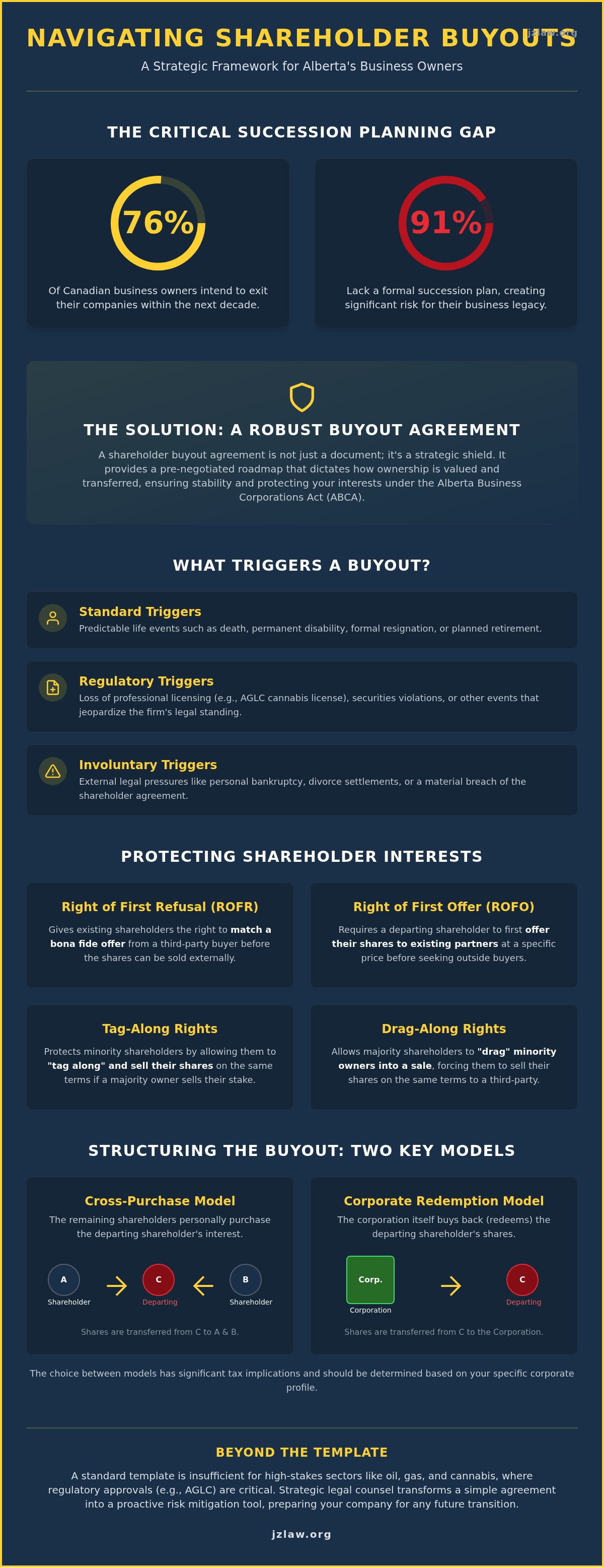
While 76% of Canadian business owners intend to exit their companies within the next decade, a staggering 91% lack a formal succession plan to facilitate that transition. In the high-stakes commercial environment of 2026, failing to establish a robust shareholder buyout agreement calgary professionals trust is no longer just a clerical oversight; it's a significant risk to your business legacy. You likely recognize the inherent tension between wanting a clean exit and fearing that a "shotgun" clause could be leveraged to undervalue your life's work during a period of transition.
It's natural to feel uncertain about fair market valuations in Alberta's volatile sectors, especially with the more rigorous 2026 CICBV Valuation Practice Standards now in full effect. This guide provides a sophisticated legal framework designed to secure your interests and minimize the potential for protracted litigation during a buyout. We'll examine how to structure an enforceable exit strategy that minimizes tax liabilities and protects specialized assets, such as cannabis licenses subject to AGLC approval or complex cryptocurrency holdings. By the end, you'll understand how to transform a standard contract into a strategic regulatory shield for your Calgary enterprise.
Table of Contents
Essential Components of Shareholder Buyout Agreements in Alberta
A buy-sell agreement isn't merely a contingency plan; it's a foundational pillar of corporate governance that ensures the long-term stability of your enterprise. While the Alberta Business Corporations Act (ABCA) provides a broad statutory framework, its default provisions often lack the specificity required to manage complex transitions in a volatile market. By establishing a robust shareholder buyout agreement calgary professionals recommend, you create a pre-negotiated roadmap that dictates how ownership interests are valued and transferred. For any strategic corporate transaction, this exit framework is essential to distinguish between voluntary departures, such as a partner's planned retirement, and mandatory buyouts triggered by a breach of duty or regulatory failure.
Unanimous Shareholder Agreements (USA)
A Unanimous Shareholder Agreement (USA) is the gold standard for private corporations in Alberta because it allows for a level of customization that standard bylaws can't match. Under the ABCA, a USA can effectively shift powers from the directors to the shareholders, providing critical protections for minority owners who might otherwise be silenced in major decisions. These agreements are particularly effective at restricting share transfers to unauthorized third parties, ensuring that you don't find yourself in business with a competitor or an incompatible partner. By integrating Essential Components of Shareholder Buyout Agreements into a USA, you ensure that these rules bind all current and future stakeholders, preserving the company's internal culture and operational integrity.
Common Triggering Events
The efficacy of a shareholder buyout agreement calgary business owners rely on depends on the precision of its triggering events. These events must be clearly defined to avoid the ambiguity that often leads to expensive litigation. We categorize these triggers into three distinct areas:
Standard Triggers: These include predictable life events such as death, permanent disability, or the formal resignation of a shareholder.
Regulatory Triggers: In highly regulated sectors, a shareholder's loss of cannabis licensing eligibility or a significant securities violation can jeopardize the firm's standing. For cannabis retailers, any share transfer requires prior AGLC approval to prevent the automatic termination of the license.
Involuntary Triggers: These involve external legal pressures such as personal bankruptcy, a divorce settlement that threatens to split shareholdings, or a material breach of the shareholder agreement itself.
Proactively addressing these scenarios allows the remaining partners to maintain control while ensuring the departing party receives a fair, contractually determined payout. This systematic approach minimizes emotional friction and protects the company's valuation during sensitive periods of change.
Valuation Methodologies and Triggering Mechanisms
Establishing the price of shares is often the most contentious aspect of a shareholder buyout agreement calgary. In 2026, the Canadian Institute of Chartered Business Valuators (CICBV) introduced more rigorous standards that demand transparency and deeper scrutiny of assumptions. Relying on a vague "fair market value" clause is no longer sufficient. Integrating precise Valuation Methodologies for Calgary Shareholder Agreements into your contract ensures that all parties operate from a shared financial reality, whether you're navigating a Right of First Refusal (ROFR) or a Right of First Offer (ROFO). While a ROFR allows shareholders to match a third-party offer, a ROFO requires a departing owner to offer their shares to existing partners before seeking external buyers, providing more control over the company's internal composition.
To protect stakeholders during a sale, "Tag-Along" and "Drag-Along" rights are indispensable. Tag-along rights protect minority shareholders by allowing them to join a transaction if a majority owner sells their stake. Conversely, drag-along rights enable a majority owner to force minority shareholders to join in the sale of the company, ensuring a buyer can acquire 100% of the equity without holdouts. For those considering an eventual exit through securities regulation pathways, these clauses are vital for maintaining a clean cap table.
Fixed Price vs. Formula-Based Valuation
Using a fixed price in a shareholder buyout agreement calgary is a high-risk strategy. If the agreement isn't updated annually, the price quickly becomes decoupled from the company's actual worth. Most sophisticated Calgary firms now utilize formula-based models, such as EBITDA multiples or capitalized earnings. As of late 2025, main street business multiples averaged around 2.57x, though this varies significantly in tech-heavy sectors. When dealing with digital assets, specialized knowledge in cryptocurrency law is required to accurately value and transfer private keys or tokenized equity without triggering unintended tax events.
The Shotgun Clause: A Strategic Weapon
The "shotgun" clause is frequently described as the great equalizer in corporate law. It allows one shareholder to offer to buy out another at a specific price; however, the recipient has the option to either accept the offer or turn around and buy the initiator's shares at that same price. This mechanism forces the proposer to name a fair price. The risk remains significant for "cash-poor" shareholders who may be unable to fund a counter-buyout, effectively allowing a wealthier partner to seize control. If you're concerned about the aggressive nature of these clauses, consulting with a strategic legal partner can help you draft more balanced alternatives, such as multi-stage appraisals or mediated settlements.
Cross-Purchase vs. Corporate Redemption Models
Deciding how to fund and execute a shareholder buyout agreement calgary involves evaluating the tax implications and administrative burdens of two primary structures. While both achieve the same goal of ownership transition, their impact on the remaining shareholders and the company's financial health differs significantly. Sophisticated tax structuring is often the deciding factor in these high-value transactions. Funding these buyouts typically requires a mix of life insurance policies, sinking funds, or promissory notes. For the third quarter of 2026, the CRA prescribed interest rate for shareholder loans sits at 3%, which directly influences the cost and feasibility of deferred payment plans using promissory notes.
Cross-Purchase Strategy
In a cross-purchase model, shareholders buy shares directly from the departing party. This approach offers a distinct tax advantage because the buying shareholders receive a "stepped-up" basis in the acquired shares. This higher cost base can significantly reduce capital gains taxes during a future sale or when eventually taking the company public. However, administrative complexity grows exponentially with the number of partners. If a firm has five shareholders, they would need twenty separate life insurance policies to cover every possible buyout scenario. This model remains the preferred choice for smaller Calgary startups where the number of stakeholders is limited and the personal tax basis is a primary concern.
Corporate Redemption Strategy
Corporate redemption simplifies the process by having the corporation itself buy back and cancel its own shares. The company manages the funding and the insurance policies, which keeps the administrative overhead low regardless of how many shareholders exist. However, this model must pass strict solvency tests under the Alberta Business Corporations Act. Directors must ensure the buyout doesn't render the company unable to pay its liabilities as they become due or reduce its assets below its liabilities. This strategy impacts the balance sheet and can affect future borrowing capacity, as the redemption reduces the company's equity. For companies in capital-intensive sectors, balancing these redemptions against operational needs is a critical strategic task that requires precise financial modeling.
Whether you choose a direct purchase or a corporate buyback, the goal is to ensure the departing shareholder is compensated fairly without destabilizing the company's path toward growth. Each model has its own set of pitfalls that can trigger unexpected tax liabilities if not handled with professional precision.
Buyouts in Regulated Industries: Oil, Gas, and Cannabis
Generic corporate templates often overlook the intricate regulatory demands of Alberta's specialized markets. A standard shareholder buyout agreement calgary might suffice for a simple service business, but it fails when applied to the complexities of oil and gas law joint ventures. Within the energy sector, buyout provisions must align with existing Joint Operating Agreements (JOAs) to prevent conflicts over operator status or preferential rights. If a buyout is triggered, the agreement must clearly dictate how environmental liabilities and reclamation obligations are apportioned, ensuring the departing party doesn't leave the remaining shareholders with unforeseen regulatory debts.
In tech-heavy buyouts, the transfer of intellectual property and digital assets requires equally precise handling. It's not enough to transfer shares; the agreement must ensure that all proprietary code, patents, and private keys for cryptocurrency holdings are contractually secured. This prevents a departing founder from retaining "backdoor" access to specialized assets that constitute the company's core value.
Cannabis and Regulatory Compliance
The cannabis industry remains one of the most strictly policed sectors in Canada. Any shareholder buyout agreement calgary licensed producers or retailers use must include mandatory buyout clauses for shareholders who fail AGLC background checks. Because the AGLC requires all key stakeholders to be "fit and proper," a single disqualified person can jeopardize the entire retail license. Our approach focuses on creating regulatory-proof agreements that trigger an immediate, mandatory sale if a shareholder becomes a "disqualified person" under the Gaming, Liquor and Cannabis Act. This proactive mechanism protects the company's operational continuity and prevents the automatic termination of licenses during ownership shifts.
Pre-IPO and Securities Law Considerations
If your strategic roadmap includes taking companies public, your private buyout agreement must serve as a precursor to rigorous securities regulation. Private agreements often contain restrictions that conflict with the liquidity requirements of a public exchange. We structure these documents to account for standard lock-up periods, which typically restrict share sales for 180 days following an initial public offering. Navigating prospectus requirements during a significant ownership shift is a delicate process. A poorly timed buyout can trigger disclosure obligations that delay a listing or impact investor confidence. To ensure your agreement aligns with your long-term exit goals, consult with our strategic corporate team to build a framework that supports your growth trajectory.
Strategic Drafting and Enforcement with JZ Law
JZ Law, under the leadership of John Zang, prioritizes strategic counsel over mere clerical drafting. When you engage John Zang Services, you aren't just purchasing a document; you're investing in a sophisticated legal architecture designed to anticipate and neutralize disputes before they manifest. A shareholder buyout agreement calgary must be viewed as a dynamic instrument that reflects the unique operational realities of your firm. With a physical presence in Calgary, Toronto, and Vancouver, our firm is uniquely positioned to manage multi-jurisdictional deals that require a nuanced understanding of varying provincial regulations and inter-provincial corporate transactions. This broad geographic reach ensures that your business interests remain protected even as your operations expand across Canada.
Custom vs. Template Agreements
In 2026, the risks associated with "off-the-shelf" or template-based agreements have never been higher. These generic documents often fail to address the specific valuation standards or the regulatory triggers unique to Calgary's energy and tech sectors. Poor drafting is a significant liability that can lead to protracted litigation, often costing far more than the initial investment in expert review. We tailor every clause to the specific needs of our clients, ensuring that intellectual property rights, tax structures, and exit mechanisms are logically closed and enforceable. For tech founders, this means securing digital assets; for energy leaders, it involves aligning with complex joint venture obligations. Precision in these early stages is the most effective form of proactive risk mitigation.
Litigation and Dispute Resolution
Even the most meticulously drafted shareholder buyout agreement calgary may eventually face a challenge. JZ Law brings extensive experience in enforcing buy-sell provisions within the Court of King’s Bench. However, we recognize that public litigation can damage a company's reputation and market value. Whenever possible, we leverage arbitration and mediation to resolve shareholder deadlocks quietly and efficiently. This approach ensures a smooth transition of power while maintaining the confidentiality of sensitive business interests. By acting as a strategic partner rather than a mere service provider, we help you navigate the complexities of shareholder activism, which saw 28 campaigns against Canadian issuers in the first half of 2026 alone. Our goal is to protect your legacy through high-level representation and a deep understanding of the market's evolving economic processes.
Securing Your Corporate Future in Alberta
Structuring a robust ownership transition requires more than just a standard contract; it demands a proactive legal architecture that anticipates the unique regulatory and economic shifts of the 2026 market. By adopting sophisticated valuation methodologies and tailored triggering mechanisms, you ensure that your business remains resilient during sensitive periods of change. A well structured framework balances tax efficiency with operational stability, providing a clear path forward for both departing and remaining stakeholders.
Establishing a shareholder buyout agreement calgary professionals trust is a critical step in protecting your life's work and your company's specialized assets. JZ Law provides the high level strategic counsel needed to manage these transitions with precision. John Zang's expertise in Calgary's energy sector and modern regulated markets like cannabis and crypto ensures your agreement functions as a strategic shield for your enterprise. If you're ready to formalize your exit strategy and minimize corporate risk, Consult with JZ Law for Strategic Shareholder Agreements. We're here to help you build a legacy that's both secure and scalable.
Frequently Asked Questions
What is a shotgun clause in a Calgary shareholder agreement?
A shotgun clause is a mandatory buy-sell mechanism designed to resolve deadlocks between shareholders. It allows one party to offer to buy out another at a specific price per share. The recipient then has the choice to either sell their stake at that price or purchase the initiator's shares at the same valuation. This structure ensures fairness because the person setting the price must be willing to both buy and sell at that amount.
Do I need a lawyer to draft a shareholder buyout agreement in Alberta?
Engaging a specialized lawyer is essential for a shareholder buyout agreement calgary, especially when navigating the 2026 Alberta Business Corporations Act (ABCA) framework. Generic templates often fail to address industry-specific regulatory triggers or complex tax structuring. Professional drafting ensures that your exit strategy is enforceable in the Court of King’s Bench and protects specialized assets like cryptocurrency holdings or cannabis retail licenses that require strict regulatory vetting.
How is the value of shares determined in a buyout?
Valuation is typically determined through one of three methods: a pre-agreed fixed price, a formula based on EBITDA multiples, or an independent appraisal. In 2026, the Canadian Institute of Chartered Business Valuators introduced stricter standards that require deeper documentation and transparency. Using a formula-based approach is often preferred in volatile sectors because it reflects the current market reality at the time of the buyout rather than a static, outdated number.
Can a shareholder be forced to sell their shares in Alberta?
A shareholder can be compelled to sell their shares if the Unanimous Shareholder Agreement (USA) contains specific "drag-along" rights or mandatory buyout triggers. Common triggers include a material breach of contract, personal bankruptcy, or the loss of professional licensing. These provisions protect the company's operational continuity by ensuring that a single dissenting minority owner cannot block a beneficial sale or jeopardize the firm's regulatory standing in sectors like energy or finance.
What happens to a shareholder agreement if the company goes public?
When a company transitions from private to public, most existing shareholder agreements are terminated and replaced by securities regulations and exchange-mandated bylaws. Publicly traded entities must follow rigorous disclosure and liquidity rules that often conflict with private buyout clauses. Shareholders are typically subject to lock-up periods, which prevent them from selling their equity for a specific duration, usually 180 days, following the initial public offering to ensure market stability.
How does a buyout impact the company’s cannabis license or AER permits?
A shareholder buyout in a regulated industry often triggers a "change of control" provision. For Alberta cannabis retailers, any transfer of shares must receive prior approval from the AGLC. Failing to obtain this consent can result in the automatic termination of the retail license. Similarly, oil and gas operators must ensure that ownership shifts don't affect their standing with the Alberta Energy Regulator (AER) regarding liability management and reclamation bonds.
What is the difference between a ROFR and a shotgun clause?
The Right of First Refusal (ROFR) is a defensive mechanism that allows existing shareholders to match a legitimate offer from a third-party buyer before shares are sold externally. In contrast, a shotgun clause is an internal, aggressive mechanism where one partner forces a buyout without an external offer. While a ROFR protects the company from unwanted outsiders, a shotgun clause is primarily used to resolve irreconcilable differences between current owners.
Are verbal buyout agreements enforceable in Alberta courts?
Verbal agreements regarding the sale of corporate shares are notoriously difficult to enforce in Alberta. The Business Corporations Act and the Statute of Frauds generally require share transfers and significant corporate contracts to be in writing to be legally binding. Without a formal shareholder buyout agreement calgary, proving the specific terms, price, and timing of a verbal deal in court is nearly impossible, often leading to protracted and expensive litigation.


Comments