


Strategic Oil and Gas Lease Negotiation: Maximizing Asset Value in 2026
Would you knowingly sign a contract that leaves twenty percent of your asset's potential value on the table simply because the language appeared standard? With WTI crude oil opening at $96.68 per barrel in September 2026, the financial weight of every clause in a lease has reached a critical threshold. Many stakeholders feel understandably overwhelmed by dense legal jargon and the fear of signing away long-term rights for less than market value. Retaining a strategic oil and gas lease negotiation lawyer is the most effective way to ensure your agreement is treated as a sophisticated corporate asset rather than a mere administrative formality.
We recognize that the current energy climate, defined by Colorado's stringent methane regulations and Alberta's expedited project approvals, requires a level of precision that goes beyond basic document review. This guide promises to show you how expert legal counsel transforms boilerplate templates into high-yield, protected instruments that serve your broader financial strategy. You'll learn how to secure higher royalty percentages, establish rigorous environmental safeguards, and structure a lease that remains resilient throughout the market cycles of 2026 and beyond.
Table of Contents
The High Stakes of Oil and Gas Lease Negotiations
The relationship between an energy operator and a mineral owner is rarely a meeting of equals. Major producers deploy specialized landmen and internal legal departments to secure the widest possible operational latitude at the lowest cost. For a corporate entity or a private estate, the mineral interest represents a significant asset, yet it's often vulnerable to agreements that prioritize the lessee's convenience over the lessor's equity. Engaging a specialized oil and gas lease negotiation lawyer serves as a critical strategic counterweight, ensuring the final document reflects a balanced commercial partnership rather than a one-sided concession. A poorly structured lease doesn't just reduce immediate income; it creates a cloud over the asset that can persist for decades.
The Illusion of the 'Standard' Lease Agreement
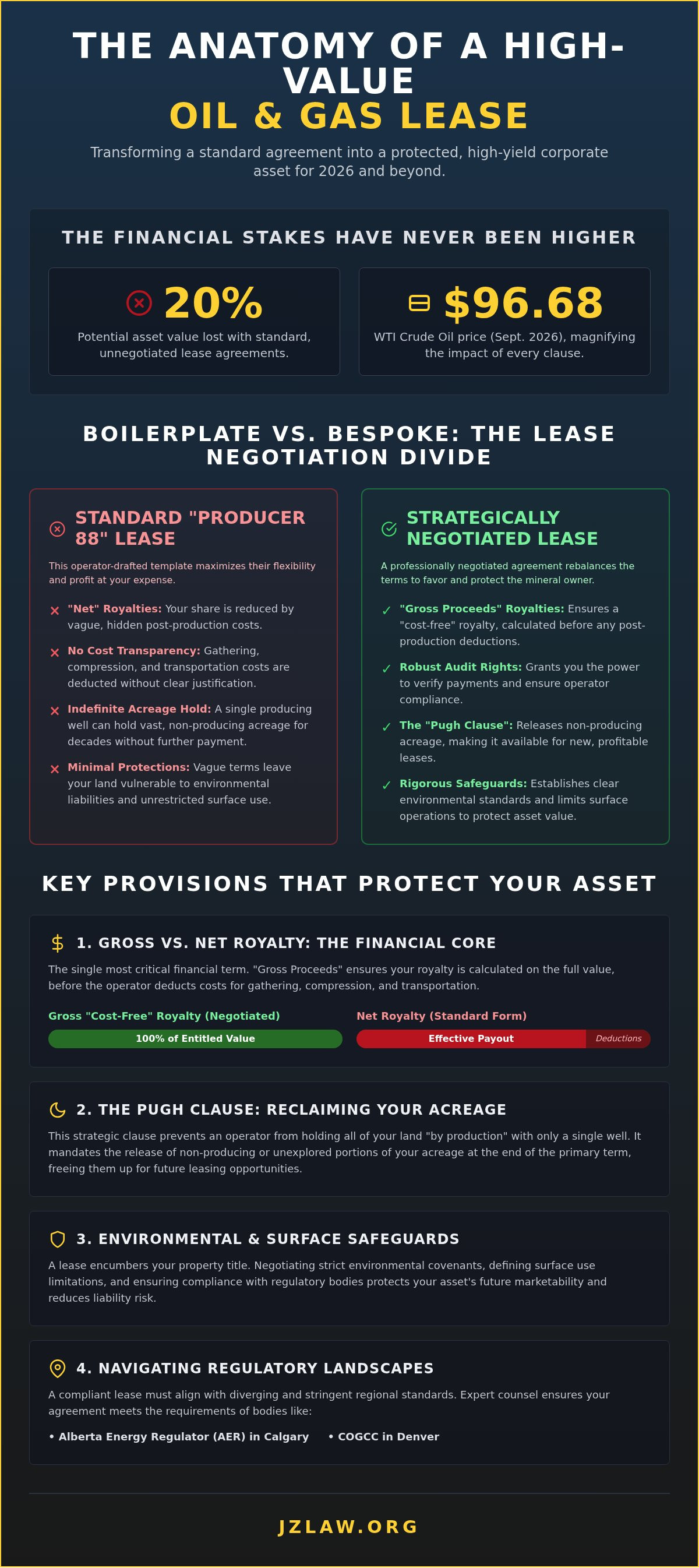
Producers frequently present a "standard form" to imply the terms are non-negotiable or industry-mandated. These templates are often designed to minimize friction for the producer's accounting and operations teams while burying unfavorable terms in dense, technical prose. The "Producers 88" form is a historical template designed to provide lessees with maximum flexibility and minimal obligations, establishing a legacy of producer-friendly bias in energy contracting. While the foundational principles of U.S. oil and gas law provide a framework for these transactions, the boilerplate language within these forms often contains subtle deductions for gathering, compression, and transportation. These "hidden" costs can erode a 20% royalty down to an effective rate significantly lower than the market average. Strategic redlining identifies these erosive clauses before they become binding obligations.
Protecting Your Asset’s Future Marketability
A lease is more than a temporary rental; it's a long-term encumbrance on the property's title. If terms are overly restrictive or grant the producer excessive surface rights, the future liquidity of an entire corporate real estate portfolio may be compromised. Investors and subsequent buyers scrutinize existing leases for environmental liabilities and "held by production" clauses that might tie up acreage indefinitely without active development. While a high upfront bonus payment is attractive, it shouldn't come at the expense of multi-generational royalty potential or the ability to sell the land unencumbered. By partnering with an oil and gas lease negotiation lawyer, you're not just reviewing a contract; you're engineering a protected revenue stream. Precision in the initial negotiation ensures the asset remains an attractive, liquid component of a broader estate or corporate strategy.
Critical Clauses Every Mineral Owner Must Negotiate
Precision in the drafting phase is the only defense against the erosion of an asset's value over time. While the primary bonus payment often captures the owner's immediate attention, the long-term yield depends entirely on the technical nuances of the lease's specific clauses. A professional oil and gas lease negotiation lawyer focuses on transforming these boilerplate provisions into a protective framework that aligns with the owner's broader estate or corporate objectives. Without these modifications, the producer retains nearly all the operational leverage, often at the expense of the lessor’s financial security.
Royalties and Post-Production Deductions
The most pervasive financial trap in energy agreements is the distinction between "gross" and "net" proceeds. Producers often insert "market enhancement" clauses that allow them to deduct costs for gathering, compression, and transportation from your royalty check. In a market where WTI crude opened at $96.68 in September 2026, these deductions can quietly strip away a significant portion of your revenue before the check is even cut. Owners should insist on a "cost-free" royalty provision, ensuring that payments are based on the value at the wellhead without burdening the lessor with the producer’s operational overhead. Implementing a robust audit right is equally vital, providing the transparency needed to verify that the producer is calculating payments accurately. If you're concerned about how these deductions affect your portfolio, consulting with a firm specializing in oil and gas law can clarify your standing and help recover lost value.
Limiting the Scope of the Lease
A standard lease often grants the producer rights to all depths and all substances, which is an unnecessary concession of value that a skilled oil and gas lease negotiation lawyer will seek to restrict. Strategic negotiators implement both vertical and horizontal Pugh clauses to ensure that non-producing acreage and formations return to the owner after the primary term expires. This prevents a single shallow well from holding an entire deep-shale formation hostage for decades. Similarly, depth severance clauses allow owners to retain rights to formations above or below the producing zone, which is critical as exploration technology evolves. You should also restrict the lease to specific hydrocarbons, explicitly excluding valuable non-hydrocarbons like helium. Finally, ensuring the lease terminates automatically upon the cessation of production prevents "zombie" leases from encumbering your property without generating income.
Navigating Regulatory Landscapes in Calgary, Denver, and Beyond
Successful negotiation in 2026 requires more than just contract expertise; it demands a granular understanding of shifting provincial and state mandates. Whether you're managing assets in the Western Canadian Sedimentary Basin or the DJ Basin in Colorado, the regulatory environment dictates the true feasibility of your lease terms. A seasoned oil and gas lease negotiation lawyer ensures that your agreement isn't just legally sound but also operationally compliant with the latest local enforcement standards. This is especially critical as ESG reporting has shifted from voluntary disclosure to a regime of audit-ready controls that influence capital allocation.
The Calgary Advantage: Alberta Energy Law
Alberta's energy sector operates under a sophisticated dual-track system involving the Alberta Energy Regulator (AER) and the Surface Rights Board. The Alberta Surface Rights Act provides specific protections for owners, ensuring they're fairly compensated for the "right of entry" and ongoing "adverse effect" on their land. In May 2026, the introduction of the Expedited 120-Day Approvals Act streamlined project timelines, yet this increased speed places more pressure on owners to finalize negotiations quickly. Understanding how oil and gas law impacts lease duration is vital, particularly regarding the management of liability for abandoned wells. With stricter reclamation requirements in 2026, owners must ensure their leases clearly define the producer's responsibility for site restoration to avoid long-term environmental encumbrances on the title.
The Denver Context: Colorado’s Evolving Regulations
In Colorado, the legacy of SB 19-181 continues to reshape the hierarchy of control, granting local governments significant authority over oil and gas operations. This shift makes set-back requirements and noise mitigation essential points of negotiation for any surface owner. As of April 14, 2026, the Air Quality Control Commission's revisions to Regulation 7 have aligned Colorado's methane rules with federal EPA standards, imposing rigorous leak detection and repair (LDAR) schedules. For mineral owners, these rules influence the producer's cost structure and, by extension, your royalty potential. Negotiation must also address water use and disposal rights, which are high-stakes issues in the arid Western U.S. A knowledgeable oil and gas lease negotiation lawyer will secure specific language regarding water sourcing and the protection of local aquifers to safeguard the property's long-term agricultural or commercial value.
Cross-border legal expertise is no longer a luxury for North American energy players. As the Canada Energy Regulator took over pipeline and facility reviews from the Impact Assessment Agency in September 2026, the integration of federal and provincial standards has become more complex. Proactive legal counsel identifies these regulatory intersections early, preventing delays and ensuring that your lease remains a viable, high-yield asset throughout its lifecycle.
The Negotiation Process: From Initial Offer to Final Signature
The transition from receiving an initial offer to executing a binding agreement is a methodical progression that requires both patience and technical scrutiny. Most mineral owners first encounter a landman who may represent a major producer or a third-party leasing agent. It's vital to verify these credentials and investigate the producer's operational track record before sharing sensitive data. A specialized oil and gas lease negotiation lawyer serves as your primary shield during this phase, ensuring that the pressure of "exploding offers" doesn't force a premature or unfavorable commitment. Every interaction with the producer's representative should be viewed as an opportunity to gather intelligence on their drilling schedule and regional objectives.
Step 1: The Strategic Assessment
Before responding to an offer, you must establish the true market value of your minerals by analyzing nearby production data and recent leasing activity. In September 2026, a Bureau of Land Management lease sale in Colorado yielded an average bid of $334 per acre, though individual parcels reached as high as $2,121 per acre. These benchmarks provide the necessary leverage to challenge low-ball bonus offers. Your strategy should distinguish between "must-have" protections, such as environmental indemnification, and negotiable commercial points like the length of the primary term. For sophisticated owners, this assessment might also reveal joint venture opportunities that allow for greater participation in the project's success rather than a traditional lessor-lessee relationship.
Step 2: Counter-Offers and Tactical Redlining
When a landman presents a "take it or leave it" scenario, tactical redlining becomes your most effective tool for rebalancing the contract. A lawyer systematically identifies and strikes clauses that grant the producer excessive rights, such as broad warranties of title that could leave the owner liable for legal defects. We replace these with custom addendums that specifically address your property's unique needs. In the event of a conflict between the pre-printed lease form and the custom addendum, the terms of the addendum legally prevail and control the agreement. This ensures that your negotiated protections aren't accidentally nullified by boilerplate language buried in the main body of the document. If you're ready to move beyond standard forms and secure a lease tailored to your goals, you can consult with our oil and gas legal team to begin the redlining process.
The final stage involves a meticulous review of the closing documents and ensuring the memorandum of lease is properly recorded with the local county clerk or provincial land titles office. This public record protects your interests against third-party claims and confirms the producer's obligations are legally attached to the land. By maintaining a structured approach from the first phone call to the final filing, you transform a high-pressure solicitation into a disciplined corporate transaction.
JZ Law: Strategic Counsel for High-Stakes Energy Transactions
JZ Law, led by John Zang, operates at the intersection of technical energy regulation and sophisticated corporate finance. For mineral owners in hubs like Calgary, Denver, and New York, a lease is rarely an isolated agreement; it's a component of a larger financial ecosystem. By engaging an oil and gas lease negotiation lawyer with a background in complex transactions, you ensure that your royalty management plan isn't undermined by poor fiscal planning. We specialize in integrating tax structuring directly into the negotiation process, protecting your income from unnecessary erosion and ensuring compliance with evolving international standards.
Our firm's expertise extends beyond the wellhead. We manage the critical overlap between energy law and real estate law, which is essential for clients with diversified portfolios who must balance surface use with long-term property development. Whether you're a corporate entity or a high-net-worth estate, our boutique approach provides the high-touch, meticulous representation that larger, impersonal firms often fail to deliver. We prioritize the security of your assets by anticipating how regulatory shifts in 2026 will impact your bottom line.
A Strategic Partner, Not Just a Document Reviewer
We don't view a lease as a static document to be checked for errors. Instead, JZ Law analyzes the "big picture" of your business or estate to identify latent risks and opportunities. John Zang's extensive experience in taking companies public and navigating securities regulation provides a unique vantage point. This allows us to advise on how a specific lease might impact future corporate liquidity or potential public offerings. A specialized oil and gas lease negotiation lawyer from our team acts as a strategic partner, ensuring that every redline serves your ultimate financial trajectory. Boutique representation ensures your matter receives the exhaustive attention to detail required in a high-volatility market.
Contact JZ Law for a Strategic Consultation
Engaging JZ Law for your lease negotiation starts with a comprehensive assessment of your current position. To maximize the efficiency of our initial consultation, we recommend preparing the following materials:
Original lease offers and any correspondence from landmen.
Detailed property maps and legal descriptions of the mineral acreage.
Existing title documents or previous lease agreements.
A summary of your broader corporate or estate objectives.
Our team will review these documents to identify immediate points of leverage and long-term vulnerabilities. Don't leave the value of your minerals to the discretion of a producer's standard form. Protect your energy assets with JZ Law and secure a lease that functions as a high-yield, protected corporate asset.
Securing Your Energy Portfolio’s Long-Term Yield
Transforming a standard energy agreement into a high-yield corporate asset requires more than a surface-level review of terms. The volatility of 2026 markets and the increasingly complex regulatory frameworks in Calgary and Denver demand a proactive, strategic approach to every clause. By prioritizing gross proceeds royalties and implementing precise depth severance protections, you insulate the underlying value of your minerals from operational erosion. Retaining a specialized oil and gas lease negotiation lawyer ensures that your agreement is fully integrated with your broader corporate and tax structuring goals.
JZ Law provides the boutique legal excellence necessary to navigate these high-stakes transactions with confidence. John Zang’s unique combination of energy law expertise and corporate finance insight allows for a level of protection that standard legal services cannot match. You don't have to accept a producer’s first offer or their standard forms as final. With the right counsel, you can turn a complex legal challenge into a predictable, protected revenue stream. Secure Your Energy Future with Expert Lease Negotiation at JZ Law and take command of your mineral interests today.
Frequently Asked Questions
Is it worth hiring a lawyer for an oil and gas lease negotiation?
Retaining a specialized professional is essential because the financial consequences of a single overlooked clause can far outweigh the cost of legal fees. An oil and gas lease negotiation lawyer identifies hidden risks in "standard" forms that a layperson might miss, providing a strategic buffer against high-pressure tactics from landmen. In hubs like Calgary or Denver, where regulations shift rapidly, expert counsel ensures your agreement remains compliant and profitable for the entire production cycle.
What is a 'Pugh Clause' and why is it essential for mineral owners?
A Pugh Clause is a protective provision that prevents a producer from holding non-producing portions of your land indefinitely under a single lease. Without this clause, one producing well could tie up thousands of acres, even if the rest of the property remains undeveloped. It ensures that any acreage not included in a producing unit is released back to you when the primary term ends. This is a fundamental tool for maintaining the long-term liquidity of your estate.
How are oil and gas lawyers typically paid for lease negotiations?
Legal fees for these services are generally structured as hourly rates or flat fees for specific document reviews and redlining phases. Some practitioners may work on a contingency basis, taking a percentage of the upfront bonus, though this is less common for complex corporate transactions. You should always establish a clear fee agreement during your initial consultation. At JZ Law, we focus on providing transparent, value-driven representation tailored to the complexity of your specific energy assets in Calgary or Denver.
Can I negotiate the royalty rate if the company says it's fixed?
Royalty rates are almost always negotiable despite what a landman might claim during initial discussions. While state or federal lands have statutory minimums, private lease negotiations depend on the competitive interest in your specific acreage and current market benchmarks. If a company claims a rate is fixed, it's often a tactical maneuver to limit their long-term overhead. Demonstrating that you have multiple interested parties or professional legal representation can effectively break a "fixed" rate deadlock.
What happens to my lease if the energy company goes bankrupt?
The fate of your lease during bankruptcy depends on whether it's classified as an unexpired lease or a property interest under local jurisdiction laws. In many cases, the lease remains an encumbrance on the title, and a successor company may eventually take over the obligations. However, unpaid royalties can become unsecured debts, making it difficult to recover past-due funds. Including specific "termination upon insolvency" clauses can provide an extra layer of security against operator default and financial instability.
How do I protect my water and surface rights during drilling?
Protection is achieved through a detailed Surface Use Agreement that sits alongside the mineral lease. You should define exact "no-drill" zones, specify the source of water for operations, and mandate rigorous testing of local aquifers before and after drilling begins. In arid regions like Colorado, these protections are vital for the land's future. Your oil and gas lease negotiation lawyer can also negotiate for the restoration of the land to its original condition once production ceases.
What is the difference between a 'Gross' and 'Net' royalty?
A "Gross" royalty is calculated based on the full value of the minerals at the point of sale without any deductions for post-production costs. Conversely, a "Net" royalty allows the producer to subtract expenses for gathering, processing, and transportation before paying the owner. This distinction is critical because net proceeds can reduce your actual income by thirty percent or more. We recommend a "cost-free" gross royalty provision to ensure your financial interest isn't burdened by the operator's logistics.
How long does the lease negotiation process usually take?
The process typically spans four to twelve weeks from the initial offer to the final recording of the memorandum. This timeline accounts for title verification, multiple rounds of redlining, and internal approvals by the producer’s legal department. Rushing this sequence often leads to overlooked liabilities or missed commercial opportunities. A disciplined approach ensures that every provision is scrutinized for its impact on your broader corporate strategy, providing peace of mind and long-term asset security.


Comments