


Taking Your Cannabis Company Public
Updated: Apr 3
In 2026, the traditional IPO is no longer a mere capital-raising event; it's a high-stakes regulatory gauntlet where a single filing error can cost a Canadian firm upwards of C$250,000 in avoidable legal delays. Taking companies public requires more than just financial readiness; it demands a defensive legal posture against the increasing scrutiny of the CSA and SEC. John Zang advises that you likely felt the weight of these requirements, fearing that the complexity of a cross-border listing might erode your management control or lead to spiraling compliance costs. We understand that the transition from a private entity to a public one often feels like a sacrifice of agility for the sake of capital.
John Zang provides this guide as a legal roadmap you need to navigate these waters with absolute confidence. You'll learn the specific structural differences between TSX and NASDAQ requirements and how a preventive legal strategy mitigates the risks of regulatory overreach. We'll explore the strategic advantages of RTOs versus traditional IPOs and how to select a legal partner who views your business through a lens of both rigorous protection and long-term growth.
Key Takeaways
Evaluate the strategic shift from entrepreneurial agility to institutional accountability to determine if your firm is prepared for the rigorous demands of the public market.
Learn how to assemble a specialized legal and financial "A-Team" to navigate the comprehensive due diligence process required to ensure your corporate structure is market-ready.
Compare the traditional IPO "gold standard" against the strategic advantages of Reverse Takeovers (RTOs), a frequently utilized pathway for emerging Canadian technology and cannabis enterprises.
Identify the unique regulatory hurdles associated with taking companies public in high-growth sectors, including navigating the complex cross-border compliance landscape between Canada and the United States.
Understand how boutique legal counsel provides the precise, preventive strategy necessary to manage niche industry challenges in the cryptocurrency, energy, and cannabis sectors.
Table of Contents
The Strategic Decision: Is Taking Your Company Public the Right Move in 2026?
The 2026 fiscal environment presents a unique window for Canadian firms seeking to scale through equity markets. John Zang advised that deciding on taking companies public requires a rigorous analysis of capital needs versus the long-term demands of institutional oversight. While the Toronto Stock Exchange (TSX) and the TSX Venture Exchange remain premier venues for resource and tech sectors, the primary driver for an IPO is often the need for massive capital infusions that private rounds can't sustain. By mid-2025, Canadian mid-cap companies sought an average of C$45 million in initial offerings to fund international expansion, proving that the public market's depth remains unmatched for high-growth trajectories.
Transitioning to a public entity isn't merely a financial transaction; it's a structural metamorphosis. You're moving from entrepreneurial agility, where decisions happen in hours, to a framework of institutional accountability. This shift demands a "Public Company" mindset long before the first bell rings. To understand the foundational mechanics, one should review a comprehensive overview of the IPO process before committing to a specific 2026 timeline. At JZ Law, we view this transition through the lens of 'Preventive Law.' This means we don't just react to filing deadlines; we structure your early-stage corporate governance to withstand the scrutiny of a public audit years in advance.
The legal trade-offs involve a delicate balance between transparency and competitive advantage. Public status requires disclosing executive compensation, material contracts, and sensitive risk factors. While this openness builds investor trust, it also hands a roadmap of your strategic vulnerabilities to competitors. It's a price paid for the ability to use your shares as a liquid currency for acquisitions, allowing you to buy out competitors using stock rather than depleting your C$ cash reserves.
Advantages of Public Markets for High-Growth Firms
Public listing provides an immediate boost to global credibility. Institutional partners in London or New York often view a TSX listing as a badge of regulatory rigor. Beyond capital, public stock serves as a critical tool for talent. In 2026, competitive Employee Stock Option Plans (ESOPs) are often the deciding factor for C-suite hires who demand liquid equity. For your early venture capital partners, the IPO provides the necessary exit to realize returns on their initial C$5 million or C$10 million investments.
The Reality of Regulatory Scrutiny and Disclosure
Once public, you're bound by the stringent reporting obligations of the Canadian Securities Administrators (CSA) and, if cross-listed, the SEC. National Instrument 51-102 dictates continuous disclosure that can't be ignored. The pressure of quarterly earnings often forces management to prioritize short-term targets over three-year strategic goals. Perhaps most critically, directors and officers face increased personal liability. In the current legal climate, a 15% drop in share price following a missed disclosure can trigger immediate class-action litigation, making robust D&O insurance and precise legal counsel non-negotiable.
The IPO Roadmap: A Step-by-Step Legal Process for Founders
The transition from a private entity to a publicly traded corporation requires a meticulous assembly of the "A-Team". Mr. Zang has found that this group typically includes lead underwriters from investment banks, independent auditors from firms like Deloitte or KPMG, and specialized securities counsel. These professionals manage the intricate mechanics of taking companies public; they ensure every financial statement and legal disclosure meets the rigorous standards of the Canadian Securities Administrators (CSA) and the relevant stock exchange. Securities counsel acts as the primary architect of the legal framework, protecting the founders from personal liability while satisfying the demands of institutional investors.
The due diligence phase serves as a rigorous internal audit. It involves cleaning up the corporate house before the blinding light of public exposure. Founders must recognize that Canadian standards often mirror international benchmarks, and reviewing the SEC requirements for going public provides a necessary perspective for companies eyeing North American expansion. This phase identifies potential litigation risks, environmental liabilities, or gaps in the corporate record that could derail a C$50 million offering. Securing a strategic legal partner early in the due diligence phase prevents costly delays during the regulatory review.
Phase 1: Pre-IPO Corporate Cleanup and Governance
Success in 2026 requires founders to audit shareholder agreements and consolidate the capitalization table. This process often involves converting preferred shares into common stock and eliminating complex "drag-along" or "tag-along" rights that conflict with public market liquidity. Issuers must implement formal board committees, specifically Audit and Compensation committees, to satisfy TSX listing requirements. Legal teams must also ensure that all intellectual property assignments and employment contracts are fully executed and "bulletproof" to prevent ownership disputes after the valuation increases. Most successful Canadian IPOs initiate this cleanup at least 12 months before the intended filing date.
Phase 2: Filing and Regulatory Review
The interplay between the issuer, the exchange (such as the TSX or TSXV), and the provincial securities commission is a delicate dance of transparency. Once the preliminary prospectus is filed, regulators issue comment letters that demand precision and speed in their responses. Addressing these queries often takes 30 to 60 days. A red herring prospectus is a preliminary disclosure tool that includes all essential company information except for the final offer price and the effective date. During the subsequent "Quiet Period", strict compliance is mandatory; any public statements that could be perceived as "priming the market" may result in a forced 90-day cooling-off period by the regulators. This ensures that the roadshow remains a disciplined marketing effort focused on the facts presented in the legal filings.
IPO vs. Reverse Merger: Choosing the Optimal Path to Market
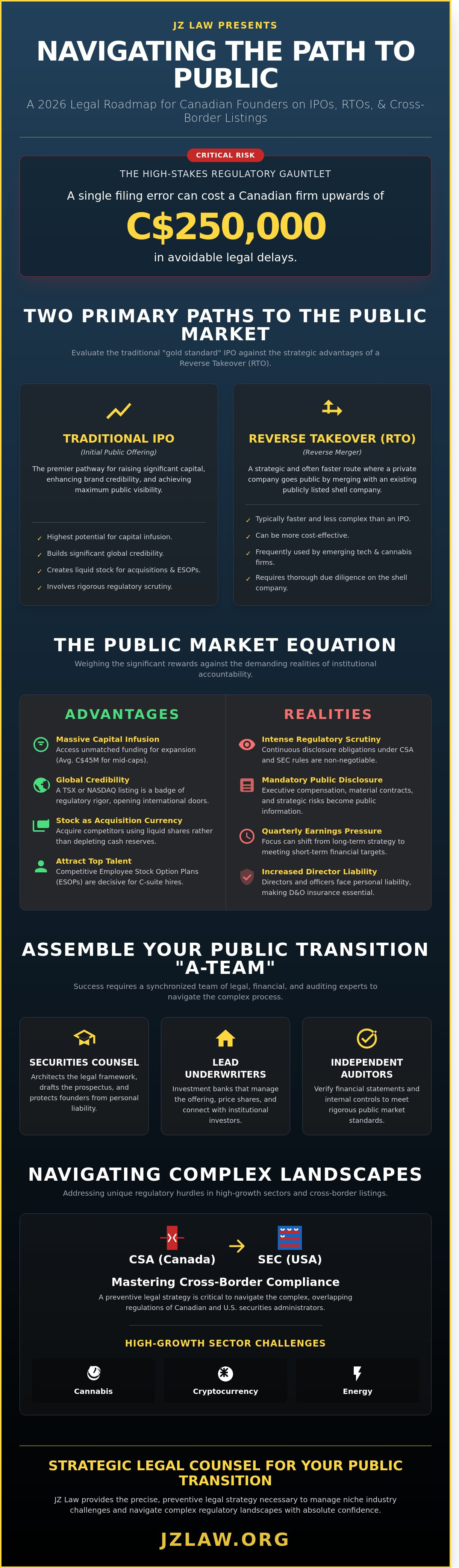
The decision of how to enter the public markets requires a strategic assessment of a firm's capital needs and risk tolerance. While the traditional Initial Public Offering remains the prestigious choice for taking companies public, alternatives like RTOs or direct listings offer distinct advantages depending on the issuer's profile. A traditional IPO attracts institutional interest by providing a rigorous valuation process; however, it demands significant time and often costs between C$1.5 million and C$5.5 million in underwriting and legal fees. For firms that don't require immediate capital, direct listings provide a streamlined entry. This path allows existing shareholders to sell shares directly to the public without the dilution inherent in new share issuances. Direct listings require the company to have a pre-existing level of financial transparency and a diverse shareholder base, usually exceeding 300 round-lot holders, to ensure market liquidity without a formal bank-led roadshow.
Reverse Takeovers (RTO) and the TSX Venture Exchange
john Zang advises that many Canadian cannabis firms select the RTO route for its speed. By merging with a pre-existing "shell" company, a private entity can go public in as little as 90 to 120 days. The Capital Pool Company (CPC) program is a specialized vehicle for this; it allows seasoned directors to raise a pool of capital to identify a target business. Despite the efficiency, legal risks remain high. The successor entity inherits all historical liabilities and "baggage" of the shell. We recommend an exhaustive due diligence process to ensure no hidden litigation or tax debts exist within the shell's history before the merger is finalized.
Niche Industry Challenges: Public Listings for Cannabis, Crypto, and Energy
The process of taking companies public demands a specialized understanding of sector-specific hurdles. While a traditional software firm might focus on R&D capitalization, an energy or cannabis company must navigate a maze of provincial and federal mandates that can stall an IPO for months. These industries operate in a state of constant regulatory flux, making the role of a strategic legal partner essential for maintaining a predictable timeline.
Cannabis Securities Law and Federal Restrictions
Canadian capital markets became the global hub for cannabis ventures following the federal legalization established by the Cannabis Act in 2018. US-based operators frequently seek listings on the Canadian Securities Exchange (CSE) or the Toronto Stock Exchange (TSX) to access liquidity that US federal exchanges currently deny to "touch-the-plant" entities. This distinction is critical; companies that directly handle cultivation or distribution face much stricter listing requirements than ancillary service providers like packaging or software firms.
Preparing for the anticipated 2026 federal rescheduling in the United States requires firms to build flexible corporate structures today. This foresight ensures they'll be ready to migrate to senior exchanges like the NASDAQ without triggering massive tax liabilities or regulatory blocks. Any firm taking companies public in this space must prove that its operations don't violate the laws of the jurisdictions where it conducts business, a task that requires meticulous documentation and cross-border legal coordination.
As you evaluate these complexities, JZ Law, through John Zang, provides the strategic legal representation necessary to navigate high-stakes regulatory environments.
Strategic Legal Counsel: Why JZ Law is the Partner for Your Public Transition
Selecting the right legal team is the most critical decision a board makes when taking companies public. JZ Law and its lawyer John Zang, functions as a boutique powerhouse, offering the high-level expertise typically found in international firms without the layers of bureaucracy that slow down "big law" operations. This agility allows our clients to move at the speed of the market. Our dual presence in Calgary, Alberta, and San Francisco, California, creates a unique cross-border bridge for Canadian issuers looking to tap into North American capital markets. We understand the specific regulatory nuances of the TSX Venture Exchange and the CSE.
Our firm's experience spans the sectors that drive the modern economy. We've guided clients through the rigorous demands of thecannabis industry and the Oil & Gas industry, where environmental and resource disclosures are under constant scrutiny. In the Cannabis sector, we've managed complex filings since the 2018 legalization, ensuring compliance across shifting provincial and federal landscapes. For Emerging Tech startups, we protect the underlying intellectual property that forms the basis of a public valuation. The "John Zang" approach defines our work; it's a methodology that treats legal precision as a tool for business growth. We don't just identify legal obstacles; we build the strategic frameworks to move past them.
Direct Access: You work with senior counsel, not junior associates learning on your billable hours.
Cross-Border Depth: Seamless integration of Alberta corporate law and California's tech-driven market insights.
Strategic Precision: Every legal structure we design is stress-tested against long-term business goals.
A Strategic Partner for Long-Term Compliance
A successful listing is merely the first milestone in a company's public life. JZ Law remains a dedicated partner well after the initial bell rings, providing essential corporate secretarial services and ensuring continuous disclosure requirements are met. We focus on preventive legal strategies that minimize the risk of shareholder litigation, which can cost a mid-cap company upwards of C$300,000 in defense fees alone. By maintaining rigorous internal controls and transparent reporting, we protect your reputation and your bottom line. Learn more about our Securities Regulation services.
Get Started with a Strategic Consultation
The most successful public transitions begin 12 to 24 months before the filing of a preliminary prospectus. JZ Law evaluates your IPO readiness by auditing your current corporate governance, tax structures, and minute books. Early engagement allows us to rectify structural issues that might otherwise lead to delays at the Alberta Securities Commission. We provide a clear roadmap for the transition, ensuring your entity is attractive to institutional investors from day one. Schedule a confidential consultation with JZ Law to discuss your public market strategy.
Navigating Your Path to the Public Markets in 2026
The decision regarding taking companies public in 2026 hinges on more than just market timing; it's about structural integrity and regulatory foresight. Founders must weigh the C$100 million plus valuation requirements of a traditional IPO against the efficiency of a reverse merger while navigating the strict 2026 CSA disclosure mandates. Whether you're scaling a cannabis venture in Alberta or a crypto platform with cross-border aspirations, the legal landscape demands precision. JZ Law bridges the gap between Calgary's resource sector and San Francisco's venture capital ecosystem, providing principal-led guidance from John Zang. You don't have to navigate these complex C$50 million plus transactions alone. Our boutique approach ensures your listing meets every TSX or CSE requirement while protecting your long-term vision. Secure your company's future with strategic securities counsel; Contact JZ Law today. The public markets offer unparalleled growth opportunities for those who prepare with diligence and expert strategy. This level of success also unlocks remarkable personal adventures; for an idea of what's possible, you can check out Los Buzos for a world-class offshore experience.
Frequently Asked Questions
How long does it typically take to take a company public in 2026?
The timeline for taking companies public in 2026 generally spans 6 to 12 months from the initial organizational meeting to the final closing. This duration depends on your firm's audit readiness and the current review backlog at provincial regulators like the Ontario Securities Commission. If your financial records aren't compliant with IFRS standards, the preparation phase alone can add 120 days to the schedule.
What are the primary differences between an IPO and a Reverse Takeover (RTO)?
An IPO involves a private company issuing new shares through a prospectus, while an RTO occurs when a private entity acquires a publicly listed shell company. RTOs often bypass the traditional roadshow process, potentially saving 3 to 4 months of marketing time. However, IPOs typically generate 40% more initial capital and provide a cleaner corporate structure for long term institutional investment.
Do I need to be profitable to take my company public on the TSX or NASDAQ?
You don't need to be profitable to list, but you must meet specific financial pillars regarding assets or market value. For instance, the TSX Venture Exchange Tier 2 requires a minimum of C$500,000 in net tangible assets or significant revenue growth. On the NASDAQ Capital Market, companies can qualify under the Equity Standard if they maintain at least C$6.8 million in shareholders' equity and a C$20 million market value.
What are the estimated legal and accounting costs for a mid-market IPO?
A mid-market IPO in Canada typically requires a budget between C$800,000 and C$1.6 million for professional fees. Legal counsel fees usually account for C$350,000 to C$550,000 of this total, while auditing three years of historical data often costs upwards of C$275,000. It's vital to include an additional 15% contingency fund for unexpected regulatory inquiries during the filing process.
When taking companies public, these upfront costs don't include the underwriter's commission, which generally ranges from 5% to 8% of the total gross proceeds. These figures represent the price of ensuring full compliance and mitigating future litigation risks.
How does the 'Quiet Period' affect my company's ability to communicate with the media?
The Quiet Period prohibits your management team from making public statements that could artificially inflate the stock price or influence investor sentiment. This restriction starts when you file the preliminary prospectus and continues for 40 days after the shares begin trading. Violating these rules can result in the Canadian Securities Administrators (CSA) imposing a 30 day cooling off period, which delays your entire funding schedule.
What is a prospectus, and why is it the most important legal document in the process?
A prospectus is a comprehensive disclosure document that details your business operations, financial history, and specific risk factors for potential investors. It serves as your primary legal protection because it ensures all material facts are transparently communicated under NI 41-101 standards. If a material omission occurs, directors face personal liability, making the precision of this 200 page document the foundation of your legal defense. The need for such precise legal guidance is critical in any high-stakes legal environment, not just corporate finance. For English-speakers navigating personal or business matters in a foreign country, for example, a firm like the Salior Ben Hamou Law Office provides that essential local expertise in Israel.
Can a Canadian cannabis company list on a US stock exchange like the NYSE?
Canadian cannabis companies can list on the NYSE or NASDAQ only if they don't engage in federally illegal activities within the United States. This means firms with "plant-touching" operations in the US are currently restricted to the Canadian Securities Exchange (CSE) or the NEO Exchange. In 2023, several large producers restructured their US holdings into non-voting entities to maintain their NYSE listings while waiting for federal law changes.



Comments