


Tokenization of Real Estate Assets in California: A 2026 Legal Framework
As of July 2026, the era of "wait and see" for digital property rights in the Golden State has officially ended. The tokenization of real estate assets california now operates within a sophisticated regulatory environment where the Digital Financial Assets Law (DFAL) and the DFPI's latest mandates dictate the terms of market entry. You likely recognize that while blockchain offers a powerful solution to the historic illiquidity of private real estate, the fear of SEC enforcement actions or unexpected state level tax triggers often stalls even the most promising projects.
We understand that navigating these overlapping jurisdictions requires more than just technical proficiency; it demands a strategic synthesis of property law and securities regulation. This article provides a clear roadmap for achieving compliance, ensuring your fractionalized offerings are structured to withstand regulatory scrutiny. You'll gain a thorough understanding of how tokens interact with California title transfers, the specific licensing deadlines established by SB 97, and a framework for choosing between tokenized SPVs and traditional REIT structures. Our analysis moves beyond theory to provide the practical logic necessary for securing your assets in a digital world.
Table of Contents
The Rise of Tokenization for California Real Estate Assets
As we move through 2026, California has solidified its position as the global epicenter for real-world asset (RWA) innovation. The financial landscape has shifted away from stagnant, paper-based systems toward a more dynamic model of digital asset management. In this professional environment, the tokenization of real estate assets california is defined as the process of converting ownership rights in a property into digital tokens on a distributed ledger. Within the specific context of the California Corporate Code, real estate tokenization is the issuance of digital securities that represent a fractional, beneficial interest in an underlying real property asset held by a legal entity. This structural evolution allows for the seamless distribution of equity while maintaining the rigorous standards of oversight expected in the state's legal jurisdiction.
The transition from traditional syndication to digital models isn't merely a technical upgrade; it's a strategic response to the evolving needs of modern investors. By utilizing Tokenization, sponsors can now offer fractional interests in high-value assets that were previously inaccessible to a broader pool of capital. This approach combines the traditional dignity of property ownership with the efficiency of modern blockchain technology.
The Liquidity Problem in Traditional Real Estate
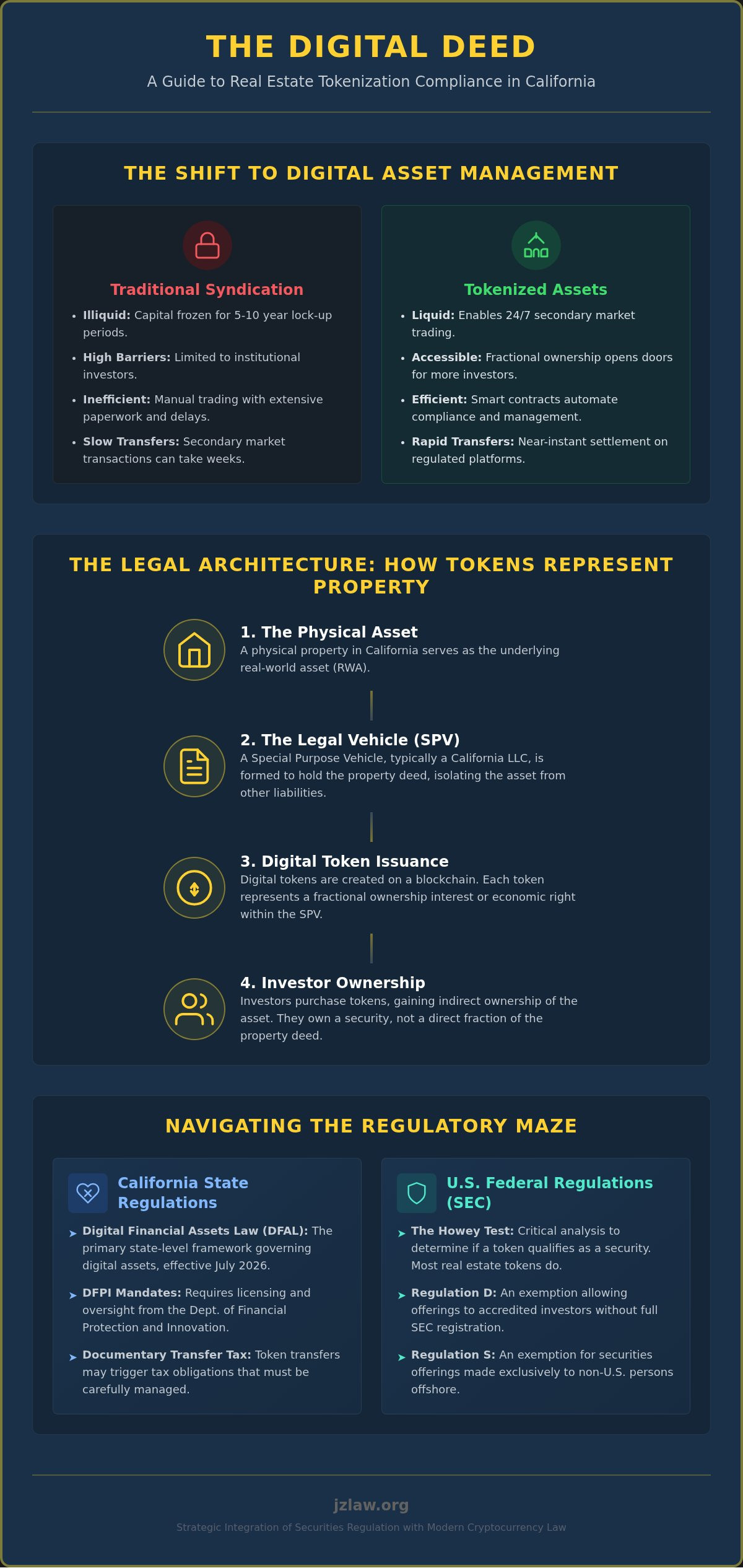
Private equity real estate has historically been characterized by its lack of flexibility. Investors in California markets often face restrictive lock-up periods that can last five to ten years, effectively freezing capital in a way that doesn't align with modern portfolio management. These high barriers to entry have limited participation to institutional players who can afford long-term illiquidity. Furthermore, the secondary market for private real estate shares has traditionally been inefficient. Manual trading requires extensive legal reviews, physical paperwork, and administrative delays that can span several weeks. This friction has long suppressed the true market value of private property holdings.
How Blockchain Solves the Fractional Ownership Puzzle
Blockchain technology addresses these systemic inefficiencies by introducing programmable compliance. Through the use of smart contracts, the tokenization of real estate assets california allows for the automation of regulatory requirements. These contracts can verify investor accreditation and enforce transfer restrictions in real-time, ensuring that every transaction remains compliant without the need for constant manual intervention. This automation significantly reduces the administrative overhead associated with cap table management and investor distributions. Most importantly, it facilitates 24/7 secondary market trading on regulated platforms. This provides investors with an exit strategy that is both transparent and predictable, mirroring the liquidity of public markets while retaining the benefits of direct real estate exposure.
The Legal Architecture: How Tokens Represent Property Interests
Establishing a robust legal architecture for the tokenization of real estate assets california requires more than just deploying a smart contract; it necessitates a foundation built on proven corporate structures. While blockchain technology provides the immutable ledger, the California Revised Uniform Limited Liability Company Act provides the legal teeth. Most successful projects utilize a Special Purpose Vehicle (SPV) to bridge the gap between physical property and digital representation. This structure ensures that the underlying asset is isolated from other liabilities, providing a clean vehicle for investment.
In this model, the property deed is held by a California LLC. Investors don't own a fraction of the dirt directly. Instead, they own digital tokens that represent membership interests or economic rights within that specific entity. This indirect ownership structure is vital because it aligns with current county recording practices while enabling the high-velocity trading discussed in The Future Of Real Estate: Tokenization. To ensure compliance, every offering must be analyzed through the lens of the Howey Test. If there's an investment of money in a common enterprise with a reasonable expectation of profits derived from the efforts of others, the token is a security and must be treated with the same dignity as traditional equity.
Structuring the California LLC for Tokenization
The Operating Agreement is the most critical document in this framework. It must explicitly recognize digital tokens as the primary evidence of membership interest. We recommend manager-managed structures for most tokenized projects to streamline operational decisions while protecting passive investors. Key clauses must address how blockchain addresses are integrated into the official member registry. "The LLC Operating Agreement serves as the definitive source of truth, where digital token rights are translated into enforceable legal obligations under the California Revised Uniform Limited Liability Company Act." This ensures that the "source of truth" on the ledger matches the legal requirements for entity record-keeping. If you're looking to establish a compliant entity, our team specializes in securities regulation and corporate transactions to protect your interests.
Smart Contracts as Legal Instruments
Smart contracts aren't just code; they're the digital manifestation of the LLC’s internal rules. Under California law, electronic signatures and records are generally enforceable, but the contract must be carefully drafted to hard-code compliance. Transfer restrictions, such as KYC/AML whitelisting, should be built directly into the token's logic. This prevents unauthorized secondary market transfers that could jeopardize the issuer's SEC exemptions. By hard-coding these rules, the tokenization of real estate assets california becomes a self-regulating ecosystem that protects both the sponsor and the investor. Embedding dispute resolution mechanisms, such as mandatory arbitration, into both the code and the legal filings allows sponsors to mitigate the risks associated with on-chain asset management.
Navigating the Regulatory Maze: SEC and DFPI Compliance
Compliance in the tokenization of real estate assets california is a multi-layered obligation that begins with federal exemptions. Most issuers rely on Regulation D, specifically Rules 506(b) and 506(c), to conduct private placements without full SEC registration. Rule 506(b) allows for an unlimited number of accredited investors and up to 35 sophisticated non-accredited participants, provided no general solicitation occurs. Conversely, Rule 506(c) permits public advertising but mandates that the issuer takes reasonable steps to verify that every purchaser is an accredited investor. For sponsors looking to attract global capital, Regulation S provides a safe harbor for offers and sales that occur outside the United States, effectively bypassing certain SEC registration requirements for international participants. As of 2026, Regulation A+ continues to serve as a high-threshold crowdfunding mechanism, allowing issuers to raise up to $75 million from both accredited and non-accredited investors while requiring more rigorous ongoing reporting than Regulation D.
Accredited vs. Non-Accredited Investors
Verification protocols have evolved significantly by late 2026. The SEC now recognizes specific professional certifications as qualifying criteria for accredited status, expanding the pool beyond simple net worth or income tests. When managing the tokenization of real estate assets california, sponsors must implement rigorous on-chain and off-chain identity verification. While Rule 506(b) permits non-accredited investors, the administrative burden of providing "IPO-lite" disclosure documents often makes this path less attractive for lean tokenization projects. Navigating the Legal Landscape of Real Estate Tokenization requires a proactive approach to these shifting definitions to ensure the offering's exemption remains intact throughout the lifecycle of the asset.
The California Department of Financial Protection and Innovation (DFPI)
State-level oversight adds another layer of complexity. Under California’s "Blue Sky" laws, issuers must generally file a notice with the DFPI within 15 days of the first sale in the state. A critical development for 2026 is the Digital Financial Assets Law (DFAL) deadline. By July 1, 2026, any entity engaging in digital financial asset business activity must have a completed application pending or a license issued by the DFPI. This requirement is particularly relevant for platforms facilitating the tokenization of real estate assets california. Issuers must also be wary of the "Investment Adviser" registration traps. If the sponsor provides advice regarding the value of the tokens or the advisability of investing in them for compensation, they may inadvertently trigger registration requirements. Finally, compliance with the California Consumer Privacy Act (CCPA) is mandatory. Sponsors must balance the transparency of the blockchain with the privacy rights of token holders, ensuring that personally identifiable information is not stored directly on public ledgers.
Operationalizing Tokenization: Title, Taxes, and Transfer
Moving from a conceptual framework to a live offering requires a disciplined operational strategy. The tokenization of real estate assets california isn't a replacement for traditional title work; it's a digital layer that sits atop established property law. To successfully bridge this gap, sponsors must follow a rigorous 5-step process. First, the asset is identified and appraised. Second, a California-compliant Special Purpose Vehicle (typically an LLC) is formed. Third, the physical deed is transferred from the current owner to the LLC. Fourth, the smart contract is deployed to mint tokens representing membership interests. Finally, these tokens are issued to investors through a compliant portal. This sequence ensures that the digital representation always remains tethered to a valid legal entity.
One of the most significant hurdles in this process is managing California's Documentary Transfer Tax. While the base rate is $1.10 per $1,000 of value, many charter cities, such as San Francisco or Los Angeles, apply significantly higher rates. Sponsors must also account for the "Change in Ownership" rules under Proposition 13. If more than 50% of the membership interest in the LLC is transferred, the property may be subject to a full reassessment, potentially increasing the property tax burden from the base 1% rate to current market values. Understanding these Real Estate Law 2026 frameworks is essential for maintaining the asset's long-term yield. If you need a detailed review of your property's tax exposure, our team provides expert tax structuring services to optimize your offering.
The County Recorder and the Blockchain
Major California counties like Los Angeles and Orange have modernized their systems to allow for electronic deed recording, but they don't yet recognize blockchain tokens as a valid method for recording property transfers. This is why the "Legal Wrapper" strategy is vital. The deed is recorded once at the county level in the name of the LLC. Subsequent trades of tokens between investors occur on-chain without requiring a new filing at the recorder's office. This maintains the integrity of the chain of title while providing the liquidity investors demand. To protect these interests, sponsors must secure title insurance policies that include specific endorsements, ensuring coverage remains in place even as the LLC's membership fluctuates through token trades.
Tax Implications for Issuers and Investors
Operationally, tokenization simplifies investor relations through the automation of K-1 distributions. Modern platforms can track on-chain ownership and generate tax documents based on the duration of an investor's hold. However, sponsors must remain vigilant regarding withholding requirements. Under the Foreign Investment in Real Property Tax Act (FIRPTA), any investment from non-U.S. persons triggers a 15% withholding requirement on gross proceeds unless specific exemptions apply. Additionally, California-specific LLC fees are based on gross income, which can impact the net returns of high-value tokenized assets. By structuring the entity with a proactive tax lens, issuers can mitigate these costs and provide a more attractive net-yield to their token holders.
Strategic Legal Frameworks: Why JZ Law is Your Partner
Success in the tokenization of real estate assets california isn't merely a technical achievement; it's a rigorous legal exercise. JZ Law serves as the strategic partner capable of synthesizing the traditional requirements of the California Corporate Code with the dynamic nature of digital finance. We don't just draft documents. We build frameworks designed to withstand the scrutiny of both the SEC and the DFPI. By navigating the global complexities outlined in Cryptocurrency Law 2026, our firm ensures your domestic assets are protected within an increasingly interconnected regulatory context. Whether you're a developer in San Francisco or an institutional investor based in Hamburg, we provide the localized precision necessary for cross-border compliance.
Our approach is defined by a commitment to audit-proofing your digital offerings. We recognize that the 2026 regulatory environment, particularly the Digital Financial Assets Law (DFAL) mandates, requires a proactive stance. We work closely with our clients to ensure every smart contract is tethered to a solid legal entity, preventing the common pitfalls that lead to SEC enforcement. This strategic oversight allows you to focus on asset acquisition and growth while we manage the complexities of state and federal compliance.
Beyond the Code: Strategic Corporate Transactions
Structuring a tokenized project requires a sophisticated understanding of joint ventures and capital stacks. We help sponsors manage the delicate balance between GP and LP rights within a digital registry, ensuring all stakeholders are protected under California law. Our counsel extends beyond the initial minting of tokens. We provide the strategic roadmap for taking tokenized real estate companies public, ensuring your transition to secondary markets is both seamless and compliant. To secure your project's future, contact JZ Law for a comprehensive regulatory audit that addresses state-level mandates and federal securities laws.
The JZ Law Advantage in Emerging Markets
We approach every matter with a classic professional dignity, yet we remain open to technological and economic evolution. This dual mindset is essential in high-stakes regulatory environments where the rules are still being refined. Our team focuses on a proactive, preventative mindset, identifying potential audit triggers before they become liabilities. By choosing a partner who understands the business interests behind the blockchain, you ensure that the tokenization of real estate assets california serves as a tool for capital growth rather than a source of legal risk. We're committed to providing the composure and precision required to build your digital portfolio on a foundation of absolute legal certainty.
Securing Your Digital Position in the California Property Market
The evolution toward digital ownership represents a permanent shift in how capital interacts with physical land. We've explored how the tokenization of real estate assets california requires a disciplined synthesis of traditional property law and modern securities regulation. By anchoring tokens in a robust LLC structure and maintaining strict adherence to the DFPI's 2026 licensing mandates, you transform illiquid holdings into high-velocity investment vehicles. Success in this sector isn't defined by the technology alone, but by the legal certainty that supports it.
Navigating these overlapping jurisdictions demands a partner who understands both the technical smart contract and the underlying fiduciary obligations. JZ Law provides the strategic real estate law frameworks and expertise in securities regulation necessary to audit-proof your digital offerings. With our global perspective on digital asset compliance, we ensure your project is built for long-term stability and growth. Consult with JZ Law on Your Real Estate Tokenization Strategy to secure your position in the next era of property management. We're ready to help you lead this market with absolute confidence.
Frequently Asked Questions
Is tokenization of real estate assets legal in California in 2026?
Yes, provided the entity complies with the Digital Financial Assets Law (DFAL). Entities must have a license or a pending application with the DFPI by the July 1, 2026 deadline. This legal framework ensures that the tokenization of real estate assets california follows a regulated path. JZ Law helps sponsors from New York City to Calgary navigate these state-level mandates while maintaining federal and international compliance standards.
Do real estate tokens require SEC registration?
Most real estate tokens are classified as securities under the Howey Test and therefore require registration or a valid exemption. Issuers frequently utilize Regulation D for private placements or Regulation S for international offerings. Failure to secure an exemption can lead to significant enforcement actions. Professional counsel is essential to ensure the offering's structure meets the SEC's rigorous disclosure standards and protects the sponsor's reputation.
How does Proposition 13 affect tokenized real estate in California?
Proposition 13 limits property tax increases but triggers a reassessment upon a "change in ownership." In a tokenized LLC structure, a reassessment occurs if more than 50% of the total membership interest is transferred. Sponsors must carefully monitor secondary market trades to prevent an accidental tax reset. This threshold is a critical consideration for the long-term financial modeling of any tokenized asset in the state.
Can non-accredited investors buy tokenized real estate?
Yes, but only under specific exemptions like Regulation A+ or Regulation D, Rule 506(b). Rule 506(b) allows up to 35 sophisticated non-accredited investors, though this often requires more extensive disclosure documentation. Most sponsors prefer Rule 506(c), which limits participation to verified accredited investors to simplify the compliance burden. JZ Law provides strategic advice on choosing the right exemption for your specific capital-raising goals in Denver or Toronto.
What is the difference between a REIT and a tokenized real estate offering?
A REIT is a corporate entity that must follow strict IRS distribution rules and often involves a large portfolio of assets. Tokenized offerings typically focus on a single asset or a smaller pool via a Special Purpose Vehicle (SPV). Tokenization provides greater liquidity through 24/7 secondary market trading and lower administrative costs. While both offer fractional exposure, tokenization allows for more granular control and immediate settlement on the blockchain.
How are property taxes handled when tokens are traded on a secondary market?
Property taxes remain the responsibility of the LLC that holds the deed. However, the cumulative transfer of tokens can trigger a reassessment if the "control" or "majority interest" rules are met. Sponsors must implement tracking mechanisms within their smart contracts to ensure compliance with California's 50% transfer rule. This proactive approach prevents unexpected tax liabilities that could diminish the net returns for all token holders in Frankfurt or Hamburg.
Does a tokenized property require a new deed recording for every trade?
No, the physical deed remains in the name of the LLC or SPV and is recorded once with the county. The tokens represent membership interests in that entity; therefore, trades occur on the digital ledger without requiring a new filing at the recorder's office. This "legal wrapper" strategy allows for high-velocity trading while maintaining a stable chain of title, a method we implement for clients across New York City and Vancouver.
What are the risks of failing to comply with California Blue Sky laws?
Non-compliance can lead to rescission offers, where the issuer must return all investor capital plus interest. The DFPI has the authority to issue cease-and-desist orders and impose significant administrative fines. Beyond financial penalties, a regulatory breach can damage the sponsor's reputation and preclude them from future offerings. JZ Law specializes in audit-proofing your tokenization of real estate assets california to mitigate these high-stakes risks for developers in Berlin and Denver.


Comments