


Venture Capital Financing Lawyer Calgary: Strategic Legal Counsel for High-Growth Founders
- jzanglaw
- May 15
- 12 min read
Calgary’s tech talent workforce grew by 61% between 2021 and 2024, cementing its status as the fastest-growing innovation hub in North America and a primary destination for serious investment. While this growth offers unprecedented opportunities, many founders remain concerned about the potential for predatory term sheets or the administrative weight of Alberta Securities Commission compliance. Retaining a venture capital financing lawyer calgary allows you to approach these negotiations with the authority of a seasoned executive who prioritizes long-term equity over short-term convenience. You’ve built your company with a vision for the future, and your legal strategy should reflect that same level of foresight and precision.
We understand that you want to secure funding without exhausting your runway on excessive legal fees or losing control of your board. This article outlines the strategic steps necessary to maintain a clean regulatory path toward a future IPO while utilizing the March 19, 2026, semi-annual reporting pilot to streamline your compliance obligations. We’ll also examine how the December 18, 2025, amendments to the Securities Act (Alberta) regarding statutory civil liability impact your disclosure requirements during a raise. You'll gain a clear understanding of how to structure your financing to ensure it serves as a catalyst for growth rather than a source of future litigation.
Key Takeaways
Discover how Calgary’s rapid ascent as a North American tech leader creates unique opportunities for founders to leverage local investment trends.
Learn to evaluate complex financing instruments and term sheets with a venture capital financing lawyer calgary to ensure your ownership and board control remain protected.
Master the nuances of Alberta Securities Commission exemptions and recent regulatory updates to prevent administrative friction during your capital raise.
Understand how early-stage structural decisions and cap table hygiene directly impact your company's eventual transition to public markets.
Identify the advantages of partnering with a strategic boutique counsel who specializes in high-stakes sectors like cryptocurrency, energy, and cannabis licensing.
Table of Contents
Understanding the Venture Capital Landscape in Calgary
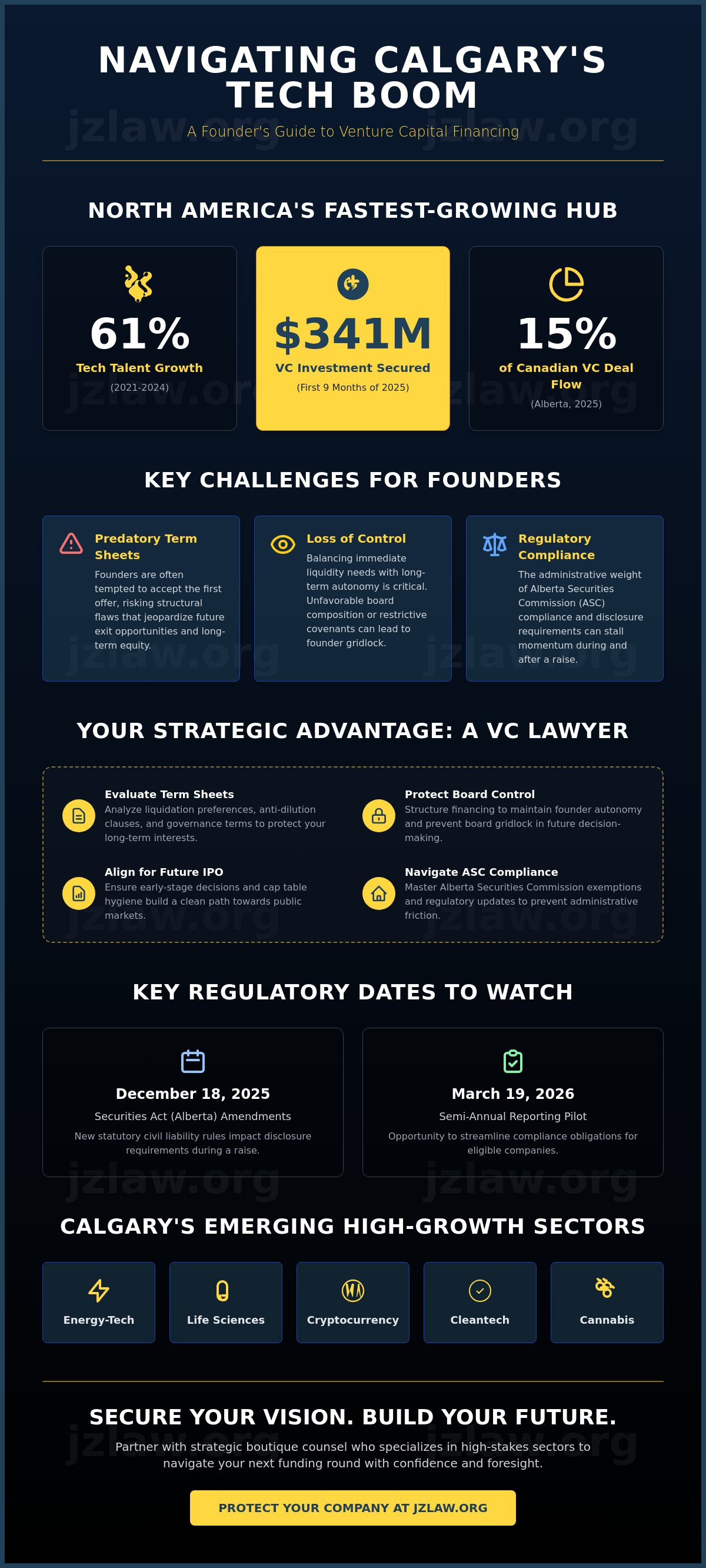
Calgary’s economic identity is undergoing a fundamental transformation. While the city remains the heartbeat of Canada's energy sector, it's simultaneously emerging as a premier destination for high-growth innovation. In 2025, Alberta accounted for 15% of all Canadian venture capital deal flow, with Calgary leading the charge by securing $341 million in investment through the first nine months of the year. This influx of capital isn't limited to software; it spans across cleantech, life sciences, and sophisticated industrial applications that require a deep understanding of both local and international markets.
Understanding What is Venture Capital? in this specific geographic context requires more than a dictionary definition. It involves recognizing how private equity, angel investors, and venture funds interact within Alberta's unique regulatory framework. Founders often face the temptation to accept the first term sheet that arrives, yet doing so without the guidance of a venture capital financing lawyer calgary can lead to structural flaws that jeopardize future exit opportunities. Early legal involvement ensures that the foundation of your company is built to withstand the rigors of institutional due diligence and future public market scrutiny.
The Role of a VC Lawyer for Calgary Startups
A specialized legal partner functions as a strategic architect rather than a mere document reviewer. Your lawyer’s primary objective is to balance your immediate need for liquidity with the necessity of long-term dilution protection. They don't just look at the valuation; they examine liquidation preferences, anti-dilution clauses, and board composition. By navigating local networking and investor relations through a legal lens, a venture capital financing lawyer calgary helps you build relationships that are both productive and compliant with Alberta Securities Commission standards. This proactive stance prevents the common pitfalls that often stall a company's momentum during subsequent funding rounds.
Emerging Sectors: VC in Cannabis and Energy-Tech
The city's industrial heritage provides a distinctive launchpad for energy-transition startups. These companies often require specialized financing structures that account for heavy R&D and capital-intensive scaling. Similarly, the cannabis sector presents its own set of hurdles. Navigating a cannabis licensing framework during a VC round requires precise coordination to ensure that investor entry doesn't trigger regulatory red flags or licensing delays. Whether you're innovating in the oil patch or the regulated cannabis market, the intersection of high-growth capital and niche regulation demands a lawyer who understands the operational realities of your industry. You need a partner who can translate complex regulatory requirements into actionable business strategies.
Structuring Venture Capital Financing for Growth and Control
Capital is a tool for acceleration, but the specific architecture of that capital determines who remains at the helm of the enterprise. In the Calgary ecosystem, founders often face a delicate balance between securing necessary liquidity and maintaining the autonomy required to execute their vision. A venture capital financing lawyer calgary acts as a safeguard during these negotiations; ensuring that the instruments used to fuel growth don't inadvertently compromise the founder's long-term influence. Structuring a deal isn't merely about the headline valuation; it's about the technical nuances of governance, board composition, and the subtle mechanics of equity distribution.
Every term sheet is a blueprint for the company's future governance. While investors may push for significant oversight through board seats or observer rights, founders must prioritize a structure that prevents gridlock. Negotiating these points requires a clinical understanding of what to concede and what to defend. For instance, granting an investor a board seat might be a reasonable trade-off for strategic expertise, but founders should remain wary of restrictive covenants that require unanimous board approval for routine corporate transactions. Precision in these early documents prevents the friction that often arises as a company matures toward a Series B or C round.
Equity vs. Debt: Choosing the Right Instrument
For early-stage startups in Alberta, the Simple Agreement for Future Equity (SAFE) has become a standard for its efficiency and low administrative cost. It's particularly effective when a precise valuation is difficult to determine. However, as a company moves toward priced rounds, the transition to Preferred Shares introduces complex tax structuring considerations. Alberta founders must weigh the immediate benefits of convertible debt against the long-term implications of liquidation preferences and participation rights. Choosing the wrong instrument can lead to unintended tax liabilities or a "messy" cap table that complicates future raises.
Founder Protection Clauses
Protecting founder equity requires more than just a high valuation. It involves the strategic implementation of Right of First Refusal (ROFR) and co-sale rights to control how shares move within the company. Understanding liquidation preferences is equally critical; a 1x non-participating preference is generally the standard for founder-friendly deals, whereas participating preferences can significantly erode founder returns during an exit. Additionally, implementing "double-trigger" acceleration in vesting schedules ensures that if the company is acquired, the founders' hard-earned equity is protected. These clauses aren't just legal boilerplate; they're essential components of a robust defense strategy for any high-growth founder.
Navigating Alberta Securities Commission (ASC) Compliance
The arrival of fresh capital is a milestone for any founder, yet the administrative weight of regulatory compliance remains a constant reality. In Alberta, every share issuance is technically a distribution that requires either a full prospectus or a valid exemption under the Securities Act (Alberta). For high-growth companies, the latter is the only practical path forward. A venture capital financing lawyer calgary provides the technical precision needed to interpret these rules, ensuring that your private placement doesn't inadvertently trigger a requirement for a full prospectus. This oversight is vital; errors in early filings create "legal debt" that often resurfaces during the scrutiny of future institutional funding rounds or an eventual public listing.
Staying current with evolving regulations is essential for maintaining a clean regulatory record. For example, as of March 19, 2026, the Canadian Securities Administrators (CSA) implemented a pilot project allowing eligible venture issuers to file financial reports on a semi-annual basis instead of quarterly. This shift significantly reduces the regulatory burden on smaller issuers, allowing founders to focus more on operations and less on repetitive administrative tasks. Additionally, the May 1, 2026, adoption of Coordinated Blanket Order 33-930 provides temporary exemptions regarding the submission of certain personal information. These updates reflect a regulatory environment that's increasingly responsive to the needs of the innovation sector.
Prospectus Exemptions for Calgary Startups
Most early-stage raises in Calgary rely on a few specific exemptions to move quickly. The "Friends, Family, and Business Associates" exemption is common for initial seed capital, but as the round size increases, the "Accredited Investor" exemption becomes the primary vehicle. This allows you to raise unlimited amounts from sophisticated investors without a disclosure document. If you're targeting a broader group, the Offering Memorandum (OM) exemption provides a structured way to raise capital, though it requires a detailed disclosure document that outlines business risks and financial performance. Using the right exemption at the right time is a strategic decision that your venture capital financing lawyer calgary will help you navigate.
Managing Investor Disclosures
Effective compliance isn't just about choosing an exemption; it's about the quality of your documentation. Robust subscription agreements are your first line of defense, capturing the necessary representations to ensure every investor meets the legal criteria for their specific exemption. Ensuring all corporate transactions meet ASC standards is critical for avoiding the severe consequences of illegal distributions, which can include cease-trade orders or heavy fines. By implementing a proaktive, megelőző szemléletmód (proactive, preventive approach), you can remediate potential filing errors before they become systemic issues that jeopardize your company's future.
Preparing for the Exit: Aligning VC Rounds with IPO Goals
Every financing round should be viewed as a stepping stone toward a liquidity event. If you intend to transition from private funding to a public listing, your early-stage legal architecture must be designed with institutional rigor. A venture capital financing lawyer calgary plays a critical role in this alignment, ensuring that the rights granted to early-stage investors don't conflict with the requirements of major stock exchanges. Cleaning up a cap table that's been cluttered with complex convertible instruments, inconsistent shareholder rights, or unverified option pools is a prerequisite for any successful exit. Public market investors expect a level of transparency and structural simplicity that private seed rounds often overlook, and failing to address these issues early creates significant legal debt that can stall a listing.
The Bridge to Public Markets
Preparing for an IPO requires more than just financial growth; it demands a total audit of your corporate governance and operational history. Shareholder agreements that worked for a small group of angels often need to be replaced with public company bylaws that address wider stakeholder interests and independent board oversight. Due diligence at this stage is exhaustive. You must address any legal skeletons, such as undocumented intellectual property transfers or informal employment agreements, well before the filing process begins. The December 18, 2025, amendments to the Securities Act (Alberta) have already expanded the ASC’s ability to include climate-related disclosures in safe harbour regimes, reflecting the type of sophisticated reporting you'll need to master as a public entity.
Exit Strategies: IPO vs. Reverse Merger vs. Acquisition
While an IPO is the traditional gold standard, many Calgary firms explore a Reverse Takeover (RTO) as a faster route to the public markets, particularly in the tech and energy-tech sectors. Each path carries distinct legal nuances, particularly regarding the treatment of existing equity and the securities regulation involved in the transition. Whether you are taking companies public through a traditional offering or merging with a capital pool company, the deal must be structured for maximum tax efficiency. Managing investor expectations is equally important during this transition; the liquidation preferences and anti-dilution clauses discussed in earlier rounds may need to be converted, waived, or renegotiated to facilitate the listing. This process requires a delicate balance between fulfilling past promises and meeting the demands of future public shareholders.
If you're planning your long-term roadmap, securing strategic legal counsel now can prevent costly restructuring later. This proactive approach ensures your company remains attractive to both private venture funds and future public shareholders.
JZ Law: Strategic Boutique Counsel for Calgary Founders
High-growth ventures require more than just a legal service provider; they need a strategic partner who understands the velocity and specific pressures of the Calgary market. JZ Law offers founders direct access to principal lawyer John Zang, ensuring that your most critical negotiations and structural decisions aren't delegated to junior associates. This boutique approach provides the agility necessary to close funding rounds quickly while maintaining the meticulous attention to detail required for complex securities regulation. Whether you're operating in the volatile space of cryptocurrency law or scaling a traditional enterprise, our focus remains on building a foundation that supports your journey from initial seed funding to an eventual public listing.
The transition from a private startup to a public entity is rarely a linear path. It involves a series of calculated risks and precise legal maneuvers that must be executed with a long-term perspective. By prioritizing strategic partnership over simple billable hours, we align our success with your growth. Retaining a venture capital financing lawyer calgary who remains involved at every stage of your company’s lifecycle prevents the fragmented advice that often occurs when founders switch firms between rounds. We provide a consistent, authoritative voice in the boardroom, helping you navigate the complexities of Alberta’s regulatory environment with confidence and clarity.
The Boutique Advantage for Startups
Startups often find that large-firm fee structures don't align with their early-stage cash flow or the rapid pace of innovation. JZ Law addresses this by offering tailored arrangements that reflect the reality of your growth trajectory. Our deep local knowledge of the Alberta Securities Commission and the Calgary innovation ecosystem allows us to anticipate regulatory hurdles before they disrupt your momentum. This proaktive, megelőző szemléletmód (proactive, preventive approach) ensures that every term sheet and shareholder agreement is drafted with your ultimate exit strategy in mind, protecting your equity from unnecessary dilution.
Contact JZ Law for Your Next Financing Round
Securing a venture capital financing lawyer calgary who understands the technical nuances of your specific industry is essential for long-term success. We provide comprehensive support for founders and early-stage investors, ranging from the initial review of cap tables to the execution of high-stakes oil and gas law strategies and tech innovation. If you're preparing for your next financing round or need a thorough audit of your current corporate structure, we invite you to reach out for a strategic consultation. Our goal is to ensure your legal framework is as innovative and resilient as the technology you've built, providing a clean path to your future goals.
Mastering the Capital Path for Calgary Founders
Building a high-growth enterprise in Calgary requires more than technical innovation; it demands a legal architecture that's both resilient and adaptable. The decisions you make during your initial seed and Series A rounds dictate your future flexibility in the public markets. By prioritizing structural precision and maintaining rigorous ASC compliance, you ensure your company remains attractive to institutional investors while protecting your own equity and control. A venture capital financing lawyer calgary provides the strategic foresight necessary to bridge the gap between early-stage liquidity and a successful long-term exit.
JZ Law, led by principal lawyer John Zang, offers specialized expertise in the complex regulatory environments of cryptocurrency, cannabis licensing, and taking companies public. We focus on the unique needs of Calgary’s most ambitious sectors, providing high-level counsel with the agility of a boutique practice. Don't let administrative friction or predatory terms compromise your vision. Secure your startup’s future—Contact JZ Law for a strategic consultation and ensure your next financing round serves as a catalyst for sustainable growth. Your success is built on the strength of your foundation.
Frequently Asked Questions
What does a venture capital lawyer actually do for a startup?
A venture capital lawyer serves as a strategic architect who structures the legal foundation of your business to facilitate rapid scaling and future liquidity. Beyond drafting documents, they negotiate term sheets to protect founder control and ensure that every share issuance complies with provincial regulations. This role is essential for maintaining a clean cap table, which is a prerequisite for attracting institutional investors in later rounds or preparing for a public listing.
How much does venture capital legal representation cost in Calgary?
Legal fees for venture capital representation are typically determined by the complexity of the financing structure and the stage of the company. While founders often seek predictable costs, it's important to check with individual firms regarding their fee structures for seed versus Series A rounds. Prioritizing expertise in niche sectors like cannabis or energy-tech often provides a higher return on investment than choosing a firm based solely on the lowest initial quote.
What is the most common mistake Calgary founders make during a Series A round?
The most frequent error is conceding too much control through restrictive board seats or "participating" liquidation preferences that disproportionately benefit investors during an exit. Founders often focus exclusively on the headline valuation while ignoring the technical mechanics of anti-dilution provisions. These structural flaws can lead to significant friction during subsequent funding rounds or when the company eventually seeks to transition to the public markets.
Do I need a lawyer for a SAFE or Convertible Note?
Retaining a venture capital financing lawyer calgary for a SAFE or Convertible Note is critical because these instruments dictate how your equity will convert in future priced rounds. While the documents appear simple, the specific valuation caps and discount rates you agree to today can lead to unexpected dilution later. Professional oversight ensures these early-stage agreements are harmonized with your long-term tax structuring and governance goals.
What is the Alberta Securities Commission (ASC) and why does it matter to my raise?
The Alberta Securities Commission (ASC) is the regulatory body responsible for overseeing the capital markets in the province and ensuring investor protection. For founders, the ASC matters because every capital raise must either follow a full prospectus or qualify for a specific exemption under the Securities Act. Failing to file the correct reports or verify investor status can lead to cease-trade orders that halt your company's growth.
Can a Calgary VC lawyer help with cross-border investments from the US?
Specialized legal counsel in Calgary can effectively coordinate cross-border investments by managing the interaction between Canadian securities laws and foreign investor requirements. This process often involves complex tax structuring to ensure that the investment remains efficient for both the founder and the US-based venture fund. A local lawyer with international experience provides the necessary bridge to ensure that your corporate governance meets the standards of global institutional investors.
How long does a typical venture capital financing round take to close legally?
A typical venture capital round generally takes between 30 and 90 days to close once the term sheet is signed. This timeline depends heavily on the thoroughness of the investor's due diligence and the complexity of the company's existing cap table. Engaging a lawyer early to "clean up" corporate records can significantly accelerate this process, allowing you to secure funding and return your focus to operational growth.
What is the difference between venture capital and private equity law?
Venture capital law focuses on early-stage, high-growth companies where investors typically take minority stakes in exchange for equity. In contrast, private equity law usually involves more mature businesses and often includes majority buyouts or complex debt-financed restructurings. While both involve corporate transactions, the governance structures and exit strategies in venture capital are specifically designed to accommodate the rapid, non-linear growth typical of the tech and innovation sectors.


Comments